![워싱턴 D.C.에 있는 미국 연방준비제도(Fed) 이사회 본부 건물인 매리너 S. 에클스 빌딩에 대한 리모델링 공사가 한창인 가운데 현장 거울에 빌딩 전경이 비친 모습. [게티이미지]](https://wimg.heraldcorp.com/news/cms/2026/10/14/news-p.v1.20261012.37af49395c5e42388798ef9d8de6e08b_P1.jpg)

2001년 경기침체 이후 미국 연방준비제도(Fed·연준)는 정책금리를 인하했고, 2003년에는 결국 1%까지 낮췄다. 경제가 회복되자 연준은 2004년부터 이례적인 경기부양 조치를 거둬들이기 시작했다. 그해 6월 연준은 통화정책의 완화 기조를 “신중한 속도로 거둬들일 수 있을 것”이라고 밝혔다. 단기금리는 계획대로 상승했다. 그러나 2005년 2월, 당시 연준 의장이었던 앨런 그린스펀은 미국 상원에서 연준이 단기금리를 1.5%포인트 인상했는데도 장기금리는 오히려 하락했다고 증언했다. 그는 “현재로서는 세계 채권시장이 보이는, 대체로 예상하지 못했던 움직임이 여전히 수수께끼로 남아 있다”고 말했다.
가장 큰 영향력을 발휘한 설명은 벤 버냉키에게서 나왔다. 아시아 국가들과 산유국을 중심으로 전 세계에 저축 과잉이 발생했고, 그 막대한 자금이 안전자산인 미국 채권으로 흘러들어 채권 수익률을 낮추고 있다는 것이었다. 장기금리는 연준의 통제를 벗어난 글로벌 요인에 의해 결정되고 있었다.
21년이 지난 지금, 그 수수께끼가 이번에는 정반대의 형태로 돌아왔다.
2026년의 수수께끼
2월 28일 중동에서 전쟁이 발발했다. 그 이후 연준은 9월에 단 한 차례, 0.25%포인트 금리를 인상하는 데 그쳤지만, 미국 10년물 국채 수익률은 1.3%포인트 넘게 올라 약 5.3%에 도달했다. 2005년에는 진행 중인 긴축에도 장기금리가 아랑곳하지 않았다. 반면 2026년에는 당장의 통화정책 조치보다 장기금리가 앞서 움직였다. 이는 미국에만 국한된 현상이 아니다. 영국과 유로존, 일본에서도 장기금리가 급등했다. 물가상승률이 1%를 밑도는 스위스에서도 장기금리가 상승했다.
이 문제는 채권시장을 훨씬 넘어서는 의미를 갖는다. 장기금리는 주택담보대출 금리, 기업이 투자 자금을 조달하기 위해 발행하는 채권의 금리, 정부가 차환해야 하는 부채의 조달 비용을 결정한다. 장기금리가 오르면 가계와 기업, 정부 재정당국 모두 더 많은 비용을 부담해야 한다. 흔히 제기되는 설명은 재정정책이다. 각국 정부는 막대한 자금을 빌리고 있으며, 팬데믹 이후 공공부채는 훨씬 늘어났다. 양적완화가 시행되던 시기에 수조 달러 규모의 국채를 매입했던 중앙은행들은 이제 매입 규모를 줄이거나 보유 자산을 축소하고 있다. 그 결과 민간 투자자들이 더 많은 국채 물량을 흡수해야 하고, 이들은 그 대가로 더 높은 수익률을 요구한다는 것이다.
재정에 대한 우려에는 분명한 근거가 있다. 미국의 정부 부채는 국내총생산(GDP) 대비 2005년 약 66%에서 2025년 약 124%로 상승했다. 재정적자의 GDP 대비 비율도 3.1%에서 6.8%로 두 배 이상 높아졌다. 다른 나라들의 상황은 엇갈린다. 영국의 정부 부채는 팬데믹 이후 GDP 대비 약 100% 수준을 유지해 왔다. 프랑스의 부채 비율은 2026년 2분기 119%에 도달해 팬데믹 당시 고점을 넘어섰다. 이탈리아의 부채 비율은 다시 조금씩 상승하고 있다. 반면 일본은 팬데믹 당시 고점에서 하락해 이전 수준에 가까워졌다.
그렇다면 2026년의 상황을 설명하는 핵심은 재정 문제일까.
시장의 시각으로 살펴보기
투자자들이 정부 부채를 외면하기 시작했는지는 어떻게 알 수 있을까. 한 가지 방법은 정부의 차입 금리와 금리스와프 금리를 비교하는 것이다. 금리스와프는 정부 채권을 거래하지 않고도 은행과 투자자들이 고정금리 지급과 변동금리 지급을 서로 교환하는 계약이다. 특정 정부의 부채에 대한 우려가 금리 상승을 유발한다면, 일반적으로 해당 정부의 차입 비용은 스와프 금리보다 더 빠르게 올라야 한다. 그러나 전반적으로 이런 양상은 나타나지 않는다.
전쟁 직전부터 미국의 10년물 차입 금리는 1.35%포인트 상승했고, 10년물 스와프 금리는 그보다 조금 더 올랐다. 독일과 일본, 스위스에서도 같은 양상이 관찰된다. 영국에서만 정부의 10년물 차입 금리가 시장의 기준 금리보다 조금 더 빠르게 상승했는데, 그 차이도 0.1%포인트에 못 미쳤다.
달러화의 움직임도 같은 방향을 가리킨다. 투자자들이 한 정부에 대한 신뢰를 잃으면 해당 국가의 채권과 통화를 함께 매도하는 경우가 많다. 2022년 9월 영국에서 그런 현상이 나타났다. 그러나 이번에는 전쟁 발발 이후 달러화 가치가 다른 주요 통화 대비 거의 5% 상승했다.
이러한 비교 결과는 정부 부채 전반에 대한 신뢰가 광범위하게 무너지고 있다는 해석을 뒷받침하지 않는다. 그렇다면 금리 상승은 무엇으로 설명할 수 있을까.
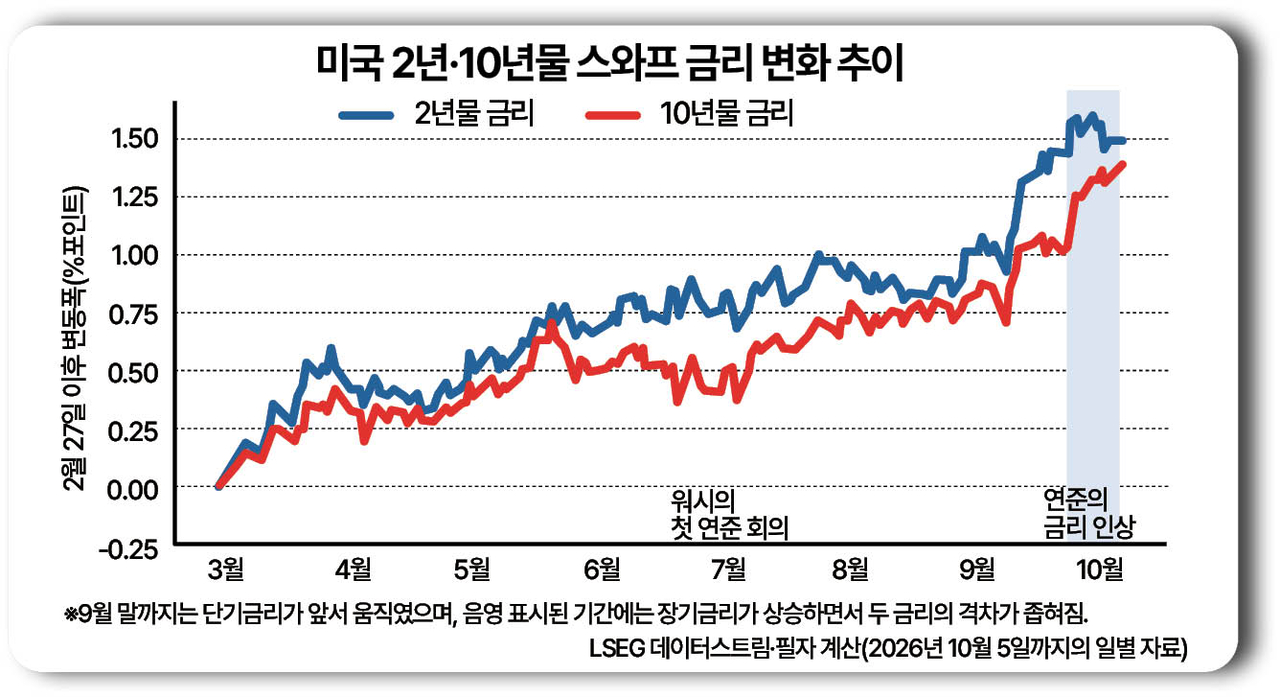
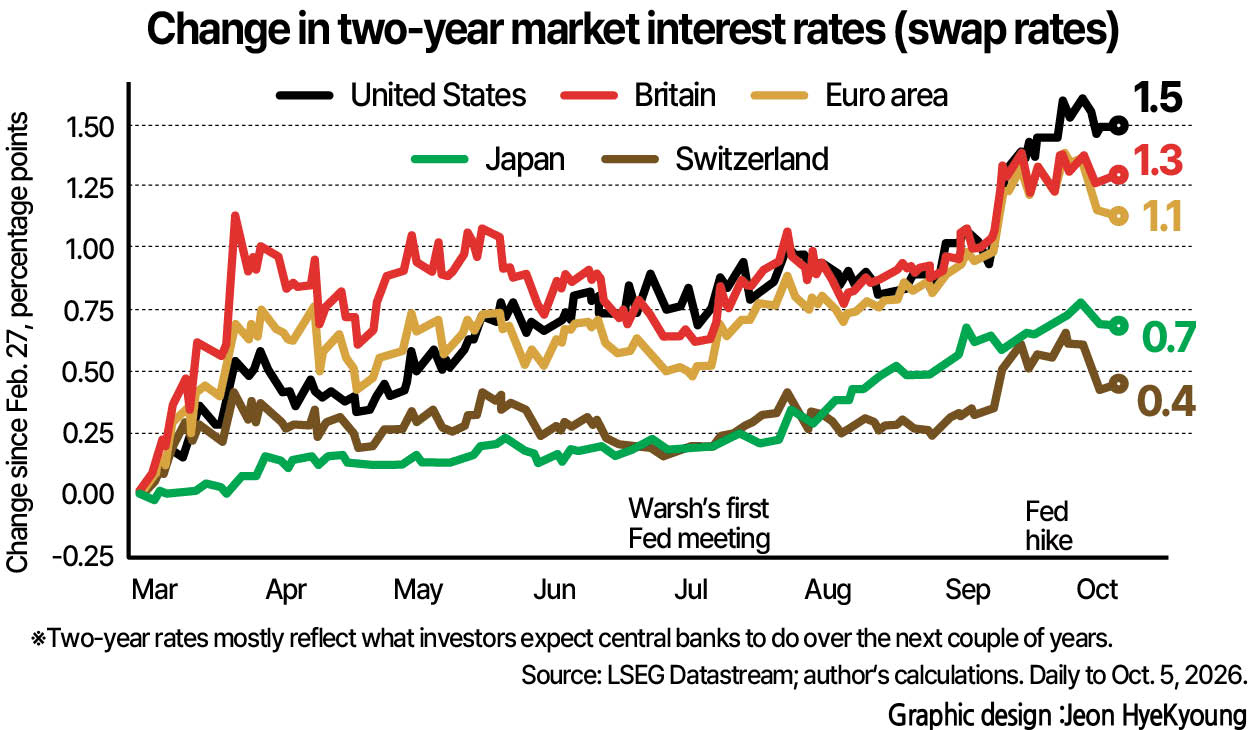
내가 주목하는 첫 번째 지표는 어느 만기 금리가 가장 크게 올랐느냐다. 2년물 금리는 유용한 기준이다. 대체로 향후 2년 동안 중앙은행의 정책금리가 어떻게 움직일지에 대한 투자자들의 기대를 반영하기 때문이다. 따라서 2년물 금리가 10년물 금리보다 더 빠르게 상승한다면, 시장이 통화정책에 대한 전망을 수정하고 있다는 의미다.
실제로 그런 일이 벌어졌다. 전쟁 발발부터 9월 말까지 미국의 2년물 스와프 금리는 약 1.4%포인트 상승한 반면, 10년물 스와프 금리는 약 1%포인트 올랐다. 두 금리의 상승 폭 차이는 마지막 2주 동안에야 좁혀졌다. 이 변화에 대해서는 뒤에서 다시 살펴보겠다. 영국과 유로존, 스위스에서도 같은 양상이 나타났다. 금리가 수년간 제로에 가까운 수준에 머물렀다가 다시 상승하고 있는 일본만 예외였다.
투자자들이 물가 통제 능력에 대한 신뢰를 잃었다는 징후도 거의 없다. 미국과 유로존, 영국에서 향후 5~10년의 물가상승률에 대한 시장의 기대를 보여주는 지표는 거의 움직이지 않았다.
하나의 글로벌 충격, 서로 다른 중앙은행의 대응
세계 경제는 또 하나의 공통된 충격을 받았다. 호르무즈 해협을 통과하는 해상 운송이 차질을 빚으면서 유가가 급등했다. 근월물 브렌트유 선물 가격은 전쟁 전 배럴당 약 72달러에서 3월 말 118달러까지 올랐다. 이후 휴전으로 72달러까지 떨어졌다가 9월에는 다시 100달러를 넘어섰다.
모든 주요 경제국이 같은 문제에 직면했다. 그리고 모두가 같은 질문을 던져야 했다. 자국 중앙은행은 어떻게 대응할 것인가.
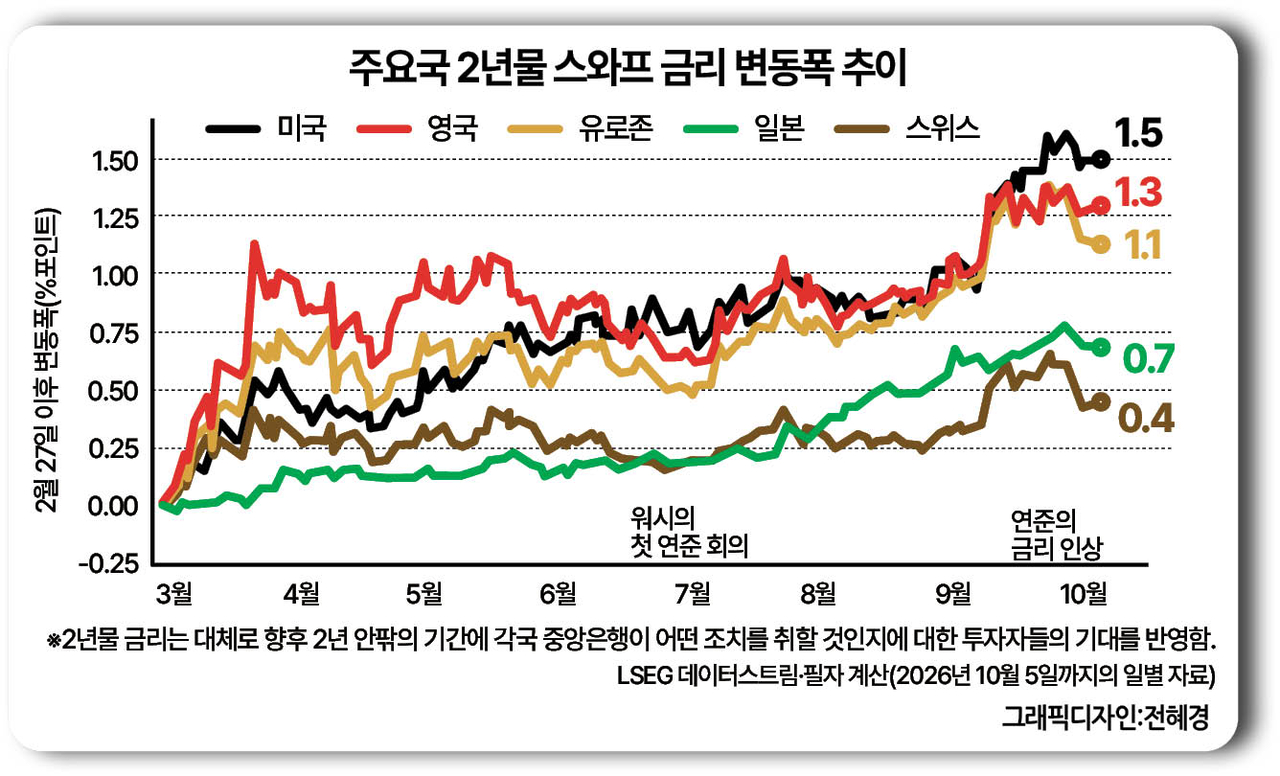
각국의 답은 달랐고, 금리의 움직임도 달랐다. 유럽중앙은행(ECB)은 6월과 9월에 금리를 인상하면서 “물가상승률이 상당 기간 목표치를 크게 웃돌 것”이라고 밝혔다. 일본은행은 금리를 두 차례 인상해 1.25%로 올렸다. 일본은행은 “중장기 인플레이션 기대가 계속 상승하고 있다”고 설명했다.
영란은행은 금리를 인상하지 않았지만, 높은 에너지 가격이 임금과 물가로 전이될 위험에 대해 경고했다. 영란은행은 “높은 에너지 가격이 오래 지속될수록 이러한 위험은 커진다”고 밝혔다. 영국의 2년물 금리는 실제 금리 인상이 한 차례도 없었는데도 1%포인트 넘게 상승했다. 투자자들이 중앙은행의 향후 대응을 미리 반영하고 있기 때문이다.
가장 뚜렷한 대조를 보이는 곳은 스위스다. 스위스 역시 같은 유가 충격을 받았지만, 8월 물가상승률은 0.8%에 불과했다. 스위스중앙은행은 9월에도 정책금리를 0%로 유지했다. 중앙은행은 “중기 인플레이션 압력이 소폭 증가하는 데 그쳤다”고 설명했다. 전쟁 발발 이후 스위스의 2년물 금리는 0.5%포인트도 오르지 않았다. 미국의 상승 폭과 비교하면 약 3분의 1 수준이다.
가장 큰 변화는 미국에서 나타났다. 시장은 연준이 금리를 인하할 것으로 예상하다가, 이제는 오히려 인상할 것으로 전망하게 됐다.
폴 크루그먼은 인공지능(AI)에 더 큰 비중을 둔다. 데이터센터를 건설하는 기술기업들의 막대한 자금 수요가 금리를 끌어올리는 가장 큰 요인일 가능성이 높다는 것이다. 나 역시 부채 위기가 임박했다는 주장에는 회의적이며, 크루그먼 또한 전쟁이 연준에 대한 시장의 기대를 재설정한 계기였다고 본다. 차이는 강조점에 있다. 두 설명은 서로 겹치는 부분이 있다. 강력한 투자 수요 자체가 투자자들로 하여금 정책금리가 더 높아질 것으로 예상하게 만들 수 있기 때문이다. 그럼에도 국가별 움직임을 비교하면, 각국 시장금리가 해당국 중앙은행의 예상 대응을 따라 움직였다는 점이 드러난다. 이런 양상에 비춰볼 때 나는 올해 금리 재평가의 중심에 에너지 충격에 대한 중앙은행의 대응이 있다고 본다.
워시 효과
왜 미국에서 변화가 가장 컸을까. AI가 그 이유의 일부일 수 있다. 또 다른 이유는 연준이 시장과 소통하는 방식에서 찾을 수 있다.
나는 지난 8월 발표한 칼럼에서 케빈 워시 신임 의장이 이끄는 연준이 투자자들에게 향후 금리의 방향을 알려주는 일을 중단했다고 주장했다. 대신 경제지표에 어떻게 반응할 것인지를 설명하고, 금리의 향방은 시장이 판단하도록 맡긴다는 것이다.
워시는 이를 두고 시장이 “심판이 아니라 공을 보고 경기하는 법”을 배우고 있다고 표현했다. 중앙은행의 암시나 신호가 아니라 경제 자체를 살펴야 한다는 뜻이다. 그는 시장이 따라야 할 원칙도 분명히 했다. “목표는 하나뿐이며, 그것은 2%다.” 에너지 충격으로 물가가 상승하는 상황에서 투자자들은 당연한 결론을 내렸고, 연준이 더 강경한 통화정책을 펼칠 것으로 예상해 이를 금리에 반영했다.
9월은 시장이 연준의 의도를 제대로 읽었는지 확인하는 시험대였다. 연준은 9월 16일 만장일치로 금리를 인상하면서 “연방공개시장위원회(FOMC)는 물가 안정을 실현할 것”이라고 밝혔다.
내가 보기에 시장은 신뢰할 만한 긴축을 금리에 반영하고 있다. 6월 중순 이후 물가연동 10년물 미국 국채 수익률은 약 0.8%포인트 상승했다. 이 수익률은 물가를 반영한 실질 차입 비용을 보여주는 지표다. 반면 시장의 물가상승률 기대를 나타내는 지표들은 거의 움직이지 않았다. 이는 투자자들이 긴축적인 통화정책이 물가를 억제할 것으로 예상하고 있다는 해석과 부합한다.
지난 2주간의 변화
9월 말에는 앞서 설명한 흐름에 변화가 나타났다. 9월 22일부터 10월 5일까지 2년물 시장금리는 대체로 안정적인 수준을 유지했지만, 10년물 금리는 계속 상승했다. 미국에서는 약 0.3%포인트 올랐고, 영국과 유로존, 일본에서도 상승했지만 그 폭은 더 작았다.
이러한 괴리는 투자자들이 장기채를 보유하는 위험을 감수하는 대가로 더 높은 수익률을 요구하고 있다는 해석과 부합한다. 다만 더 먼 미래의 정책금리가 높아질 것이라는 기대를 반영한 결과일 수도 있다.
뉴욕 연방준비은행의 국채 수익률 모형은 첫 번째 해석에 더 무게를 싣는다. 해당 모형에 따르면 이 2주 동안 연준 정책금리의 예상 경로는 사실상 변하지 않았다. 대신 10년물 수익률 추정치의 상승분은 전적으로 기간 프리미엄의 확대에서 비롯된 것으로 나타났다. 기간 프리미엄은 투자자들이 장기채권을 보유하는 대가로 요구하는 추가적인 보상을 뜻한다. 물론 이는 짧은 기간을 대상으로 한 하나의 모형에 불과하다. 그러나 추가 수익률이 부채에 대한 우려를 반영하는 것이라면, 바로 이 지점에서 그 흔적이 나타날 것이다.
실제로 한 국가에서는 그런 징후가 이미 나타났다. 최근 몇 주 동안 프랑스의 10년물 국채금리와 독일의 10년물 국채금리 간 격차는 약 1%포인트에서 거의 1.5%포인트로 확대됐다. 프랑스의 공공재정과 정치 상황에 대한 우려가 반영된 결과로 볼 수 있다.
데이터상에서 부채 우려가 나타나는 방식은 바로 이런 것이다. 특정 국가의 차입 금리가 독일의 금리에서 멀어지는 현상이다. 미국과 독일, 일본, 스위스에서는 정확히 이러한 양상이 나타나지 않고 있다.
프랑스의 불안이 다른 나라의 장기채에도 투자자들이 요구하는 추가 수익률을 높이는 파급효과를 낳았는지, 아니면 두 현상이 우연히 같은 시기에 나타났는지는 아직 판단하기 어렵다.
아시아에 중요한 이유
한국과 주변국에는 이러한 요인들을 구분하는 일이 실질적인 정책적 의미를 갖는다. 미국의 금리 상승이 연준의 강경한 통화정책에 대한 기대에서 비롯된다면, 그 영향은 환율과 달러 자금조달 비용, 자본 흐름을 통해 전파된다. 한국의 공공재정에 아무런 변화가 없더라도 국내 차입 비용이 상승할 수 있다는 뜻이다. 이런 금리 움직임을 재정정책에 대한 시장의 평가로 받아들여 그에 대응해 재정을 긴축한다면, 금리 상승을 초래한 근본 원인을 해결하지 못할 것이다.
지금까지의 교훈
2005년 채권시장을 움직인 요인은 글로벌 차원에서 작용했고, 시장에 충분히 예고된 미국의 국내 통화긴축 효과를 압도했다. 2026년에도 충격 자체는 글로벌 차원에서 발생했다. 그러나 올해 대부분의 기간에 각국이 보인 대응은 국내적이었다. 영국처럼 중앙은행이 아직 실제 조치를 취하지 않은 경우에도, 각국의 단기금리는 투자자들이 해당국 중앙은행의 향후 행보를 예상하는 방향으로 움직였다.
앞으로의 판단은 조건부로 이뤄져야 한다. 물가상승률이 둔화하고 투자자들이 미래의 정책금리에 대한 기대를 낮춘다면 장기금리도 함께 내려갈까. 그렇다면 중앙은행의 대응이 금리 상승을 주도했다는 설명에 힘이 실릴 것이다. 반대로 시장이 수정된 정책금리 전망에 비해 여전히 높은 장기금리를 유지한다면, 투자자들이 추가적인 위험 보상을 요구하고 있다는 뜻이다. 프랑스에서 나타난 것과 같은 국가 간 금리 격차 확대까지 이어진다면, 재정 불안이 금리 상승의 원인이라는 주장에도 더 큰 설득력이 생길 것이다.
프랑스는 다른 유로존 국가들과 마찬가지로 자국이 통제할 수 없는 통화로 돈을 빌린다. 이것이 프랑스의 공공재정에 대한 의구심이 차입 비용에 뚜렷하게 드러나는 이유 중 하나다.
현재까지 2026년의 대대적인 금리 재평가는 무엇보다 인플레이션 충격에 맞선 중앙은행들의 대응에 관한 이야기였다. 그리고 채권시장은 중앙은행이 무엇을 하려는지 읽어내는 법을 배웠다.
![The Marriner S. Eccles Federal Reserve Building undergoes renovations as seen from a construction mirror on July 02, 2026 in Washington, DC. [Getty Images]](https://wimg.heraldcorp.com/news/cms/2026/10/14/news-p.v1.20261014.40f8c63b019841ee86969ed0887fcf59_P1.jpg)
Long-Term Rates and Greenspan’s Conundrum, Inverted
After the 2001 recession, the Federal Reserve cut its policy rate, eventually to 1 percent in 2003. As the economy recovered, in 2004, it began to remove that extraordinary support, saying in June that policy accommodation “can be removed at a pace that is likely to be measured.” Short-term rates rose as planned. Yet in February 2005, Alan Greenspan, then the Fed‘s chairman, told the US Senate that long-term interest rates had fallen even though the Fed had raised short-term rates by 1.5 percentage points. “For the moment,” he said, “the broadly unanticipated behavior of world bond markets remains a conundrum.”
The most influential answer came from Ben Bernanke: a global glut of savings, much of it from Asia and the oil exporters, was pouring into safe American bonds and holding their yields down. Long-term rates were being set by global forces beyond the Fed‘s control.
Twenty-one years on, the conundrum has returned in reverse.
The puzzle of 2026
War in the Middle East broke out on Feb. 28. Since then the Fed has raised its policy rate only once, by a quarter point in September, while the 10-year Treasury yield has climbed by more than 1.3 percentage points, to about 5.3 percent. In 2005 long-term rates ignored a tightening that was under way. In 2026 they have run ahead of any immediate policy action. This is not just a US story: long-term yields have surged in Britain, the euro area and Japan as well. Even Switzerland, where inflation is below 1 percent, has seen its long-term yields rise.
This matters well beyond bond markets. Long-term yields set the cost of mortgages, of the bonds companies issue to finance investment, and of the debt governments must refinance. When they rise, households, businesses and finance ministries all pay more.
A common explanation is fiscal policy. Governments are borrowing heavily, and public debt is much higher after the pandemic. Central banks that bought government bonds by the trillion during the years of quantitative easing are now buying fewer or letting their holdings shrink, so private investors must absorb more of the supply, and they want to be paid more for doing so.
The fiscal concerns have a firm basis. In the United States, government debt has risen from about 66 percent of GDP in 2005 to about 124 percent in 2025, and the deficit has more than doubled as a share of the economy, from 3.1 to 6.8 percent. Elsewhere the picture is mixed. Britain‘s debt has stayed around 100 percent of GDP since the pandemic. France’s reached 119 percent in the second quarter of 2026, above its pandemic peak. Italy‘s is creeping up again, and Japan’s has fallen back from its pandemic peak to roughly where it stood before. Is this the story of 2026?
The lens of the market
How can we tell whether investors are turning against government debt? One way is to compare what governments pay to borrow with the rate on interest-rate swaps, contracts in which banks and investors trade fixed interest payments for floating ones without any government bond involved. A rise driven by worries about a particular government‘s debt would normally push its borrowing costs up relative to swap rates. That is not the broad pattern. Since the eve of the war, America’s 10-year borrowing cost has risen by 1.35 percentage points, and the 10-year swap rate by slightly more. Germany, Japan and Switzerland show the same pattern. Only in Britain did the government‘s 10-year cost climb a little faster than the market benchmark, and by less than a tenth of a percentage point.
The dollar points the same way. When investors lose faith in a government, they often sell its bonds and its currency together, as they did with Britain in September 2022. Instead, the dollar has gained almost 5 percent against other major currencies since the war began.
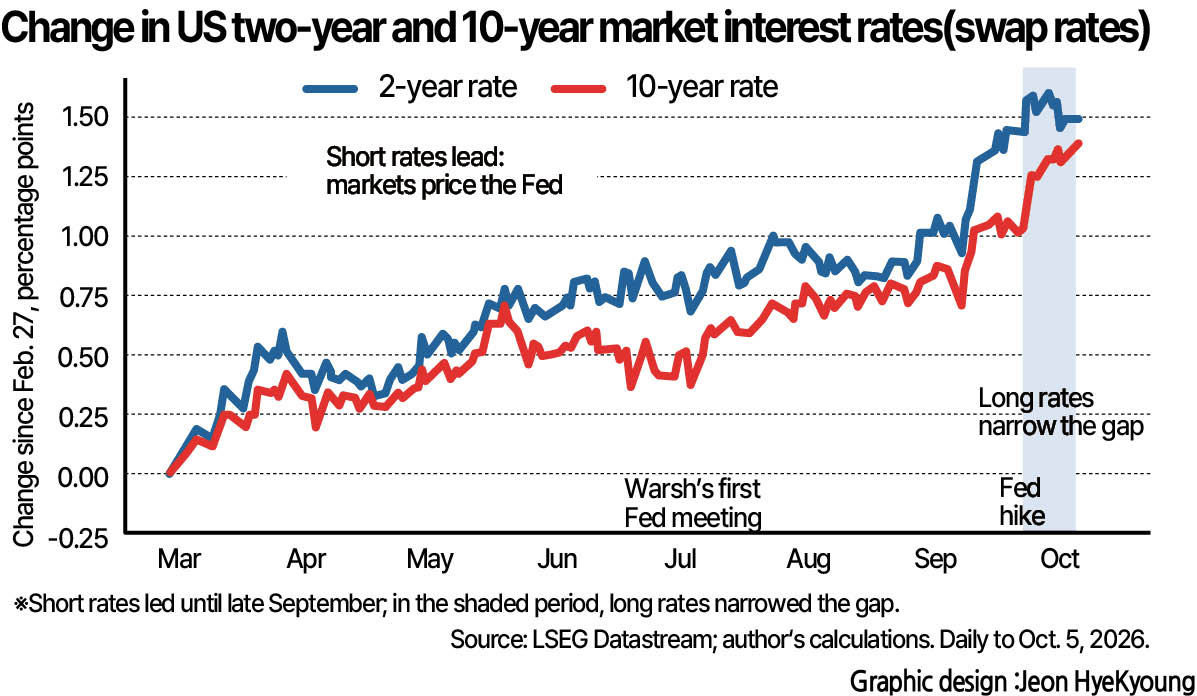
These comparisons offer little support for a broad loss of confidence in government debt. What, then, explains the rise? My starting point is which rates rose most. The two-year rate is a useful guide: it largely reflects where investors expect central-bank rates to go over the next couple of years, so when it rises faster than the 10-year rate, markets are rethinking monetary policy. That is what happened. From the start of the war until late September, the US two-year market rate rose by about 1.4 percentage points, while the 10-year rate rose by about 1. Only in the final two weeks did the 10-year rate narrow the gap, a shift I return to below. Britain, the euro area and Switzerland followed the same pattern; Japan, where rates are climbing back from years near zero, was the exception.
Change in US two-year and 10-year market interest rates (swap rates) since Feb. 27, in percentage points. Short rates led until late September; in the shaded period, long rates narrowed the gap. Source: LSEG Datastream; author‘s calculations. Daily to Oct. 5, 2026.
There is little sign, either, of investors losing confidence in inflation control. Market measures of where inflation will be five to ten years from now barely moved in America, the euro area or Britain.
One global shock, different central banks
The world economy has been hit by another common shock. Disruption to shipping through the Strait of Hormuz sent oil prices soaring: front-month Brent crude futures rose from about $72 a barrel before the war to $118 by the end of March, fell back to $72 after a ceasefire, and climbed above $100 again in September. Every major economy faced the same problem and the same question: how will our central bank respond?
The answers differed, and so did the moves in interest rates. The European Central Bank raised rates in June and again in September, saying that “inflation is set to remain well above target for an extended period.” The Bank of Japan raised its rate twice, to 1.25 percent, noting that “medium- to long-term inflation expectations have continued to rise.” The Bank of England has not raised rates, but it warned that the risk of inflation feeding into wages and prices “is greater the longer higher energy prices persist.” British two-year rates have risen by well over a percentage point without a single hike: investors are anticipating how the central bank will respond.
Switzerland is the clearest contrast. It faced the same oil shock, but Swiss inflation was only 0.8 percent in August, and the Swiss National Bank kept its rate at zero in September. In its words, “Medium-term inflationary pressure has increased only slightly.” Swiss two-year rates have risen by less than half a percentage point since the war, about a third of the American rise. The biggest shift came in the United States, where markets went from expecting the Fed to cut rates to expecting it to raise them.
Change in two-year market interest rates (swap rates) since Feb. 27, in percentage points. Two-year rates mostly reflect what investors expect central banks to do over the next couple of years. Source: LSEG Datastream; author‘s calculations. Daily to Oct. 5, 2026.
Paul Krugman puts more weight on artificial intelligence: the enormous demand for funds from technology companies building data centres is, he argues, likely the biggest force pushing interest rates higher. I share his skepticism about a debt crisis, and he too sees the war as the trigger that reset expectations for the Fed. Where we differ is emphasis. The two explanations overlap, since strong investment demand can itself lead investors to expect higher policy rates. The cross-country pattern, with each market tracking what its own central bank was expected to do, nevertheless leads me to put central banks‘ response to the energy shock at the centre of this year’s repricing.
The Warsh factor
Why did America move most? AI may be part of the answer. Another part lies in how the Fed now talks to markets. In an essay published in August I argued that the Fed under its new chairman, Kevin Warsh, has stopped telling investors where interest rates are heading. Instead it tells them how it will react to the data and leaves the pricing to them. Warsh‘s phrase for this was that markets are learning to “play the ball, not the referee”: to watch the economy, not the central bank’s hints. And he left no doubt about the rule they should apply: “There‘s only a target, and it’s 2 percent.” With an energy shock pushing inflation up, investors drew the obvious conclusion and priced a firmer Fed.
September was the test of whether they had read the Fed correctly. The Fed raised rates on Sept. 16, by a unanimous vote, stating that “The Committee will deliver price stability.” My reading is that markets are pricing a credible tightening. Since mid-June the yield on inflation-protected 10-year Treasuries, a measure of the inflation-adjusted cost of borrowing, has risen by about 0.8 percentage points, while market measures of inflation expectations have barely moved. That pattern is consistent with investors expecting tighter policy to contain inflation.
The last two weeks
In late September, the pattern I described earlier changed. Between Sept. 22 and Oct. 5, two-year market rates were broadly stable while 10-year rates kept climbing: by about a third of a percentage point in the United States and by less in Britain, the euro area and Japan. That divergence is consistent with investors demanding more to bear the risk of holding long-term bonds. It could also reflect higher expected policy rates further into the future. The New York Fed‘s model of Treasury yields favors the first reading: over those two weeks it shows the expected path for the Fed’s policy rate essentially unchanged, and the whole of the rise in its estimate of the 10-year yield coming from that extra return. It is one model over a short window. But if the extra return reflects worries about debt, this is where they would show up.
In one country, they already have. In the last weeks, the extra cost France pays to borrow for ten years compared with Germany jumped from about one percentage point to almost one and a half, consistent with concerns about French public finances and politics. This is what a debt worry looks like in the data: one government‘s borrowing costs pulling away from Germany’s. It is precisely the pattern that is missing in the United States, Germany, Japan and Switzerland. Whether the French scare spilled over into the premium investors demand for long-term bonds everywhere, or the two simply coincided, it is hard to say at this point.
Why it matters for Asia
For Korea and its neighbors, telling these forces apart has practical consequences. A rise in American yields driven by expectations of a tougher Fed travels through the exchange rate, dollar funding costs and capital flows, and it can lift Korean borrowing costs even when nothing about Korea‘s public finances has changed. Treating such a move as a verdict on fiscal policy, and tightening the budget in response, would not address the source of the increase.
The lesson so far
In 2005 the forces behind the bond market were global and overwhelmed a well-signalled domestic tightening. In 2026 the shock is global, but for most of the year the response was local: each country‘s short-term rates followed the path investors expect its central bank to take, even where, as in Britain, it has not yet acted.
The test ahead is conditional. If inflation recedes and investors lower their expectations for future central-bank rates, do long-term yields come down with them? If they do, that would support the central-bank explanation. If they remain high relative to that revised path, investors are charging a premium, and wider spreads like France‘s would strengthen the case that fiscal stress is behind it. France, like other euro-area countries, borrows in a currency it does not control, which is one reason doubts about its public finances show up so plainly in what it pays to borrow. For now, the great repricing of 2026 has been first of all a story about central banks fighting an inflation shock, and about bond markets that have learned to read their intentions.


![온기[溫記]](https://wimg.heraldcorp.com/svc/series/202601/2b3df642-aa35-42bd-a9e6-cb4ad932be11.png)