![2025년 7월 13일 도쿄 신쿠쿠 구에서 ‘일본인 퍼스트(Japanese -First)’로 대표되는 인종차별과 민족주의를 표방하는 참정당(산세이토)에 반대하는 ‘시위 랠리’에 참가한 시위대. 극우성향의 군소정당인 참정당은 7월20일 치러진 일본 참의원 선거에서 14석을 차지하는 돌풍을 일으켰다. [AP]](https://wimg.heraldcorp.com/news/cms/2025/08/12/news-p.v1.20250812.5758bf9f34dd48d8abd380b18a3529d5_P1.jpg)
지난 7월 20일, 일본은 참의원 선거를 실시했다. 선거 결과 외국인 노동자 수의 증가에 반대하는 정당들이 큰 성과를 거뒀다. 특히 극우 성향의 군소정당인 참정당(Sanseito)은 의석 수를 크게 늘렸다. 참정당은 외국인 노동자 배제를 명시적으로 주장하지는 않지만, 감소하는 노동력을 값싼 외국인 노동력으로 대체하려는 발상은 잘못됐다고 비판한다. 이들은 저숙련 외국인 노동자의 수용을 제한하고, 이들의 영주권 및 가족 초청을 규제하는 근본적인 개혁이 필요하다고 주장한다. 국내외 언론은 이러한 산세이당의 부상에 놀라움을 표하며, 일본 국민 사이에 ‘우경화’ 경향이 감지된다고 보도했다.
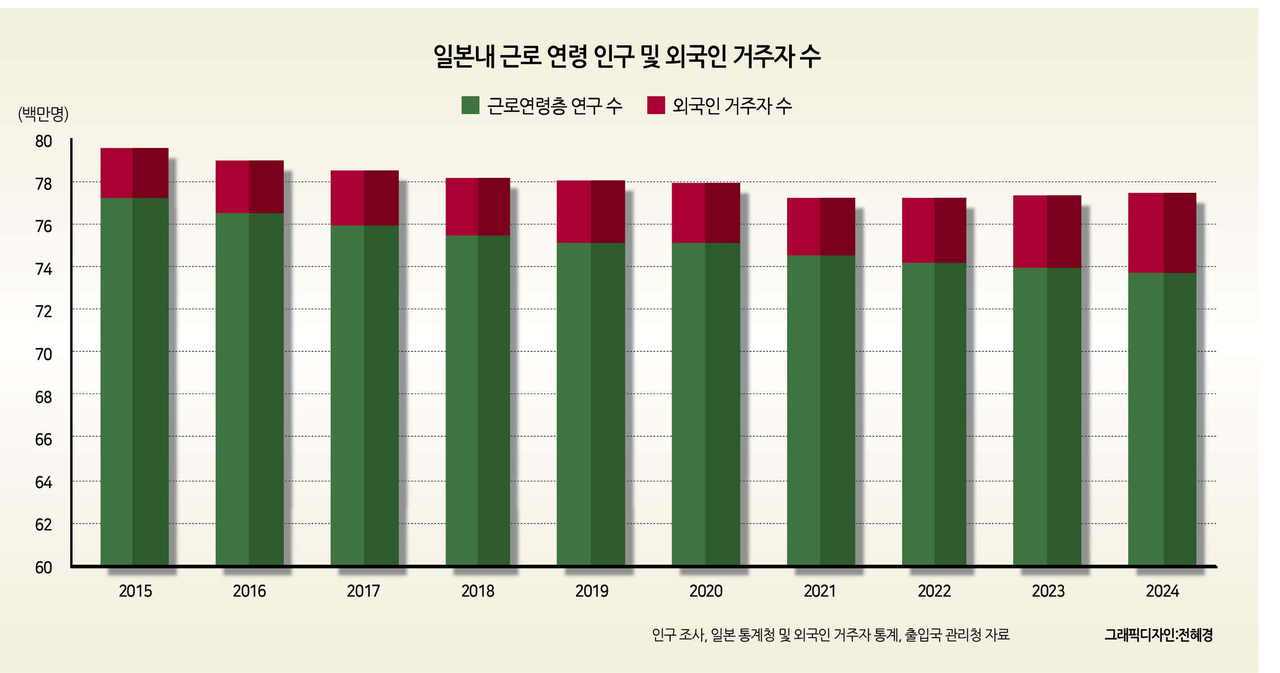
역사적으로 일본은 다른 주요 국가들에 비해 외국인 노동자 비율이 매우 낮았다. 하지만 1995년을 정점으로 생산가능인구(15~64세)가 감소하면서, 일본은 대체 노동력으로 외국인 노동자 유치를 위한 정책을 추진해왔다. 그 결과, 최근 수년간 일본에 거주하는 외국인 수는 꾸준히 증가해왔다. 일본 출입국재류관리청의 발표에 따르면, 2024년 기준 일본 내 외국인 거주자는 약 37만7000명으로, 매년 약 3만6000명씩 증가하고 있다. 이 증가는 같은 해 일본 인구 감소의 약 40%를 보완하는 수준이다. 특히 생산가능인구의 감소는 외국인 수 증가로 대부분 상쇄되었으며, 이미 노동력 부족을 겪고 있던 많은 업종은 외국인 노동자 없이는 운영이 어려운 상황에 이르렀다.
일본의 인구 문제는 정부의 예측보다 빠르게 악화하고 있다. 후생노동성이 발표한 ‘인구동태통계’에 따르면, 2024년 출생아 수는 전년 대비 5.7% 감소하며 70만 명을 밑돌았다. 여성 1인당 평균 출생아 수를 나타내는 합계출산율은 1.15명으로 역대 최저치를 기록했다. 출생아 수에서 사망자 수를 뺀 자연 인구감소는 91만9237명에 이르러 사상 최대를 기록했다. 이러한 출생률 급락은 가까운 미래에 생산가능인구의 감소 속도 역시 가속화될 것임을 의미한다. 이는 일본의 경제 전망에 암울한 그림자를 드리우고 있다.
일본은 여성과 고령자의 노동시장 참여를 유도하여 감소하는 생산가능인구를 보완해왔다. 그 결과 여성과 고령층의 경제활동 참가율은 크게 높아졌고, 이는 전체 노동력 규모의 감소를 어느 정도 막는 데 기여했다. 그러나 이들 그룹의 참여율이 한계치에 가까워지면서, 노동력 자체는 곧 감소할 것으로 예상된다. 향후 다양한 노동절감형 기술 발전이 그 충격을 완화할 것으로 기대되지만, 모든 직업군에서 이러한 기술만으로 노동력 부족을 완전히 해소할 수는 없다. 출생률 급락의 속도를 감안할 때, 일본이 향후 인구 감소를 보완하기 위해 외국인 노동자에 의존하는 것은 불가피한 현실이다.
고령화와 출생률 저하로 인해 일본 전체 인구에서 생산가능 연령의 일본인 비중은 60% 아래로 떨어졌지만, 외국인 거주자의 85% 이상은 젊은 노동가능 인구다. 이들은 특히 노동력 부족이 심각한 산업 분야에서 점차 더 중요한 역할을 하게 될 것이다. 인구 감소가 비교적 덜한 도쿄 같은 대도시에서는 외국인이 사무직에 많이 종사하고 있으며, 이는 해당 지역의 일자리 특성을 반영한다. 반면, 지방에서는 심각한 인력난으로 인해 외국인 단순노무직 종사자가 급증하고 있다. 지방의 많은 일자리는 일본인 지원자가 없어 공석으로 남아 있는 상황이며, 외국인 인력을 활용하는 경향은 점차 확산하고 있다.
일본 정부는 최근 인력난이 심각한 업종에 외국인 노동력을 안정적으로 공급하기 위해 외국인 채용 프로그램을 시행해왔다. 특히 수용 산업 범위를 확대하고 있으며, 이는 단순히 생산가능인구 감소뿐 아니라, 이웃 국가들과의 ‘인재 확보 경쟁’에 대응하기 위한 조치이기도 하다. 고령화와 출생률 저하는 일본만의 문제가 아니다. 향후 몇 년간 한국과 중국에서도 생산가능인구 감소 속도가 빨라질 것으로 전망된다. 따라서 우수한 외국 인재 확보는 일본의 시급한 과제로 떠올랐다.
과거에는 일본이 아시아 유일의 선진국으로서 우수한 치안과 높은 임금을 앞세워 외국인을 유치할 수 있었지만, 최근 경쟁력은 급격히 약화했다. 예컨대 20년 전에는 일본의 최저임금이 한국의 두 배 이상이었지만, 현재는 약 10% 낮아졌다. 특히 엔화 약세로 인해 베트남, 인도네시아 출신 노동자들이 일본 대신 한국을 선택하는 사례가 늘고 있다. 일본 정부는 한국이 외국 인재 유치에 국가적 노력을 기울이고 있는 반면, 자국은 뒤처지고 있다고 판단하며 외국인 수용 정책을 더욱 확대할 필요성을 인식하고 있다.
그러나 최근 참의원 선거 결과는 이러한 정부 정책에 찬물을 끼얹었다. 선거에서 큰 성과를 거둔 정당은 “일본인은 일본인의 힘으로 살린다”는 구호를 내세웠다. 이 정당은 인구가 8000만명 수준으로 줄어도 “일본인만으로도 사회 운영이 충분히 가능하다”고 주장하며, 국민주의적 정서를 자극해 큰 지지를 받았다. 하지만 현재 이미 다양한 분야에서 극심한 노동력 부족이 나타나고 있으며, 더 많은 외국 인재 수용이 일본 경제에 긍정적 영향을 미칠 것이 분명하다.
주요 과제는 이러한 경제적 이점과 국민 정서 간의 간극을 어떻게 좁히느냐다. 일본처럼 극심한 노동력 부족에 시달리는 사회에서 외국인 노동자를 전혀 수용하지 않는다는 것은 비현실적이다. 대신 외국인 노동자가 일본의 규범을 준수하며 평화롭게 공존할 수 있는 제도적 기반 마련이 점점 더 필요해지고 있다. 다른 선진국들도 외국인 노동자로부터 다양한 인재 혜택을 받고 있는 한편, 이들의 열악한 근무 환경은 지속적인 비판 대상이 되고 있다. 문화적·제도적 차이에서 발생한 갈등, 차별, 편견 등은 여전히 문제로 남아 있다. 일본 내에서도 외국인 노동자가 낮은 임금, 긴 노동시간, 의사소통 문제 등 열악한 근무 조건에 놓여 있다는 지적이 있으며, 문화·언어 차이로 인한 지역사회와의 마찰을 우려하는 목소리도 존재한다. 이 같은 문제 해결과 평화적 공존의 촉진은 점점 더 중요한 과제로 떠오르고 있다.
이민 문제는 현재 여러 국가에서 사회 갈등의 원인이 되고 있다. 유럽과 미국에서는 이 문제가 국민 분열과 정치 불안정으로 이어지고 있다. 일본에서는 아직 외국인 노동자가 자국민의 일자리를 뺏는다는 논의는 적지만, 다수 국민이 외국인 노동자가 치안을 위협하고 일상생활에 불안을 준다고 느끼고 있다. 이에 대한 해결은 치안 강화 등 정부 주도의 조치가 필요하다. 더 나아가, 외국인과 공존하는 사회를 지향하는 것이 국민 분열과 정치적 혼란을 방지하는 핵심이 될 것이다. 인구 감소가 불가피한 일본 사회에서 외국인 노동자는 이제 피할 수 없는 과제가 됐다. 일본인과 외국인이 평화롭게 살아갈 수 있는 환경을 조성하려면 정부·기업·지역사회의 협력이 필수적이다.
Coexistence with Foreign Workers in Japan
On July 20, Japan held its Upper House election, in which parties that oppose increasing foreign workers made significant gains. In particular, the Sansei Party substantially increased its number of seats. Although the Sansei Party does not explicitly advocate for excluding foreign workers, they do argue that the idea of filling the declining labor force with cheap foreign labor is misguided. They emphasize the need for fundamental reforms to limit the acceptance of low-skilled foreign workers and regulate their permanent residency and family reunification. Both domestic and international media outlets reported on the party‘s rise with surprise, with many noting an underlying “right-wing shift” among the Japanese people.
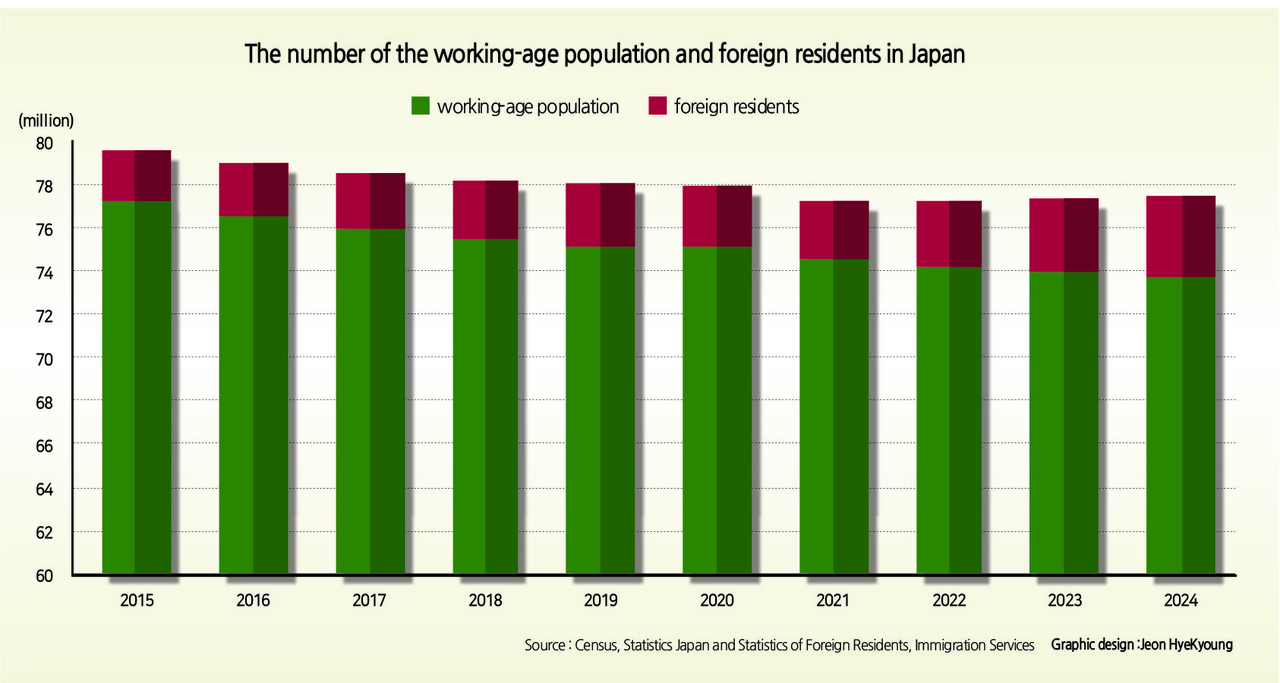
Historically, Japan has had a much smaller foreign worker population than other major countries. However, as its working-age population (aged 15–64 years) declines from its 1995 peak, Japan has promoted policies to secure foreign workers as an alternative labor force. Consequently, the number of foreigners residing in Japan has steadily increased in recent years. A press release by the Immigration Services Agency reported approximately 377,000 foreign residents in 2024, an increase of approximately 36,000 people annually. This increase accounted for approximately 40% of Japan‘s population decline in the same year. Among the working-age population, most of the decline in Japan was offset by an increase in the number of foreigners. Many occupations that were already struggling with labor shortages have become unable to function without foreign workers.
Japan‘s population problem is worsening as its birthrate declines faster than the government had projected. According to the “Vital Statistics” released by the Ministry of Health, Labor and Welfare, the number of births in 2024 decreased by 5.7% from the previous year, falling below 700,000. The total fertility rate, which indicates the average number of children born per woman, reached a record low of 1.15. The natural population decrease, defined as the difference between births and deaths, increased to 919,237 people, marking the largest decline on record. The current accelerated decline in births implies that the working-age population will also decrease more rapidly in the near future. This anticipated population decline has cast a dark shadow over Japan’s economic outlook.
Japan has compensated for its declining working-age population by incorporating women and older adults into the workforce. Consequently, the labor force participation rates of women and older adults have increased significantly, helping prevent a decline in the overall labor force. However, as these rates approach their limits, the labor force will soon begin to decline. Various labor-saving technological advances expected in the future may mitigate the impact of the shrinking labor force. However, technological advancements cannot fully compensate for labor shortages in many occupations. The rapid decline in birth rates makes it inevitable that Japan will need to rely on foreign workers to compensate for population decline in the future.
As the population ages and birth rates decline, the proportion of working-age Japanese nationals in the total population has fallen below 60%. In contrast, more than 85% of foreign residents are of young working age. These young foreign workers will play an increasingly important role in addressing labor issues, particularly in industries with severe shortages. Urban areas such as Tokyo, where the population decline has been minimal, have a higher proportion of foreign residents in white-collar jobs, reflecting the prevalence of this type of employment. In contrast, severe labor shortages have led to a rapid increase in foreign blue-collar workers in rural areas. Job openings in rural areas often remain unfilled because of a lack of Japanese applicants. Relying on foreign workers to fill labor shortages is becoming more common in these areas.
Recently, the Japanese government has implemented programs to recruit and employ foreign workers, ensuring a steady labor force in industries experiencing serious shortages. In particular, the government has expanded the number of industries that accept foreign workers. The government has made urgent efforts to expand acceptance systems to account for not only the decline in the working-age population but also the “talent acquisition competition” with neighboring countries. Aging populations and declining birth rates are not unique to Japan. The rate of decline in the working-age population is expected to increase in South Korea and China in the coming years. Therefore, swiftly securing high-quality foreign labor is a significant challenge in Japan.
Previously, Japan was the only advanced country in Asia and could attract foreign workers by promoting its good public safety record and high wages. However, the country has rapidly lost its competitive edge in recent years. For example, Japan‘s minimum wage was more than twice that of South Korea 20 years ago, but is now approximately 10% lower. The continued weakening of the yen has notably increased the number of Vietnamese and Indonesian workers choosing South Korea over Japan. The Japanese government recognizes that while South Korea has made a national effort to attract foreign talent, Japan has fallen behind and acknowledges the need to further promote acceptance policies.
Unfortunately, the recent Upper House election results have undermined these government policies. The political party that gained significant ground in the election announced its intention to “run Japan utilizing the Japanese people.” The party claims that even if the population were to decrease to 80 million, social activities could still be “adequately managed by Japanese people alone.” This stance has stirred nationalist sentiments among the public and garnered significant electoral support. However, labor shortages are already extremely severe in various occupations, leaving no question as to whether accepting more foreign talent would have significant positive macroeconomic effects.
The major challenge lies in reconciling the economic benefits of securing such talent with negative national sentiment. In a society such as Japan, which is struggling with severe labor shortages, not accepting any foreign workers is unrealistic. Conversely, an institutional design that can ensure that foreign workers adhere to Japanese rules and create an environment conducive to peaceful coexistence is increasingly needed. Other major countries that have accepted foreign workers benefit from the diverse talent they provide. At the same time, their poor working conditions have been criticized. Numerous reports of conflicts arising from cultural and institutional differences have emerged. Discrimination and prejudice are ongoing issues. In Japan, some argue that foreign workers face poor labor conditions, including low wages, long working hours, and communication problems. Others have expressed concerns regarding friction with local communities caused by cultural differences and language barriers. Resolving these issues and concerns and promoting peaceful coexistence with foreign workers are becoming increasingly important.
Immigration issues are currently causing conflict in many countries. For example, in Europe and the United States, these issues have led to divisions among the people and political instability. In Japan, whether foreign workers are taking jobs from locals has received little debate. However, many people feel that foreign workers endanger public safety and encroach on their everyday lives. These issues must be addressed through government initiatives such as public safety measures. Furthermore, striving for a society that coexists with foreigners is essential to prevent public division and political instability. As the population continues to decline, foreign workers are becoming an unavoidable challenge in Japanese society. Collaboration among the government, businesses, and local communities will be indispensable for creating an environment in which Japanese and foreign workers can live peacefully.

![온기[溫記]](https://wimg.heraldcorp.com/svc/series/202601/2b3df642-aa35-42bd-a9e6-cb4ad932be11.png)