
다자간 무역체제가 공격받고 있는 상황에서 세계 최대의 지역 자유무역협정인 역내포괄적경제동반자협정(RCEP)의 확대 협상이 추진될 전망이라는 소식은 반가운 일이다. 이번 발표는 많은 이들에게 뜻밖의 소식이었으며, RCEP의 성공을 입증하는 사례로 받아들여질 수도 있다. 그러나 그 의미를 과장해서는 안 된다. 참여국들에는 다른 무역협정이 오히려 더 큰 이익을 가져다줄 가능성도 있다.
RCEP, 성공 사례
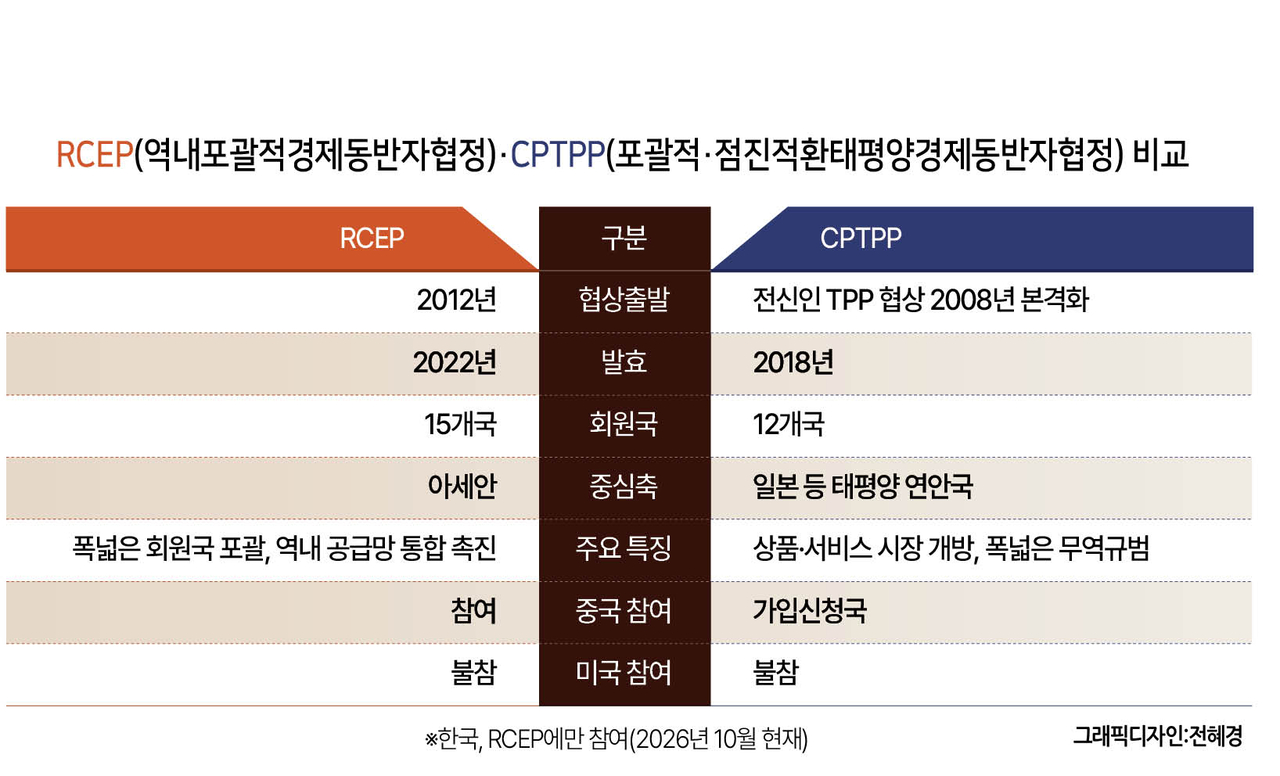
RCEP는 출범 초기부터 대다수 관측자의 예상을 뛰어넘었다. 아세안(ASEAN)이 주도한 RCEP는 기존의 아세안 중심 자유무역협정(FTA) 5개를 하나로 통합하기 위해 추진됐다. 해당 협정은 중국, 인도, 일본, 한국, 그리고 호주·뉴질랜드와 각각 체결한 협정들이었다. 8년이 넘는 치열한 협상 끝에 RCEP는 2020년 11월 서명됐다. 대다수 관측자의 예상과 달리 비준 절차는 신속하게 진행됐고, 비준을 마친 첫 10개국을 대상으로 1년 뒤인 2022년 1월 1일 발효됐다. 인도는 협상 초기부터 참여했지만 막판에 탈퇴를 결정해 협정에 포함되지 않았다.
RCEP는 당시에도 그랬고 지금도 중요한 의미를 지닌다. 동아시아 전체를 포괄하는 최초의 지역 무역협정이기 때문이다. 세계의 다른 지역과 달리 동아시아는 공식적인 제도적 틀이 없는 상태에서도 경제통합을 진전시켜 왔다. 동아시아는 정부 주도로 경제통합을 추진한 유럽과 대조적으로, 사실상의(de facto) 경제통합, 즉 민간 부문이 주도하는 경제통합의 대표적인 사례로 오랫동안 평가받았다. RCEP는 이러한 사실상의 경제통합 현실을 제도화하는 데 어느 정도 기여했다. 특히 RCEP를 통해 중국·일본·한국이 단일 무역협정의 틀 안에 처음으로 함께 들어왔다는 점도 주목할 만한 성과다.
더욱이 RCEP를 가치 있는 협정으로 만드는 특징은 원산지 규정이 단순하고 비교적 느슨하다는 점이다. 모든 무역협정에서는 상품이 협정의 특혜를 받으려면 해당 협정에 참여하는 지역 안에서 일정 수준 이상 생산돼야 한다. RCEP에서는 상품이 특혜관세를 적용받기 위해 필요한 역내 부가가치 비율이 40%에 불과하며, 역내 누적 원산지 기준도 적용할 수 있어 요건을 충족하기가 한층 쉽다. 원산지 규정의 통일과 함께 통관·국경 절차 간소화 등 무역 원활화 조치도 도입됐다. 이는 역내 생산 네트워크의 효율성을 높이고, 이른바 ‘누들볼 증후군(noodle-bowl syndrome·다수의 양자간·다자간 FTA와 통상 규정이 복잡하게 얽혀 거래 비용과 혼란을 증가시키는 현상)’을 완화하기 위한 것이다.
협정 이행 전인 2019~2022년과 비준 이후인 2022~2025년을 비교하면 RCEP 역내 교역은 34% 증가했다. 그러나 비준 이후의 역내 교역 증가 양상은 국가별로 엇갈렸으며, 대체로 주요국보다 규모가 작은 경제권의 성과가 더 좋았다. 주요 경제권 가운데서는 중국이 자동차, 특히 전기차와 배터리, 반도체 등 전략 산업에서 RCEP 발효 이후 가장 두드러진 성장세를 기록했다. 전반적으로 최근 통계는 소규모 경제권이 주요 회원국보다 RCEP 역내 교역에 훨씬 더 깊이 편입된 반면, 주요 회원국들은 RCEP 역외로도 수출시장을 계속 다변화해 왔음을 보여준다. 그럼에도 RCEP가 회원국들을 글로벌 시장의 변동성과 도널드 트럼프 미국 행정부의 변덕스러운 무역정책으로부터 보호하는 한편, 역내 무역 및 생산 네트워크의 재편에 기여했다는 점은 분명하다.
성공이라는 평가에는 단서가 필요
그러나 최근의 확대 절차 착수를 성공의 증거로 보는 것은 과장된 평가일 가능성이 크다. 우선 확대 절차는 아직 초기 단계에 불과하다는 점에 주목해야 한다. RCEP 장관들은 방글라데시, 칠레, 홍콩(중국), 스리랑카의 가입 가능성을 검토하기 위한 절차를 시작하는 차원에서 임시 가입 작업반을 설치하기로 합의했을 뿐이다. 가입 작업반이 설치됐다고 해서 신청국이 RCEP 회원국이 되는 것은 아니다. 해당 경제권의 기업들이 RCEP 특혜관세를 즉시 적용받게 되는 것도 아니다. 이는 단지 첫 단계일 뿐이다.
더욱이 RCEP 출범 초기부터 제기됐던 비판은 지금도 유효하다. 가장 큰 문제는 협정의 개방 수준이 상대적으로 낮고, 무역자유화가 단편적으로 이뤄진다는 점이다. 관세 자유화 약속은 아직 완결되지 않았으며 상당수 예외 조항도 남아 있다. 수천 쪽에 달하는 37개의 관세 양허표가 존재하고, 특정 조항마다 이행 일정도 달라 협정상 약속이 얼마나 복잡하고 예외가 많은지를 보여준다. RCEP는 궁극적으로 관세의 90%를 철폐할 수 있지만, 그때까지 최소 20년이 걸릴 전망이다. 농업뿐 아니라 다수의 공산품에도 광범위한 예외가 적용된다.
협정의 다른 분야들도 개방 수준과 목표의 야심도에서 차이가 있다. 서비스 분야에서는 예상외로 상당히 높은 수준의 개방을 담고 있지만, 투자·전자상거래·정부조달·경쟁 규정에 대해서는 제한적인 수준에 머물러 있다.
이러한 한계 탓에 협정 발효 후 거의 5년이 지났는데도 실제 활용률은 여전히 매우 낮다. 기존의 양자 간 협정이 오히려 더 매력적이고 이용하기 편리한 것으로 보인다. 따라서 우선순위는 기업들이 RCEP의 특혜 내용을 더 잘 알도록 하고, 협정을 더욱 쉽게 활용할 수 있도록 하는 데 있다. 2017년에 실시할 예정인 협정 재검토는 바로 이러한 협정 개선에 도움이 돼야 한다. 협정 확대와 현대화가 병행되고 있지만, 후자에 훨씬 더 높은 우선순위를 부여해야 한다.
한국, RCEP와 CPTPP
협정이 개선되더라도 RCEP는 동아시아 경제권이 참여하는 또 다른 초대형 자유무역협정인 포괄적·점진적 환태평양경제동반자협정(CPTPP)에 뒤처질 가능성이 크다. CPTPP는 당초 태평양 양안의 11개국으로 출범했으며, 2024년 영국의 가입으로 12개국으로 확대됐다. 올해 말 코스타리카의 비준 절차가 마무리되면 회원국은 곧 13개국으로 늘어날 전망이다. CPTPP는 흔히 ‘황금 기준(gold standard)의 협정’으로 불린다. 이 표현이 정확히 무엇을 의미하는지는 분명하지 않지만, CPTPP가 RCEP보다 더 높은 수준의 의무를 부과하고 예외나 적용 제외 조항을 두지 않는다는 점은 부인하기 어렵다. CPTPP는 관세와 상품무역뿐 아니라 서비스, 투자, 지식재산권, 디지털 무역에 관한 약속을 담고 있으며, 표준·노동·환경 관련 규정도 포함한다.
한국은 RCEP에 참여하는 것보다 CPTPP에 가입함으로써 얻을 수 있는 이익이 더 크다. 그런 점에서 이재명 대통령이 한국의 CPTPP 가입 신청을 또다시 미루기로 한 결정은 매우 유감스럽다.
한국이 이런 결정을 내린 것은 이번이 두 번째다. 첫 번째는 2022년이었다. 당시 문재인 대통령은 중국과 대만에 이어 2021년 12월 CPTPP 가입 의사를 공식적으로 밝혔지만, 국내 이해집단, 특히 농민과 어민의 압박으로 정식 가입 신청은 끝내 이뤄지지 않았다.
이번 결정이 더욱 안타까운 이유는 한국이 신규 가입국에 요구되는 세 가지 ‘오클랜드 원칙(Auckland Principles)’을 충족하는 데 별다른 어려움이 없기 때문이다. CPTPP 가입의 필요성은 2022년보다 지금 더욱 커졌다. 우선 회원국이 늘어나면서 협정이 포괄하는 시장도 확대됐고, 시장이 넓어질수록 잠재적인 이익도 커진다. 또한 미국의 관세 조치는 양자 간 협정이나 제한된 지역에 국한된 협정의 한계를 드러냈다. 보다 일반적으로 특혜무역협정은 협정에 참여하지 않은 기업보다 참여 기업에 유리한 조건을 제공하는 것을 목적으로 한다. 따라서 한국이 협정 밖에 머물면 경쟁국에 뒤처질 위험이 있다.
실제로 최근 산업연구원(KIET)의 분석에 따르면 선박과 자동차를 비롯한 한국산 제품은 CPTPP 역내 시장에서 회원국 제품에 비해 수출 경쟁력이 약화됐다. 특히 멕시코 시장에 특혜를 받아 진출하는 경쟁업체들과 비교할 때 한국 기업들은 불리한 위치에 놓여 있다. 다른 요인들도 영향을 미쳤을 수 있지만, CPTPP에 가입하지 않은 것이 한국의 경쟁력 약화에 기여했다는 점은 분명하다.
마지막으로, 어쩌면 더욱 심각한 문제는 한국이 가입 신청을 또다시 미루기로 한 결정이 무역 거버넌스와 규칙 제정에 미칠 영향이다. 세계무역기구(WTO)를 중심으로 한 다자간 무역체제에 대한 공격이 거세지는 상황에서 CPTPP는 더 이상 단순한 특혜무역협정에 머물지 않는다. 디지털 경제, 녹색 경제, 공급망 회복력 등 새롭게 부상하는 분야의 규칙을 논의하는 장으로 자리 잡았다. 한국이 CPTPP에 참여하지 않으면 이러한 핵심 분야의 규칙을 만드는 과정에서 배제될 가능성이 크다. 안타깝게도 한국 정부는 다음과 같은 경고를 간과하는 듯하다. “협상 테이블에 앉지 못한다면, 당신은 메뉴에 오르게 된다.”

RCEP enlargement, a deceptive success
At a time when the multilateral trading system is under attack, the prospect of negotiations to enlarge the Regional Comprehensive Economic Partnership (RCEP), the world’s largest regional free trade agreement, is welcome news. The announcement came as a surprise to many and may be seen as a testament to the success of the scheme, but it should not be overblown. And other arrangements may hold more in store for participating countries.
RCEP, a success story …
From the very beginning the RCEP has taken most observers by surprise. Initiated by ASEAN, the RCEP was meant to consolidate the five existing ASEAN-centered FTAs (concluded with China, India, Japan, South Korea and the Australia/New Zealand pair). After more than eight years of intense negotiation, the RCEP was signed in November 2020. To most observers‘ surprise, the ratification process went swiftly, and the agreement entered into force one year later (on January 1st, 2022) for the first group of ten countries that had ratified it. While it had participated in the negotiations since the beginning, India decided to withdraw at the eleventh hour and is thus not part of the deal.
The RCEP was (and still is) a big deal as it was the first regional trading arrangement covering the whole of East Asia. In contrast to other regions in the world East Asia had been integrating economically in the absence of any formal institutional framework. East Asia has long been seen as the champion of de facto (or private sector-led) economic integration in contrast to European government-backed economic integration. RCEP contributed in a way to institutionalizing a de facto reality. Notably also, with RCEP, it is the first time China, Japan and South Korea have been brought together under a single trade agreement, and this is no minor achievement.
Moreover, what is remarkable and what makes RCEP a precious arrangement are the simple and rather loose rules of origin requirements. Under any trade agreement, a product earns preferential treatment only if enough of it is made inside the agreement. In the case of RCEP, to be eligible to preferential treatment, a good needs to have 40% local content only, and regional cumulation is possible, making the condition even easier to meet. The harmonization of the rules of origin, together with other trade facilitation measures such as streamlined customs and border procedures aimed to improve the efficiency of regional production networks and to address the “noodle-bowl syndrome” of intertwining agreements.
Comparing the pre-implementation period (2019~2022) to the post-ratification era (2022~2025), intra-RCEP trade rose by 34%, but post-ratification trade growth within RCEP remained mixed, with smaller economies generally performing better than major economies. Among the latter, China recorded by far the strongest post-RCEP growth in strategic sectors such as automobiles (especially electric vehicles), batteries and semi-conductors. Overall, recent figures suggest that smaller economies have been much more integrated into RCEP trade than the major members, that have continued to diversify their export markets beyond RCEP. However, RCEP has undoubtedly contributed to shielding member states from global volatility (and the vagaries of Trump’s trade policies) while helping reshape regional trade and production networks.
… that needs to be qualified
However, viewing the recent launch of an enlargement process as evidence of success is probably an overstatement. First, it is worth noting that the enlargement process is still in its very early stages. The RCEP ministers simply agreed to establish an ad hoc accession working group that would usher in the process for the potential accession of Bangladesh, Chile, Hong Kong, China and Sri Lanka. An accession working group does not make an applicant a RCEP member, and it does not make RCEP tariff preferences immediately available to companies in that economy. It is merely the first step.
Moreover, the criticisms that were expressed right from the beginning about RCEP are still valid. First among those is the relatively shallow nature of the agreement and the fragmented liberalization it will bring. Commitments on tariff liberalization are far from complete, and a significant number of exceptions remain. There are 37 different tariff schedules (covering several thousand pages), and different implementation timelines for specific articles are indicative of the complexity of the commitments and the large number of exceptions. The RCEP may eventually eliminate 90 percent of tariffs but only after at least 20 years, with broad carve-outs not only for agriculture but also many industrial products.
As for the other chapters in the agreement, they vary in their degree of ambition: while the agreement is surprisingly impressive on services, it is rather limited on investment, e-commerce, government procurement, as well as on competition rules.
As a result of these weaknesses, almost five years since the agreement entered into force, the utilization rate remains extremely low, and existing bilateral agreements are apparently more attractive and more convenient. The priority is thus to enhance business awareness of RCEP preferences and to make the deal easier to use. The review that is planned to take place in 2017 should precisely help with upgrading the agreement. Enlargement and modernization are moving in parallel, but the latter should definitely be the higher priority.
Korea, RCEP and the CPTPP
Even if it gets upgraded, the RCEP is likely to still lag behind the other mega-FTA involving East Asian economies, namely the Comprehensive and Progressive Trans-Pacific Partnership (CPTPP) that initially encompassed eleven countries on each side of the Pacific, eventually grew to twelve with the addition of the United Kingdom in 2024, and will soon be thirteen once Costa Rica’s ratification process is completed later this year. The CPTPP is often referred to as “a gold standard agreement”. Although the meaning of this expression remains unclear, there is no denying that the agreement is more demanding, with no exclusions or carve-outs, than RCEP. The agreement includes commitments on tariffs and trade in goods, but also on services, investment, intellectual property rights, digital trade as well as provisions on standards, labor and the environment.
For Korea, there is more to be gained from joining the CPTPP than from being part of RCEP, and President Lee Jae-myung’s decision to delay once again the country’s application to join the CPTPP is most unfortunate.
It is the second time that Korea has made such a move. The first time was in 2022. While then-President Moon Jae-in formally announced its intention to join the trade bloc in December 2021 (shortly after China and Taiwan), a formal application was never formalized, under the pressure of domestic lobbies (primarily farmers and fishers).
This decision is all the more regrettable as Korea would have no difficulty in meeting the 3 “Auckland principles” that prospective members need to fulfill. And the case for joining is even stronger today than it was in 2022. First, the group has expanded, and the more markets are covered, the larger the potential gains. Also, US tariffs have exposed the limits of bilateral (or regionally limited) agreements. More generally, since a preferential agreement aims, by definition, at giving firms preferences over those firms that are outside the arrangement, Korea risks losing ground to competitors
A recent assessment by the Korea Institute for Industrial Economics and Trade report (KIET) indeed suggests that Korea’s products, including ships and automobiles, lost export competitiveness within the CPTPP market relative to member countries. In particular, Korean companies are at a disadvantage against competitors enjoying preferential access to Mexico’s market. Although other factors may have been at work, staying outside the CPTPP undoubtedly contributed to eroding Korea’s competitiveness.
Lastly, another, perhaps even more damaging, impact of Korea’s decision to delay its application one more time relates to trade governance and rule-setting. In the context of rising attacks against the WTO-based multilateral trading system, the CPTPP is no longer a simple preferential trade agreement but has become the venue for discussing rules on emerging issues such as the digital economy, the green economy, supply-chain resilience and the like. By not participating in the CPTPP, Korea is likely to be excluded from rule-setting in such key sectors. Regrettably, the Korean government seems to ignore that “if you are not at the table, then you are on the menu.”