Kospi falls 0.04% to close at 6,715.41, after rising as much as 1.15% intraday
Won-dollar rate surges to 1,382-won range; foreigners sell for 7th straight session
Retail investors, institutions and other corporations buy to absorb downward pressure
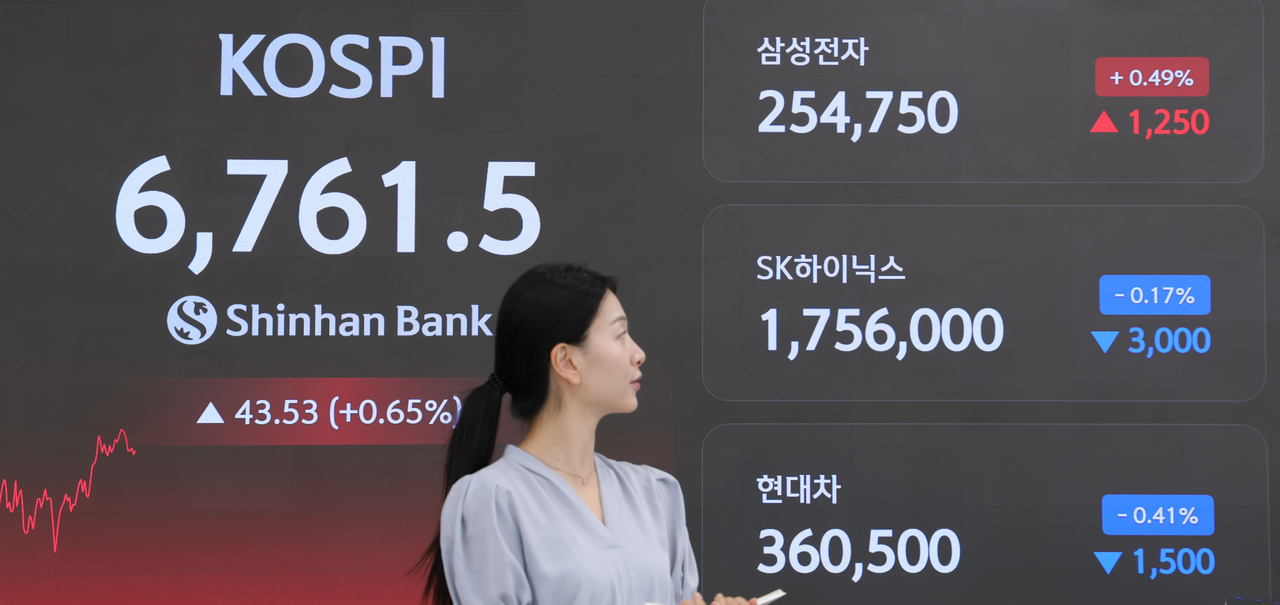
The Kospi closed with a modest loss Thursday despite the Federal Reserve raising its benchmark interest rate for the first time in three years and two months and signaling the possibility of further tightening, with the index holding up relatively well.
Foreign investors sold more than 2 trillion won ($1.46 billion) net, intensifying downward pressure, but retail investors, institutions and other corporations stepped in as buyers to limit the index's decline. Market participants said the Fed's rate hike concerns had already been largely priced in, and a pullback in global oil prices helped support investor sentiment.
According to Korea Exchange, the Kospi closed at 6,715.41, down 2.56 points, or 0.04 percent, from the previous session. The index held up relatively well despite the hawkish rate hike from the United States.
The index opened up 61.05 points, or 0.91 percent, at 6,779.02 and at one point climbed as high as 6,795.53, a gain of 1.15 percent. It then gradually pared its gains, swinging between positive and negative territory before turning lower in the final stretch of trading, briefly dipping to 6,697.85, a decline of 0.30 percent.
Foreign investors posted net selling of 2.28 trillion won in the Kospi market, extending their selling streak to seven consecutive sessions. Retail investors and institutions recorded net purchases of 413.7 billion won and 158.6 billion won, respectively, while other corporations were net buyers of 1.7 trillion won.
The domestic stock market spent the session in a cautious, wait-and-see mode as upside and downside factors competed. Overnight, all three major US indexes fell in response to the Fed's rate hike and its hawkish messaging, adding to the downward pressure on local equities.
The Fed raised its benchmark interest rate by 25 basis points to a range of 3.75 to 4.00 percent at its Federal Open Market Committee meeting overnight — the first tightening move since July 2023.
The Fed also signaled the possibility of an additional hike before year-end. In its economic projections, the median year-end rate forecast among 18 of the 19 FOMC members averaged 4.1 percent, up 0.3 percentage points from the June projection.
Fed Chair Kevin Warsh said at a press conference that "inflation has been too high for too long," underscoring the central bank's commitment to price stability. Markets interpreted the remarks as hawkish, dampening investor appetite for equities.
The yield on the 10-year US Treasury note, a global benchmark, rose 2.2 basis points from the previous session to 5.024 percent.
The market had already priced in much of the Fed's rate hike concerns, and a growing sense that uncertainty over the future rate path had been resolved served as an upside factor for stocks.
Global oil prices, which had surged for two consecutive days, also turned lower on reports that Saudi Arabia was rerouting crude supplies, which appeared to encourage bargain hunting.
Among large-cap stocks, major semiconductor names weighed on the index, with Samsung Electronics falling 0.39 percent and SK hynix declining 0.80 percent. SK Square, Samsung Electro-Mechanics and LG Energy Solution also fell, by 1.18 percent, 3.69 percent and 0.54 percent, respectively.
Banking stocks rose on the global rate-hike trend, with KB Financial Group gaining 1.41 percent, Shinhan Financial Group advancing 1.07 percent and Hana Financial Group adding 0.59 percent.
Hanwha Systems surged 12.65 percent on news that it is pursuing participation in building an integrated air defense network for the UAE, while other defense stocks also gained — Hanwha Aerospace rose 3.98 percent and Hyundai Rotem climbed 2.34 percent.
The Kosdaq closed at 822.18, up 6.20 points, or 0.76 percent, from the previous session, extending its winning streak to three consecutive sessions.
The Kosdaq opened up 4.18 points, or 0.51 percent, at 820.16, briefly turned negative after trimming its gains intraday, then recovered and at one point reached 826.22, a rise of 1.25 percent. Institutions were net buyers of 44.8 billion won, while retail investors and foreigners were net sellers of 25.1 billion won and 33.4 billion won, respectively.
Ecopro gained 0.12 percent, Jusung Engineering rose 0.99 percent, Rainbow Robotics advanced 1.18 percent, Leeno Industrial added 0.76 percent and Robotis climbed 0.32 percent.
Stocks linked to SpaceX's planned first orbital test flight of its Starship spacecraft also surged, with Spear jumping 16.71 percent and AJU IB Investment rising 10.14 percent. Alteogen, Ecopro BM and Wonik IPS fell 0.59 percent, 1.34 percent and 1.17 percent, respectively.
The won weakened against the dollar in response to the US rate hike. As of 3:30 p.m. at the Seoul foreign exchange market, the won-dollar rate stood at 1,382.2 won, up 13.6 won from Wednesday. It was the first time the rate had closed above the 1,380-won mark since Aug. 27, when it settled at 1,380.9 won — a gap of three weeks.
th5@heraldcorp.com