
South Korean chipmakers Samsung Electronics and SK hynix surged Tuesday, leading a broad rebound in domestic semiconductor stocks on the back of a powerful Nvidia-driven rally. Huang's return as CEO eased concerns over a leadership vacuum at the AI chip giant, fueling expectations that cooperation within the existing AI semiconductor supply chain would continue. US technology stocks soared overnight, and buying momentum quickly spread to Korean chip shares. Still, US restrictions on semiconductor exports to China and financing pressures facing AI infrastructure companies remain as lingering risks.
Buoyed by Huang's return and a broad rally among US AI and semiconductor companies, the domestic market rebounded sharply, led by chip stocks. Samsung Electronics and SK hynix opened up 8.85 percent and 11.71 percent, respectively, on Tuesday. The gains reflected investor expectations that Nvidia's management uncertainty would diminish with Huang back at the helm.
On Monday in New York, news of Huang's return stoked expectations for a stabilization of Nvidia's management, spreading buying interest across the AI value chain. Nvidia surged 31.48 percent, while the NASDAQ rose 6.51 percent and the S&P 500 gained 4.73 percent. SK hynix's American depositary receipts also jumped 20 percent, signaling strength ahead for domestic chip stocks.
Huang's return is expected to benefit both Samsung Electronics and SK hynix. Uncertainty over HBM supply negotiations and next-generation product development — which had grown during Nvidia's leadership vacuum — has now eased. As Nvidia needs a stable HBM supply chain to expand AI accelerator production, Huang's comeback has also raised hopes for continuity in existing supply agreements and next-generation memory cooperation.
Samsung Electronics and SK hynix are key suppliers of HBM chips used in Nvidia's AI accelerators. SK hynix in particular has a long-term partnership with Nvidia to co-develop next-generation HBM and secure stable memory supply. Huang's return alleviates concerns that this partnership could be disrupted by a change in leadership.
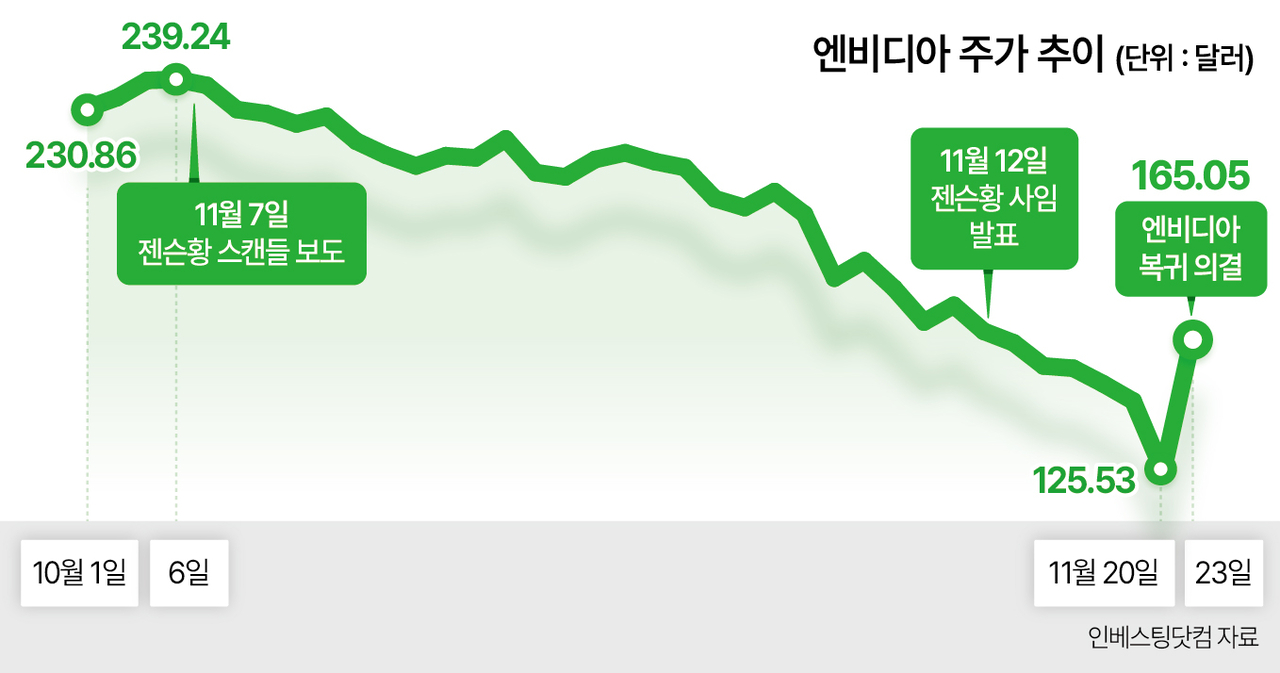
Wall Street analysts also raised their assessments of Nvidia following news of Huang's return. Melius Research upgraded its rating on Nvidia from hold to buy and lifted its price target from $185 to $220. "Huang's return — which we thought was essentially impossible — has significantly alleviated the long-term concerns we had," said Ben Reitches, an analyst at Melius Research. Citigroup also raised its Nvidia price target from $225 to $240. Atif Malik, a Citigroup analyst, said restoring continuity in Nvidia's product roadmap, customer relationships and supplier partnerships "would reduce the leadership risk that has partly weighed on the stock's valuation recently."
Political controversy surrounding Huang's return, however, continues to simmer in Washington. Reports that Huang returned under pressure from President Donald Trump have drawn pushback, particularly from the Democratic Party. Investigators are also examining his relationship with a woman alleged to have ties to Chinese intelligence services, as well as the possibility that advanced Nvidia AI chips may have been leaked to China.
Jung Hee-chan, an analyst at Samsung Securities, said uncertainty is likely to persist for now, noting that Huang is scheduled to testify before the Senate on Dec. 3. Jung also noted that options market activity — with same-day expiry, or 0DTE, call selling and longer-dated put buying dominating S&P 500 options — reflected a cautious stance among market participants.
Analysts also note that financing conditions for neo-cloud companies remain difficult. With the bar for bond market funding still high, the gap between companies with strong self-financing capacity and those without could widen further.
Lee Kyung-rok, an analyst at Shinyoung Securities, said credit risk and funding pressures for neo-cloud companies remain substantial, citing rising credit default swap premiums for CoreWeave, a sharp jump in yields on Nebius convertible bonds and the withdrawal of a high-yield bond offering. Lee added that Nvidia's support commitments take effect only after a customer has independently secured financing and begun operating its facilities, meaning the arrangement functions more as additional support for companies that have already raised funds than as a direct lifeline for those in financial distress.
A significant number of Korean retail investors have yet to recover their principal. Even after the surge, Nvidia's share price remains roughly 20 percent below the $200 level it traded at earlier this month. According to Korea Securities Depository's SEIBRO system, Korean investors' net purchases of Nvidia shares totaled approximately 372.6 billion won ($277 million) over the past week, making it the top-bought US stock excluding ETFs. Net purchases over the past month reached 1 trillion won.
Whether Tuesday's gains can translate into a sustained rebound remains uncertain, as US semiconductor export restrictions targeting China, regulations on data center construction and credit risks among AI companies have yet to be resolved.
Seo Sang-young, an analyst at Kiwoom Securities, said the domestic market rebounded sharply on Tuesday, led by chip stocks, on the back of Huang's return and strength among US AI and semiconductor companies. Seo cautioned, however, that the rally was driven not only by easing management uncertainty but also by short-covering and options-related hedging flows, meaning the intraday gain could fluctuate depending on foreign investors' activity in both the spot and futures markets.
Foreign investor flows, key macroeconomic indicators and AI company earnings are seen as the main variables that will determine whether the domestic market can sustain its recovery. Han Ji-young, an analyst at Kiwoom Securities, said this week's US October personal consumption expenditure price data, Federal Reserve officials' remarks and earnings from AI-related companies such as Dell will also be important. Han added that near-term variables shaping the market's recovery momentum will include whether the stock market stabilization fund's specific criteria are finalized and actual capital deployment begins, and whether the easing of buyback limits translates into meaningful increases in actual repurchases by companies.

kacew@heraldcorp.com




