
- HOME
- POLITICS
-
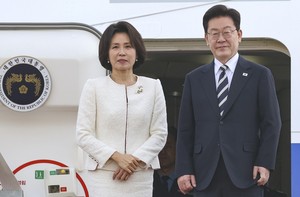
Lee departs for ASEAN, APEC summits, vowing to 'protect national interests'
President begins 3-night, 4-day trip to Manila and Shenzhen Bilateral talks with Japanese Prime Minister Takaichi Sanae planned President Lee Jae Myung departed Monday for Manila, the Philippines, to attend the Association of Southeast Asian Nations summit, and for Shenzhen, China, for the Asia-Pacific Economic Cooperation summit. During the 3-night, 4-day trip, Lee plans to deepen economic and diplomatic cooperation with ASEAN member states and push for concrete follow-through on initiatives discussed at last year's APEC summit in Gyeongju. Lee left aboard Air Force One from Seoul Airport in Seongnam, Gyeonggi Province, on Monday morning. Chief of Staff Lim Gwang-hyeon, Senior Political Secretary Choi In-ho and Democratic Party of Korea leader Kim Min-seok were among those who saw Lee off. On the sidelines of the ASEAN summit, Lee is scheduled to hold bilateral talks with Japanese Prime Minister Takaichi Sanae, Thai Prime Minister Anutin Charnvirakul and Philippine President Ferdinand Romualdez Marcos Jr., among other leaders. Cheong Wa Dae spokesperson Kim Seong-wan said the two leaders — Lee and Takaichi — would be meeting for the first time in six months since their summit in Andong last May, adding that they plan to discuss the South Korea-Japan relationship as well as regional and international affairs. Lee is also set to attend the ASEAN Plus Three summit — bringing together South Korea, China and Japan — where he will outline a vision for future cooperation. In a written interview with the Philippine Star ahead of the ASEAN summit, Lee said it was important to strengthen the close relationship between South Korea and ASEAN. "Thanks to ASEAN, South Korea's potential has expanded and our engagement with the world has grown," he said. Lee also said he would build on the "CSP Vision" — Catalyst, Springboard, Partner — that he had put forward at last year's ASEAN summit in Malaysia. Citing ongoing negotiations to upgrade the South Korea-ASEAN Free Trade Agreement, Lee said the talks aim to incorporate forward-looking trade rules into the pact. "We will support the smooth implementation of the ASEAN Digital Economy Framework Agreement to advance digital economic integration, and share South Korea's technology and experience in AI and the cultural and creative industries," he said. The ASEAN Digital Economy Framework Agreement, known as DEFA, seeks to harmonize rules across member states on e-commerce, digital payments, data flows and AI, with the goal of building a unified digital economy within the region. Lee also cited enhanced investigative cooperation between the Korean National Police Agency and Aseanapol as a key example of South Korea-ASEAN collaboration. Aseanapol is a regional law enforcement cooperation body that coordinates policing among Southeast Asian nations. "This cooperation is part of our efforts to combat transnational crimes such as online scams," Lee said. "Such responses are necessary if economic and people-to-people exchanges are to fully translate into opportunities for cooperation and shared prosperity." Lee also stressed the importance of strengthening ties with the Philippines — this year's ASEAN host — across defense, security and cultural sectors. Emphasizing a vision to expand cooperation beyond infrastructure and manufacturing, Lee said the two countries had maintained friendly relations for 77 years. "Bridges built by Korean companies connect the islands of the Philippines, and ships built by Korean companies at the Subic shipyard will sail the oceans ahead, serving as a bridge between the Philippines and the world," he said. Just before departing, Lee posted on X, formerly Twitter, that he would "protect national interests and expand South Korea's role in keeping with its elevated standing," adding that "broadening international support for peaceful coexistence on the Korean Peninsula is also an indispensable task."
Nov. 16, 2026
-
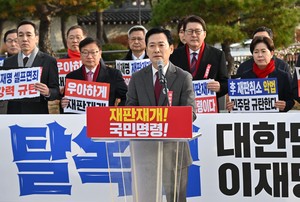
PPP holds rally outside Cheong Wa Dae, intensifies pressure over special prosecutor act
Opposition mounts offensive day before Cabinet meeting on special prosecutor bill Jang Dong-hyeok: 'Today may be the last day of rule of law' Jeong Jeom-sik: 'The bill itself is the president's guilty plea' The People Power Party held an outdoor supreme council meeting in front of Cheong Wa Dae on Monday, sharply escalating its campaign against the so-called "fabricated indictment special prosecutor act." With the bill widely expected to be placed on the Cabinet agenda Tuesday, the PPP moved its fight from a large outdoor rally in Busan on Saturday to the gates of the former presidential compound, stepping up pressure on the government. PPP leader Jang Dong-hyeok said at the meeting that President Lee Jae Myung's "jailbreak bill" was set to be taken up at a Cabinet session the president himself had fled. "Today, Nov. 16, as we stand before Cheong Wa Dae, may be the last day of the rule of law in the Republic of Korea," Jang said. Jang raised the stakes further, arguing that authoritarian states are not marked by a nameplate on the door. "A country that uses power delegated by the people to erase the president's trial, a country that uses power granted by the Constitution to tear down the Constitution — a South Korea where Lee Jae Myung's jailbreak bill passes is a dictatorship," he said. Jang also directed criticism at Prime Minister Han Seong-sook. If the Cabinet passes the bill Tuesday, he warned, every Cabinet member would be listed as an accomplice in Lee's escape from justice. "Prime Minister Han Seong-sook will become the ringleader of the jailbreak conspiracy alongside criminal Lee Jae Myung," he said. Jang said Lee's trial must resume. "Delaying Lee Jae Myung's trial is a grave act of complicity in dictatorship," he said. "The only path to protecting the lives and safety of the people, our freedom and daily lives, and the future of our children is the resumption of Lee Jae Myung's trial." Floor leader Jeong Jeom-sik said the reason the president chose not to put the special prosecutor bill on the agenda at the Cabinet meeting he personally chaired — referring to the session held Nov. 10 — was clear. "The special prosecutor act is directly tied to the president's own criminal case," Jeong said. Jeong described a Cabinet meeting held without the president as "outsourcing the jailbreak." He said the political backlash from the president personally approving a bill designed to eliminate his own trial was predictable. "So he is deflecting that backlash onto the prime minister. The president is subcontracting the jailbreak vote to the prime minister," Jeong said. Jeong called the bill a law that should never have existed. "Think about it rationally — if someone were wrongly accused and standing trial, they would try to prove their innocence in court," he said. "But President Lee Jae Myung is doing the opposite. He orchestrated the special prosecutor act to delete his own trial," Jeong said. "It is because the president is convinced of his own guilt. The very existence of this bill is the president's guilty plea." Jeong also warned the prime minister directly. "The prime minister must not approve the special prosecutor act with her own hands," he said. "If she insists on doing so, she will spend the rest of her life branded as Lee Jae Myung's collaborator and an accomplice in his jailbreak." Meanwhile, the PPP plans to continue its outdoor public campaign across the country. The party opened the series with a rally in front of Gyeongbokgung Station in Seoul on Nov. 7, followed by the Busan gathering on Saturday, and has scheduled another rally in Daegu on Nov. 21. Chief Spokesperson Choe Bo-yun told reporters Sunday that the party was planning an outdoor general assembly of lawmakers Tuesday and would "continue the outdoor fight, breathing together with the people in Daegu" the following Saturday.
Nov. 16, 2026
-
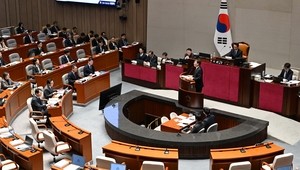
Budget subcommittee convenes to decide fate of record W820tr spending plan
Budget adjustment subcommittee runs Monday through Friday; full committee vote set for Nov. 30 Opposition signals 27 trillion won in cuts; ruling party vows to hold total New 162 trillion won Future Response Fund anchors key dispute Calls to shift items to general account, cap self-revision authority The National Assembly on Monday launched full-scale deliberations on next year's record 820 trillion won ($615 billion) budget proposal, with roughly two weeks remaining before the Dec. 2 legal deadline for passage. The People Power Party has signaled the need for cuts of around 27 trillion won, targeting a newly proposed 162 trillion won Future Response Fund among other items, while the Democratic Party of Korea has vowed to hold the total spending level — setting the stage for a difficult negotiation. The Special Committee on Budget and Accounts opened its budget adjustment subcommittee Monday, with sessions running through Friday. The subcommittee will decide on increases and decreases to major government projects and budget items that have already undergone preliminary review by standing committees. Next year's budget proposal represents a 12.8 percent increase over this year's, with both the growth rate and total size at record highs. The full committee had earlier completed a series of preliminary hearings — general policy questions from Nov. 4 to 5, economic ministry reviews from Nov. 9 to 10, and non-economic ministry reviews from Nov. 11 to 12. The subcommittee begins Monday with materials from the Agriculture, Fisheries and Food Committee, the Political Affairs Committee, and the Science and Technology Committee, which completed their preliminary reviews and voted on their findings that day. Reviews of the Trade, Industry and Energy Committee, the Health and Welfare Committee, and the Culture and Sports Committee follow Tuesday, with the Education Committee, the Defense Committee, and the Public Administration and Security Committee scheduled for Wednesday. Other standing committees will be reviewed in sequence depending on when they complete their votes. The ruling party plans to hold a full Budget and Accounts Committee plenary session on Nov. 30 to pass the budget proposal and meet the Dec. 2 legal deadline. The central flashpoint in this year's budget review is expected to be the proposed Future Response Fund — a roughly 162 trillion won vehicle to be financed by surplus and additional tax revenues generated by the semiconductor boom. The fund is structured around four program accounts covering youth, growth engines, education and regional development, totaling about 43.4 trillion won in project expenditures, along with 12.5 trillion won in non-project outlays such as reduced new government bond issuance, and 104.4 trillion won in reserve funds. The Democratic Party has framed the Future Response Fund as both a foundation for growth and a buffer against future revenue shortfalls, and plans to maintain the total amount even as individual line items are adjusted. The People Power Party, by contrast, is pushing for sweeping cuts. Members of the People Power Party's fiscal and economic planning committee and the Budget and Accounts Committee held an emergency joint news conference at the National Assembly on Sunday, criticizing the fund sharply. "They issued as much as 100.1 trillion won in government bonds to pocket 104.4 trillion won as the administration's personal slush fund, holding young people's futures hostage," they said. "The 162.3 trillion won Future Response Fund flies directly in the face of that principle." Criticism from within the ruling party itself — that some programs included in the fund do not fit its stated purpose — has lent weight to expectations that revisions will be made during the subcommittee review. The Health and Welfare Committee agreed Friday, with bipartisan support, to attach a supplementary opinion calling for items such as the basic child allowance and childbirth support grants to be transferred from the Future Response Fund to the general account. The rationale is that programs requiring multi-year funding should not be placed in a one-time vehicle like the Future Response Fund. Concern has also emerged over a provision allowing project expenditures from the Future Response Fund to be increased without National Assembly approval. Up to 30 percent of the roughly 45.4 trillion won in project outlays could be revised unilaterally, meaning as much as 13.62 trillion won could theoretically be added without legislative sign-off. Under current law, financial funds may self-revise by up to 30 percent, while project-type funds like the Future Response Fund are capped at 20 percent. Given criticism that the provision infringes on the Assembly's budget deliberation and approval authority, there is growing speculation that the self-revision ceiling for the Future Response Fund will be adjusted during the subcommittee process. Demands for budget increases from within the Assembly add another layer of uncertainty. At the preliminary review stage, lawmakers' requests for additions are said to total around 25 trillion won, with cash-transfer programs and constituency projects expected to draw controversy. People Power Party floor leader Jeong Jeom-sik has already instructed lawmakers from constituency districts to withdraw all their increase requests.
Nov. 16, 2026
-
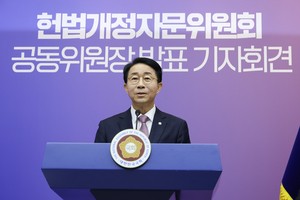
Kim Hyong-o, Chung Sye-kyun named co-chairs of Assembly constitutional reform panel
Assembly Speaker Cho Jeong-sik announces appointments at press conference; PPP pushes back, saying 'no constitutional reform under this government' National Assembly Speaker Cho Jeong-sik announced Monday the appointment of former Assembly speakers Kim Hyong-o and Chung Sye-kyun as co-chairs of the Constitutional Reform Advisory Committee, a body operating directly under the speaker's office to guide constitutional revision discussions. With two elder statesmen from the conservative and progressive camps jointly leading the effort, analysts say the Assembly's push for constitutional reform has now shifted into high gear. Speaking at a press conference at the National Assembly, Cho explained the rationale behind the selections. "Both are respected senior figures in our politics who led the National Assembly, the representative body of the people, and they possess deep insight into constitutional reform as well as hands-on experience in advancing it," he said. Cho added that Kim had opened the door to constitutional reform discussions in the Assembly by establishing a constitutional research advisory committee under the speaker's office in 2008, while Chung had devoted his entire term as speaker to the cause, including launching a special Assembly committee on constitutional reform in 2017. "Next year will mark 40 years of the constitutional framework established in 1987. As the times change, so does the spirit of the age, and the law must change with it," Cho said. "The Constitution, as the supreme norm of the state, is a mirror reflecting the era and a vessel that holds the lives of the people." He went on to say that the current Constitution was drafted in 1987, when per capita national income stood at around $3,000, and that over the past 40 years the lives, sense of rights and the spirit of the age of the Korean people had changed dramatically. "The current Constitution has its limits in fully capturing the changes demanded by South Korea and its people in an era of $40,000 per capita income," he said. Cho also laid out three guiding principles for the reform process: it would be led by the National Assembly, the question of allowing the incumbent president to seek an additional term would be excluded from discussion, and the process would proceed through agreement between the ruling and opposition parties and with the consent of the public. Kim is a five-term lawmaker from the former Hannara Party who served as Assembly speaker during the first half of the 18th Assembly from 2008 to 2010. Chung is a six-term lawmaker from the Democratic Party of Korea who served as speaker during the first half of the 20th Assembly from 2016 to 2018. Chung also served as prime minister under the Moon Jae-in administration. Meanwhile, People Power Party floor leader Jeong Jeom-sik pushed back shortly after Cho's press conference, telling reporters there would be "no constitutional reform under this government." Jeong accused the speaker of using constitutional reform as bait to deflect public criticism ahead of a Cabinet meeting scheduled for Tuesday, at which a bill he described as the "Lee Jae Myung jailbreak law" was set to be approved.
Nov. 16, 2026
-
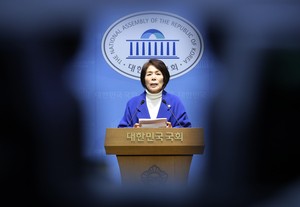
Choi Min-hee discipline case reaches turning point as calls for expulsion grow within Democratic Party
Park Sung-joon: disciplinary outcome expected this week Pro-Lee faction calls for maximum punishment, including expulsion First-term lawmakers hold emergency meeting as intraparty criticism spreads Senior members say discipline 'unavoidable' This week is shaping up as a critical turning point in the disciplinary proceedings against Choi Min-hee, the Democratic Party of Korea's senior supreme council member, as intraparty criticism over a string of controversial remarks continues to mount. The party's largest pro-Lee Jae Myung reform caucus has called for the harshest possible punishment, including expulsion, while first-term lawmakers convened an emergency meeting to discuss how to respond — signs that the fallout is spreading across the party. Park Sung-joon, the Democratic Party's chief spokesperson, said Monday on the YouTube channel "Minti07" that a ruling from the party's Ethics Tribunal could come as early as this week, given that the case had already been referred there. On Sunday, party leader Kim Min-seok received the findings of an ethics audit into Choi and ordered the case transferred to the central party's Ethics Tribunal. The controversy stems from a leaked recording of a closed-door party membership meeting in which Choi appeared to suggest that President Lee Jae Myung had opposed the impeachment of former President Yoon Suk Yeol. Separate remarks she made — implying that the Unification Church and Shincheonji had backed Kim at the last party leadership election — also drew fire. Choi said she had been confused when she made the statements. When former Democratic Party Education and Training Institute head Choi Kang-wook was referred to the Ethics Tribunal last year, he received a one-year suspension of party membership just nine days later. A similarly swift conclusion to the disciplinary review of Choi Min-hee is now being discussed as a possibility. Some within the party have gone further, calling outright for her expulsion. The leadership of the pro-Lee reform caucus held a press conference at the National Assembly's communication hall Monday morning, urging the Ethics Tribunal to "strictly deliberate the highest level of discipline, including expulsion," citing party rules that call for heavier punishment when a member who has already received a warning commits additional violations. Choi received a warning in February over a controversy involving wedding gift money at her daughter's ceremony. The group also called on Supreme Council Members Lee Sung-yoon and Han Min-su — who skipped the supreme council meeting on Friday and held a separate news conference instead — to "take political responsibility and immediately resign from their party posts." Criticism from rank-and-file lawmakers has also been building. Park Ju-min said on YTN Radio on Monday that Choi "needs to be careful about her words and actions, because she is not just an ordinary lawmaker but a supreme council member — and the senior one at that." Park Ji-won, speaking on SBS Radio, called discipline "unavoidable," though he stressed the tribunal's independence and said the outcome should be awaited. The steering committee of the Democratic Party's first-term lawmakers' caucus held an hour-long video conference Sunday evening to discuss how to respond to the controversy. The group was set to convene another emergency meeting Monday to continue those discussions.
Nov. 16, 2026
-
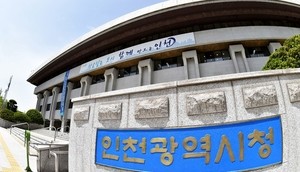
Incheon launches public-private emergency relief network for crime victims, offering up to W30 million
Incheon Metropolitan City is launching a public-private emergency relief system to support residents facing medical costs and livelihood crises in the wake of unexpected crimes. The city announced Monday that it is partnering with the Incheon Metropolitan Police Agency and the Community Chest of Korea's Incheon chapter to provide additional tailored support for crime victims, drawing on a 50 million won ($37,500) designated donation from Shinhan Bank. The initiative is part of the city's comprehensive crime victim protection plan announced Oct. 29, designed to close gaps in existing public support and strengthen its practical reach. Relief funds will be distributed on a tiered basis, reflecting the severity of each victim's injuries and the urgency of their recovery. Critically injured victims — those facing life-threatening conditions who require prolonged intensive care and substantial medical expenses — will receive up to 30 million won. Victims with serious injuries requiring ongoing treatment, as well as those with minor injuries needing short-term outpatient care, will also receive proportional consolation payments to prevent them from falling through the cracks and to help all recipients return to daily life. The support process operates through a three-way public-private partnership: the city sets the overall relief framework, the Incheon Metropolitan Police Agency assesses and refers victims, and the Community Chest of Korea's Incheon chapter conducts the final review and disburses funds following a decision by its distribution review committee. Payments are expected to reach victims in mid-November. Meanwhile, the city plans to use this project as a springboard to sign MOUs with relevant agencies aimed at establishing a permanent crime victim relief network, and to institutionalize a standing relief system that integrates public safety and welfare.
Nov. 16, 2026
-

Han Dong-hoon's return to PPP 'will happen naturally,' lawmaker says
'Can't talk conservative unity without Han' 'Oh Se-hoon's remarks on need for return gave us a big boost' People Power Party lawmaker Park Jeong-hun said Monday that Han Dong-hoon's return to the party "will happen naturally, as it reflects the majority view within our party." Park made the remarks on CBS Radio's "Park Seong-tae's News Show" in response to allegations that party leader Jang Dong-hyeok had interfered in Han's ethics committee disciplinary process. If evidence supporting those allegations were made public, Park said, "it would be hard to refute, and calls for his resignation would spread like wildfire." On the likelihood of Han rejoining the party, Park said Jang had indicated "there is not even a 1 percent chance as long as I am here," and added, "That means the moment he is gone, the situation changes to one where it becomes entirely possible." Park said that if Jang refused to step down, "we would have to consider legal means or other options." Park went on to say the direction on Han's return would become clear after watching developments — including the outcome of the main lawsuit over Bae Hyun-jin's disciplinary case and the release of materials related to the disciplinary allegations. Park said a significant number of lawmakers within the party share the view that Han's return is necessary. "They say the disciplinary action was wrong," Park said. "You cannot talk about conservative unity without Han." Regarding the mood among lawmakers from the greater Seoul area, Park said, "There will be those who believe we cannot win an election without Han participating in our party — and those people are actively in favor." However, Park explained why those lawmakers have not spoken out publicly: "They cannot say it because they would draw the ire of the party's ruling faction, its traditional base and the hard-line right." Park also welcomed Seoul Mayor Oh Se-hoon's recent remarks on the need for Han's return, saying they had "already given us a big boost." Park said Oh "started out in a very cautious mode, then there was some controversy after various statements, and after that he organized his thoughts and spoke his mind — and the important thing in that was his saying Han Dong-hoon needs to come back." Park said Han himself is still working toward his return, noting that Han "is increasing contact with lawmakers, attending forums more often and clearing those hurdles on his own." Park said the disciplinary dispute must not be allowed to drag on any further. "It has now come to light that the substance, the grounds and the procedures of the disciplinary action were all problematic," Park said. "Prolonging this any further will only accelerate the division within our party. It is better to resolve it quickly."
Nov. 16, 2026
-
Cheong Wa Dae vows to scrutinize all AI cheating risks ahead of college entrance exam
Prime Minister Han Seong-sook chairs inter-ministry vice ministerial meeting Monday; presidential policy chief held emergency session Sunday Cheong Wa Dae convened meetings to discuss countermeasures against AI-assisted cheating in national exams, after it emerged that the top scorer on the 2026 certified tax accountant licensing exam had cheated using AI. Prime Minister Han Seong-sook chaired a vice ministerial meeting Monday involving the Ministry of Education, the Ministry of Employment and Labor, the Ministry of Interior and Safety and other related ministries to discuss measures against AI-assisted cheating in national examinations. The meeting was held to work out concrete follow-up steps after Presidential Policy Chief Ha Jun-kyung chaired an emergency session Sunday on preventing the spread of AI-assisted cheating in exams. Sunday's session was called to review measures to prevent a recurrence of AI cheating and to ensure the fairness and integrity of the College Scholastic Ability Test — now four days away — as well as other national examinations. At that meeting, Cheong Wa Dae decided to conduct a comprehensive investigation into suspected cases of AI-assisted cheating across all national licensing examinations. With regard to the college entrance exam in particular, officials agreed to establish procedures for inspecting AI devices carried by all test-takers, and closely reviewed the supervisory framework — including the deployment of dedicated AI-device screening personnel at each exam venue and strengthened training for both examinees and proctors. Police and other investigative agencies plan to respond swiftly and strictly to any reports of exam-related cheating, and will form dedicated teams to pursue the full chain of responsibility in serious cases involving new methods or organized misconduct. "The fairness of examinations is directly tied to public trust, and no form of cheating can be tolerated," Ha said at the meeting, instructing each ministry to draw up fundamental measures to prevent a recurrence of cheating that exploits AI and other emerging technologies. Ha called on the Ministry of Education and other relevant agencies to "thoroughly examine every possibility to ensure that AI-assisted cheating does not occur at the upcoming college entrance exam, and deploy every available method — including thermal detection cameras — while taking every precaution to avoid causing distress to examinees who wear ordinary glasses or medical devices." Ha also instructed officials to explore ways to monitor the retail distribution of equipment used for cheating, such as miniature cameras, and to encourage tip-offs from the public. He further called for establishing the principle that past offenses would be tracked down and prosecuted without exception.
Nov. 16, 2026
-
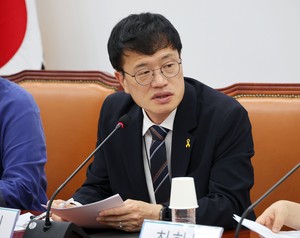
Park Ju-min pushes back on calls to ease comprehensive real estate tax threshold
'Shaking it up again would not be desirable,' lawmaker says of property tax standard 'Don't move based on just some public opinion — need a long-term vision' Choi Min-hee referred to ethics panel over controversial remarks; sanction above 'warning' expected Democratic Party of Korea lawmaker Park Ju-min pushed back Monday against calls within the party to ease the deduction threshold for the comprehensive real estate tax, saying it would not be desirable to "shake it up again." Park said the current government standard should be maintained, noting that the threshold has already been significantly loosened compared with the past. Speaking on YTN Radio's "Jang Seong-cheol's News Myeongdang" that day, Park said the comprehensive real estate tax "is a tax designed to curb speculative demand in real estate and strengthen equity — and hasn't it been maintained all this time precisely because those policy goals were recognized as valid?" Park added that "the spirit behind it should be respected." Park then said the government had gone through a process of setting the current standard, incorporating extensive debate and even accepting many opinions from the National Assembly, including the Democratic Party's own position. "So I wonder whether it is really desirable to shake that up again — that is my thinking," Park said. Divisions have recently surfaced within the Democratic Party over the comprehensive real estate tax deduction threshold. The government is pursuing a plan to apply different deduction standards depending on whether a single-home owner actually lives in the property, but some lawmakers in the party have argued that the deduction threshold should be raised to 1.4 billion won ($1.05 million) even for single-home owners who do not reside there. Asked whether it was right to maintain the government's chosen comprehensive real estate tax standard, Park said frankly that "compared with the past, the threshold has already been weakened considerably," adding, "So I think it would be right to hold on to at least this level of standard." On suggestions that mounting public discontent over the tax burden could hurt the party ahead of the 2028 general election, Park said "that part needs to be assessed carefully." Park went on to say that while some people oppose the comprehensive real estate tax and its thresholds, others want greater equity in real estate or are frustrated by persistently rising home prices. "Rather than moving unconditionally based on current public opinion — or particularly just some slice of it — it seems necessary to approach this with a long-term vision," Park said. Meanwhile, Park criticized Supreme Council member Choi Min-hee over recent controversial remarks, saying that "because she is not an ordinary lawmaker but a supreme council member — and the senior one at that — she always needs to be careful about what she says and does." Earlier, Choi drew controversy after reportedly telling a closed-door party member meeting that President Lee Jae Myung had opposed the impeachment of former President Yoon Suk Yeol. Separate remarks she allegedly made at the same gathering — suggesting that religious groups including the Unification Church and Shincheonji had backed Democratic Party leader Kim Min-seok at the party convention — also drew fire. On the claim that President Lee had opposed Yoon's impeachment, Park said it "does not match the facts as I know them at all," adding, "Even looking at the statement as reported in the press, the explanation does not hold together. She needs to provide a fuller account of this." On the allegations of religious group involvement in the party convention, Park said Choi had acknowledged the claims lacked credibility and had not raised them for that reason — "but then she should not have said it at all." Park added that as a member of the party leadership, "if she had suspicions, she should have proposed that the leadership investigate the matter together — not bring it up casually at a private gathering. I think that was not prudent." Asked whether the disciplinary action against Choi could exceed the "warning" she received in the past over a controversy involving wedding gift money for her daughter, Park said, "It will be at least that." However, on the possibility of heavier sanctions such as expulsion or suspension of party membership, Park drew a line, saying, "I don't think it would be appropriate for me to speculate about what might or might not happen at this point."
Nov. 16, 2026
-

Lee departs for ASEAN, APEC summits in Philippines and China
President Lee Jae Myung departed Monday for the ASEAN-related summit in the Philippines and the Asia-Pacific Economic Cooperation summit in China, vowing to "protect national interests and expand South Korea's role in keeping with its elevated standing." In a Facebook post before leaving that morning, Lee said he was departing for the ASEAN-related summit in the Philippines and the APEC summit in China. "South Korea's standing in the international community has risen remarkably," he wrote. "With that comes greater expectations and a greater role for South Korea. I will do my utmost to deliver results without a hitch." Lee departed through Seoul Airport in Seongnam, Gyeonggi Province. Among those who saw him off were Chief of Staff Lim Gwang-hyeon, Political Affairs Senior Secretary Choi In-ho, Democratic Party of Korea Chairman Kim Min-seok, Democratic Party Floor Leader Han Byung-do, Ministry of Interior and Safety Vice Minister Kim Min-jae, Ministry of Foreign Affairs First Vice Minister Park Yun-ju, Chinese Ambassador to South Korea Dai Bing, and Philippine Ambassador to South Korea Bernadette Therese C. Fernandez. Lee outlined the core goals of the trip as building on last year's APEC chairmanship outcomes in Gyeongju and pursuing shared prosperity across the Asia-Pacific region. "I will continue follow-up cooperation so that the tasks discussed at last year's Gyeongju APEC summit translate into real results, and I will seek ways to expand economic and diplomatic cooperation with ASEAN nations while pursuing a path of growth and prosperity together with Asia-Pacific countries," he said. Lee also made clear his intentions on specific agenda items and Korean Peninsula peace. "I will take a leading role in delivering results on cooperation in future growth sectors such as AI and the cultural and creative industries, as well as on shared challenges including energy supply chain instability and transnational crime," he said. "Broadening international support for peaceful coexistence on the Korean Peninsula is also an indispensable part of this trip." Lee closed by pledging practical diplomatic outcomes that citizens and businesses would feel directly. "I will ensure that the fruits of diplomacy are felt by our people and our companies," he said, adding that he would "actively support Koreans abroad to be safer and Korean businesses to gain more opportunities in global markets."
Nov. 16, 2026
-
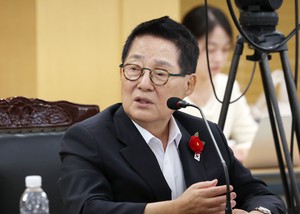
Park Ji-won says Choi Min-hee 'cannot avoid' disciplinary action
Democratic Party of Korea lawmaker Park Ji-won said Supreme Council member Choi Min-hee, whose case has been referred to the party's ethics tribunal, faces punishment that is "an unavoidable path." Park made the remarks Monday on SBS Radio's "Kim Tae-hyun's Politics Show," saying the core problem was that Choi's comments "damaged the identity of the Democratic Party and the identity of President Lee Jae Myung." Park also pushed back against suggestions that he had inspired the controversy. "I have never once heard President Lee, who was party leader at the time, say he opposed the impeachment," Park said. "Some are acting as if Park Ji-won gave the idea, but that is simply wrong." The controversy erupted after Choi was reported to have said at a closed-door regional meeting in Namyangju, Gyeonggi Province, in mid-October that President Lee had opposed the impeachment of Yoon Suk Yeol. According to those accounts, Choi said Lee's position had been to "work things out by having him step down voluntarily and join hands with Han Duck-soo," who was prime minister at the time. Democratic Party leader Kim Min-seok ordered the party's ethics inspection unit to investigate Choi over the remarks on Thursday. "The fact that leader Kim escalated the matter from the ethics inspection unit to the ethics tribunal suggests discipline was already a foregone conclusion," Park said. Park added that while talk of possible penalties — including expulsion, voluntary withdrawal from the party and suspension of membership rights — was circulating, politics should be about finding solutions. "If you tangle things up, it becomes very hard to sort out later," he said. "Since the case has gone to the ethics tribunal, the right order of things is to wait and see what comes of it." Park said communication was key for party leader Kim to assert his leadership amid ongoing factional tensions within the party, and again urged Kim to meet with former party leader Jung Chung-rae. "Leader Kim has apologized several times over the Shinchonji allegations, but he has not apologized to former leader Jung personally," Park said. "It may not have affected the election outcome, but Jung did suffer losses and has reason to feel aggrieved. I hope the two of them can sit down and talk things through." Park added that "the party must trust leader Kim, and leader Kim must establish firm and decisive leadership."
Nov. 16, 2026
-

PM Han calls for pan-government emergency team on college entrance exam, AI-based cheating prevention
Prime Minister Han called for the formation of a pan-government emergency response team for the college entrance exam and the development of measures to prevent cheating using AI.
Nov. 16, 2026
-
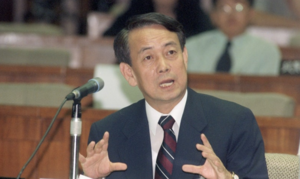
Jin Hyeong-gu, former Daejeon High Prosecutors' Office chief and father-in-law of Han Dong-hoon, dies at 81
Jin Hyeong-gu, the former chief of the Daejeon High Prosecutors' Office and father-in-law of independent lawmaker Han Dong-hoon, died Sunday. He was 81. A native of Gwangju in Gyeonggi Province, Jin graduated from Gyeongbok High School and Seoul National University with a degree in electrical engineering. He passed the 11th bar examination and completed the inaugural class of the Judicial Research and Training Institute. Jin drew early attention as a legal professional with a science and engineering background, going on to hold a series of senior posts within the prosecution service — including chief of the investigation division at the Seoul District Prosecutors' Office, head of the legal affairs division at the Ministry of Justice, second deputy chief of the Seoul District Prosecutors' Office, chief of the Seoul Western Branch Prosecutors' Office, and head of the trial and litigation division and the inspection division at the Supreme Prosecutors' Office. He was widely regarded as one of the prosecution's foremost strategic planners. His tenure as head of the Supreme Prosecutors' Office's public security division in 1998 was credited with smoothly resolving a series of labor strikes. However, after his promotion to chief of the Daejeon High Prosecutors' Office in 1999, controversy erupted when he remarked at a dinner with reporters in June of that year that prosecutors had induced the Korea Minting and Security Printing Corporation union to strike. The fallout from those comments triggered a widening scandal over the alleged instigation of the strike, ultimately leading to the introduction of South Korea's first special prosecutor system in constitutional history. Jin subsequently left the prosecution service and was convicted on charges of violating the prohibition on third-party interference under the Trade Union Act. After retiring, Jin served as publisher of China Life, a media outlet focused on China, and was also active as a member of Lawyers for a Free and Unified Korea. His daughter, attorney Jin Eun-jeong of Kim & Chang, is Han's wife. A memorial altar has been set up at the Seoul St. Mary's Hospital funeral home. A representative of Han's office said condolences would be received from 2 p.m. Monday. The funeral procession is scheduled for 8:30 a.m. Wednesday.
Nov. 16, 2026
-

[Breaking] Assembly Speaker Cho Jung-sik calls emergency press conference on constitutional revision
Nov. 16, 2026
-
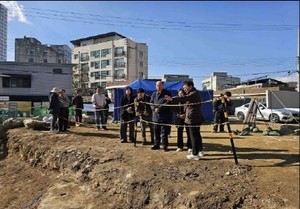
Dongducheon completes excavation of royal well site linked to Joseon founder
Mayor Park Hyung-deok vows to restore site as 'historic cultural landmark' Well is said to be where King Taejo stopped to drink water on his way to Hamheung Dongducheon said Monday it has successfully completed a precision excavation of a buried cultural heritage site at 612-3 Saeyeon-dong, covering 211 square meters, as part of its project to restore the Eosujong royal well site. The city received final notification of excavation completion from the Cultural Heritage Administration on Thursday. The excavation marks the first precision investigation of buried cultural heritage conducted within the city's urban area since Dongducheon was elevated to city status in 1981, setting a new milestone for local cultural heritage. The dig was carried out by the Hanbaek Cultural Heritage Research Institute under a Cultural Heritage Administration permit, running from Oct. 26 to Nov. 3. To determine the precise condition and surrounding distribution of a well ruin identified through a heritage impact assessment in June last year and a trial excavation last August, the city expanded the investigation area from the original 162-square-meter trial zone to a total of 211 square meters by incorporating adjacent land. The excavation confirmed the overall structure and original state of preservation of the Eosujong well — traditionally said to be where King Taejo Yi Seonggye stopped to drink water while traveling to Hamheung. The site features a layered structure: the upper portion holds the foundation of an octagonal pavilion (270 by 270 centimeters) built after the Korean War, along with interior steps, while the lower portion contains a circular well roughly 130 centimeters in diameter and 160 centimeters deep, built with five to six tiers of stone masonry. A fragment of white porcelain was recovered from the lowest layer of the well, which sits on a sand and gravel bed, and a steady flow of clear groundwater was confirmed still rising from the site. The research team also noted that the Eosujong site stands alone along a major road that once connected Hanyang and Wonsan, rather than within a residential area. Based on this, the team proposed as an academic hypothesis that the well may have served in the early Joseon period as a controlled rest and water-supply facility along a military road leading to training grounds in the Yeoncheon area, before being temporarily closed. In the late Joseon period, it may have evolved into a waypoint along a key trade and transport route — confirmed on 18th-century maps as part of the Dongducheon-ri market zone — used to carry northern goods such as pollock and dried pollock from Wonsan to Hanyang. During an academic advisory meeting held Wednesday, Dongducheon Mayor Park Hyung-deok visited the site in person to examine the excavated stone masonry and the groundwater flow, and held discussions with site officials and advisory committee members on the direction of preservation and restoration. Following the committee's recommendations, the city completed detailed 3D scanning documentation and protective measures using sandbags and plywood before fully backfilling and safely restoring the site to its original condition. Building on the excavation results, Dongducheon plans to hold an academic conference and commission a comprehensive restoration plan for the Eosujong site. Through the conference, the city intends to cross-verify historical documents, old maps, topographical data and archaeological findings to establish the precise construction period of the well and trace its evolution as a transportation and trade hub, with the aim of creating a historic cultural space in the heart of the city for residents. "Through the first precision excavation conducted since Dongducheon became a city in 1981, we have made the meaningful discovery of the original stone masonry and living groundwater of the Eosujong — a well connected to the Joseon royal family some 600 years ago — right in the middle of our urban center," Mayor Park said. "Starting from the Cultural Heritage Administration's completion notice, we will carry out thorough documentary and academic verification before restoring the site as a historic cultural landmark that defines Dongducheon."
Nov. 16, 2026
-
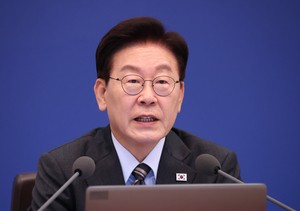
Lee calls for closer Korea-ASEAN ties, eyes expanded defense and cultural cooperation with Philippines
President departs Monday for ASEAN, APEC summits Lee speaks to Philippine media ahead of Manila visit Cooperation between Korean National Police Agency and Aseanapol also highlighted President Lee Jae Myung said Monday that "ASEAN has expanded Korea's potential and increased its engagement with the world," while laying out plans to broaden cooperation with the Philippines across defense and culture. Lee made the remarks in a written interview with the Philippine Star ahead of his attendance at the ASEAN Summit, saying "it is important to promote the close relationship between Korea and ASEAN." He noted that ASEAN is Korea's second-largest trade and investment partner and that people-to-people exchanges between the two sides reach about 12 million a year. Lee also cited progress on the "CSP Vision" — Catalyst, Springboard and Partner — that he had put forward at last year's ASEAN Summit in Malaysia. Pointing to the ongoing negotiations to upgrade the Korea-ASEAN Free Trade Agreement, Lee said the talks "aim to incorporate forward-looking trade norms into the agreement." He added that Korea would support the smooth implementation of the ASEAN Digital Economy Framework Agreement to advance digital economic integration, and share its technology and experience in AI and the cultural and creative industries. DEFA is an agreement among ASEAN member states that seeks to harmonize rules in digital areas — including e-commerce, digital payments, data flows and AI — with the goal of building a unified digital economic zone within the region. Lee also highlighted the strengthening of investigative cooperation between the Korean National Police Agency and Aseanapol as a key example of Korea-ASEAN collaboration. Aseanapol is a regional law enforcement cooperation body that coordinates policing among Southeast Asian nations. "This cooperation is part of our efforts to combat transnational crimes such as online scams," Lee said, adding that such measures are necessary "for economic and people-to-people exchanges to fully translate into opportunities for cooperation and shared prosperity." Lee said he sees significance in the cooperation as a foundation for building a robust regional framework among law enforcement agencies, and expressed hope that "in the medium to long term, it could develop into a platform for security cooperation that other ASEAN dialogue partners also join." Lee also underscored the importance of strengthening ties with the Philippines — this year's ASEAN Summit host — in the areas of defense, security and culture. Emphasizing a vision to expand cooperation beyond infrastructure and manufacturing, Lee said: "For 77 years, the two countries have maintained a relationship of friendship and cooperation. Bridges built by Korean companies connect the islands of the Philippines, and vessels constructed by Korean firms at the Subic shipyard will sail the oceans ahead, serving as a bridge between the Philippines and the world." "Our cooperation does not stop there," Lee added. "We are expanding into new areas such as AI, space, nuclear power and critical minerals." Lee also shared lessons Korea has learned in building its defense industry base. Praising the Philippines' potential to develop a defense industry suited to its own geographic and security conditions, Lee said: "The unique security environment of having to defend vast maritime and island territories is an important foundation that shapes the Philippines' distinct defense industry needs and direction." "There are many areas where the Philippines and Korea can combine each other's strengths," Lee said, adding that cooperation could expand "beyond the simple supply of weapons systems to technology cooperation, joint production, maintenance and repair, and the training of specialized personnel." Lee also stressed the need to establish an institutional framework for exchanges and cooperation, and pledged to streamline visa procedures for Filipino group tourists visiting Korea. Lee departed Monday on a trip to the Philippines and China to attend the ASEAN Summit and the Asia-Pacific Economic Cooperation summit.
Nov. 16, 2026
-

Lee's approval rating rises 0.5 percentage points to 36.4%; Democratic Party hits post-inauguration low: Realmeter
Nov. 16, 2026
-
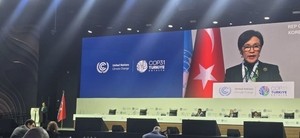
South Korea's special envoy pledges 'green transformation' at COP31
Kang Keum-sil, South Korea's Global Climate and Environment Ambassador serving as a special envoy for President Lee Jae Myung, reaffirmed the country's commitment to a "green transformation" at the 31st Conference of the Parties to the UN Framework Convention on Climate Change (COP31). According to the Ministry of Foreign Affairs, Kang delivered a speech at the COP31 leaders' summit in Antalya, Turkey, on Thursday (local time), calling for collective international action on the climate crisis and a transition that reconciles economic growth with decarbonization. Kang introduced South Korea's 2035 Nationally Determined Contribution and its green transformation strategy, outlining a path toward becoming an "electric nation" through the electrification and decarbonization of industry, renewable energy expansion and grid development. Kang also expressed support for the "35 by 35 Global Electrification Pledge" proposed by Turkey, the COP31 host country. The pledge aims to raise electricity's share of global final energy consumption to 35 percent by 2035. On the sidelines of the summit, Kang met with Brazilian President Luiz Inácio Lula da Silva, UN Climate Change Executive Secretary Simon Stiell, European Commission President Ursula von der Leyen and China's climate envoy Liu Zhenmin to discuss key climate issues. Meanwhile, the Ministry of Foreign Affairs said it had signed a framework agreement with Nepal on climate change cooperation on the occasion of the summit.
Nov. 16, 2026
-
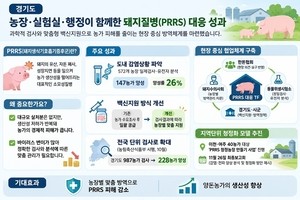
Gyeonggi Province builds tailored disease management system for pig respiratory syndrome
Province launches first dedicated PRRS task force this year Gyeonggi Province announced Monday that it has established a tailored disease management system bringing together farms, testing institutions and government agencies to combat porcine reproductive and respiratory syndrome, or PRRS, through a dedicated task force launched for the first time this year. PRRS is a major wasting disease in pigs that causes miscarriages, piglet deaths and stunted growth, significantly reducing farm productivity. The virus is particularly difficult to manage because it mutates frequently and infection patterns vary from farm to farm, making accurate testing and analysis essential. Gyeonggi Province formed the PRRS Response Task Force in February and worked with the Korea Swine Association and the Korean Association of Swine Veterinarians to first assess infection conditions on individual farms, then apply testing and analysis results to biosecurity management and vaccine support. The most significant achievement was mapping PRRS infection conditions across the province's pig farms through comprehensive testing and genetic analysis. Using carcass samples collected during a province-wide African swine fever inspection in March and April, the province tested 572 pig farms and confirmed the PRRS virus at 147 of them, putting the positive rate at 26 percent. The detection rate had previously hovered around 3 percent under blood-based monitoring, but the use of carcass samples gave officials a far more accurate picture of actual infection conditions on farms. The test results were also put to practical use in supporting farms. Previously, vaccines were purchased and distributed in bulk based on demand surveys from farmers. Starting this year, the province shifted to a four-step approach — precision testing, genetic analysis, sharing of results and targeted vaccine allocation — and supplied 368,980 doses of PRRS vaccine to 575 farms across 15 cities and counties. The infection-mapping method Gyeonggi Province developed in the first half of the year was later expanded to a national scale. The Ministry of Agriculture, Food and Rural Affairs conducted a nationwide PRRS inspection in October in conjunction with its African swine fever survey. In Gyeonggi Province, 987 farms were tested and the virus was confirmed at 228 of them; genetic analysis of those cases is ongoing. The province also held four task force meetings throughout the year and continuously shared test results and field information through specialized training sessions for biosecurity and diagnostic personnel, expert briefings on PRRS management, and seminars. Alongside this, the province pursued a regional eradication model in partnership with Icheon, Yeoju, the Korea Swine Association and the Gyeonggi Province Swine Veterinarians Association. The initiative targets 40 farms in Icheon and Yeoju under a program to create PRRS-free farms, with Jeonbuk National University also participating in genetic analysis. Following an interim briefing in June, a final results presentation is scheduled for Nov. 26 to outline infection and transmission patterns in the region and propose a path toward eradication. "The biggest achievement this year was connecting on-the-ground farm information and veterinary expertise with laboratory analysis data and government biosecurity policy," said Lee Eun-gyeong, head of Gyeonggi Province's Animal Disease Control and Hygiene Division. "We will continue to strengthen cooperation with the field and, based on scientific test results, provide farm-specific biosecurity management support to reduce damage caused by PRRS and improve the productivity of pig farms."
Nov. 16, 2026
-
Obituary: Mother of Democratic Party National Assembly member Lee Gae-ho
Kim Sun-ae, mother of Lee Gae-ho (Democratic Party of Korea National Assembly member), Lee Byeong-ho, Lee In, Lee Yong and Lee Ae-ran; mother-in-law of Oh Myeong-suk, Kim Haeng-hwa and Choe Mi-gyeong; grandmother of Lee Eun-su, Lee Yu-ri, Lee Yu-gyeong, Lee Eun-seop, Lee Yu-seok, Lee Eun-jin and Lee Eun-hyeong; maternal grandmother of Jeong Ha-yeon and Min-seok — died Sunday. Services are being held at Best Funeral Culture Center Yeongnim Hall, Room VIP 201, 2nd floor, 509 Sangmudae-ro, Gwangsan-gu, Gwangju. The funeral procession departs Tuesday at 8:30 a.m. Burial will be at Seoul National Cemetery in Daejeon. Tel. 062-454-1000.
Nov. 16, 2026
MOST READ
- 1Malaysia's BE International brings 1,500-strong incentive tour to Korea, bypassing Turkey
- 2AI singer tops Melon chart for first time with 'Did You Become the Adult You Dreamed Of?'
- 3Jensen Huang's daughter took the photo of him embracing his alleged mistress
- 4Man beat live-in girlfriend 514 times over 3 hours, killing her; forensic expert says footage was too disturbing to watch
- 5Madison Huang acted as de facto chief of staff at Nvidia, shouted at vice president: report
- 6'A concert is a ritual for the soul': Currentzis makes long-awaited Korea debut after six years
-
WORLD
US warns of punishment for anyone enabling Iran's Strait of Hormuz toll scheme
-
INDUSTRY
Toyota union puts productivity first; Hyundai Motor union demands bigger share of profits
-
FINANCE

National Growth Fund to invest $531M in FuriosaAI, which rebuffed Meta's $800M takeover bid
-
INDUSTRY
Korea Shipowners' Association holds amateur baduk tournament for Maritime Day