Mayor Park Hyung-deok vows to restore site as 'historic cultural landmark'
Well is said to be where King Taejo stopped to drink water on his way to Hamheung
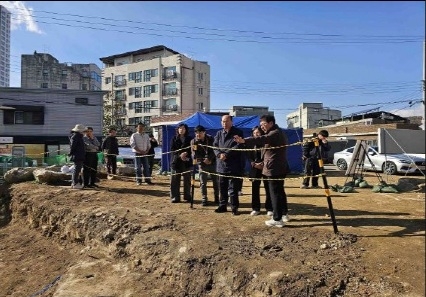
Dongducheon said Monday it has successfully completed a precision excavation of a buried cultural heritage site at 612-3 Saeyeon-dong, covering 211 square meters, as part of its project to restore the Eosujong royal well site. The city received final notification of excavation completion from the Cultural Heritage Administration on Thursday.
The excavation marks the first precision investigation of buried cultural heritage conducted within the city's urban area since Dongducheon was elevated to city status in 1981, setting a new milestone for local cultural heritage.
The dig was carried out by the Hanbaek Cultural Heritage Research Institute under a Cultural Heritage Administration permit, running from Oct. 26 to Nov. 3. To determine the precise condition and surrounding distribution of a well ruin identified through a heritage impact assessment in June last year and a trial excavation last August, the city expanded the investigation area from the original 162-square-meter trial zone to a total of 211 square meters by incorporating adjacent land.
The excavation confirmed the overall structure and original state of preservation of the Eosujong well — traditionally said to be where King Taejo Yi Seonggye stopped to drink water while traveling to Hamheung. The site features a layered structure: the upper portion holds the foundation of an octagonal pavilion (270 by 270 centimeters) built after the Korean War, along with interior steps, while the lower portion contains a circular well roughly 130 centimeters in diameter and 160 centimeters deep, built with five to six tiers of stone masonry. A fragment of white porcelain was recovered from the lowest layer of the well, which sits on a sand and gravel bed, and a steady flow of clear groundwater was confirmed still rising from the site.
The research team also noted that the Eosujong site stands alone along a major road that once connected Hanyang and Wonsan, rather than within a residential area. Based on this, the team proposed as an academic hypothesis that the well may have served in the early Joseon period as a controlled rest and water-supply facility along a military road leading to training grounds in the Yeoncheon area, before being temporarily closed. In the late Joseon period, it may have evolved into a waypoint along a key trade and transport route — confirmed on 18th-century maps as part of the Dongducheon-ri market zone — used to carry northern goods such as pollock and dried pollock from Wonsan to Hanyang.
During an academic advisory meeting held Wednesday, Dongducheon Mayor Park Hyung-deok visited the site in person to examine the excavated stone masonry and the groundwater flow, and held discussions with site officials and advisory committee members on the direction of preservation and restoration. Following the committee's recommendations, the city completed detailed 3D scanning documentation and protective measures using sandbags and plywood before fully backfilling and safely restoring the site to its original condition.
Building on the excavation results, Dongducheon plans to hold an academic conference and commission a comprehensive restoration plan for the Eosujong site. Through the conference, the city intends to cross-verify historical documents, old maps, topographical data and archaeological findings to establish the precise construction period of the well and trace its evolution as a transportation and trade hub, with the aim of creating a historic cultural space in the heart of the city for residents.
"Through the first precision excavation conducted since Dongducheon became a city in 1981, we have made the meaningful discovery of the original stone masonry and living groundwater of the Eosujong — a well connected to the Joseon royal family some 600 years ago — right in the middle of our urban center," Mayor Park said. "Starting from the Cultural Heritage Administration's completion notice, we will carry out thorough documentary and academic verification before restoring the site as a historic cultural landmark that defines Dongducheon."
pjh@heraldcorp.com