
- HOME
- POLITICS
-
'Fiercely negotiating' US investment terms, no fear of Korea being sidelined on North Korea talks, Lee says
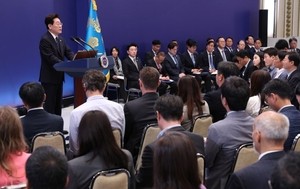
'Commercial rationality' clause unique among US trade partners North Korea-US dialogue resumption seen as key to enabling inter-Korean talks President Lee Jae Myung said Friday that South Korea is engaged in intense negotiations with the United States to structure investment projects in ways that serve the national interests of both countries. Speaking at a press conference at Cheong Wa Dae, Lee said that while the investment negotiations had been described as nearly settled, he found certain elements difficult to accept after reviewing the details. "There are parts I cannot easily agree to," he said. "We are going back to the table." On the tariff negotiations, Lee said the process had been "very difficult and grueling," but that South Korea had succeeded in inserting the phrase "commercial rationality" into the agreement — a term he said no other country had managed to secure. "It was an enormously difficult achievement," he said. He said that as specific investment discussions got underway, new complications had emerged. "We will only pursue projects that have commercial rationality," Lee said. "National interest is truly important." Lee said he believed South Korea must not be swayed by "improvised pressure or coercion" during the process, then smiled and added, "I am not saying the United States is doing that." Asked about reports that Washington is pressuring South Korean companies to build semiconductor factories in the United States, Lee said the outcome would be "a reasonable conclusion that protects South Korea's national interest while respecting the views of the companies." He acknowledged the issue remains "still a matter of contention." Lee also moved to dismiss concerns that South Korea could be sidelined as North Korea-US dialogue progresses. "There is no need to worry about being 'passed over,'" he said flatly. "In the early stages of dialogue, we may be somewhat on the periphery," Lee said, "but the South Korean government has a role to play in advancing North Korea-US relations, and our government's role in North Korea-US cooperation cannot be absent." He added that resuming dialogue between North Korea and the United States was "far easier" than restarting inter-Korean talks, and that such dialogue would in turn make inter-Korean engagement possible. Lee said he could not say with certainty whether a meeting between US President Donald Trump and North Korean leader Kim Jong-un would materialize, but noted that Trump wants dialogue. "I am continuing to play a coordinating role behind the scenes to make North Korea-US talks possible," he said. "It is still difficult, that is true," Lee said, "but I cannot say it is impossible. We must make every effort to turn possibility into reality." Lee also addressed the question of deploying troops to the Strait of Hormuz, making clear that South Korea would not send forces in any capacity that involved participation or intervention in a war. He added, however, that a minimal level of activity to protect South Korean merchant vessels, oil supply routes, and the lives and safety of its citizens would be necessary.
Sept. 18, 2026
-
Kim Min-seok says he shares president's 'thoughts and heart' after press conference
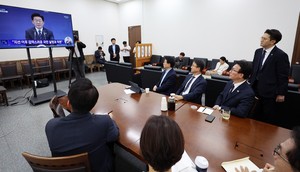
Ruling party reacts to Lee's press conference 'Reaffirmed will for livelihoods, reform, national unity' 'Will complete stable reform as one pillar of governance' PPP's impeachment talk, outdoor rally called 'shameless political bickering' Democratic Party of Korea leader Kim Min-seok said Friday, immediately after President Lee Jae Myung's press conference, that he had been "of the same thoughts and heart as the president throughout." The party pledged to "support real improvements in people's lives through livelihood legislation, policy and the budget in the National Assembly." Kim made the remarks to reporters at the National Assembly after watching the press conference. "I would like to share a few thoughts after watching it from start to finish," he said. "The party will also listen more humbly and look after people's livelihoods." He left without taking questions after the brief statement. Democratic Party Chief Spokesperson Park Seong-jun said in a briefing that the press conference was "an occasion for the president to speak candidly and humbly before the people about his thinking on key national affairs." He added that it "reaffirmed President Lee's commitment to livelihoods, reform and national unity." Park said he agreed with the president's remarks that the gap between improving economic indicators and what people actually feel in their daily lives must be addressed. "We take seriously the president's words that he will adopt an even more humble posture before the people and pay closer attention to their will and their lives," he said. The party also pledged to "do its utmost, as one pillar of governance, to resolve the pressing livelihood issues piling up and to complete stable reform amid national unity," Park added. The Democratic Party urged the People Power Party to "fulfill its duties and role as the main opposition party." Party spokesperson Cho Gye-won said PPP leader Jang Dong-hyeok had named "impeachment" as his Chuseok gift to the public, and that the PPP was reportedly planning to take the stage on the steps in front of the National Assembly's main building on Tuesday and hold a large-scale outdoor rally. Cho called it "shameless conduct by the main opposition party, which should be tending to people's livelihoods, once again becoming consumed by political bickering." He urged the PPP to stop clinging to political feuds and focus its energy on fulfilling its role as the main opposition party in the National Assembly and on reviving people's livelihoods, saying that "absurd agitation about putting impeachment on the Chuseok dinner table will not improve people's lives." The party also called on the PPP to join constitutional reform discussions. Floor Spokesperson Jeon Eun-su criticized the PPP for having "refused to engage in constitutional reform talks altogether by pushing the framing of 'term-extension reform.'" She said the demand that the president promise not to seek an additional term "was nothing more than a political offensive designed to make it look as though he were abandoning a plan that never existed in the first place." Jeon said the PPP had now "completely lost any justification for opposing constitutional reform." She urged the party to come to the table immediately, warning that continued opposition after the president had spoken so clearly "would be nothing but obstruction for its own sake."
Sept. 18, 2026
-
PPP slams Lee's press conference as 'verbal acrobatics,' questions sincerity on term limit
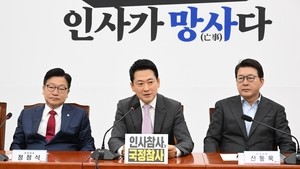
Jang Dong-hyeok: Lee reached out only to the left Im Yi-ja: Lee's message was ultimately 'I did nothing wrong' The People Power Party on Friday slammed President Lee Jae Myung's press conference as "verbal acrobatics," reserving particular sharpness for his remarks on a second term, asking whether "a clear declaration of 'I will not seek re-election' is really so difficult." PPP leader Jang Dong-hyeok said on Facebook that Lee "claimed to be the president of all, yet reached out only to the left," adding that Lee had declared only those aligned with the pro-Moon, pro-Roh and pro-Kim Dae-jung factions to be "comrades of Lee Jae Myung." "It appears the goal is not national unity but left-wing unity," Jang said. Jang also said Lee had pledged to address the dismantling of the prosecution and the abolition of supplementary investigative powers through "police reform," calling the claim "absurd given that he has not even appointed a national police chief." He added that Lee said he would pursue a so-called special prosecutor probe into alleged indictment manipulation — stopping short of dropping charges — while still portraying himself as "a victim of political investigation." "In the illegal inter-Korean funds transfer case, the Daejang-dong case and the Baekhyeon-dong case, all accomplices were convicted," Jang said. "In his own election law violation case, the Supreme Court in effect handed down a guilty verdict." "If President Lee Jae Myung truly feels wronged, there would be no one left in prison," Jang said, adding that Lee had faulted Kim Seung-won for failing to reach a "final conclusion." "Ultimately, he has not let go of his desire to drop the charges," Jang said. Jang also said Lee had confirmed he had "no intention whatsoever of changing real estate policy," characterizing the surge in home prices across the Greater Seoul area as a "flattening of prices," blaming the supply shortage on others and rising prices on loans. On the single-stock leveraged ETF controversy, Jang quoted Lee as saying "someone must have made the decision," and said Lee showed "absolutely no intention of taking responsibility" for the 54 trillion won ($39.1 billion) in losses suffered by the public. PPP policy committee chairwoman Im Yi-ja said she had hoped the president would "listen to the public's voice, acknowledge flawed policies and commit to changing the direction of economic policy." "But the president's answer on Friday was ultimately: 'I did nothing wrong,'" she said. Im said that "while the public worries about policy, the president insists there is no problem and blames others when results are bad," adding that "the Lee Jae Myung administration has no intention at all of changing its current failed economic policy direction." "If the government will not change, the People Power Party will," she said, pledging to put forward measures to shift real estate policy toward expanding supply and normalizing the market rather than relying on regulation and taxes, to reform capital market policy by properly identifying the causes of policy failure and protecting investors rather than shifting responsibility onto them, and to move fiscal policy toward responsible management of both inflation and national debt rather than indiscriminate spending.
Sept. 18, 2026
-
Han Dong-hoon says Lee Jae-myung chose 'Chun Doo-hwan's path,' fears only Choo Mi-ae and Kim Eojun
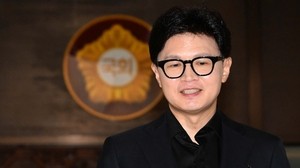
'Mocking the public with words that contradict his actions' 'Has forgotten he is president of all the people, beyond his own supporters' Independent lawmaker Han Dong-hoon on Friday criticized President Lee Jae-myung's press conference, saying Lee had ultimately chosen "the path of Chun Doo-hwan's April 13 constitutional preservation declaration" rather than the June 29 Declaration. Writing on Facebook that day, Han said Lee was "claiming the public is right, yet announcing he will appoint Kim Seung-won as justice minister — the very person the public absolutely opposes through the 'oppa poison lobby.'" Han added that Lee was "mocking the public with words that contradict his actions, declaring war on the people," and said Lee's refusal to utter the word "no" despite persistent questioning from reporters amounted to a "yes" under the current circumstances. Han also said Lee had indicated he would pursue the dismissal of charges against himself through whatever procedure was available, while simultaneously demanding that a special prosecutor act be used to conduct an investigation favorable to that dismissal — only agreeing to remove the provision allowing the special prosecutor to directly drop the charges. "He wants the charges dropped but is looking for a way to take less heat for it," Han said. "Wake up — there is no such way." Han went on to say that Lee was "clinging to his base, begging them not to abandon him, while rallying only his own camp," and criticized Lee for showing no fear of the public while being "intimidated only by the likes of Choo Mi-ae and Kim Eojun." Han also said Lee "has forgotten that he is the president of all the people, obligated to serve the entire nation beyond the bounds of those who support him."
Sept. 18, 2026
-
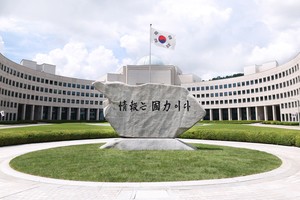
NIS holds national counterintelligence strategy meeting, vows stronger inter-agency cooperation
Chaired by NIS director, with 22 counterintelligence agencies in attendance Meeting focuses on expanding national counterintelligence framework and homeland security collaboration The National Intelligence Service held its 13th National Counterintelligence Strategy Meeting on Friday and announced plans to strengthen cooperation among related agencies. The National Counterintelligence Strategy Meeting is the country's highest deliberative body on counterintelligence, established under a presidential decree on counterintelligence operations. It has been held annually since its launch in 2013. This year's session was held in person for the first time since 2022, timed to coincide with the promulgation and enforcement of revisions to the espionage provisions of the Criminal Act — the first such revision in 73 years. Chaired by NIS Director Lee Jong-seok, the meeting brought together vice minister-level officials from 22 counterintelligence-related agencies, including the Ministry of Foreign Affairs, the Ministry of Unification, the Ministry of Industry, the Ministry of SMEs and Startups, the Seoul Metropolitan Government, and military and police authorities. Participants deliberated and adopted measures to expand the national counterintelligence framework in line with the new espionage law, enhance collaboration on homeland security, and strengthen research security to protect the country's research and development competitiveness. Specifically, the agencies agreed to pool their response capabilities and further tighten their cooperative framework to actively counter not only the theft of diplomatic and defense secrets by foreign actors but also the leakage of advanced and defense industry technologies — areas the revised espionage law now more directly addresses. The meeting also designated the strengthened management of land in strategically sensitive areas — including remote outlying islands — and the protection of national R&D outputs as priority tasks tied to national security and future competitiveness. Participants discussed how to divide responsibilities according to each agency's distinct functions and authority, and explored ways to expand collaboration. Director Lee expressed gratitude to the agencies that helped bring about the long-sought revision to the Criminal Act's espionage provisions, saying, "Let us tear down the walls between agencies and work ever more closely together to counter foreign acts that undermine our security and national interests — acts that will only grow more covert and sophisticated." Meanwhile, according to materials submitted to People Power Party lawmaker Ahn Cheol-soo of the National Assembly's Foreign Affairs and Unification Committee on Thursday, the government said it supports legislation that would abolish the legal basis allowing authorities to selectively reject applications filed by South Korean citizens seeking to contact North Korean residents. The NIS had initially opposed the move, according to sources familiar with the matter.
Sept. 18, 2026
-
![[Breaking] President Lee says he 'lacked attentiveness' by focusing on work and results, vows more communication and respect](https://wimg.heraldcorp.com/news/cms/2026/09/18/news-p.v1.20260918.3e51be675cee46d988b8e28397f49c6a_T1.jpg?type=h&h=240)
[Breaking] President Lee says he 'lacked attentiveness' by focusing on work and results, vows more communication and respect
Sept. 18, 2026
-
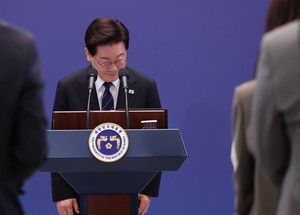
Lee acknowledges 'shortcomings' in leveraged ETF policy, weighs social focus for next policy chief
President says briefing cited overseas capital outflows; product launch coincided with market peak, amplifying losses Next policy chief selection to reflect possible shift from economic growth to social policy President Lee Jae Myung acknowledged Friday that the introduction of single-stock leveraged ETFs was marked by policy shortcomings and incompleteness, while signaling that the selection of a new Cheong Wa Dae policy chief could reflect a shift away from economic priorities toward social policy. Speaking at his seventh press conference since taking office, held at Cheong Wa Dae's Yeongbingwan, Lee said he had been briefed on the leveraged ETF regime when it was introduced, though he acknowledged gaps in his knowledge of the procedural details. "I have not yet grasped the specific procedural details of how the decision was made," he said, "but I was briefed on the introduction of leveraged ETFs at the time." Lee said the briefing centered on the fact that leveraged ETF products tied to Samsung Electronics, SK hynix and other domestic companies were already available on overseas markets, including in Hong Kong, and that Korean investors were going abroad to buy them because no equivalent product existed at home. "Domestic investors were anyway going to overseas markets to buy leveraged ETFs on Samsung, SK hynix and the like," he said, "so there were clear advantages to letting them do that at home." He cited two benefits: keeping investment flows domestic would support foreign exchange market stability by eliminating the need to purchase dollars, and it was simply the right principle to encourage investment in the domestic market rather than sending investors abroad. Lee noted, however, that the product launch coincided with what turned out to be the peak of the market rally, magnifying investor losses as share prices fell. "Looking back, it seems that was nearly the final stage of the share price upswing," he said. "Once the market turned downward, gains that had been doubled became losses that were doubled — and as prices fell below the purchase price, those losses were amplified further, leaving quite a few people significantly worse off." He was candid about the limits of government policy. "Whether share prices will rise, or whether an investment will produce a gain or a loss, is something even the spirits cannot know," Lee said. "But I do think there was some incompleteness in government policy." He added that criticism was valid: "One could fairly ask why we did not build in all those safeguards from the start rather than adding them later. I think it is fair to say there were shortcomings." Meanwhile, Lee signaled a possible role adjustment in selecting the next Cheong Wa Dae policy chief. "I am still deliberating over the policy chief appointment," he said, explaining that the administration had until now concentrated almost all its energy on economic recovery, sustained growth and securing growth drivers. "Now that about a year and several months have passed, there are calls to shift the policy focus somewhat toward strengthening social policy, which I feel has been considerably lacking," he added. "I am deliberating on that point as well, and I am looking for the right person."
Sept. 18, 2026
-
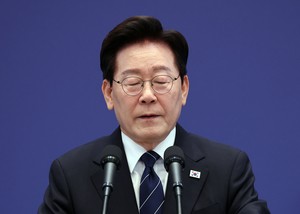
Lee vows all-out push to escape 'real estate republic,' pledges faster housing supply
'Metropolitan concentration, supply cliff, loan expansion are root causes' 'Expand supply financing, curb demand lending' President Lee Jae Myung on Friday blamed the recent surge in home prices in outer areas such as Gangbuk on the concentration of population and resources in the greater metropolitan area, a sharp drop in construction permits under the previous administration, and the entrenched belief that real estate prices never fall. He pledged to accelerate housing supply through reconstruction, redevelopment and urban renewal. Lee made the remarks during the question-and-answer session of his seventh press conference since taking office, held at Cheong Wa Dae's Yeongbingwan. Responding to a question on real estate, he said breaking free from what he called a "real estate republic" was his administration's top priority. Lee first cited the concentration of economic activity in the greater metropolitan area as a structural driver of rising home prices. "All economic power, infrastructure and living conditions are converging on Seoul, Gyeonggi Province and Incheon," he said. "That is precisely why we are putting every ounce of effort into balanced national development." He also cited past policies that encouraged people to take out loans to buy homes, a sense of relative deprivation among those who did not, and excess liquidity generated as the nominal growth rate surpassed 20 percent in the second quarter as compounding factors. On the near-term supply shortage, Lee directly assigned responsibility to the previous administration and the Seoul Metropolitan Government. Citing 2022 — the year former President Yoon Suk Yeol and Seoul Mayor Oh Se-hoon were elected — he said the number of permits and ground-breakings was cut in half from that year onward. "In 2022, 2023, 2024 and through 2025, supply was slashed by nearly half. That is the short-term cause," he said. On recent market trends, however, Lee offered a more optimistic reading. "Fortunately, prices have started to fall in areas including Gangnam and the decline continues to spread," he said. "Gangnam is at the top and other areas are lower — it looks as though a kind of leveling is under way." Lee underscored rapid supply expansion as the central solution for market stabilization. "We will increase supply as quickly as possible through land development, reconstruction, redevelopment and urban renewal, including building permits," he said. He added that the Prime Minister's Office was monitoring progress daily and that he himself received weekly briefings tracking specific sites. Lee also reaffirmed his policy of expanding financing to support supply. Addressing critics who questioned why his administration was loosening credit while trying to cool home prices, he said the approach was a targeted one. "We are expanding financing as much as possible in areas that can increase housing supply," he said. "On the demand side, we are maintaining existing lending policies. Supply will increase substantially as a result." "We will take every possible measure on regulation, supply and taxation, so the real estate market will gradually stabilize," Lee said. He added that the government was also developing detailed policies to address the difficulties faced by jeonse and monthly rent tenants caught in the transition.
Sept. 18, 2026
-
![[Breaking] President Lee admits he failed to grasp details of leveraged ETF transactions, says 'shortcomings' existed](https://wimg.heraldcorp.com/news/cms/2026/09/18/news-p.v1.20260918.ee8e6fc4004049f6802bc23aee607e2d_T1.jpg?type=h&h=240)
[Breaking] President Lee admits he failed to grasp details of leveraged ETF transactions, says 'shortcomings' existed
Sept. 18, 2026
-
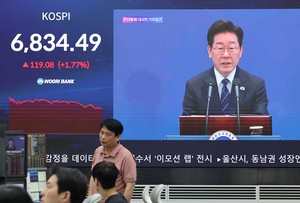
Ruling, opposition parties split over Lee's press conference remarks on second term
Ruling party defends Lee's stance on reelection; PPP says president has 'already lost public trust' The ruling and opposition parties offered sharply divergent reactions to President Lee Jae Myung's press conference Friday. The Democratic Party of Korea defended his remarks ruling out a second term, saying he had made his position clear, while the People Power Party kept up its offensive, calling Lee someone who had "already completely lost the public's trust." Democratic Party spokesperson Cho Gye-won said Lee had "once again made unmistakably clear his thinking and vision on livelihood reform and national unity, as well as his determination to follow through." Cho added that Lee had also "stated a clear position on the question of a second term." The Democratic Party leadership canceled a scheduled Supreme Council meeting in Jeju that day. Party leader Kim Min-seok had been set to attend a budget policy consultation and other events on the island, but those were pushed back to after the "chuseok" holiday to accommodate the press conference. Instead, the leadership convened a closed-door Supreme Council meeting at the National Assembly to discuss internal party matters. Afterward, Kim and floor leader Han Byung-do gathered with other senior members in the party leader's office to watch a live television broadcast of the press conference. Earlier that morning, Kim said on the Democratic Party's YouTube channel that the leadership considered the press conference significant enough to delay its public remarks at the Supreme Council meeting. "The party — starting with me — needs to be far more humble and measured in what we say," he said. "We need to work harder at producing real, step-by-step results." The opposition also watched Lee's every word closely. PPP chief spokesperson Park Chung-kwon said, "Who among the public would believe what President Lee Jae Myung says now that his approval ratings are slipping? He is someone who has already completely lost the public's trust." Park added that if Lee's stated goal of "a fair country where no power lords over the people" were genuine, he should rescind the appointment of Kim Seung-won, whom Park described as having been tasked with dropping criminal charges against Lee. Park further criticized the remarks as "a political maneuver to create the impression that Lee considered a second term and then gave it up," saying Friday's press conference was "nothing more than groundwork for reelection" and that the president was "speaking out of both sides of his mouth." Reform Party floor leader Cheon Ha-ram said Lee's apology and reflection on the vetting failures of his personnel appointments fell short given the level of public anger. "He has stated he has no intention of seeking a second term, but public trust in a constitutional reform led by President Lee has already eroded and does not appear likely to recover," Cheon said. The PPP plans to keep up its offensive against the administration even after the press conference. The party is set to hold a public rally titled "Report to the Nation on the Lee Jae Myung Administration's Failures" in front of the main National Assembly building on Tuesday, where it will criticize the government and ruling party over the controversy surrounding the second Cabinet reshuffle, as well as key issues including real estate, the stock market and prosecution reform. The party is expected to intensify its public campaign against the ruling side before chuseok before deciding how far to escalate its street protests. Independent lawmaker Han Dong-hoon also pressed Lee. In a Facebook post Friday, Han noted that the press conference had been pushed back 30 minutes from its originally scheduled 10 a.m. start and wrote, "President Lee should face reality."
Sept. 18, 2026
-
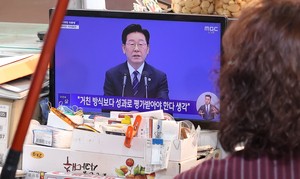
Lee delays press conference 30 minutes, holds close-quarters Q&A with reporters
No ceremonial theme — 90 minutes of issue-focused, direct exchange Navy tie read by some as nod to progressive coalition President maintains measured, composed tone throughout Seating tightened; live YouTube comments fed directly into session President Lee Jae Myung's seventh press conference since taking office, held Friday, broke from the format of its predecessors in several notable ways. Rather than marking a specific occasion or milestone, the session focused entirely on current issues — and it got off to a delayed start after Cheong Wa Dae pushed back the opening by 30 minutes, citing a desire to ensure thorough preparation. Cheong Wa Dae announced at around 8:24 a.m. Friday that the conference, originally scheduled for 10 a.m., would begin at 10:30 a.m. A Cheong Wa Dae official told reporters at the Chunchugwan briefing room that Lee was approaching the conference with a strong sense of responsibility. "He wanted time to make final preparations, which is why we pushed it back about 30 minutes," the official said. The conference began at 10:30 a.m. with about 150 domestic and foreign journalists in attendance. Lee wore a navy tie with diagonal stripes running from upper right to lower left. Some political observers noted that navy — also the symbolic color of the Democratic Party of Korea and the Rebuilding Korea Party — may have been a deliberate choice intended to project unity across the progressive camp. In his opening remarks, Lee appeared mindful of a recent dip in his approval rating, adopting a noticeably calmer and more measured tone than at previous conferences. During the question-and-answer session that followed, Cheong Wa Dae Chief Spokesperson Kang Yu-jung moderated and called on reporters, while Lee answered questions directly. Cheong Wa Dae arranged the seating to place the president and reporters as close together as possible, raising the sense of immediacy in the room. Unlike at previous conferences, Lee stood throughout as he fielded questions. "Because the president was standing, we were able to seat the reporters much closer to him," a Cheong Wa Dae official said. The backdrop read "Listening more closely to the will and lives of the people — President Lee Jae Myung press conference," but the session carried no separate theme. In contrast to past conferences tied to specific milestones — such as 30 days or 100 days in office, the new year, or the first anniversary of inauguration — this one imposed no thematic restrictions. The Q&A was divided into two broad sessions — politics and diplomacy, and policy and the economy — but the format was open, with reporters free to ask about any current issue and Lee responding directly. Devices used at some past conferences, such as pre-recorded video questions, were dropped. In their place, staff introduced a mechanism to incorporate real-time reactions from the public watching the live stream. Between the two Q&A sessions, staff selected notable comments from live YouTube and other new-media feeds — questions or topics that had not come up in the room or that warranted further explanation — and presented them to the president.
Sept. 18, 2026
-
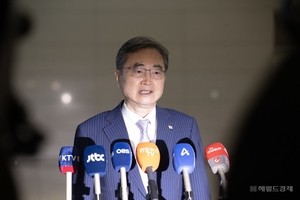
Foreign Minister Cho meets US lawmakers, urges support for alliance cooperation and summit commitments
Minister stresses active engagement with US Congress Asks for continued alliance support beyond November midterms Foreign Minister Cho Hyun, currently on a US visit, met with senior members of both chambers of Congress on Thursday (local time), urging their active support for the swift implementation of the joint fact sheet from the South Korea-US summit while stressing the importance of bilateral cooperation amid rapidly shifting global conditions. According to the Ministry of Foreign Affairs, Cho held separate meetings with Sen. Bill Hagerty (R-Tennessee), House Judiciary Committee Chairman Jim Jordan (R-Ohio) and Rep. Gregory Meeks (D-New York), exchanging views on the South Korea-US relationship, the Korean Peninsula and regional affairs. Hagerty said the South Korean government was actively working to strengthen trilateral cooperation among South Korea, the United States and Japan on the foundation of a solid alliance. He noted that South Korea had built the alliance on a mutually beneficial basis through remarkable economic growth, and said he would continue to play his part as a firm supporter of the alliance — including backing Korean companies operating in his home state of Tennessee. Jordan agreed on the need for cooperation to advance the bilateral relationship, saying outstanding issues between the two countries should be managed smoothly on the basis of mutual trust. He proposed maintaining ongoing communication to ensure the relationship develops in a mutually beneficial direction. Meeks said it was important for South Korea and the United States to work closely together to build peace on the Korean Peninsula on the basis of firm mutual trust, and to pool their wisdom in addressing the diverse challenges facing the international community. He also proposed consulting on ways Congress could support broader bilateral cooperation, drawing on bipartisan backing for the alliance within the legislature. Cho called for strengthening the alliance through active engagement not only with the US administration but also with Congress, and asked lawmakers to demonstrate unwavering support for the alliance even after the November midterm elections. Cho is scheduled to meet US Secretary of State Marco Rubio on Friday (local time). The talks are expected to cover major issues including South Korea's investment projects in the United States and the question of a troop deployment to the Strait of Hormuz.
Sept. 18, 2026
-
![[Breaking] President Lee: Escaping 'real estate republic' is top priority, 'government will deliver'](https://wimg.heraldcorp.com/news/cms/2026/09/18/news-p.v1.20260918.c583f16044e7474fafa3ae59554e56e4_T1.jpg?type=h&h=240)
[Breaking] President Lee: Escaping 'real estate republic' is top priority, 'government will deliver'
Sept. 18, 2026
-
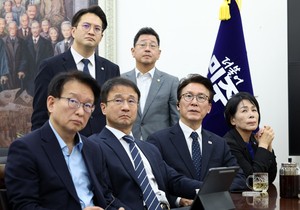
Ruling party calls on PPP to stop 'political offensive' after Lee requests deletion of controversial special prosecutor clause
'The premise of the allegation has disappeared,' Democratic Party spokesperson says The Democratic Party of Korea on Friday called on the People Power Party to stop its political offensive over the withdrawal of indictments as President Lee Jae Myung held a press conference on current affairs. Jeon Eun-su, the Democratic Party's floor spokesperson, said in a statement that President Lee "made his position clear at Friday's press conference regarding the so-called 'indictment withdrawal' controversy." At the press conference, Lee was asked about a provision in the proposed "fabricated indictment" special prosecutor bill that would grant the special prosecutor authority to withdraw existing indictments. He responded by asking the National Assembly to delete clauses related to the transfer and disposition of previously indicted cases from the bill's scope of authority and to focus solely on uncovering the truth. "Please take measures to prevent unnecessary controversy over the withdrawal of indictments from arising," he said. Jeon said the PPP had "blown up baseless allegations and framed the president as trying to use the special prosecutor to make his own trials disappear." The president had himself requested the deletion of the very clause that had fueled the controversy, she added. "The premise on which the allegations rested has now disappeared," she said. Jeon went on to say the PPP should "stop confusing the public with claims that do not reflect the facts," warning that continuing the same offensive even after the president had clarified his position would amount to "political strife for its own sake, not a pursuit of the truth." She added that the PPP should "stop this wasteful political offensive and actively cooperate in uncovering the truth about prosecutors' indiscriminate investigations, which is the real issue at the heart of this matter."
Sept. 18, 2026
-
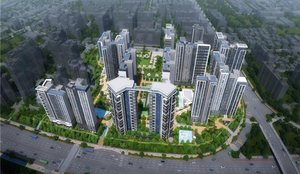
Pre-sale prices at Seoul redevelopment, reconstruction sites surge 70% in 5 years
Lawmaker Jang Jong-tae analyzes data submitted by Korea Housing and Urban Guarantee Corporation Pre-sale price per 3.3 square meters rises from 31.3 million won to 52.9 million won Increases seen across Seoul, not just Gangnam, Seocho and Songpa 'Need to examine whether housing stability for end-users is actually being achieved' Pre-sale prices at Seoul redevelopment and reconstruction project sites have surged roughly 70 percent over the past five years, while the share of units available for general public subscription has fallen to just 22 percent of total supply from such projects. Democratic Party of Korea lawmaker Jang Jong-tae, a member of the National Assembly's Land, Infrastructure and Transport Committee, analyzed data submitted by the Korea Housing and Urban Guarantee Corporation showing that the average pre-sale price per 3.3 square meters across 62 Seoul redevelopment and reconstruction sites that received cooperative project cost loan guarantees between 2021 and August this year rose from 31.3 million won ($22,700) in 2021 to 52.9 million won this year. The increase reflects a broad rise in pre-sale price levels across project sites, not just a handful of ultra-premium developments in Gangnam. Excluding the three Gangnam districts — Gangnam, Seocho and Songpa — the average pre-sale price climbed from 25.5 million won in 2021 to 42.5 million won this year. The median pre-sale price also nearly doubled over the five-year period, rising from 27 million won to 50.5 million won. Some sites have already crossed the 100 million won per 3.3 square meters threshold. A project in Seocho-gu posted a pre-sale price of 101 million won per 3.3 square meters in November last year, becoming the first to exceed that mark. This year, sites in Seocho-gu and Dongjak-gu have listed pre-sale prices of 95 million won and 77 million won, respectively. Even as pre-sale prices have climbed steeply, the share of units set aside for general public subscription within total redevelopment and reconstruction supply has actually declined. In 2021, general subscription units numbered 2,401 out of 8,129 total units supplied at Seoul project sites, accounting for 29.5 percent. That share rose to 33.5 percent in 2022 and 37.8 percent in 2023 before falling for three consecutive years. As of August this year, general subscription units stood at 4,361 out of a total supply of 19,962 units, limited to just 21.8 percent. "The Seoul Metropolitan Government has touted accelerating redevelopment and reconstruction projects and expanding supply as a key achievement in housing stability, but pre-sale prices are rising rapidly while the share of general subscription units is shrinking," Jang said. "We need to examine how much the expansion of supply through these projects is in fact translating into housing stability for prospective homebuyers without existing properties." He added that while redevelopment and reconstruction projects are a necessary tool for supplying housing in urban areas, ensuring that the gap in housing accessibility does not widen in the process is also an important responsibility of the Seoul Metropolitan Government. He called for scrutiny not only of total supply volumes but also of the number of general subscription units and whether pre-sale prices remain within reach for end-users.
Sept. 18, 2026
-
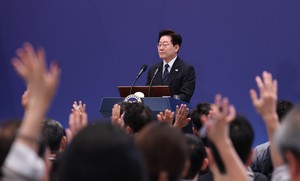
Lee rules out combat deployment to Strait of Hormuz, vows to protect nationals and oil routes
'No combat troops, no placement under foreign command,' president says; cites direct order to allow tankers into Red Sea President Lee Jae Myung on Friday drew a firm line against sending combat forces to the Strait of Hormuz, saying there would be "no deployment that involves or intervenes in the war," as the United States has pressed South Korea for a military contribution to the waterway. He said the government is reviewing ways to strengthen the Cheonghae Unit's protective operations to safeguard national interests, energy supply routes and the safety of South Korean nationals. Speaking at his seventh press conference since taking office, held at Cheong Wa Dae's Yeongbingwan, Lee was asked when and in what form South Korea was considering making a substantive contribution to the Strait of Hormuz. "On the question of military deployment, there will be no deployment that involves or intervenes in the war. I can say that clearly," he said. Lee said misunderstandings arise because "too many concepts are lumped together under the single word 'deployment,'" and that the location, purpose, type of assets and timing must each be considered separately. "It makes a complete difference whether we are talking about a deployment that directly or indirectly participates in the war between the United States and Iran, or one aimed at protecting our own vessels, crew members and national interests," he said. He was particularly emphatic that no war-related deployment would occur. "There will be no war deployment. The principle of non-involvement and non-intervention in the war has been upheld until now and will continue to be upheld," he said. He added that he was aware of public concern about sending combat troops or placing South Korean service members under foreign command and putting them in harm's way. "We will not carry out that form of deployment or dispatch of military assets," he said. Lee acknowledged the need for independent defensive measures to protect lives and economic security. He noted that the Cheonghae Unit is already deployed and operating across an expanded area, responding to threats to shipping lanes — including from pirates — and to the safety of South Korean nationals. "Just as other countries do, we must carry out the minimum activities needed to protect our merchant vessels, oil supply routes and the lives of our people, and we are reviewing and deliberating on ways to strengthen that," he said. Lee also disclosed that early in the war he had personally ordered the lifting of restrictions that had prevented South Korean oil tankers from entering the Red Sea. Blanket guidelines put in place after the Sewol ferry disaster had led ships to avoid the Red Sea on safety grounds, causing significant disruptions to the country's crude oil supply. "Because the economic hardship and the suffering of our people were so severe, I personally gave the order to keep monitoring the situation and consider entering the Red Sea," he said. "I judged that if an accident occurred and criticism followed, I would have to bear that criticism myself. That is something I must take responsibility for," he added.
Sept. 18, 2026
-
![[Breaking] President Lee vows to irreversibly strip prosecutors of investigative powers](https://wimg.heraldcorp.com/news/cms/2026/09/18/news-p.v1.20260918.264480e806864312a84993131f63fdc5_T1.jpg?type=h&h=240)
[Breaking] President Lee vows to irreversibly strip prosecutors of investigative powers
Sept. 18, 2026
-
![[Breaking] President Lee: No troop deployments to wars, non-intervention principle to be upheld](https://wimg.heraldcorp.com/news/cms/2026/09/18/news-p.v1.20260918.ffdffb882aa945ee98e7febb2be9234a_T1.jpg?type=h&h=240)
[Breaking] President Lee: No troop deployments to wars, non-intervention principle to be upheld
President Lee said there would be no troop deployments to wars and that the principle of non-intervention in armed conflicts would continue to be upheld.
Sept. 18, 2026
-
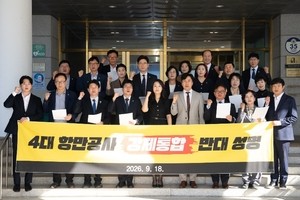
Why Incheon put the brakes on the four-port authority merger
Ruling and opposition party lawmakers on the Incheon City Council say autonomy for Incheon Port must come before any organizational merger Council demands long-term national investment plan for Incheon New Port, logistics complex and inner-harbor redevelopment project A government plan to merge the four major port authorities — covering Incheon, Busan, Ulsan and the Yeosu-Gwangyang complex — into a single entity has ignited a debate over who will ultimately control decision-making at Incheon Port. The Incheon Metropolitan Council's public opposition to the merger is not simply a reaction to the prospect of a larger bureaucracy. At the heart of the dispute is who will decide the direction of key projects and investment at Incheon Port after a merger, and whether revenue generated there can be reliably channeled back into the port's own future. Ruling and opposition party lawmakers on the council gathered in front of the council building Friday to issue a joint statement opposing what they called a "forced merger" of the four port authorities, urging the government to reconsider its current approach. "Organizational integration must not be pursued before there is a concrete plan to guarantee Incheon Port's substantive decision-making authority and autonomy," the lawmakers said. **Government focuses on efficiency; Incheon focuses on control** The government's public institution reform plan, announced Sept. 3, calls for consolidating the four port authorities into a tentatively named Korea Port Authority, with each existing authority converted into a regional branch. The government has framed the merger as a way to eliminate overlapping functions and excessive competition while improving operational efficiency through unified management. The Incheon council sees the problem differently. If a single integrated body were to coordinate funding and investment projects across all national ports, the council warns, the competing interests of each port could clash — and projects critical to a particular region could be pushed down the list of investment priorities. Incheon Port in particular faces a backlog of projects requiring long-term investment, including Incheon New Port, its logistics complex and the inner-harbor redevelopment project. The central question, the council argues, is whether funding and investment decisions for those projects can be made swiftly and in line with Incheon Port's actual needs after a merger — and, more fundamentally, whether Incheon retains the authority to shape its own port's future on its own terms. **Why the council is demanding an investment plan first** The council's demand to the government is straightforward: before rushing toward a merger, present a long-term national fiscal investment plan for Incheon Port's key projects. The council argues that a national-level investment commitment must be secured first to ensure that core projects — Incheon New Port, the logistics complex and the inner-harbor redevelopment — are not deprioritized during the consolidation process. The council's position reflects a concern that the government's current proposal does not provide sufficient clarity on how the scale and priority of investment in Incheon Port would be determined after a merger. The council therefore maintains that mechanisms guaranteeing Incheon Port's autonomy, fiscal stability and long-term investment plan must be established before any organizational integration takes place. **'The four ports serve different functions and different regional economies'** The council also offered an alternative, arguing that physical organizational merger is not the only path to greater efficiency. Because each of the four port authorities has developed distinct functions shaped by its region's industrial and logistics structure, the council said the government should first explore ways to strengthen joint projects and cooperative frameworks while preserving each port's principle of autonomous, accountable management. In other words, the council argues that national-level cooperation can be deepened without folding each port's distinct characteristics, expertise and decision-making structure into a single body. Underlying that view is the belief that, given Incheon Port's role in the regional economy and logistics industry, a degree of local-level judgment over port operations must be preserved. **The ultimate question: who decides?** The core divide between the government and the Incheon council is likely to center less on whether a merger is necessary and more on how the merged entity would be governed. The government has cited the elimination of redundant functions and improved operational efficiency as its primary rationale, but the council is demanding concrete answers on how Incheon Port's decision-making authority and investment funding would be protected after consolidation. The council urged the government to carefully assess the impact of any restructuring of Incheon Port Authority on the port's functions, competitiveness and the regional economy, and to determine its policy direction only after thorough legal review and sufficient consultation with the local community. Lawmakers were particularly firm that they "cannot agree to pursuing a merger before Incheon Port's autonomy, fiscal stability and long-term investment plan are guaranteed." How the government's forthcoming detailed merger plan addresses Incheon Port's autonomous decision-making structure, its investment funding arrangements and the prioritization of key projects is expected to define the central battleground of the debate going forward.
Sept. 18, 2026
-
[Breaking] President Lee says no final decision yet on Kim Seung-won appointment, will decide carefully
Sept. 18, 2026
MOST READ
- 1KAIST develops high-performance bio-based adhesive using E. coli instead of petroleum
- 2Pope Leo XIV declines French honors and banquet, accepts only private meeting with Macron
- 3Daimler Truck unveils next-generation transport solutions at IAA 2026
- 4What was Rachmaninoff's performance fee? A 1928 price list tells all
- 5Samsung Biologics union's show of force backfires at the bargaining table
- 6APR says hair-loss treatment research published in international journal
-
WORLD
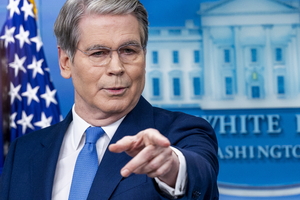
US warns of punishment for anyone enabling Iran's Strait of Hormuz toll scheme
-
INDUSTRY
Toyota union puts productivity first; Hyundai Motor union demands bigger share of profits
-
FINANCE
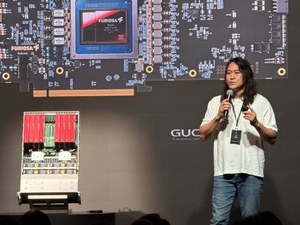
National Growth Fund to invest $531M in FuriosaAI, which rebuffed Meta's $800M takeover bid
-
INDUSTRY
Korea Shipowners' Association holds amateur baduk tournament for Maritime Day