
- HOME
- POLITICS
-
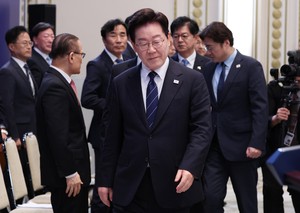
Lee vows to stabilize real estate, pursue dual-capital plan with Seoul and Sejong
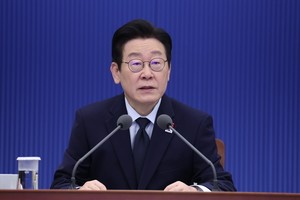
President pledges swift action on housing supply, regulation and taxation; calls 1987 constitution outdated President Lee Jae Myung on Friday took direct aim at soaring housing prices in the Greater Seoul area and widening asset inequality, vowing to stabilize the real estate market to prevent what he called a potential "lost 30 years." As a structural remedy, he announced plans to complete the administrative capital in Sejong as quickly as possible, ushering in a dual-capital era in which Seoul would serve as the economic capital and Sejong as the administrative one. Lee made the remarks in his opening statement at his seventh official press conference since taking office, held Friday morning at the Yeongbingwan banquet hall of Cheong Wa Dae. Lee identified the country's lopsided geographic development as a root cause of housing instability. "We will steadfastly pursue balanced national development — overcoming the single-hub dominance of the Greater Seoul area, which is the fundamental obstacle to stabilizing housing prices there, and diversifying the centers of growth across the country," he said. On specific policy tools, he added that the government would ensure "firm and swift execution of supply, regulation and taxation policies" while minimizing confusion and resistance through sufficient communication with stakeholders. Lee formally designated the completion of Sejong's administrative capital as the centerpiece of his roadmap for decongesting the capital region and achieving balanced development. "We will complete, as swiftly as possible, the construction of the administrative capital that has long been pursued to ease overcrowding in the Greater Seoul area and promote balanced national development," he said. "Like New York and Washington, we will open a dual-capital era — Seoul as the economic capital and Sejong as the administrative capital." The underlying aim is to diversify the country's growth axis and redirect the excessive demand that has been funneling into Greater Seoul real estate. Alongside this, Lee laid out a detailed vision for constitutional reform covering both the structure of power and fundamental rights. He described the current constitution as "a garment that no longer fits today's Republic of Korea," saying the 1987 charter was "born as a product of political compromise." He said he would work to ensure it could be revised through rational debate between the ruling and opposition parties and national consensus. He identified three priorities for constitutional reform: historical legitimacy, the distribution of authority and accountable governance. "My position on constitutional reform has been consistent for a long time — incorporating the spirit of the May 18 Gwangju Democracy Movement and the Buma Democratic Uprising into the constitutional preamble, strengthening the fundamental rights of citizens, distributing some presidential powers to the National Assembly and local governments, and introducing a presidential re-election system to ensure policy consistency and governmental stability," Lee said. He shrugged off suggestions that he was seeking to shift toward a power-sharing arrangement, calling claims that he intended to introduce a cabinet or semi-presidential system "utterly groundless." Lee said he had made countless pledges to the public across politics, the economy, society, culture, diplomacy and security. "I will carry out those many promises and tasks one by one, building greater trust and creating a better life for the people and an irreplaceable Republic of Korea," he said. He added that the government would pursue sustained recovery and growth while ensuring that "the opportunities and fruits of growth are shared by all," and pledged to build "a safe and peaceful country, and a hopeful and happy world — not just for the socially vulnerable, but for every citizen."
Sept. 18, 2026
-
![[Breaking] President Lee urges deletion of case-transfer provisions from special prosecutor bill, focus on fact-finding](https://wimg.heraldcorp.com/news/cms/2026/09/18/news-p.v1.20260918.95da6482d4fc4aa9818435b409a0eef7_T1.jpg?type=h&h=240)
[Breaking] President Lee urges deletion of case-transfer provisions from special prosecutor bill, focus on fact-finding
President Lee called for the removal of provisions in the special prosecutor bill governing the transfer and disposition of existing cases following the withdrawal of indictments, urging the special prosecutor to focus on uncovering the truth.
Sept. 18, 2026
-
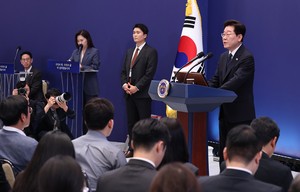
Lee rules out second term, vows 'irreversible' prosecution reform
7th press conference since inauguration; president promises personnel system review, checks on expanded police powers Calls for unity amid factional tensions: 'We are all comrades — blame me, not each other' President Lee Jae Myung drove a stake through speculation about a constitutional amendment to allow him a second term on Friday, declaring he has "absolutely no intention of seeking re-election." He also pledged to complete what he called an "irreversible" overhaul of the prosecution service — centered on separating investigative and indictment powers — and took personal responsibility for factional tensions within his own support base. Speaking at his seventh official press conference since taking office, held Friday morning at the Yeongbingwan banquet hall of Cheong Wa Dae, Lee said a second term was constitutionally impossible and that he had never entertained the idea. "I have made clear through numerous channels on multiple occasions that I have never even considered re-election," he said. Lee said he had previously viewed calls for him to formally renounce a second term as a political attack designed to frame him as someone abandoning a plan he had already been pursuing. "Even so, I will again state this clearly and firmly: I have absolutely no intention of seeking re-election," he said, drawing a firm line. He added that all state power, including the power to make appointments, derives from the people, and promised to respect the will of the sovereign public to the fullest in exercising that power. "I will also take this opportunity to review the personnel appointment system," he said. On reform of powerful state institutions, Lee announced steps both to deepen the prosecution overhaul and to prevent an excessive concentration of power in the police. "After long effort, the reform goal of separating investigation from indictment — through the exclusion of prosecutors from investigations and the division of functions between the public prosecution office and the serious crimes investigation agency — is nearing its conclusion," he said. "I will responsibly complete the irreversible prosecution reform." Lee also pledged to guard against side effects from the separation of investigative and indictment functions. "The investigation and indictment functions must not fail to operate properly in ways that harm the protection of victims' and citizens' human rights," he said. He added that any problems arising from the absence of prosecutors' supplementary investigative powers would be addressed through rigorous checks and safeguards on police investigations. A sweeping police reform, he said, would put to rest public concerns that the police could degenerate into an unchecked power unto themselves as a result of their monopoly over investigations. Turning to recent factional tensions within his support base, Lee made a forceful appeal for unity. "It is heartbreaking to see people who gave everything — even risking their lives — to overcome the insurrection and work wholeheartedly for the success of a government of popular sovereignty now exchanging words of hatred," he said. "We are all supporters of former Presidents Roh Moo-hyun and Kim Dae-jung, and of the pro-Moon camp — we are all comrades of Lee Jae Myung." He said the greatest responsibility for the painful situation lay with him as the person ultimately in charge of state affairs. "If you want to blame someone, blame my shortcomings and those of my government," he said. "I will listen more, communicate more, and reach out first." Lee said he would become a "president of unity" who does not lose sight of the values of reform and progress he has set before the people, while drawing on dialogue and communication to reflect the reasonable views of the broadest possible public in state affairs. "I will prove it not with words but with results, and walk the path of people's livelihoods, reform and unity without wavering," he said.
Sept. 18, 2026
-
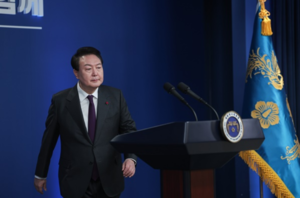
How have past Korean presidents fared after holding crisis press conferences?
Yoon sought a rebound over Kim Keon Hee backlash but faced a public backlash; Moon and Lee Myung-bak won back support by acknowledging policy failures As President Lee Jae Myung held his seventh press conference since taking office Friday at Cheong Wa Dae's banquet hall, past South Korean presidents have similarly turned to emergency press conferences as a way out of crises — from sudden shifts in security and economic conditions to plunging approval ratings. The outcomes, however, varied widely from president to president. Former President Yoon Suk Yeol, facing mounting controversy over the so-called "Myung Tae-kyun gate" scandal and allegations of first lady Kim Keon Hee's interference in state affairs, held a national address and press conference on Nov. 7, 2024, after his approval rating had collapsed into the teens. Yoon bowed his head and apologized, saying "all of this is the result of my own negligence and lack of virtue." But during the question-and-answer session that followed, he pushed back against reporters' questions one by one, drawing widespread criticism that the event was a hollow exercise — and his approval rating failed to recover. Former President Moon Jae-in took a different approach. At his New Year's press conference in January 2021, he acknowledged policy failures on real estate — the most pressing issue at the time — and outlined a plan to expand housing supply. Polls afterward showed a rebound in positive assessments of his job performance, and the press conference was widely credited with helping turn his approval ratings around. According to Gallup Korea, Moon's average positive job-approval rating during the final quarter of his five-year term — January through March 2022 — stood at 42 percent, the highest of any president elected since the restoration of direct presidential elections. Former President Lee Myung-bak also saw his approval rating plunge from 52 percent to 21 percent in his first year in office, battered by the fallout from the US beef import controversy, but a special press conference on June 19, 2008, is widely credited with helping him stage a comeback. Lee bowed his head at the time, saying, "As I watched countless candles flickering in the dark streets, I deeply blamed myself for what I had done wrong." He then reshuffled key presidential office aides and met directly with Park Geun-hye, then a Grand National Party lawmaker, to minimize intraparty divisions — efforts that helped him sustain approval ratings in the 40 percent range in the third year of his presidency, in 2010. Former President Park Geun-hye also managed to halt a slide in her approval ratings through a public address. After she delivered a national address on May 19, 2014, following the Sewol ferry disaster, a Realmeter poll showed that a five-week downward trend in her approval rating came to a stop. However, when the so-called "Choi Soon-sil state-meddling scandal" erupted in 2016, her public apology failed to prevent a further decline. Going further back, former President Kim Dae-jung held a televised national dialogue on May 10, 1998, during the Asian financial crisis, explaining the severity of the situation and appealing for public cooperation on restructuring and shared sacrifice. His approval rating was already high at the time and did not rise further. Former President Roh Moo-hyun held a public briefing and press conference immediately after the conclusion of the Korea-US free trade agreement in April 2007, and a Realmeter poll at the time showed his positive job-approval rating at 32.5 percent — up 10 percentage points from the previous week.
Sept. 18, 2026
-
[Breaking] President Lee says he has no intention of seeking a second term
Sept. 18, 2026
-
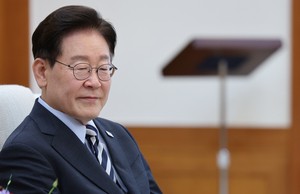
Lee's approval rating hits record low of 37% on day of press conference: Gallup Korea
Positive rating down 1 percentage point from previous poll; negative rating up 5 points Negative ratings lead in all regions and age groups except Honam and those in their 40s Real estate tops negative-rating factors since July; cabinet reshuffle appointments rank second A poll released Friday showed President Lee Jae Myung's job approval rating at 37 percent — the lowest since he took office and down 1 percentage point from the previous survey. The result comes as Lee faces mounting controversy over issues including a constitutional amendment to allow consecutive terms and the withdrawal of criminal charges against him, and as he holds a press conference focused on current affairs in a bid to reverse the slide. In a Gallup Korea survey of 1,002 people aged 18 and older nationwide conducted Tuesday through Thursday, 37 percent said Lee was doing his job well, while 56 percent said he was not. Compared with the previous poll, the positive rating fell 1 percentage point while the negative rating rose 5 points — marking a record low for approval and a record high for disapproval. Lee's approval rating had hovered in the 60 percent range from March through May, before the June 3 local elections, then entered the 50s in June and continued to decline. It stood at 54 percent in the first week of July and 46 percent in the second week of August. In the third week of August, positive and negative ratings tied at 45 percent each, marking the point at which disapproval crossed above approval. Since then, the rating has fallen further: 42 percent in the fourth week of August, 40 percent in the first week of September, 38 percent in the second week of September, and 37 percent in the latest survey. By region, negative ratings outpaced positive ones everywhere except South Jeolla Province, Gwangju and North Jeolla Province. Daegu and North Gyeongsang Province recorded the lowest approval at 26 percent, the only region in the 20s. Seoul followed at 30 percent, then Busan, Ulsan and South Gyeongsang Province at 34 percent, Daejeon, Sejong and the Chungcheong provinces at 35 percent, and Incheon and Gyeonggi Province at 39 percent. South Jeolla Province, Gwangju and North Jeolla Province posted the highest approval at 61 percent. Negative ratings also exceeded positive ones across all age groups except those in their 40s. Those in their 30s had the lowest approval at 31 percent, followed by those in their 60s at 32 percent and those aged 18 to 29 and 70 and older at 33 percent. Among those in their 50s, approval stood at 46 percent, 3 points below the disapproval rate of 49 percent, within the margin of error. Among those in their 40s, approval and disapproval were tied at 47 percent each. Among those who rated Lee's performance positively, "diplomacy" was cited most often at 26 percent, followed by "economy and livelihoods" at 11 percent, "doing well overall" at 6 percent, "welfare policy for ordinary people" at 5 percent, and "working hard," "competence," "communication," "national stability and normalization," and "change and innovation" at 3 percent each. Among those with a negative view, "real estate policy" ranked first at 20 percent, followed by "personnel appointments" at 16 percent. Lee recently carried out a cabinet reshuffle involving six ministries, including the Ministry of Justice, the Ministry of Economy and Finance, and the Ministry of Land, Infrastructure and Transport. "Economy and livelihoods" came in at 9 percent, while "curtailing prosecutorial powers," "ethical concerns and avoiding his own trial," and "doing poorly overall" each stood at 5 percent. "Excessive welfare and livelihood subsidies" and "national defense and security" were each cited by 3 percent. Gallup Korea noted that real estate issues have consistently topped the list of reasons for negative ratings since the fourth week of July. The survey was conducted via telephone interviews using randomly selected virtual mobile numbers. The margin of error is plus or minus 3.1 percentage points at a 95 percent confidence level, with a response rate of 9.8 percent. For further details, visit the National Election Survey Deliberation Commission website.
Sept. 18, 2026
-
![[Breaking] President Lee says he was 'flustered' by public disappointment after election, apologizes](https://wimg.heraldcorp.com/news/cms/2026/09/18/news-p.v1.20260918.1b212e50a13f4d55a637b6315e00d138_T1.jpg?type=h&h=240)
[Breaking] President Lee says he was 'flustered' by public disappointment after election, apologizes
President Lee Jae-myung said he was "flustered" to face public disappointment following the election and expressed regret, saying he was "sorry."
Sept. 18, 2026
-
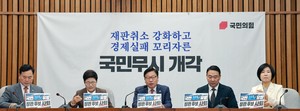
PPP warns Lee of public backlash if Kim Seung-won appointment goes ahead
Jeong Jeom-sik calls Kim 'worst nominee in history of confirmation hearings' Im Yi-ja says forced appointment would signal collapse of Lee administration The People Power Party warned President Lee Jae Myung on Friday that "an angry public will come crashing down on the president" if he pushes ahead with the appointment of Kim Seung-won as justice minister. PPP Floor Leader Jeong Jeom-sik, speaking at a floor strategy meeting at the National Assembly, said the Democratic Party of Korea had unilaterally adopted a confirmation hearing report on Kim on Thursday. "Not a single allegation — solicitation of favors, the family cooperative and the rest — has been resolved," he said. He said a majority of the public opposes the appointment, yet the Democratic Party is "bulldozing ahead regardless," calling it "by far the worst confirmation hearing in history." Jeong said the president had only one reason for nominating a candidate with such fatal flaws: Kim's background as a leader of a group that sought to withdraw criminal charges. "A candidate without qualifications is trying to become justice minister — the person who would make the president's trial disappear — after sailing through a hearing with no real scrutiny," he said. Jeong also took aim at a social media post in which President Lee vowed to track down ticket scalpers. "While trampling the rule of law purely for his own political survival, the president is flexing cheap muscle on social media, promising to chase down ticket scalpers to the end," he said. "The very person trying to bury his trial in secret is out there worrying about scalped tickets." He urged the president to abandon both the Kim appointment and the push to withdraw the charges against him if he wanted to avoid a lame-duck presidency. PPP Policy Committee Chair Im Yi-ja drew a parallel with the Moon Jae-in administration's appointment of former Justice Minister Cho Kuk. "This is an exact replay of the Moon administration's catastrophic misjudgment when it forced through Cho Kuk's appointment," she said. "What happened? Cho resigned just 35 days after taking office, and that arrogant forced appointment was the decisive opening act of the Moon administration's downfall." She added that countless citizens are now warning that forcing through Kim Seung-won's appointment will likewise serve as the starting gun for the collapse of the Lee administration. Im also said the president's press conference, scheduled for 10:30 a.m. Friday, should open with an apology to the public. "The first words out of his mouth must not be more excuses," she said. "It is only right that he begin with a public apology and a confession of remorse — withdrawing the nomination of Kim Seung-won and pledging a complete reversal of his autocratic governing approach." PPP Secretary-General Jeong Hee-yong said the president must bear responsibility for any decision to force the appointment through. "All eyes are on what answer the president will give to the public's concerns and what decision he will make on the ministerial appointment," he said. "Public sentiment is already clear — in most polls, opposition to appointing Kim as minister runs more than twice as high as support." "If the president forces the appointment through regardless, he alone must bear the consequences," he added.
Sept. 18, 2026
-

President Lee's approval rating hits post-inauguration low of 37%, down 1 percentage point: Gallup Korea
President Lee's approval rating fell 1 percentage point to 37 percent, its lowest since he took office, according to a Gallup Korea survey.
Sept. 18, 2026
-
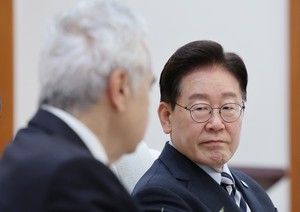
Lee meets UAE's Khaldoon to discuss defense, AI and nuclear cooperation
Follow-up to state visit last November; greetings to be conveyed to UAE president Kang Hoon-sik holds separate talks, lunch; high-level exchanges and space cooperation expansion on agenda President Lee Jae Myung will meet Khaldoon Khalifa Al Mubarak, chairman of the Abu Dhabi Executive Affairs Authority and the UAE's top official overseeing cooperation with South Korea, at Cheong Wa Dae on Friday afternoon. Cheong Wa Dae said Lee will sit down with Khaldoon at 2 p.m. to review the practical cooperation outcomes the two countries have actively pursued since Lee's state visit to the UAE in November 2025, and to convey his regards to UAE President Mohamed bin Zayed Al Nahyan. Khaldoon is the UAE's key power broker overseeing all-around cooperation with South Korea and one of the country's most prominent Korea-friendly figures. Before calling on Lee, Khaldoon will hold separate talks and lunch with Presidential Chief of Staff Kang Hoon-sik, the South Korean side's designated point person on UAE affairs. The two sides plan to exchange in-depth views on expanding cooperation across a broad range of areas — including high-level personnel exchanges, defense and the defense industry, AI, culture, nuclear power and the space industry — as well as other key issues of mutual interest.
Sept. 18, 2026
-
Lee declares special disaster zone in Baengsu-eup, Yeonggwang-gun after heavy rains
Declaration issued Thursday following joint central government probe President Lee Jae Myung has declared Baengsu-eup in Yeonggwang-gun, South Jeolla Province a special disaster zone following heavy rains that have caused damage since late last month. Cheong Wa Dae spokesperson Kang Yu-jung said in a written briefing Friday that Lee declared the area a special disaster zone at around 9 p.m. Thursday, after a joint central government investigation confirmed the extent of the damage. Areas designated as special disaster zones receive additional state funding for disaster recovery. Affected residents are also eligible for deferred national and local tax payments, as well as reductions on public utility bills. "The government will finalize a recovery plan as soon as possible and make every effort to help residents in the affected area return to their normal lives quickly," Kang said.
Sept. 18, 2026
-
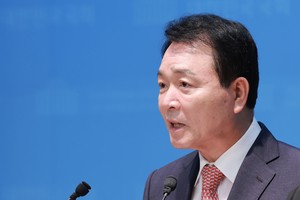
PPP lawmaker says Hormuz deployment decision 'already made,' warns of lost ground
'Relevant agencies would have finished consultations through on-site dispatch' 'Opposition must judge whether decision serves national interest' People Power Party lawmaker Sung Il-jong said Friday that a potential troop deployment to the Strait of Hormuz has left South Korea with "nothing to gain — neither in principle nor in practical terms." Sung made the remarks during an appearance on YTN Radio, questioning whether the government had already decided to proceed with the deployment. "Whether combat or non-combat troops, that judgment would also have been made internally," he said, adding that the head of the Defense Support Command had been dispatched to the UAE to assess the battlefield situation and security conditions on the ground. "That means the government has already made its decision, and by the time things had progressed to that point, all relevant agencies would have finished their consultations," Sung said. "But whatever decision is made, South Korea has already lost a great deal — both in principle and in practical terms." He noted that 70 percent of South Korea's crude oil imports pass through the Strait of Hormuz, and questioned how closely the deployment was tied to the country's national interest. Sung also said that when South Korean assets and citizens came under fire, he had called for the arrest of Israeli Prime Minister Benjamin Netanyahu even then. "Because the ruling party and the government hold all the intelligence and assessment materials, when their decision reaches the opposition, the opposition can then judge whether it serves the national interest and benefits the country — and make its determination accordingly," he said.
Sept. 18, 2026
-
President Lee's press conference delayed 30 minutes, to start at 10:30 a.m.
President Lee's press conference has been delayed by 30 minutes and will now begin at 10:30 a.m.
Sept. 18, 2026
-

Paju sets 2027 living wage at 12,620 won
550-won rise from 2026 rate of 12,070 won Paju announced Friday that it has set its 2027 living wage at 12,620 won ($9), following a recent meeting of its labor-management-civil society council. The new rate represents a 550-won increase from the 2026 level of 12,070 won, a rise of 4.6 percent. The living wage is set above the minimum wage to ensure workers can afford a basic standard of living, including cultural and social participation. The city determined next year's rate after weighing recent inflation, local economic conditions and its fiscal situation. The decision also took into account a government guideline issued in May 2026 on improving the treatment of non-regular workers in the public sector, which recommends a wage level equivalent to at least 118 percent of the minimum wage. The new living wage takes effect Jan. 1, 2027, and applies to workers at Paju city and its affiliated institutions who meet the relevant eligibility criteria. Paju Mayor Son Bae-chan said the city's vision under its ninth directly elected administration is "Paju, the economy, through Paju," adding that achieving it requires quality jobs, safe working conditions and cooperative labor-management relations. "We will work to improve the quality of life for workers and to respect the value of labor," he said.
Sept. 18, 2026
-

Dongducheon to hold 2nd children's reading quiz festival Oct. 31
60–70 students in grades 4–6 sought for elementary school event Dongducheon will hold the second Children's Reading Golden Bell quiz competition as part of its Book Culture Festival on Oct. 31 at the indoor lobby of the city's multipurpose cultural community center. The event is designed to encourage children to enjoy reading by having them read selected books in advance and take part in a literary quiz, with the aim of boosting their interest in reading and sense of achievement. Between 60 and 70 students in grades 4 through 6 will take part in the competition, which will be hosted by a professional emcee and feature a range of questions drawn from the selected titles to determine an overall winner. The three required books are "Wanini the Blue Lion," "Always Warm Porridge Shop" and "The Long Night." Participants must read all three before the event. Awards will go to four students in total — one grand prize, one excellence prize and two encouragement prizes. Registration opens Sept. 28 and runs through Oct. 11. Up to 60 spots are available on a first-come, first-served basis through the library's website, with an additional 10 walk-in slots on the day of the event, for a total of 70 participants.
Sept. 18, 2026
-
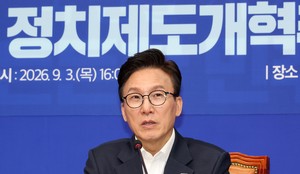
Kim Min-seok says 15-seat threshold for parliamentary floor groups was 'just an example'
Democratic Party leader holds separate lunch with three progressive parties, excluding Rebuilding Korea Party 'We may merge with Rebuilding Korea Party,' he says Democratic Party of Korea leader Kim Min-seok said Friday that his earlier mention of 15 seats as a possible threshold for forming a parliamentary floor group was merely an example, adding that "everything can be discussed, including 10 seats." The current requirement is 20 seats. Kim said, however, that his reference to 15 seats was not without basis, pointing to the fact that 15 represents 5 percent of the National Assembly's current 300 seats. Speaking on the Democratic Party's YouTube channel Friday, Kim addressed the Rebuilding Korea Party's push to lower the floor group threshold to 10 seats. "I expressed it as an example — 'say, 15 seats' — and that figure can certainly change through the course of discussion," he said. "It could end up being 15, or 10, or 14, or 17," Kim said. "Everything, including 10 seats, can be discussed. It was something I offered as one example." Kim said the 15-seat figure was not arbitrary. He noted that the lowest floor group threshold in the Assembly's history had corresponded to 5 percent of total membership — 10 seats out of 200 at the time — while the current 20-seat requirement amounts to 6.6 percent of 300 seats. "If we apply 5 percent to the current 300-seat Assembly, that comes to 15 seats," he said, adding that he had previously heard figures of around 14, 16 and 17 seats floated in discussions, which led him to use 15 as a representative example. Kim also cited the number of standing committees as a reference point. "If you calculate that a floor group should have at least one member on each standing committee, there are currently 14 standing committees plus three joint ones, which brings the figure to around 15 — and that is why numbers between 14 and 17 come up," he said. On the Rebuilding Korea Party's specific demand for a 10-seat threshold, Kim said the rationale was less clear-cut. "In any scenario, 10 seats is actually the one with the less obvious basis, because that figure dates back to when the Assembly had 200 seats," he said. Kim also explained why he had recently held a separate lunch with three progressive parties — the Progressive Party, the Social Democratic Party and the Basic Income Party — without inviting the Rebuilding Korea Party. "The Rebuilding Korea Party is a potential merger partner, so it falls into a different category of discussion," he said. "The three progressive parties are simply alliance partners, and there was a separate matter to discuss with them, which is why a separate meeting was arranged."
Sept. 18, 2026
-
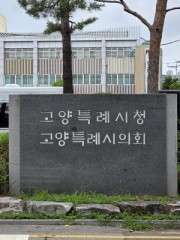
Goyang to deploy AI-powered pedestrian-priority traffic signal system
System analyzes pedestrian and vehicle demand in real time, adjusting signal patterns to match traffic conditions Goyang Special City announced Friday it will pursue a pedestrian-priority AI-CROSS project that analyzes pedestrian and vehicle movement demand in real time and flexibly adjusts traffic signal operations based on current conditions. The project is part of the Ministry of Land, Infrastructure and Transport's 2026 Digital Road AI New Technology Support Project. A consortium comprising Ssaintelecom, Dongrim T&S, Kostek Systems, the Korea National University of Transportation's industry-academic cooperation foundation, and the Korea Road Traffic Authority will carry out the work from July 2026 through June 2027. AI-CROSS is an intelligent traffic signal system that uses AI edge cameras to detect pedestrians and vehicles around crosswalks in real time, supporting signal operations tailored to on-site demand through object tracking, arrival-time prediction and pedestrian-intent analysis. A key feature is its ability to compare pedestrian and vehicle demand and flexibly switch among pedestrian-priority, vehicle-priority and balanced signal modes depending on intersection conditions. By basing signal operations on actual pedestrian and vehicle demand rather than fixed time-of-day schedules, the system is expected to respond more proactively to traffic conditions that vary by time and location. Goyang is reviewing roughly seven candidate sites in Deogyang-gu and Ilsanseo-gu, taking into account the areas' traffic and pedestrian characteristics. Sites will be selected with consideration for a range of pedestrian environments and traffic patterns, including child protection zones, senior protection zones, areas near schools and transit-oriented areas. AI-CROSS also supports safety-focused signal operations by distinguishing among pedestrians with different walking speeds and safety vulnerabilities — including children, elderly people and those using crutches — and adjusting crossing times accordingly. The city expects the project to reduce traffic accidents, improve pedestrian safety, shorten pedestrian waiting times and minimize vehicle delays while enhancing overall traffic flow. "We will use AI technology to respond proactively to changing pedestrian and vehicle demand and create a traffic environment where residents can move more safely and conveniently," a city official said. "As the project progresses, we will carefully review the traffic characteristics and safety conditions at each site and work with relevant agencies to build an AI-based signal operation model suited to Goyang."
Sept. 18, 2026
-
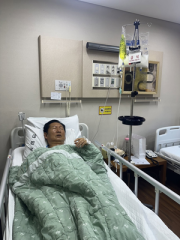
Jung Chung-rae says he's been hospitalized for 3 days, unable to eat or drink
'Pushed myself too hard for 1-2 years without rest … stepping away from a busy routine for a while' Democratic Party of Korea lawmaker Jung Chung-rae said Friday he has been hospitalized for three days after going straight to the emergency room with severe chills and fever, and that he expects to remain there for about a week. Jung wrote on his Facebook page that day that he has been fasting and has not been able to drink even a sip of water for three days. "Did I push myself too hard without rest for one to two years? My mind was fine, but maybe my body couldn't keep up," he wrote, adding that he was treating his hospitalization as a signal to slow down. He said that on Thursday evening he went for a short walk outside for the first time in two days. "It felt good to have the freedom to walk. Being sick reminds you that health really is the most important thing," he wrote. "I think my body gave out from severe overwork and accumulated fatigue. Too much of anything is never good." He added that he planned to step away from his hectic daily routine for a while and take an objective look at the world around him. "They say when you fall, you notice the stone at your feet," he wrote. "Since I've fallen, I'll take the chance to rest — and while I'm in the hospital, I'll look up at the sky often and take in my surroundings."
Sept. 18, 2026
-
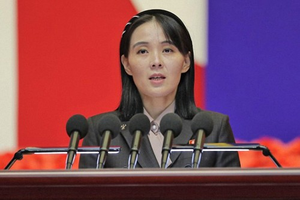
Kim Yo-jong vows 'all available means' in response to US-led multinational drills
KCNA releases statement by Kim Yo-jong 'Pacific Vanguard 2026' called 'threatening war game' Kim Yo-jong, director of the Korean Workers' Party Central Committee's General Affairs Department, criticized the US-led Pacific Vanguard 2026 exercise as "yet another threatening war game devised by the United States, through and through, for bloc confrontation in the region." According to KCNA, Kim made the remarks in a statement Thursday, noting that South Korea and Japan have participated in every iteration of the combined military exercises. She said this "suggests that the belligerent military moves led by the United States are being reinforced around the trilateral US-Japan-South Korea military cooperation framework, which is now in full operation." She went on to say that the primary target of the trilateral military cooperation among the United States, Japan and South Korea is North Korea, adding that "only a vicious cycle of escalating tensions is being repeated due to the reckless and provocative hegemonic pursuits of the United States." Describing the remarks as her "personal view," Kim stressed that "the greater the external threats to national security, the more our physical strength will be built up in direct proportion." She added that "there will be not even the slightest deviation in the course of further developing our nuclear war deterrence." She also threatened that "if it is determined that the military provocations of the enemies have gravely infringed upon the supreme interests of the state, its military sovereignty and the security environment of the region, the armed forces of the Democratic People's Republic of Korea will invoke the relevant clauses under their constitutional duty and mobilize all available means." Pacific Vanguard has been held annually since 2019 under the auspices of the US Navy's 7th Fleet. The multinational maritime exercise involves the navies of South Korea, the United States and Australia, as well as Japan's Maritime Self-Defense Force. Meanwhile, Kim's statement was not carried in the Rodong Sinmun, the Korean Workers' Party organ read by North Korean citizens.
Sept. 18, 2026
-

Siheung seeks 100 residents for child-friendly city roundtable
Siheung mayor: 'A child-friendly city is built together by children and residents' Siheung is recruiting 100 residents to take part in a citizen roundtable forum on building a child-friendly city, to be held Oct. 17 at the Siheung Business Center. The forum will be held under the theme "Building a Child-Friendly Siheung Through Children's Voices." Children — as the direct stakeholders of city policy — along with their guardians and child-related professionals will gather to propose ideas across six key areas of child-friendly city development and discuss the policies and directions needed to improve children's lives. Participants will be encouraged to speak freely about inconveniences they experience in daily life and the policies they believe are needed. The city plans to incorporate feedback from the discussions into its child-friendly policy agenda to produce measures that residents can tangibly feel. The forum will accommodate around 100 participants: 70 students from fourth through sixth grade in elementary school and middle and high school students, 20 guardians, and 10 professionals working in child-related fields. Interested residents may apply from Wednesday through Oct. 2 by scanning the QR code in the public notice on the Siheung city government website. The city will review applications and notify selected participants individually on Oct. 8. "A child-friendly city is not something the administration builds unilaterally — it is a city built together by children and residents," Siheung Mayor Lim Byeong-taek said. "I hope many people will take an interest and join us at this roundtable forum to talk about Siheung's future from the perspective of children." For more information on participation, contact the Siheung City Child Care Division. Siheung obtained UNICEF's advanced-level child-friendly city certification in 2023 and is currently pursuing renewal of that certification.
Sept. 18, 2026
MOST READ
- 1KAIST develops high-performance bio-based adhesive using E. coli instead of petroleum
- 2Pope Leo XIV declines French honors and banquet, accepts only private meeting with Macron
- 3Daimler Truck unveils next-generation transport solutions at IAA 2026
- 4What was Rachmaninoff's performance fee? A 1928 price list tells all
- 5Samsung Biologics union's show of force backfires at the bargaining table
- 6APR says hair-loss treatment research published in international journal
-
WORLD
US warns of punishment for anyone enabling Iran's Strait of Hormuz toll scheme
-
INDUSTRY
Toyota union puts productivity first; Hyundai Motor union demands bigger share of profits
-
FINANCE

National Growth Fund to invest $531M in FuriosaAI, which rebuffed Meta's $800M takeover bid
-
INDUSTRY
Korea Shipowners' Association holds amateur baduk tournament for Maritime Day