
- HOME
- POLITICS
-
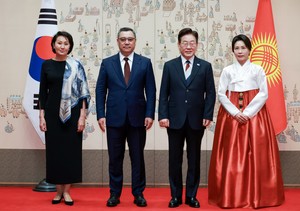
Kim Hye-kyung meets Kyrgyz first lady, finding common ground on welfare and culture
Japarova visits Seoul for Korea-Central Asia Summit, pledging to expand welfare exchanges for vulnerable groups Kim Hye-kyung, the wife of President Lee Jae Myung, met Wednesday with Aigul Japarova, the first lady of Kyrgyzstan, who is visiting Seoul alongside President Sadyr Japarov, strengthening ties between the two countries across social welfare, the natural environment and traditional dress. Deputy Cheong Wa Dae Spokesperson An Gwi-ryeong said in a written briefing that day that Kim and Japarova held wide-ranging talks covering welfare, the natural environment and traditional culture. Kim opened the meeting by saying she was "very glad to meet in person on the meaningful occasion of the first Korea-Central Asia Summit," while Japarova said she hoped "this visit will serve as an opportunity for the friendship between South Korea and Kyrgyzstan to grow even stronger." The two first ladies began by discussing welfare exchanges for vulnerable groups. Kim said she was aware that Japarova had "consistently worked in the welfare field, personally looking after children and families in need," and expressed admiration for her efforts. Japarova introduced her work through the "Pillar of Mother and Child" foundation, which supports children, women and vulnerable populations, and said she had "great interest in the experience South Korea has accumulated in areas such as healthcare and welfare." Kim said the desire for children and families to live happy lives "is the same in every country," adding that she hoped the two nations could "broaden exchanges that benefit people's lives by sharing their experiences with each other." The conversation also turned to the natural environment and shared sensibilities. Japarova described Kyrgyzstan's nomadic culture on high-altitude grasslands and said she had heard that "a significant portion of South Korea is also mountainous," adding that mountains "are deeply embedded in everyday life and culture" in Kyrgyzstan as well, making the two countries feel alike. "Seeing the scenery here in person makes it feel even more familiar and similar," she said. Kim noted that Kyrgyzstan is known as the "Switzerland of Central Asia" and mentioned South Korean mountains including Seoraksan, Jirisan and Hallasan, saying the two countries share "a sensibility of staying close to nature and drawing strength from it." When Japarova extended an invitation to visit Kyrgyzstan, Kim said she would "love to go and experience its beautiful nature firsthand if the opportunity arises." The two also found common cultural ground through traditional dress. When Japarova admired Kim's hanbok, calling it "very beautiful," Kim explained that she had chosen a red skirt to match the red of the Kyrgyz national flag "as a way of welcoming" her guest. She added that she was also contributing to efforts "to share the value of hanbok with the world and to have hanbok culture inscribed on the UNESCO Intangible Cultural Heritage of Humanity list." Kim spoke of the popularity of hanbok experiences at historic palaces and suggested that "next time, it would be wonderful if we could put on hanbok together and walk through Gyeongbokgung and take photos." Japarova smiled and replied that she would "absolutely love to do that." Closing the meeting, Kim said she was "deeply impressed by the strength and dedication" Japarova had shown as "a steadfast partner and pillar" to President Japarov over the years, and expressed hope that "exchanges that bring the hearts of our two peoples closer together will continue, just like the warm conversation we shared today."
Sept. 16, 2026
-
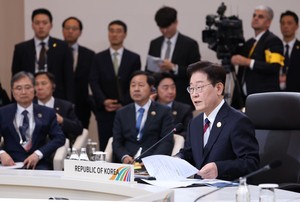
Lee calls for new era of Korea-Central Asia cooperation at inaugural multilateral summit
'Age of great transformation' demands Silk Road spirit, president says President Lee Jae Myung on Wednesday presided over the first multilateral summit between South Korea and five Central Asian nations, proposing that both sides expand their cooperation beyond individual bilateral ties to a regional level and together open a new 30-year chapter in an era where economics and security are increasingly intertwined. Speaking at the opening of the first Korea-Central Asia Summit at a hotel in Seoul, Lee called it "a meaningful day on which the leaders of South Korea and five Central Asian nations have gathered together for the first time," adding that he was "truly glad to be able to discuss a new future and a new vision together." Lee highlighted the significance of Central Asia's historical experience of integration amid today's compounding global crises. "The world today is entering a true age of great transformation, in which economics and security are closely linked across supply chains, energy, markets and technology," he said. "The 'Silk Road spirit' of Central Asia — which once connected the people, technology and cultures of East and West — is more urgently needed than ever." Lee also recalled the role of the Koryo-saram diaspora as a historic bond between the two sides. "Some 90 years ago, our Koryo-saram compatriots took root in Central Asia and began serving as a sturdy bridge connecting Korea and Central Asia," he said. "On the foundation of that long historical tie, South Korea and the five Central Asian nations have built a broad relationship of cooperation and trust spanning trade and investment, industry and infrastructure, and education and culture." He said the time had come to build on more than three decades of accumulated cooperation. "Now, on the foundation of cooperation built over the past 30-plus years, we must prepare together for the new 30 years ahead," Lee said. "The respective strengths of South Korea and Central Asia will offer boundless opportunities to solve each other's challenges together." Lee particularly stressed the synergy of multilateral regional cooperation beyond individual bilateral partnerships. "Above all, I believe we can further accelerate a future of shared prosperity when our cooperation expands beyond individual nations to the regional level," he said. "I hope today's gathering can serve as an important milestone that leads to a new leap forward, and on behalf of the Korean people, I extend a heartfelt welcome to all of you who have come to South Korea."
Sept. 16, 2026
-
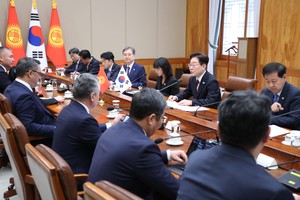
South Korea, Kyrgyzstan agree to upgrade ties, open KOTRA office in Bishkek
The two countries signed 18 agreements and MOUs covering trade, infrastructure and mutual halal recognition President Lee Jae Myung met with Kyrgyzstan President Sadyr Japarov at Cheong Wa Dae on Wednesday and agreed to elevate the two countries' "comprehensive partnership" to a new level. The two sides agreed to open a KOTRA trade office and a Korea Desk in the Kyrgyz capital, and signed 18 agreements and MOUs spanning trade, infrastructure and critical minerals. Seong Ki-hong, the presidential communications secretary, said in a written briefing that Lee held the summit with Japarov — who is visiting South Korea on the sidelines of the first Korea-Central Asia Summit — and that the two leaders held wide-ranging discussions on expanding practical cooperation. Lee noted that Japarov's first official visit to South Korea in December 2024 had been disrupted by the country's political situation at the time, and said it was meaningful to welcome him back now that South Korea had restored its constitutional order through the will and courage of its people. Japarov responded by expressing confidence in South Korea's mature democracy and dynamic development, and said Kyrgyzstan was ready to advance cooperation with Seoul. The two leaders agreed to strengthen cooperation across a broad range of areas under the comprehensive partnership framework, including trade and investment, critical minerals, urban development and infrastructure, development cooperation, food security, public administration, law enforcement and disaster response, AI, climate and the environment, and people-to-people, cultural and educational exchanges. The two sides agreed to significantly expand business support mechanisms to keep pace with rapidly growing bilateral trade. They agreed to establish a KOTRA trade office in Bishkek and set up a Korea Desk within the State Agency for Investments under the President of Kyrgyzstan. Customs cooperation to improve clearance transparency and stronger intellectual property protections are also planned. The two countries also agreed to accelerate the entry of K-food and K-beauty companies into Kyrgyzstan and Central Asia through mutual recognition of halal certification. Cooperation on infrastructure and critical minerals also took shape. Lee identified Kyrgyzstan's infrastructure needs — driven by its rapid growth — as a flagship area for mutually beneficial cooperation, and welcomed the groundwork laid at the summit for collaboration on urban planning, public-private partnership projects and smart-grid development. The two leaders also agreed to jointly identify promising cooperation projects in critical minerals by leveraging each country's complementary strengths. The two sides fleshed out plans for law enforcement, disaster response and future-oriented cooperation. They agreed to strengthen joint investigations into transnational crime, expand police education cooperation, share experience in natural disaster response, and work together on AI and on addressing cross-border environmental and climate challenges in Central Asia. On the Korean Peninsula and international affairs, Lee congratulated Kyrgyzstan on its election to the UN Security Council as a non-permanent member for 2027–2028 and thanked the country for its support of South Korea's North Korea policy. Japarov praised South Korea's contributions to the international community and expressed support for promoting peace and prosperity in the region through dialogue among the parties concerned. On the sidelines of the summit, relevant ministries and agencies from both countries signed a total of 18 agreements and MOUs.
Sept. 16, 2026
-
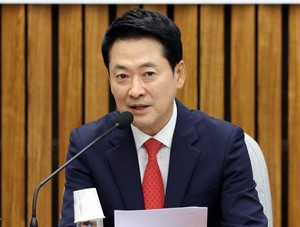
Jang Dong-hyeok says president 'can't do anything right'
People Power Party leader Jang Dong-hyeok launched a sharp attack on President Lee Jae Myung, saying he "can't do anything right." Writing on his Facebook page Wednesday, Jang said the summit Lee held with the United States last year has obligated South Korea to remit nearly 500 trillion won ($369 billion) to Washington. "If two summits go well, we might end up handing over the whole country," he said. Jang also said that before becoming president, Lee had spent his entire political career opposing the United States, Japan and the chaebol, yet since taking office he has been "taking selfies with Trump, playing drums with Prime Minister Takaichi, and bowing deeply to chaebol chairmen." He added that "even left-wingers would be furious" at the reversal. Jang criticized Lee for what he called contradictory behavior toward US President Donald Trump — prostrating himself in Trump's presence, then saying something different once he turned away — arguing that nothing has been resolved on trade, security or North Korea's nuclear program as a result. He also said Lee has stayed silent while Japan provokes South Korea over Dokdo and distorts history in its textbooks. "If he were still in the opposition, he would have been foaming at the mouth calling this a pro-Japan administration," Jang said. Jang said Lee repeatedly summons chaebol chairmen to Cheong Wa Dae but that the meetings produce no meaningful discussion on reviving the economy and appear focused only on pressuring companies. "When the president zigzags, the entire nation suffers," he said. Meanwhile, Cheong Wa Dae announced Tuesday that President Lee will hold a press conference at 10 a.m. Friday at the presidential office's state guesthouse. About 150 domestic and foreign journalists are expected to attend. The roughly 90-minute event will be divided into two broad areas — politics and diplomacy, and policy and the economy — and will include opening remarks, a question-and-answer session and closing remarks from the president.
Sept. 16, 2026
-

Lee sends chuseok gifts of regional specialties to war heroes, industrial accident families
Gift set draws on traditional liquors and local produce from across the country's five mega-regions and three special autonomous provinces President Lee Jae Myung sent chuseok gifts to people across all walks of life Wednesday, expressing his wish for national unity and the well-being of ordinary citizens. As he did last year, Lee included families of industrial accident victims among the recipients, reaffirming the government's commitment to creating safer workplaces. Cheong Wa Dae said Lee delivered the gifts to prominent figures who have contributed to national development, war heroes, national merit recipients, socially vulnerable groups and families of workers killed in industrial accidents. "The gifts embody the government's firm resolve to build a society where every citizen can work safely and enjoy a peaceful daily life," Cheong Wa Dae said. This year's chuseok gift set was composed of regional specialties from across the country, reflecting the "five mega-regions and three special autonomous provinces" framework for balanced regional development and mutual prosperity. From the five mega-regions, the set included red ginseng slices from Gimpo, Gyeonggi Province, in the Greater Seoul area; chestnut chips from Chungju, North Chungcheong Province, in the central region; Andong soju from Andong, North Gyeongsang Province, in the Daegu-North Gyeongsang region; dried shiitake mushrooms from Jangheung, South Jeolla Province, in the Honam region; and jujube chips from Miryang, South Gyeongsang Province, in the southeastern region. Representing the three special autonomous provinces, the set featured Igangju liquor from Jeonju, North Jeolla Province; gondeure greens from Yeongwol, Gangwon Province; and bracken fern from Jeju. The gift set combined traditional liquors from the Yeongnam and Honam regions — Andong soju and Igangju — with wild greens, mushrooms and confections commonly used in holiday cooking, weaving together a message of unity and coexistence that bridges regions and generations. In a card enclosed with the gifts, Lee wrote: "I wish you a precious chuseok, sending greetings to those you miss and sharing happiness with those you love." He added: "Like the moon that lights everyone's night without condition or qualification, I will work even harder to shine a bright light on the lives of all our people." Meanwhile, Lee also sent chuseok gifts to former presidents and their spouses. Kim Tae-geun, the presidential secretary for autonomous development, plans to personally visit the private residences of former presidents and their spouses to deliver the gifts.
Sept. 16, 2026
-

CFC explores space, cyber warfare for peninsula's second-by-second battlespace
2026 Korea-US Combined Warfighting Forum held in Yongsan Forum addresses AI integration, information-sharing gaps The Combined Forces Command has begun discussions on how to integrate land, sea, air, space and cyber capabilities into a future combined warfighting concept. Experts at the forum said the Korean Peninsula's compressed threat-response window — measured in seconds and minutes — demands a pre-configured force structure capable of immediate action across all domains. Also highlighted were the need to remove constraints on information sharing between South Korean and US forces, and the challenge of ensuring that commanders' use of AI does not reduce human judgment to a rubber stamp. CFC said Wednesday it held the 2026 Korea-US Combined Warfighting Forum at the Defense Convention Center in Yongsan, Seoul. About 200 people attended, including CFC Commander Gen. Xavier Brunson, Deputy Commander Gen. Kim Sung-min, Joint Chiefs of Staff Chairman Gen. Jin Young-seung, former CFC commanders and deputy commanders, senior officers from combined component commands, and military experts from industry and academia. The forum was organized to discuss effective combined warfighting methods on the Korean Peninsula and the direction of capability development needed to support them, centered on CFC's Combined Joint All-Domain Operations (CJADO) warfighting concept. CJADO is CFC's theater-level warfighting concept, expanding the traditional land, sea and air operational domains to include space, cyber and the electromagnetic spectrum. Its core is the integrated employment of operations across all domains, underpinned by advanced command-and-control systems. CFC also emphasized linkages with non-military elements — diplomacy, intelligence and economics — alongside military power. The intent goes beyond simply connecting individual capabilities: forces are to be arranged in time and space according to operational objectives, imposing multiple simultaneous dilemmas on the adversary. The peninsula's compressed response time was identified as the central challenge for applying CJADO there. KIDA researcher Ahn Byung-oh said the Korean Peninsula battlefield has a depth of only tens to hundreds of kilometers, and the Greater Seoul area is exposed to the enemy's long-range fires, leaving a threat-response window measured in seconds to minutes. He also noted that while the lack of a relatively safe rear area creates a strong need to disperse forces, the physical space in which to do so is severely limited. Ahn said that in such an environment, synchronizing the effects of cyber and space operations — which require long preparation times — with physical strikes is no easy task. Forces must be able to sustain operations even when communications are severed and a commander's intent cannot be transmitted, or when it is difficult to confirm whether cyber and space operations have achieved their intended effects. As a solution, he proposed first establishing a structure in which combinations of operational means are prepared in advance and selected at the execution stage. He said Combined Joint All-Domain Command and Control (CJADC2) capabilities must then be developed to allow real-time recombination of surveillance, detection and strike assets as the battlefield situation evolves. The practical level of information connectivity between South Korean and US forces was also raised as a challenge. Ahn said current Korea-US connectivity is limited to specific missions and data types, falling short of the "kill web" standard. "Effective connectivity must go beyond simple system-to-system access — it requires data flowing between machines," he said, calling for the identification and removal of the constraints blocking that flow. The US side's presentation also focused on command and control and information sharing. Lt. Col. Casey Miller, chief of concepts development at the US Army Futures and Concepts Center, said CJADO is fundamentally a problem of C2 and information sharing. Miller said the goal must go beyond deconflicting service-specific operations and move toward genuine integration. The objective, he said, is to rapidly identify enemy vulnerabilities, concentrate joint capabilities at decisive points, and change operations faster than the adversary can respond. The risks of expanding AI use were also put on the agenda. Ahn assessed AI as a key enabler for transforming human-centric, periodic and sequential activities into continuous ones, but cautioned that "efforts are needed to ensure that formal approval does not collapse into automation in conditions where there is in effect no time to reject an automated recommendation." CFC said it plans to continue developing CJADO concepts and combined warfighting capabilities suited to the Korean Peninsula's battlefield environment, based on the views presented at the forum. The aim is to strengthen combined defense posture and interoperability within the Korea-US military alliance. Meanwhile, the forum's first session was chaired by former Special Warfare Command chief Gen. Jeon In-bum, and the second by CFC Chief of Staff Brig. Gen. Joseph Hilbert. Former CFC commanders Gen. Robert Abrams and Gen. Paul LaCamera, along with former CFC Deputy Commander Gen. Ahn Byung-seok, discussed the role and required competencies of commanders in an environment demanding the integration of multi-domain information and combat elements.
Sept. 16, 2026
-
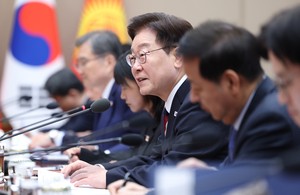
South Korea signs 35 agreements, MOUs with Tajikistan and Kyrgyzstan
17 with Tajikistan, 18 with Kyrgyzstan — covering minerals, AI, infrastructure and transnational crime Lee signs wide-ranging inter-ministerial cooperation documents on sidelines of back-to-back summits South Korea signed a total of 35 agreements, accords and MOUs with Tajikistan and Kyrgyzstan on Wednesday, significantly expanding practical cooperation with the two Central Asian nations across economic, security and cultural areas. The sweeping package of documents was concluded as President Lee Jae Myung held separate bilateral summits at Cheong Wa Dae with visiting Tajik President Emomali Rahmon and Kyrgyz President Sadyr Japarov, formalizing inter-ministerial cooperation across a broad range of policy areas. With Tajikistan, South Korea signed 17 cooperation documents, including an MOU on developing cooperation in industry and innovation. The two countries agreed to expand exports in key manufacturing sectors such as textiles, chemicals and machinery, and to lay the groundwork for advancing into AI and digital industries. They also committed to strengthening cooperation in railways, transportation, logistics, intellectual property, energy and industrial safety, while exploring collaboration on critical minerals and the green transition. On public order and security, the two sides agreed to work closely through their customs authorities and police to combat transnational crime, and to broaden exchanges in public administration, anti-corruption efforts and education. With Kyrgyzstan, South Korea concluded 18 documents, including a revised MOU on trade and investment cooperation. The two sides agreed to pursue cooperation across a wide range of fields — critical minerals, the halal market, infrastructure development, livestock technology, energy and intellectual property — and to build a public-private partnership framework to boost bilateral trade and investment. They also agreed to diversify cultural and sports exchanges and to strengthen coordination in customs, policing and disaster management. Beyond central-government cooperation, separate MOUs were also signed between the Gyeonggi Province Office of Education and Kyrgyzstan's Ministry of Education, and between the Seoul Metropolitan Government and the city of Bishkek.
Sept. 16, 2026
-
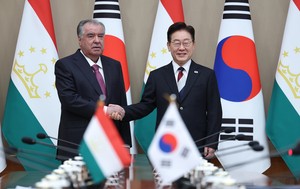
South Korea, Tajikistan elevate ties to 'comprehensive partnership,' sign 17 MOUs on infrastructure, minerals
First visit in 11 years — rail cooperation, antimony and other critical mineral supply chains take center stage Korea Desk to open in Tajikistan; Rahmon voices full support for peaceful resolution on Korean Peninsula President Lee Jae Myung held a summit with visiting Tajik President Emomali Rahmon on Wednesday and elevated bilateral ties to a "comprehensive partnership" for the first time. The two countries agreed to push ahead with railway and transportation infrastructure development and critical mineral supply chain cooperation, signing a total of 17 agreements and MOUs. Cheong Wa Dae communications chief Seong Gi-hong announced in a written briefing that Lee met Rahmon, who was in Seoul for the first Korea-Central Asia Summit. The meeting marked the two leaders' first face-to-face talks since a phone call last August, and Rahmon's first visit to South Korea in 11 years. Building on 34 years of friendly cooperation since the two countries established diplomatic relations in 1992, the leaders formally elevated the bilateral relationship to a "comprehensive partnership." They agreed to significantly broaden the scope of exchanges — previously centered on development cooperation — to cover trade and investment, railway and transportation infrastructure, critical minerals, AI and digital transformation, climate change response, and people-to-people exchanges. Lee said South Korea was paying close attention to Tajikistan's strengths and growth potential, citing its geographic advantage as a bridge between Central and Southwest Asia, its abundant mineral resources, and its young, dynamically growing population. He pledged active cooperation to support Tajikistan's economic development, including industrial upgrading. Rahmon responded by identifying "accelerating industrialization and job creation" as his country's core development priorities, saying he looked forward to "actively pursuing mutually beneficial cooperation with South Korea, a trusted partner." To improve connectivity for the landlocked, mountainous nation, the two sides signed a railway MOU and agreed to share railway policy, technology and experience while training specialized personnel. They also agreed to build a mutually beneficial critical mineral supply chain by linking South Korea's exploration and development expertise with Tajikistan's rich mineral resources, including antimony. The two sides also put in place institutional safeguards to support South Korean companies entering the Tajik market. They agreed to strengthen cooperation between KOTRA and Tajikistan's export agency and to establish a Korea Desk — a dedicated communication channel for South Korean businesses operating locally — to actively address companies' difficulties. In addition, South Korea will share its administrative know-how across areas including customs, intellectual property, civil service personnel management and capacity development, anti-corruption, and anti-money laundering, while a standing security cooperation channel will be set up to jointly tackle transnational crime. On the Korean Peninsula situation, Rahmon said he "fully understands the importance of the Korean Peninsula issue and fully supports a resolution through peaceful means, including dialogue." In the presence of both leaders, the two countries signed a total of 17 agreements and MOUs covering railway and transportation infrastructure, trade expansion, digital technology and smart grids, forest restoration, education, industrial safety and health, and public administration cooperation.
Sept. 16, 2026
-
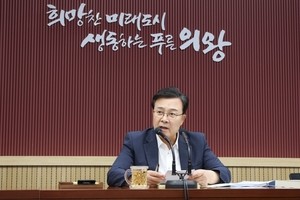
Uiwang mayor calls 2027 a pivotal year for key city projects
Remarks made at review session on 2027 work plans and 9th elected-term campaign pledges Uiwang city held a review session on its 2027 major work plans and 9th elected-term campaign pledges Tuesday at the city hall conference room, conducting an intensive examination of next year's key project plans and the direction of pledge implementation. Presided over by Uiwang Mayor Kim Sung-je, the session was organized to reassess citywide policy priorities and discuss specific action plans for each campaign pledge project heading into 2027. Key agenda items and pledge projects reviewed at the session included the full-scale push for the third-phase new town development and the Ojeon-Wanggok public housing district, the on-schedule opening of the Indeokwon–Dongtan and Wolgot–Pangyo rail lines, active pursuit of a GTX-C stop at Uiwang Station, mixed-use development of the Ojeon transit-oriented area, construction of the Uiwang Future Education Center, the opening of Uiwang Arts Center, and the widening of the road along Hak-ui Stream. Alongside this, the city conducted a comprehensive review of new projects planned for next year — the construction of the Gocheon Community Center, the establishment of an industry promotion agency, the expansion of park golf facilities, and an expansion of childbirth incentive payments — examining the necessity of each initiative, funding options, and overall feasibility. Based on the discussions from the session, the city plans to strengthen the implementation capacity of each department and actively incorporate public feedback throughout the process to improve the quality of its policies. "2027 is a critical year when the major projects of the 9th elected term will get fully on track," Mayor Kim said. "New projects must be prepared thoroughly through rigorous review, while ongoing key initiatives and campaign pledge projects should be accelerated and carried out without delay." He added that administrative resources should be focused on each individual project so that they translate into tangible results that residents can feel in their daily lives.
Sept. 16, 2026
-
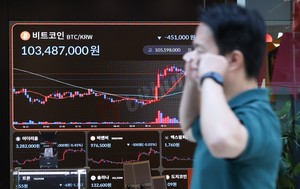
US crypto regulation bill 'CLARITY Act' fails Senate vote, sending bitcoin, ether tumbling
A key US bill to establish a comprehensive regulatory framework for virtual assets failed a procedural vote Tuesday (local time), blocking the CLARITY Act from advancing to a full Senate floor vote. The defeat of the legislation, which had been pushed as the cornerstone of US crypto regulation, sent leading virtual assets tumbling — bitcoin and ether prices both fell sharply on the news. Bitcoin market prices were visible on the electronic board at the Bithumb Lounge Gangnam branch in Seocho-gu, Seoul, on Wednesday morning.
Sept. 16, 2026
-
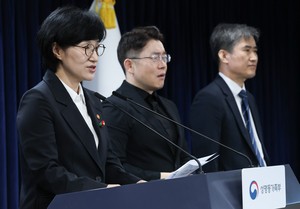
Gov't announces plan to introduce abortion pill
Minister of Gender Equality and Family Won Min-kyung held a briefing at Government Complex Seoul in Jongno-gu, Seoul, on Wednesday morning to announce a plan to introduce abortion medication. Won said the government would phase in access to abortion pills for women up to nine weeks pregnant.
Sept. 16, 2026
-
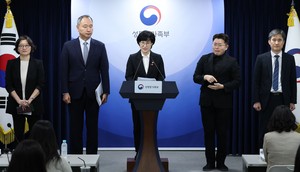
Minister Won briefs on abortion pill introduction plan
Minister of Gender Equality and Family Won Min-kyung held a briefing at Government Complex Seoul in Jongno-gu, Seoul, on Wednesday morning to announce a plan to phase in abortion medication for women up to nine weeks pregnant.
Sept. 16, 2026
-
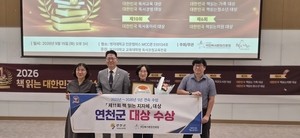
Yeoncheon-gun wins 11th Korea Reading Local Government Award
County honored in national local government category at 2026 Reading Korea ceremony Yeoncheon-gun announced Wednesday that it received the 11th Korea Reading Local Government Award in the national local government category at the 2026 Reading Korea ceremony, held at Myongji University. The ceremony is sponsored by the National Assembly's Culture, Sports and Tourism Committee and organized by the Korea National Reading Culture Promotion Association. It recognizes outstanding institutions and individuals that have led efforts to promote reading culture and strengthen reading competitiveness. Yeoncheon-gun has pursued a range of reading culture promotion projects under the vision "Into the Future with Books — YES, Yeoncheon!" Key initiatives have included a monthly humanities program called "Daldali Inmunhak," a "One City, One Book" campaign, a reading marathon and support for reading clubs. The county has also partnered with military units to run a civilian-government-military cooperative reading education program and has supported base libraries, working to build a reading ecosystem suited to the region's character. To advance its goal of becoming a sustainable reading city, Yeoncheon-gun launched the YES Yeoncheon Reading College program in earnest this month. The program is designed to broaden residents' grounding in the humanities and support deeper reading engagement, and is expected to help expand the base of reading culture across the county. Lee Mi-jeong, director of the Yeoncheon-gun Unification and Lifelong Education Center, said the award was the result of the combined efforts of residents and staff. "Going forward, we will continue to develop substantive reading policies so that local libraries can become multifaceted cultural spaces for community communication and residents can enjoy the pleasure of reading in their daily lives," she said.
Sept. 16, 2026
-
Yoon government rushed 'Whale Shark' gas project in violation of state contract law, audit finds
Board of Audit and Inspection releases findings from public interest audit of Donghae deep-sea gas field project; Yoon rebuked minister over drilling timeline, prompting rushed schedule revision Korea National Oil Corp. violated the State Contracts Act in pursuing the so-called Whale Shark Project — a deep-sea gas field development in the East Sea — by awarding improper contracts to specific firms and rushing ahead with drilling rig contracts and drilling itself without adequate technical verification or board approval, a government audit has found. The probe also confirmed that the drilling schedule was pushed forward at the behest of then-President Yoon Suk Yeol. According to the results of a public interest audit on the Donghae deep-sea gas field project, released Wednesday by the Board of Audit and Inspection, KNOC violated the State Contracts Act when selecting a contractor for a prospectivity assessment. Although 17 firms were eligible to bid — exceeding the requirement of 10 or fewer — the company arbitrarily designated a small number of specific firms without conducting a market survey. In the technical evaluation for a second contract, KNOC improperly added a "performance capability" criterion not included in the original standards, disqualifying competitors and undermining the fairness of the process. The audit also confirmed inadequate verification and rushed procedures. KNOC drew up a drilling plan for the Whale Shark site in October 2023, before the prospectivity assessment had even been completed. Despite a projected success probability of 19.1% — lower than that of previously failed exploration blocks — the company skipped thorough verification and issued a drilling rig contract without the required review and approval by its investment risk committee and board of directors. The failure to adjust the drilling schedule also cost the company a potential saving of 4.3 billion won ($3.18 million) in charter fees. When drilling was completed, gas saturation stood at just 6.3%, and the gas detected was confirmed to be biogenic gas with no commercial viability. The audit also shed light on how the project was reported to the presidential office. In May 2024, the Ministry of Trade, Industry and Energy recommended against public promotion of the project, citing uncertainty over its prospects, but the presidential office decided to proceed with a government briefing. Then, in September, after the ministry reported that drilling would be completed in the first quarter of 2028, Yoon rebuked the minister, saying, "Political judgment is mine to make." The schedule was ultimately revised to an aggressive plan calling for four additional wells to be drilled by 2026. The Board of Audit and Inspection called for disciplinary action against the staff member who led the improper bidding process, and referred a division head to the courts for violating the Conflict of Interest Prevention Act after the official awarded a perfect performance score to a former department to secure a bonus. The board also called for systemic reform requiring advance technical assessments by external expert institutions for future projects.
Sept. 16, 2026
-

Yangju to host autumn globe amaranth festival marathon Oct. 5
3km (general walk, pet-friendly walk), 5km, 10km, half marathon — 3,000 spots available Yangju City will host the 2026 Yangju Globe Amaranth Autumn Festa Marathon on Oct. 5 at Nari Farm, welcoming both local residents and running enthusiasts from across the country. Organized by the Yangju City Sports Council and administered by the Yangju City Athletics Federation, with support from the city government, the event is tied to the 2026 Yangju Globe Amaranth Autumn Festa. It aims to boost sports, tourism and the local economy while showcasing Yangju's key attractions to a national audience. The race starts at 8 a.m. at Nari Farm and offers four categories to suit different fitness levels and preferences: a 3km course (general walk and pet-friendly walk), 5km, 10km and a half marathon. The route takes participants through a mix of urban, park and historical settings — departing from Nari Farm and passing through Okjeong Central Park before reaching the Hoeamsa Temple Site. Half marathon participants will leave Nari Farm, pass through Jungchon Intersection, Samseung Intersection and Okjeong Central Park, then turn around at the Hoeamsa Temple Site. The 3km course, offered as both a general walk and a pet-friendly walk, is designed to be accessible for families. A total of 3,000 participants will be accepted. Entry fees are 15,000 won ($11) for the 3km course and 50,000 won for the 5km, 10km and half marathon. Registration is available through the event's official website. All finishers will receive a completion medal, race bib and snacks. Those entering the 5km, 10km or half marathon will also receive a commemorative T-shirt, a timing chip and a digital race certificate. To support the local economy, participants in the 5km, 10km and half marathon will receive a 10,000 won refund in Yangju Love Gift Certificates, while 3km participants will receive a 5,000 won refund. Participants will also receive admission tickets to Nari Farm, encouraging them to explore local tourist sites and nearby businesses after the race. "I hope this event becomes a festival where people can experience the beauty of Yangju's autumn alongside the charms of Nari Farm, Okjeong Central Park and the Hoeamsa Temple Site," Yangju Mayor Jeong Deok-yeong said. "We will do our best to ensure that marathon enthusiasts and residents from across the country can enjoy the race safely and discover the many attractions our city has to offer."
Sept. 16, 2026
-
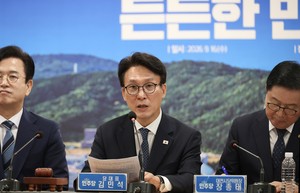
Kim Min-seok calls 15-seat threshold 'realistic'; Rebuilding Korea Party insists on 10
Kim Min-seok: '15 seats realistic, acceptable — progressive parties combined would qualify' Rebuilding Korea Party: '20-seat rule is a Yushin relic; 10 seats is common sense' Democratic Party of Korea leader Kim Min-seok on Wednesday put forward a political reform agenda that includes lowering the threshold for forming a negotiating bloc in the National Assembly from 20 seats to 15. The Rebuilding Korea Party pushed back, saying its official party position calls for a 10-seat threshold. Speaking at the party's supreme council meeting in Daejeon, Kim said he would "move in earnest toward a grand progressive coalition," adding that the party had already raised various proposals with progressive parties centered on easing the negotiating-bloc requirement, introducing a runoff voting system, adjusting the electoral system on rational grounds and consolidating competitiveness. Kim then told Rep. Park Bum-gye, who heads the party's grand coalition task force, that he should "begin making contact in earnest with each of the three progressive parties and the Rebuilding Korea Party starting today." Kim added that the party would work to stabilize its own ranks while strengthening solidarity with progressive forces and deepening dialogue with centrist and conservative groups. Before the supreme council meeting, Kim appeared on the Democratic Party's YouTube channel "Minti07" and said he believed both the Rebuilding Korea Party and other progressive parties considered 15 seats "realistic and acceptable as a starting point" for easing the threshold. He added that the combined seat count of all progressive parties outside the Democratic Party would be sufficient to meet that bar. Kim also said the party needed to discuss how best to reform the current semi-proportional representation system under single-member districts, and argued that a runoff system should apply at minimum to presidential elections — noting that some have called for extending it to certain regional government head races as well. In the 22nd National Assembly, the Rebuilding Korea Party holds 12 seats, the Progressive Party holds four, and the Basic Income Party and Social Democratic Party hold one seat each. Lowering the threshold to 15 seats would prevent the Rebuilding Korea Party from forming its own negotiating bloc independently. The Democratic Party had earlier declared at a roundtable with progressive parties in April last year that it would pursue easing the negotiating-bloc requirement and introducing a runoff system in the period immediately following the presidential election. The Rebuilding Korea Party rebuffed Kim's remarks, saying it had "not had any official or unofficial contact with the Democratic Party leadership regarding political reform, solidarity or integration," and that "the Democratic Party has not made any such proposal." On the proposed 15-seat threshold, the party said the current 20-seat requirement was "a remnant of the Yushin era, created under the Park Chung-hee regime to raise the bar for forming negotiating blocs," and that "returning to the pre-Yushin standard of 10 seats is common sense and the natural course." The party urged the Democratic Party to ensure that "solidarity must be institutionalized and promises must be kept," calling on it to present a concrete roadmap and take action — including implementing the previously agreed roundtable declaration, forming a political reform consultative body and holding a third roundtable meeting.
Sept. 16, 2026
-
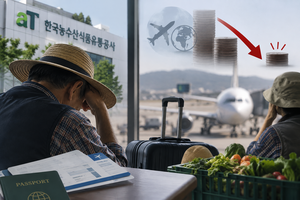
Farming cooperatives hit with cancellation fees after aT slashes overseas training support
Flights and hotels booked in April–May; 'no allocation' notices came in July aT says detailed budget was only finalized in June Cooperatives left paying cancellation fees or covering costs themselves Lawmaker Moon Dae-rim calls it 'clear administrative failure' Some agricultural production cooperatives and farming associations that had booked flights and accommodation in anticipation of support from the Korea Agro-Fisheries & Food Trade Corporation's overseas benchmarking training program have been left paying cancellation fees or covering the costs themselves after receiving late notice of a sharp funding cut, it has been confirmed. Critics say the confusion and financial burden on participants grew because aT told them early in the year that the program would continue, only for support to be drastically reduced without adequate warning. According to data submitted to Democratic Party of Korea lawmaker Moon Dae-rim of the National Assembly's Agriculture, Forestry, Livestock, Fisheries and Food Committee, funding for the overseas benchmarking support program for specialized agricultural production complexes plunged from 523 million won ($386,000) last year to 63 million won this year. The number of complexes receiving support also fell sharply, from 41 last year to just five this year. In 2023, 47 complexes received a combined 534.19 million won, and in 2024, 45 complexes received 572.41 million won. aT had supported around 40 complexes annually for years, making this year's allocation roughly one-eighth of the usual level. The core problem is that some farming cooperatives began preparing for overseas training before the funding cuts were adequately communicated to them. According to accounts from the Assembly committee and participants, aT's regional offices held information sessions early this year and told attendees the overseas benchmarking program would proceed as usual. Some complexes say they were never specifically told that support would be cut significantly from the previous year. With fuel surcharges and other costs in mind, some farming cooperatives and agricultural associations began booking flights and accommodation as early as April and May. They say they were not notified that funding had been reduced or that their applications had not been allocated a budget until around July. aT has attributed the delayed notification to a late finalization of its detailed program budgets, saying the budget for individual sub-programs — including the overseas benchmarking trips — was only confirmed around June. An aT official told Moon's office that the corporation was unaware that some complexes had already booked flights and accommodation in April and May to lock in lower fuel surcharges before the sub-program budgets were finalized. By the time participants learned of the cuts, bookings were already in place, leaving them with cancellation fees and out-of-pocket expenses. The total cancellation-related costs for four complexes that called off their trips came to 15.4 million won, ranging from 900,000 won to 6.5 million won per complex. However, that figure includes both fees already paid and projected fees, so the two categories need to be distinguished. Another 15 complexes proceeded or are proceeding with overseas training entirely at their own expense. Given that the average support per complex last year was about 12.76 million won, the financial burden now falling on individual farming cooperatives and agricultural associations is substantial. In one case, a farming cooperative covered the cost of benchmarking overseas best practices out of its own funds after receiving no program budget allocation. Another agricultural cooperative paid for overseas training it had already completed in the first half of the year from its own resources. One limited liability company canceled the participation of some farm household members and covered the remaining costs itself. One horticultural agricultural cooperative had already completed an overseas benchmarking trip in July but is struggling to settle its accounts because no support budget was allocated. Another cooperative postponed its overseas benchmarking visit to October due to the budget cuts and faces potential cancellation fees if it does not receive an additional allocation. The pattern of repeated support to the same complexes also raised expectations in the field, critics say. Of the 66 complexes that received support between 2022 and last year, 44 had received it at least twice. Eighteen had received support three times, and 10 had received it for four consecutive years. The fact that the program was announced as continuing cannot itself be taken as a guarantee of funding. However, critics argue that if aT knew support would be drastically reduced, it should have communicated that clearly before farming cooperatives and associations spent money on flights and accommodation — particularly given that many had come to expect continued support based on years of repeated participation. "Support levels can be adjusted based on budget conditions, but notifying participating complexes of the cuts only after they had already booked flights and accommodation is a clear administrative failure on aT's part," Moon said. "aT must immediately assess the damage suffered by complexes that were left paying cancellation fees or out-of-pocket costs due to the late notification, and put in place a reasonable remedy." Moon added that if the practice of repeatedly supporting the same complexes has become entrenched, the program's structure itself needs to be reformed. "Rather than continuing to support only established high-performing complexes, we need to identify new farming cooperatives and agricultural associations and develop them into competitive export complexes," he said. "I will push for systemic reform through the national audit."
Sept. 16, 2026
-
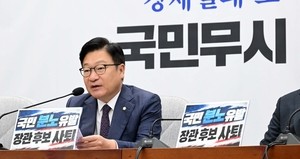
PPP floor leader calls Kim Seung-won's 'humanities major' remark proof of illegal lobbying
'Kang Shin-cheol and Hong Ji-seon also unfit for office' People Power Party floor leader Jeong Jeom-sik on Wednesday criticized justice minister nominee Kim Seung-won over a remark made at his confirmation hearing, saying Kim's claim that he could not evaluate a drug's efficacy because he was a humanities major amounted to "proof of a confession to illegal lobbying." Speaking at a press conference at the National Assembly, Jeong said the comment was tantamount to admitting that Kim "had pressured the Ministry of Food and Drug Safety simply on the word of an acquaintance he missed so dearly" — a reference to a broker identified only by the surname Yang. Jeong also directed sharp words at President Lee Jae Myung, warning that if Lee "pushes ahead with appointing Kim Seung-won as justice minister, he will face a public verdict more fearsome than any trial." He added that Lee was scheduled to hold a press conference on Friday, and urged him to show action by withdrawing Kim's nomination rather than "deceiving the public with a hundred flowery words" about dropping charges against him and pursuing constitutional reform to allow consecutive presidential terms. Turning to Tuesday's confirmation hearing, Jeong said Democratic Party lawmakers had hurled insults at People Power Party members — calling them "demons," "weapons" and "vipers" — but argued the real demons, weapons and vipers were elsewhere. "Administering to humans a drug that killed hamsters is demonic behavior; those who exploited it for stock-price manipulation are the vipers; and nominee Kim, who lobbied to get that drug approved, is the social weapon," he said. Jeong also took aim at Kim and Democratic Party lawmaker Seo Young-gyo, chair of the National Assembly's Legislation and Judiciary Committee, for shedding tears during the hearing. "Unable even to make excuses, they traded tears with each other and turned the confirmation hearing into a melodrama," he said. He declared defense minister nominee Kang Shin-cheol and land minister nominee Hong Ji-seon equally unfit, calling on President Lee to withdraw both nominations and "appoint fresh figures who can boldly renew state affairs." On Kang, Jeong said the nominee claimed ignorance of his son borrowing 700 million won ($517,000) from an aunt and uncle to purchase a commercial property, then asked sarcastically: "If he doesn't even know that, can he really be aware of and respond to North Korean provocations?" He added that Kang's family had successfully posed as demolition-displaced residents to secure a special pre-sale allocation for an apartment in Seocho, quipping that Kang appeared to be "a soldier who may be poor at maintaining alert but is skilled at disguise." On Hong, Jeong said the nominee had previously criticized buying homes through loans but had done exactly that herself. "Truly the insufferable double standard befitting a Democratic Party figure," he said. He also raised concerns that Lee Han-ju, a presidential policy adviser and key figure in the Seongnam-Gyeonggi Province network, would effectively control real estate policy, leaving Hong as "little more than an obedient, operational minister who defers entirely to Cheong Wa Dae." Asked whether the PPP would endorse the confirmation hearing reports for Kim, Kang and Hong, Jeong said he would need to consult with members of the respective hearing committees, but added: "As floor leader, my view is that endorsement is not possible."
Sept. 16, 2026
-
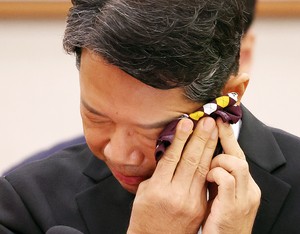
Over half oppose Kim Seung-won's appointment, deepening ruling party's dilemma
KSOI poll: 52.1% oppose Kim Seung-won's appointment President Lee, ruling bloc weigh polling trends Confirmation hearing marred by tears, insults Han Byung-do blames PPP; Jeong Jeom-sik calls it 'deception of the people' The National Assembly confirmation hearing for Kim Seung-won, the nominee for justice minister and the most closely watched flashpoint of the cabinet reshuffle under President Lee Jae Myung's second-term government, descended into an exchange of insults, shouting and tears — with little substantive vetting of the candidate. With the final decision now resting squarely with President Lee, a poll released Wednesday showed that opposition to Kim's appointment exceeds a majority, deepening the ruling camp's anxiety over how to proceed. A survey by the Korea Society Opinion Institute (KSOI), conducted Monday through Tuesday among 1,001 adults aged 18 and older nationwide, found that 52.1 percent opposed Kim's appointment — 27 percentage points higher than the 25.1 percent who supported it. Another 22.8 percent said they were unsure. (The survey used an automated response method on mobile phones, with a confidence level of 95 percent, a margin of error of ±3.1 percentage points and a response rate of 5.9 percent. For details, see the National Election Survey Deliberation Commission website.) Notably, 52.2 percent of Democratic Party supporters backed Kim's appointment, while 84.1 percent of People Power Party supporters opposed it. Among independents, opposition was dominant at 54.2 percent, compared with just 9.5 percent in favor. The same poll put President Lee's job approval rating at 35.9 percent — a drop of 5.3 percentage points from the previous survey and the lowest recorded by the same polling firm. His disapproval rating rose to 59.4 percent, up 5.5 percentage points from the prior survey. KSOI said opposition to Kim's appointment had crossed the majority threshold and that the president's final decision on the nomination would likely have a significant impact on public assessments of his administration. The institute added that the high level of opposition among centrist voters, at a time when the president's approval rating has hit a record low, could place a considerable burden on the government going forward. The ruling and opposition parties traded blame over the outcome of the hearing. Democratic Party floor leader Han Byung-do, speaking at a party leadership meeting held in Daejeon on Wednesday, said Tuesday's confirmation hearing "became a stage for political bickering filled with shouting and finger-pointing, rather than a forum to hear the nominee's explanations and assess his policies and capabilities." He urged the People Power Party to stop turning confirmation hearings into political battlegrounds and expressed regret over how the session unfolded. PPP floor leader Jeong Jeom-sik struck back at an emergency press briefing the same day, saying the hearing "was from the outset a shield to protect Kim Seung-won and a deception of the people," and that Democratic Party lawmakers had hurled insults at PPP members, calling them "demons," "weapons" and "vipers." He warned that if President Lee pushed ahead with the appointment, he would face "a public verdict far more fearsome than any court ruling." At Tuesday's hearing, Kim shed tears while defending himself against allegations surrounding a social cooperative for people with developmental disabilities where his spouse works, appealing to the committee that he had been wronged. The PPP dismissed his display of emotion as "crocodile tears." The session was also marred by a string of crude remarks. After the opposition raised objections over time limits on lawmakers' questioning, Democratic Party lawmaker Kim Dong-a shouted "demon" at PPP lawmaker Ju Jin-woo. Ju pointed back at Kim and shot back, "What did you say? The ones siphoning off subsidies for their families — they're the demons." Kim responded by repeating the word twice: "I said demon. Demon." PPP lawmaker Kim Tae-gyu then confronted Legislation and Judiciary Committee Chairwoman Seo Young-gyo, demanding she compel an apology for the "demon" remark and asking whether the situation was normal. Democratic Party lawmakers responded with shouts of their own, telling him to get his "hideous face" out of the way. During the afternoon session, Kim Tae-gyu continued his attacks on the nominee, suggesting that Kim Seung-won's tearful morning appearance might be a sign of menopause. Meanwhile, controversy erupted after a staff member accompanying Kim Seung-won was spotted appearing to covertly photograph notes written by PPP lawmaker Ju during the hearing. It was not confirmed whether the aide had actually photographed and shared Ju's documents. After the incident was caught on camera, Ju posted on Facebook that he could not hide his displeasure, writing, "How can a justice minister nominee surveil me, a member of the confirmation committee? Is this something that can happen in a liberal democracy?" Kim's camp apologized, saying the aide "took the photo out of poor judgment during the hearing and deleted it immediately upon realizing the mistake," and that "neither Kim nor anyone else instructed or was involved in directing the photo to be taken."
Sept. 16, 2026
-
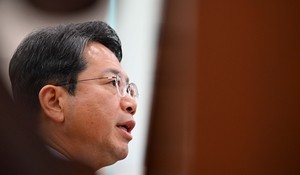
Lee's approval rating hits new low as majority oppose Kim Seung-won nomination: poll
KSOI 31st regular poll results 52.1% oppose appointing Kim Seung-won as justice minister; 25.1% in favor Opposition majority in all regions except Honam President Lee Jae Myung's approval rating falls 5.3 percentage points to 35.9% A poll released Wednesday found that a majority of respondents oppose the appointment of Kim Seung-won as justice minister, as his confirmation hearing wrapped up. The same survey showed President Lee Jae Myung's approval rating falling to a new low. The Korea Society Opinion Institute (KSOI) surveyed 1,001 adults aged 18 and older nationwide Monday and Tuesday. Among respondents, 52.1 percent opposed Kim's appointment — 27.0 percentage points higher than the 25.1 percent who supported it — while 22.8 percent said they were unsure. The survey used an automated response system on mobile phones, with a confidence level of 95 percent, a margin of error of plus or minus 3.1 percentage points, and a response rate of 5.9 percent. Opposition to Kim's appointment outpaced support among both men and women by wide margins. Among male respondents, 54.9 percent opposed the appointment and 28.3 percent supported it; among female respondents, 49.5 percent opposed it and 21.9 percent supported it, making opposition stronger among men. The share of "unsure" responses was higher among women at 28.6 percent, compared with 16.8 percent among men. Opposition exceeded support across all age groups, with respondents aged 70 and older showing the strongest opposition at 60.2 percent against 19.0 percent in favor. Those in their 60s followed, with 59.9 percent opposed and 29.3 percent in favor, and those in their 30s came next at 55.3 percent opposed and 18.3 percent in favor. Support was highest among those in their 50s at 34.6 percent and those in their 40s at 33.2 percent. Respondents in their 20s recorded the highest rate of "unsure" answers at 45.1 percent. Opposition exceeded 50 percent in every region except Honam. The Daegu and North Gyeongsang Province area recorded the highest opposition at 58.7 percent, followed by Gangwon Province and Jeju at 56.8 percent, Seoul at 56.0 percent, Daejeon, Sejong and the Chungcheong provinces at 55.7 percent, Busan, Ulsan and South Gyeongsang Province at 52.4 percent, and Gyeonggi Province and Incheon at 51.7 percent. The South Jeolla Province, Gwangju and North Jeolla Province area was the only region where support outpaced opposition, at 40.6 percent in favor and 32.9 percent against. Among Democratic Party of Korea supporters, 52.2 percent backed Kim's appointment, while 84.1 percent of People Power Party supporters opposed it. Among independents, opposition dominated at 54.2 percent against 9.5 percent in favor. Among self-identified progressives, 43.6 percent supported the appointment and 29.3 percent opposed it; among conservatives, 11.9 percent supported it and 72.3 percent opposed it; and among moderates, 29.3 percent supported it and 56.2 percent opposed it. Meanwhile, President Lee's approval rating stood at 35.9 percent — down 5.3 percentage points from the previous survey and the lowest recorded by the same polling firm. His disapproval rating rose 5.5 percentage points to 59.4 percent. Lee's approval rating has been declining for two consecutive months since posting 54.7 percent in the second week of July. "With opposition to Kim's appointment surpassing 50 percent, the final decision on whether to proceed with the appointment is likely to have a significant impact on public assessments of the administration," KSOI said. "Given that the approval rating has fallen to a record low, the high level of opposition among moderates poses a considerable burden for the administration going forward."
Sept. 16, 2026
MOST READ
- 1KAIST develops high-performance bio-based adhesive using E. coli instead of petroleum
- 2Pope Leo XIV declines French honors and banquet, accepts only private meeting with Macron
- 3Daimler Truck unveils next-generation transport solutions at IAA 2026
- 4What was Rachmaninoff's performance fee? A 1928 price list tells all
- 5Samsung Biologics union's show of force backfires at the bargaining table
- 6APR says hair-loss treatment research published in international journal
-
WORLD
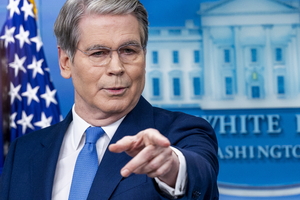
US warns of punishment for anyone enabling Iran's Strait of Hormuz toll scheme
-
INDUSTRY
Toyota union puts productivity first; Hyundai Motor union demands bigger share of profits
-
FINANCE

National Growth Fund to invest $531M in FuriosaAI, which rebuffed Meta's $800M takeover bid
-
INDUSTRY
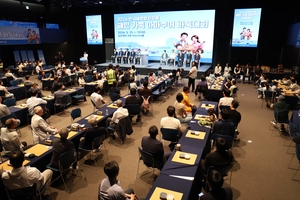
Korea Shipowners' Association holds amateur baduk tournament for Maritime Day