Budget adjustment subcommittee runs Monday through Friday; full committee vote set for Nov. 30
Opposition signals 27 trillion won in cuts; ruling party vows to hold total
New 162 trillion won Future Response Fund anchors key dispute
Calls to shift items to general account, cap self-revision authority
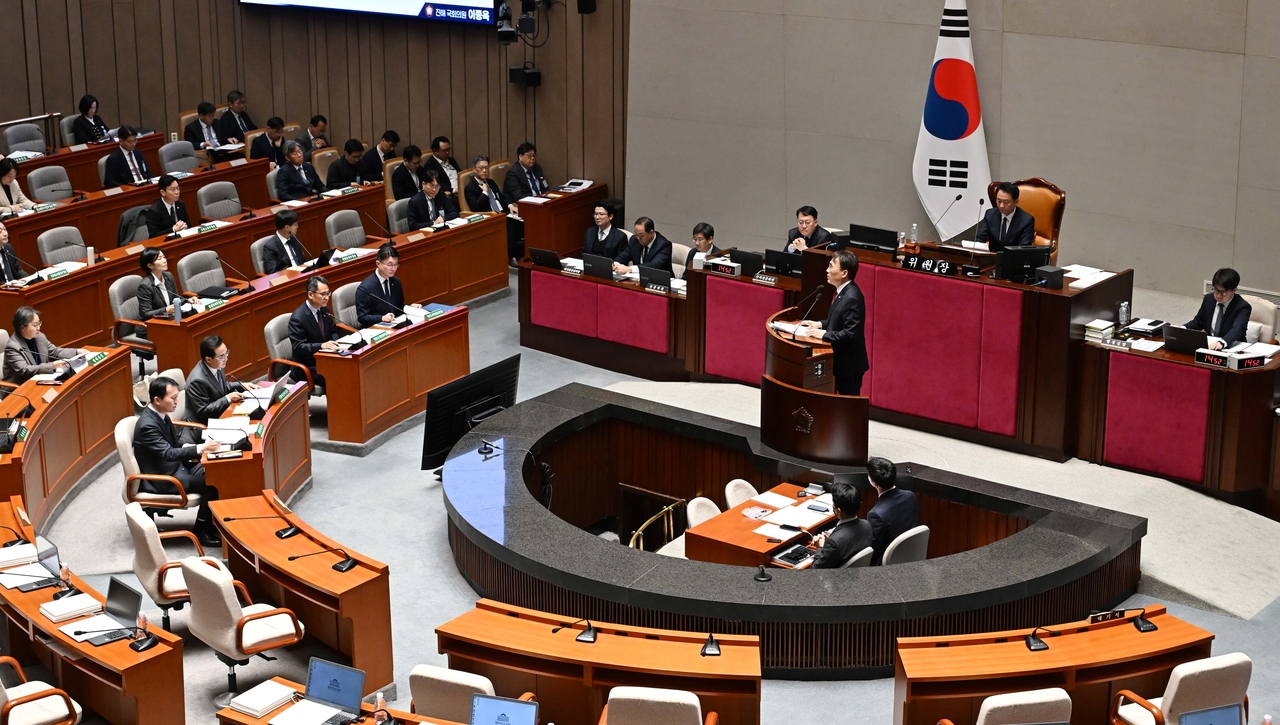
The National Assembly on Monday launched full-scale deliberations on next year's record 820 trillion won ($615 billion) budget proposal, with roughly two weeks remaining before the Dec. 2 legal deadline for passage. The People Power Party has signaled the need for cuts of around 27 trillion won, targeting a newly proposed 162 trillion won Future Response Fund among other items, while the Democratic Party of Korea has vowed to hold the total spending level — setting the stage for a difficult negotiation.
The Special Committee on Budget and Accounts opened its budget adjustment subcommittee Monday, with sessions running through Friday. The subcommittee will decide on increases and decreases to major government projects and budget items that have already undergone preliminary review by standing committees. Next year's budget proposal represents a 12.8 percent increase over this year's, with both the growth rate and total size at record highs.
The full committee had earlier completed a series of preliminary hearings — general policy questions from Nov. 4 to 5, economic ministry reviews from Nov. 9 to 10, and non-economic ministry reviews from Nov. 11 to 12. The subcommittee begins Monday with materials from the Agriculture, Fisheries and Food Committee, the Political Affairs Committee, and the Science and Technology Committee, which completed their preliminary reviews and voted on their findings that day. Reviews of the Trade, Industry and Energy Committee, the Health and Welfare Committee, and the Culture and Sports Committee follow Tuesday, with the Education Committee, the Defense Committee, and the Public Administration and Security Committee scheduled for Wednesday.
Other standing committees will be reviewed in sequence depending on when they complete their votes. The ruling party plans to hold a full Budget and Accounts Committee plenary session on Nov. 30 to pass the budget proposal and meet the Dec. 2 legal deadline.
The central flashpoint in this year's budget review is expected to be the proposed Future Response Fund — a roughly 162 trillion won vehicle to be financed by surplus and additional tax revenues generated by the semiconductor boom. The fund is structured around four program accounts covering youth, growth engines, education and regional development, totaling about 43.4 trillion won in project expenditures, along with 12.5 trillion won in non-project outlays such as reduced new government bond issuance, and 104.4 trillion won in reserve funds.
The Democratic Party has framed the Future Response Fund as both a foundation for growth and a buffer against future revenue shortfalls, and plans to maintain the total amount even as individual line items are adjusted. The People Power Party, by contrast, is pushing for sweeping cuts.
Members of the People Power Party's fiscal and economic planning committee and the Budget and Accounts Committee held an emergency joint news conference at the National Assembly on Sunday, criticizing the fund sharply. "They issued as much as 100.1 trillion won in government bonds to pocket 104.4 trillion won as the administration's personal slush fund, holding young people's futures hostage," they said. "The 162.3 trillion won Future Response Fund flies directly in the face of that principle."
Criticism from within the ruling party itself — that some programs included in the fund do not fit its stated purpose — has lent weight to expectations that revisions will be made during the subcommittee review. The Health and Welfare Committee agreed Friday, with bipartisan support, to attach a supplementary opinion calling for items such as the basic child allowance and childbirth support grants to be transferred from the Future Response Fund to the general account. The rationale is that programs requiring multi-year funding should not be placed in a one-time vehicle like the Future Response Fund.
Concern has also emerged over a provision allowing project expenditures from the Future Response Fund to be increased without National Assembly approval. Up to 30 percent of the roughly 45.4 trillion won in project outlays could be revised unilaterally, meaning as much as 13.62 trillion won could theoretically be added without legislative sign-off. Under current law, financial funds may self-revise by up to 30 percent, while project-type funds like the Future Response Fund are capped at 20 percent. Given criticism that the provision infringes on the Assembly's budget deliberation and approval authority, there is growing speculation that the self-revision ceiling for the Future Response Fund will be adjusted during the subcommittee process.
Demands for budget increases from within the Assembly add another layer of uncertainty. At the preliminary review stage, lawmakers' requests for additions are said to total around 25 trillion won, with cash-transfer programs and constituency projects expected to draw controversy. People Power Party floor leader Jeong Jeom-sik has already instructed lawmakers from constituency districts to withdraw all their increase requests.
addressh@heraldcorp.com
raining@heraldcorp.com