
- HOME
- POLITICS
-
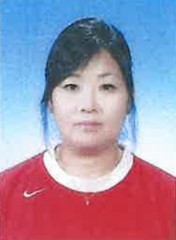
Four residents named winners of 38th Dongducheon Citizen Award
Heo Sun-ok (community service), Park Mi-ja (filial piety), Oh Jeong-hui (arts), Ma Sang-gil (sports) Dongducheon announced Friday that it has selected four recipients for the 38th Dongducheon Citizen Award, which honors residents who have dedicated themselves to the community with exceptional civic spirit. The award was first established in 1989 to recognize citizens who have enhanced the city's reputation and contributed to local development. Through last year, a total of 173 people have received the honor. This year's recipients are Heo Sun-ok in the community service category, Park Mi-ja in filial piety and good deeds, Oh Jeong-hui in culture and arts, and Ma Sang-gil in sports promotion. Heo, selected in the community service category, currently serves as women's chapter president of the Korea Freedom Federation's Dongducheon branch. She has actively led sharing initiatives for marginalized residents, environmental cleanup drives, care for vulnerable groups, and various volunteer activities. She is particularly recognized for her dedication to resolving residents' everyday difficulties and identifying welfare blind spots, contributing to local development and a broader culture of volunteerism. Park, selected in the filial piety and good deeds category, has cared for her parents-in-law over many years and serves as the head of the sixth neighborhood unit in Sangpae-dong as well as a member of the Happiness Sharing Hands and Feet Volunteer Society. She attentively looks after elderly residents and neighbors in her community, and is recognized as a model of consistent generosity and service. Oh, selected in the culture and arts category, serves as senior vice chapter president of the Korea Entertainment Artists Federation's Dongducheon branch. She participates in a range of cultural events including Citizens' Day, arts festivals and song competitions, and continues her community service through outreach performances at welfare centers and care facilities. She is also credited with helping spread popular culture and raising Dongducheon's profile nationally. Ma, selected in the sports promotion category, has served as president of the Dongducheon Volleyball Association, leading the sport's development in the city with notable passion and commitment. He is recognized for his significant contributions to local athletics through player development, expanding recreational participation and organizing various sporting events. The four recipients will receive their award certificates and medals at the Citizens' Day ceremony at the city civic hall on Oct. 2.
Sept. 18, 2026
-
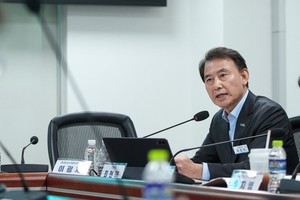
Namyangju mayor calls for protecting local fiscal autonomy amid new national fund plan
Choi attends emergency seminar on 2027 government budget as local government representative Namyangju Mayor Choi Hyun-deok has stepped forward to defend local fiscal autonomy amid growing concerns that the central government's plan to establish a new Future Response Fund could squeeze local government finances. Choi attended an emergency seminar on the 2027 government budget held at the National Assembly on Thursday as a representative discussant for local governments, raising concerns about the fund's potential impact on local allocation tax revenues and proposing directions for institutional reform. The seminar was jointly organized by the Democratic Party's Good Local Government Committee, chaired by lawmaker Yeom Tae-young, along with Fiscal Sovereignty Citizens' Action and the Narasallim Research Institute. The discussion brought together Choi, representatives from the Democratic Party's Basic Local Government Council, and officials from the Ministry of Planning and Budget and the Ministry of Interior and Safety to examine how the new fund would affect local finances and to debate the direction of fiscal decentralization. While acknowledging the need for the Future Response Fund, Choi said new national fiscal demands must not come at the expense of local government finances. He said that if the fund's revenue source were excluded from domestic taxes before calculating local allocation tax — as the government has proposed — the actual funds flowing to local governments could effectively shrink, even if the statutory rate of 19.24 percent were maintained, because the calculation base itself would be reduced. Choi said local allocation tax is a core source of local government revenue that helps narrow fiscal disparities between regions and ensures basic administrative services are available nationwide, and that a stable fiscal foundation commensurate with local governments' expanding roles and responsibilities is essential. He added that while investment to prepare for the nation's future is necessary, reducing funding for areas local governments are responsible for — such as livelihoods, welfare and public safety — would also weaken their capacity to prepare for the future. He said the creation of the Future Response Fund must not lead to a contraction of local finances. Choi also noted that Namyangju in particular faces continuously growing administrative demand in areas such as transportation, welfare, education and everyday infrastructure due to the development of a third-generation new town and a rising population. A reduction in local allocation tax, he said, could go beyond a simple drop in revenue and undermine the city's ability to carry out essential projects directly tied to residents' daily lives. Choi went beyond raising concerns and put forward specific institutional reform proposals for securing a stable local fiscal base: guaranteeing local allocation tax revenue before any transfer into the Future Response Fund, separately compensating for any reduction in local allocation tax resulting from the fund's creation, and institutionalizing local government participation in the fund's formation and operation as well as a review of its impact on fiscal decentralization. "Preparing for the nation's future and protecting local fiscal autonomy must go hand in hand," Choi said. "Guaranteeing a stable fiscal foundation so that local governments can fulfill their roles is ultimately about protecting the lives of the people and the future of South Korea." He added that he would continue to actively call on the National Assembly and the central government to incorporate local governments' voices into national fiscal policy and to advocate for genuine fiscal decentralization.
Sept. 17, 2026
-
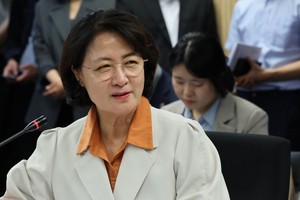
Choo Mi-ae: 'I'm not getting kicked out'
Gyeonggi Province Governor Choo Mi-ae, who is facing a public petition calling for her resignation, compared herself to a daughter-in-law who had married into the province and declared she would not be forced out. According to Gyeonggi Province, Choo made the remarks Tuesday at the "Gyeonggi Real Estate Conference 2026," held at Dasan Hall in the provincial government building, while discussing the province's fiscal situation. "I thought coming to Gyeonggi Province would be like marrying into a wealthy family," she said. "But once I took charge of the household, I found the safe had been emptied and there were piles of debt." Choo went on to say that some people were trying to drive her out. "I am also something of a strict conservative," she said. "Responsibility comes first." Choo also described the fiscal situation she inherited after taking office. "It is already September, and the budget only covers through September — there are no allocations set for October, November or December," she said. "That is the ledger I was handed." Even so, Choo said the province could not afford to stop working simply because it lacked funds. "I, Choo Mi-ae, am not getting kicked out," she said. Meanwhile, ahead of the conference, Gyeonggi Province changed the status of a petition titled "We petition for the resignation of Governor Choo Mi-ae" to "response completed" on its petition board, halting further signatures. At the time the petition was closed, it had gathered 30,775 signatures.
Sept. 17, 2026
-
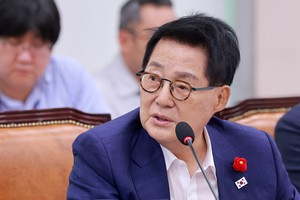
Park Ji-won urges Cho Kuk to 'enter the tiger's den and become a tiger'
Democratic Party of Korea lawmaker Park Ji-won has urged Cho Kuk, head of the Rebuilding Korea Party's policy research institute, to join the Democratic Party if he harbors greater political ambitions. Speaking in an interview with KBS Radio's "Jeongyeok Sisa" on Thursday, Park suggested Cho would be better served by joining the larger party. "Can you really become president by running as the Rebuilding Korea Party's presidential candidate?" Park said. "It would be better to come into the tiger's den and work to become a tiger." Park made the remarks while noting that Cho was not someone who merely aspired to a single National Assembly seat. "Come into the tiger's den — come to the Democratic Party — and work to become a tiger there," Park said. "Acting petulantly and throwing tantrums from the outside will absolutely not help your political career." Park also pushed back on Cho's recent criticism of the Democratic Party. "We have walked the same path and share the same goals, but there can be differences in interests on the details," he said. "Labeling us a 'red team' or making similar complaints over that amounts to nothing more than venting frustration over losing in Pyeongtaek." "Acting irritably and spitefully from the outside, the way he is doing now, will absolutely not help his political career," Park added. "I say this because I respect and care for Director Cho."
Sept. 17, 2026
-
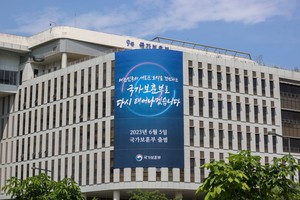
Cyberattacks targeting veterans ministry surge as AI review system raises data security concerns
Ministry detected and blocked 3,994 attacks through July this year AI-based reviews and Defense Ministry network link raise fears over military data leaks Attempted cyberattacks targeting the Ministry of Patriots and Veterans Affairs have reached 3,994 cases through July this year, raising alarms over the protection of sensitive personal data as the government moves to introduce AI-based benefit reviews and link its systems with the Ministry of National Defense. The figures were disclosed Thursday by People Power Party Rep. Yoo Yong-won, a member of the National Assembly's National Defense Committee, based on data submitted by the ministry. The 3,994 attacks detected and blocked in the first seven months of this year have already more than doubled the 1,627 recorded for all of last year. By attack type, attempts classified as "information exfiltration" were the most common at 1,645 cases, followed by "system privilege escalation" at 854, "information gathering" at 639, "website defacement" at 465 and "unauthorized access attempts" at 202. "Information exfiltration" refers to the classification of the attack attempt and does not mean data was actually stolen. The ministry said in its submission that there have been zero security breaches from 2021 through July this year, with no confirmed data leaks or system disruptions. However, the sharp rise in attack attempts is seen as a persistent risk that could translate into actual data theft at any time. Amid this, the government is pushing ahead with an AI-based review system that draws on accumulated veterans benefit data. The ministry has outlined plans to use AI to assist with document searches and draft review submissions, and to provide integrated support — from treatment to veterans registration — by linking its network with the Defense Ministry. The plans have prompted calls for careful management of service-related information belonging to applicants with military backgrounds. Particularly, if review materials include the unit affiliations or mission details of personnel who served in special operations, intelligence or counterintelligence roles, the data would require protection not just as personal information but as a matter of military security. There are also concerns that combining multiple data points could create clues allowing sensitive service histories to be reconstructed. "As we work to make the veterans review process more convenient and efficient, we also need to examine the scope of sensitive data being processed, who has access to it, and what safeguards are in place," Yoo said. "A thorough information security and response framework must be established proactively."
Sept. 17, 2026
-
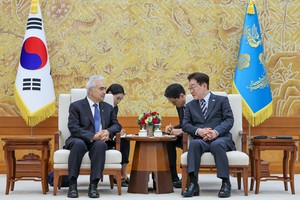
IEA chief calls South Korea's electrification policy 'global model' in meeting with Lee
Birol praises Korea's battery, grid supply chain; says renewables should lead with nuclear in support role President Lee Jae Myung met with International Energy Agency Executive Director Fatih Birol at Cheong Wa Dae on Thursday to discuss responses to instability in the Middle East and the global climate crisis. Birol praised South Korea's electrification policies and industrial capabilities as a model for the world. Cheong Wa Dae Chief Spokesperson Kang Yu-jung said in a written briefing that Lee and Birol held in-depth discussions on global energy industry and policy trends, ways to strengthen energy security through electrification, and new directions for energy security cooperation in the Asia-Pacific region. Lee opened by expressing support for the IEA's efforts to overcome the global energy crisis, then said South Korea was also facing difficulties in its energy transition — centered on renewable energy — due to the war in the Middle East, and asked about the international community's response strategies. Birol said countries around the world have adopted electrification as a core strategy in response to the Middle East war, seeking to reduce fossil fuel imports and maximize domestic power production. He added that "electrification can simultaneously achieve three goals: securing energy sovereignty, strengthening economic security, and addressing the climate crisis." Birol identified South Korea's energy policy as a global model and cited three specific strengths. He praised the country for minimizing the domestic impact of the Middle East war through bold measures in transportation and logistics beyond financial and fiscal steps, for placing electrification at the center of its policy agenda while building a supply chain of battery, heavy electrical equipment and power grid companies, and for actively supporting electrification efforts in developing countries across Asia. Birol then said he plans to present a target at COP31, the 31st UN Climate Change Conference to be held in Turkey this year, of raising electricity's share of energy consumption from the current 23 percent to 35 percent by 2035. He said that if many countries join the effort, it could also drive changes in financial markets. The two also exchanged views on nuclear power. When Lee noted that countries appear to be returning to fossil fuels and deepening their reliance on nuclear energy in the wake of the Middle East war and asked for Birol's assessment, Birol said France, Sweden, the United Kingdom and the Netherlands are expanding new nuclear capacity while maintaining their existing plants. He added that "while renewable energy will firmly establish itself as the primary power source, nuclear power, if operated in a supplementary role, can also help reduce dependence on fossil fuels and contribute to cutting greenhouse gas emissions." Birol also said that alongside falling electric vehicle prices, South Korea's automotive and battery manufacturing base has the potential to lead the electrification of the transportation sector worldwide. Lee stressed the need for joint cooperation to strengthen energy supply chain resilience in the Asia-Pacific region, and said South Korea would work closely with the IEA to actively support energy capacity building across the region.
Sept. 17, 2026
-
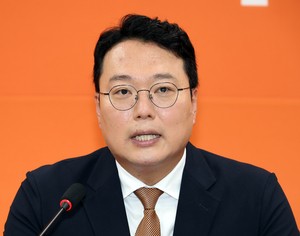
Reform Party's Cheon pushes back on call to run in Gyeonggi, says 'Suncheon is my only political base'
Reform Party floor leader Cheon Ha-ram pushed back Thursday against a directive from emergency committee chief Lee Gi-in, who formally called on the party's proportional-representation lawmakers to run in southern Gyeonggi Province at the next general election, saying his political base lies solely in Suncheon. Cheon wrote on Facebook that being told not to run in Suncheon in the next general election was "like a bolt from the blue," reiterating that Suncheon is his only political home. "I entered politics in 2020 and ran in Suncheon-gap from the very start," he said. "I was a young man from Daegu — a city known as the heartland of conservatism — but it was a decision I made with nothing but the conviction to break the ruinous regional divide between the Yeongnam and Honam areas." He added that he was determined to win a direct mandate from Suncheon voters in the next general election. "I believe that is the right way to repay the Suncheon citizens who have trusted and supported me, and the path that honors the party's greater intention in placing me on the proportional list so that I could continue doing politics in the Honam region," he said. Earlier, Lee had unveiled a party reform plan that included a directive reassigning incumbent proportional-representation lawmakers to different electoral districts. Lee rejected Cheon's application to chair the Suncheon organizing committee and formally called on both Cheon and fellow lawmaker Lee Ju-young to run in southern Gyeonggi Province. "I understand the weight of the ties and efforts he has built in Suncheon," Lee said of Cheon. "But now that the party's strategic priorities have been set, the floor leader must be the first to rally behind that decision." Lee warned that if the directive was not followed, he would exercise his authority as emergency committee chief under the party's rules and bylaws.
Sept. 17, 2026
-
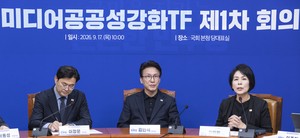
Democratic Party launches media TF, vows to pass media bills in regular session
Kim Min-seok says party will work to create 'fair media environment' from the public's perspective The Democratic Party of Korea announced Thursday it will push to pass a series of media-related bills — including revisions to the Government Advertising Act and the Newspaper Act — during the current regular session of the National Assembly. Party leader Kim Min-seok made the pledge at the inaugural meeting of the Democratic Party's Media Public Interest Strengthening TF, held at the National Assembly on Thursday. "We will make every effort to be good messengers ourselves by putting out good messages, and we will look at all issues from the public's perspective," he said. Kim said the party must "create an environment in which information is conveyed fairly and accurately — not from the standpoint of politics or a political party, but from the standpoint of the public." He added that while the TF would focus on structural problems as its foundation, it would also "resolve clearly distorted issues, such as the recent normalization of YTN and TBS, accurately and with a sense of stability." The TF identified its key legislative priorities as amendments to the Government Advertising Act, the News Agency Promotion Act, the Press Arbitration Act and the Newspaper Act, setting a goal of passing all of them on the National Assembly floor during the current regular session. Rep. Choi Min-hee, who heads the TF, said there is "deep concern that press freedom and the function of the public sphere are not working," adding that she hopes "the media reform legislation will strengthen media public interest and, above all, contribute to forming a public sphere." Rep. Noh Jong-myeon, who leads her party's side on the committee, said the TF would "conduct a comprehensive review of the situation following the passage of the three broadcasting bills and the revision to the Act on Promotion of Information and Communications Network Utilization and Information Protection." He added that the group would "accurately identify and correct the gaps between what the law requires and what is happening in reality."
Sept. 17, 2026
-
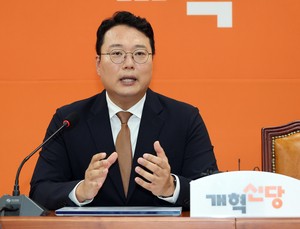
Cheon Ha-ram urges party chief to reconsider rejection of his Suncheon candidacy application
Lee Ki-in proposes Cheon run in southern Gyeonggi Province instead Cheon says Suncheon is his only political base, calls move 'thunderbolt' Reform Party floor leader Cheon Ha-ram on Thursday urged party emergency committee chief Lee Ki-in to reconsider the rejection of his application to serve as the party's Suncheon-gap district organizing committee chair. In a Facebook post that day, Cheon said being discouraged from running in Suncheon in the next general election was "like a bolt from the blue." Earlier Thursday, Lee announced a party reform plan at the National Assembly, saying he would reject Cheon's application for the Suncheon-gap organizing committee chair post. "I understand the weight of the ties and efforts you have built in Suncheon," Lee said. "But now that the party's strategic base has been set, the floor leader must be the first to rally behind that decision." Lee had designated southern Gyeonggi Province as the Reform Party's strategic stronghold and asked Cheon to "make the decision to run there," but Cheon responded by calling for a review. Cheon stressed the importance of Suncheon to his political career. "I ran in Suncheon-gap when I first entered politics in 2020," he said. As a young politician from Daegu — known as the heartland of conservatism — he said he had made that choice driven solely by a determination to break the destructive regional divide between the Gyeongsang and Jeolla provinces. "My wife, father-in-law and mother-in-law all relocated to Suncheon to help with the campaign, and I take pride in having planted seeds of meaningful change, however modest," he said. "That has been the greatest source of strength sustaining me as a politician to this day." Cheon doubled down on Suncheon as his political base. Even after winning a proportional-representation seat for the Reform Party in the 22nd general election, he said, he had maintained his post as the Suncheon-gap party chapter chair, opened a local office immediately after his election and hired a paid regional coordinator to keep up his activities there. "I am determined to win a direct mandate from the people of Suncheon in the next general election," he added. "I believe that is the right way to repay the citizens of Suncheon who have trusted and supported me, and the path that honors the party's greater vision — the vision that placed me on the proportional list so I could continue doing politics in the Honam region." Cheon appealed directly to Lee. "I urge Chairman Lee once more," he said. "Not out of personal ambition, but for the sake of my promise to the people of Suncheon and the greater future of the Reform Party — please reconsider the rejection of my Suncheon-gap organizing committee chair application."
Sept. 17, 2026
-
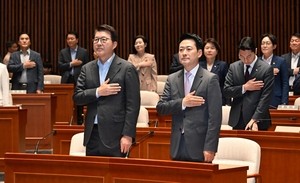
PPP endorses abolition of early voting, other National Election Commission reforms
The People Power Party has adopted as official party policy a set of National Election Commission reform measures, including the abolition of early voting and an expansion of the number of standing election commissioners. The party also decided to pursue the exclusion of judges from serving as election commissioners. Floor spokesperson Kim Tae-gyu announced the decisions at a briefing following a general assembly of PPP lawmakers held at the National Assembly on Thursday. The PPP had earlier formed an internal task force following a ballot shortage during the June 3 local elections to discuss reforms to the National Election Commission and improvements to the electoral system. Under the electoral law revision proposals finalized at Thursday's assembly, the party called for abolishing early voting and requiring that ballots be printed at 100 percent of the registered voter count. The proposals also call for simultaneous manual counting at polling stations and real-time tallying of results. They include a provision for automatic recounts if a discrepancy of 0.5 percentage points is detected during monitoring of the entire voting process. "The proposals were drawn up with a focus on ensuring fairness, objectivity and the protection of trust in the voting process," Kim said. The party said it would determine through further deliberations in the relevant standing committee whether, if early voting is abolished, Election Day should remain a single day as it currently stands or be extended to two days. On the commission's structure, the party decided to maintain the current arrangement — in which the heads of the central and provincial election commissions serve as standing officials while those at the city, district and county level serve in non-standing roles — but to bar judges and court civil servants from those positions. In addition, the party called for three of the nine central election commissioners — the chairperson and two vice chairpersons — to serve as full-time officials.
Sept. 17, 2026
-
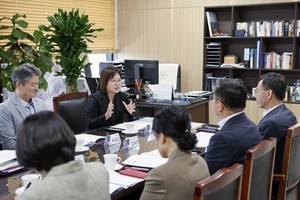
Yeongjong district mayor calls for administrative, fiscal support to keep pace with rapid growth
Yeongjong District Mayor Son Hwa-jeong has moved to address the lag in residential infrastructure development that has failed to keep pace with rapid population growth in Yeongjong International City. Son held a meeting with the Incheon Free Economic Zone Authority at her district office on Wednesday, calling for proactive administrative and fiscal support to resolve pressing issues including a shortage of public parking and a lack of essential community facilities. Much of the land in the Yeongjong area falls within a designated free economic zone, concentrating key powers — including development plan approval, licensing and land disposal — as well as land ownership in the hands of the Incheon Free Economic Zone Authority. That arrangement has long been cited as a structural constraint, leaving the district unable to respond directly to residents' essential needs and forcing it to wait on the authority's decisions even when urgent projects arise. To overcome those limitations, Son called for administrative cooperation, including the provision of sites for expanding community facilities directly tied to residents' welfare and the use of authority-owned land for public parking lots. The intent is to secure the spatial foundation that would allow the district to proactively build infrastructure in line with rapidly growing administrative and welfare demands. Son also stressed the need for expanded fiscal support — including a broader city subsidy system — to meet the surge in demand for community infrastructure that has accompanied Yeongjong-gu's official launch as a district. Yeongjong-gu plans to work through the issues raised at the meeting via ongoing working-level consultations with the Incheon Free Economic Zone Authority and to monitor progress on each project. "The Yeongjong area has long had its land and key powers tied up in the free economic zone, which has tended to push resident-centered projects to the back of the line," Son said. "I will work closely with the Incheon Free Economic Zone Authority to ensure the issues we raised translate into actual projects and deliver real improvements to residents' quality of life."
Sept. 17, 2026
-
Science ministry's AI budget tops W5tr, but hacking defense gets just 1.6% of that
'Security investment must grow alongside AI investment — I will press for answers at the national audit' The Ministry of Science and ICT's AI budget this year has surpassed 5 trillion won ($3.65 billion), but funding dedicated to countering hacking amounts to just 1.6 percent of that figure, according to a new analysis. Rep. Lee Hoon-gi of the Democratic Party of Korea, a member of the National Assembly's Science, Technology, Information, Broadcasting and Communications Committee, said Thursday that data obtained from the Ministry of Science and ICT showed the ministry's AI budget this year stands at 5.09 trillion won. By contrast, the budget for hacking prevention and response was limited to 79.06 billion won — just 1.6 percent of the AI allocation. According to Lee, the ministry's AI budget has grown rapidly over the past three years. It rose from 1.14 trillion won in 2024 to 3.41 trillion won last year, reaching 5.09 trillion won this year — a 345.9 percent increase from 2024. Over the same period, the hacking-response budget grew far more slowly, moving from 63.44 billion won in 2024 to 79.48 billion won in 2025 before slipping to 79.06 billion won this year — a cumulative increase of just 24.6 percent from 2024. As a share of the AI budget, hacking-response funding has fallen sharply: from 5.6 percent in 2024 to 2.3 percent in 2025 and 1.6 percent this year, reflecting a widening gap between the pace of AI spending and cybersecurity investment. The ministry's total information security and cybersecurity budget grew from 325.14 billion won in 2024 to 366.3 billion won this year, but its share of the AI budget fell from 28 percent to 7.2 percent over the same period. The Ministry of Science and ICT oversees not only the promotion of the AI industry but also information security and responses to hacking and cyber incidents. Its second-half work plan for this year listed investigations into private-sector hacking incidents, a comprehensive information security initiative, and the development of security-specialized AI models and vulnerability assessments as key priorities. Despite this, the ministry's hacking-response budget this year fell 423 million won — about 0.5 percent — from last year. "Expanding the budget to secure AI competitiveness is an absolutely necessary investment in the AI era," Lee said. "However, as AI use grows, so do hacking and cyber threats, which means security investment to keep that environment safe must also expand in tandem. At the upcoming national audit, I will press the government on specific measures and plans to strengthen the cybersecurity and incident-prevention budget."
Sept. 17, 2026
-
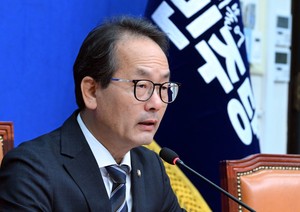
Kang Jun-hyeon retained as chair of Democratic Party's second-term lawmakers group
Lawmakers chose to keep Kang in the role at a Thursday luncheon instead of electing a successor "Re-elected on Thursday — I plan to map out a solid agenda going forward" Democratic Party of Korea lawmaker Kang Jun-hyeon will continue to lead Deominjae, the party's caucus of second-term lawmakers. Although a new chair had been expected to be chosen, members rallied behind Kang at a Thursday luncheon and re-nominated him for the role. "At a luncheon with the second-term lawmakers, we decided I would stay on," Kang said in a phone interview Thursday. "Re-elected on Thursday — I plan to map out a solid agenda going forward." Deominjae brings together all of the Democratic Party's second-term Assembly members. Kang has served as its chair, gathering members' views and acting as a liaison with party leadership. Kang had earlier signaled his intention to step down, and Deominjae had planned to select a successor by acclamation at Thursday's luncheon. The lawmakers present urged him to remain in the post, however, and he was re-nominated by consensus. Kang represents the Sejong B constituency and is a second-term lawmaker who served as Sejong City's political affairs deputy mayor before entering the 21st National Assembly in 2020 and winning re-election in the 2024 general election. He has served as chair of the Democratic Party's Sejong City chapter and as the party's chief spokesperson. In the 22nd National Assembly, he leads his party's side on the National Policy Committee. Deominjae was launched in February last year with the goal of achieving a change of government following the Dec. 3 emergency martial law declaration. Since the inauguration of the Lee Jae Myung administration, the group has worked to support the government and ruling party's policy agenda and to amplify second-term lawmakers' voices on internal party matters.
Sept. 17, 2026
-
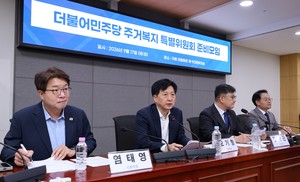
Democratic Party housing welfare committee vows to expand public rental housing to 2.5 million units
Democratic Party launches housing welfare committee — Rep. Kim Nam-geun chairs, Rep. Park Min-gyu leads party's side Public rental housing to rise from 8% to 10% of housing stock; quality upgrades through renovation and reconstruction Committee to secure dedicated staff and budgets; local-government-centered delivery system planned The Democratic Party of Korea's Special Committee on Housing Welfare announced Thursday that it plans to expand the country's public rental housing stock from about 1.94 million units to 2.5 million, and will introduce a new local housing welfare tax to fund dedicated staff and budgets at local governments. The committee held its inaugural preparatory meeting at the National Assembly members' office building Thursday. Rep. Kim Nam-geun was named chair and Rep. Park Min-gyu will lead the party's side on the committee. "The committee will work with the government to review the housing welfare policy roadmap and discuss how to supply housing for young people, newlyweds and seniors," Kim said. "We also plan to gather a wide range of opinions through consultations with housing welfare organizations on issues such as housing vouchers and social housing." Rep. Oh Gi-hyeong, who leads the ruling party's side on the Finance and Economy Committee, said public rental housing should eventually account for more than 20 percent of the total rental market. "We need to draw up a supply plan to achieve that, and the corresponding funding must also be secured — I believe it should be reflected starting from this year's budget discussions," he said. Oh added that the future response fund includes a youth category, and that direct allocation for youth and newlywed housing must continue to be discussed. Rep. Heo Yeong, the Democratic Party's senior deputy chair for policy, said government-funded housing welfare and supply for senior housing — to support a second life after retirement — is urgently needed. "At the moment, only high-priced rental and pre-sale models operated by a handful of large conglomerates exist in the domestic market," he said. Speaking to reporters after the meeting, Kim said the committee would shift public rental housing policy from a supply-side focus to one centered on the needs of residents. "In major advanced countries, about 10 percent of the existing housing stock is supplied as public housing, but we are currently at around 8 percent with 1.94 million units," Kim said. "We will bring that up to 2.5 million units, or about 10 percent." He added that housing around 15 years old would be upgraded through renovation projects, while units more than 30 years old would be rebuilt to supply a greater quantity of high-quality public housing. Rep. Yeom Tae-young, who chairs the party's Good Local Government Committee, said the proposal was to introduce a local housing welfare tax to assign dedicated personnel and provide budget support to local governments for housing welfare. "There was broad consensus on establishing a local-government-centered housing welfare delivery system," he said. "We will concentrate the currently fragmented housing welfare functions into regional housing welfare centers and encourage their mandatory establishment."
Sept. 17, 2026
-
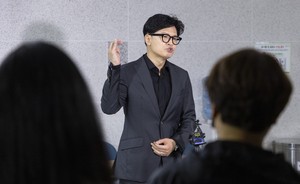
Han Dong-hoon says president's plunging trust rating more alarming than his own No. 1 ranking
Han tops Gallup Korea poll of most trusted politicians Says appointing Kim Seung-won would send president's trust rating 'to the basement' 'I'd also like to crash Friday's presidential press conference and ask about the oppa poison lobby' Independent lawmaker Han Dong-hoon said Wednesday that a poll showing him as the most trusted politician in South Korea pointed to a more troubling finding: the sitting president's trust rating has collapsed. Han shared the results of the "2026 Korea Trust Survey," conducted by Gallup Korea on behalf of the magazine Sisain, on his Facebook page, saying, "If President Lee appoints Kim Seung-won of the 'oppa poison lobby,' the president's trust rating will sink to the basement." In a separate Facebook post, Han said he would "look only to the people and move forward without wavering," adding, "I truly want to earn even greater trust from the public." He also took aim at President Lee Jae Myung's press conference scheduled for Friday, writing: "The Lee Jae Myung administration had a prime minister's office section chief impersonate a journalist and a civilian to crash National Assembly member Han Dong-hoon's press conference — I'd also like to crash Friday's press conference and ask about the oppa poison lobby." He then posed a direct question: "Did President Lee choose Kim Seung-won knowing about the oppa poison lobby?" The survey, conducted by Gallup Korea on behalf of Sisain from Sept. 6 to 8 among 1,013 men and women aged 18 and older residing nationwide, was released Wednesday. When asked in an open-ended question which currently active politician among the ruling and opposition parties they trusted most, 39.3 percent of respondents answered "none, don't know, or refused to answer" — the highest share of any response. Excluding that group, Han received 11.4 percent of responses, making him the most trusted politician in the survey. President Lee, who had held the top spot unchallenged since 2021, ceded the No. 1 position to Han for the first time. The same survey also found that distrust of President Lee outweighed trust. Some 50.4 percent of respondents said they distrust the president, while those who said they trust him was limited to 35.9 percent. Another 12.6 percent were neutral. Last year, trust in President Lee stood at 51.2 percent, outpacing distrust at 34.1 percent. On a trust score scale of 0 to 10, President Lee recorded 4.19 points, down 1.35 points from 5.54 last year. Sisain said the drop in President Lee's trust score was the second largest in the survey's history, behind only former President Park Geun-hye, whose score fell sharply from 5.39 to 3.91 in 2016. The survey was conducted via telephone interviews using a dual-frame method combining household landline random-digit dialing and mobile phone random-digit dialing. The margin of error is plus or minus 3.1 percentage points at the 95 percent confidence level, and the response rate was 8.7 percent. Further details are available on the website of the National Election Survey Deliberation Commission.
Sept. 17, 2026
-
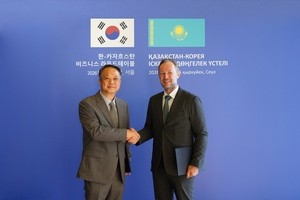
UMV Technology CEO calls for stronger AI cybersecurity rules as attacks grow more sophisticated
Bang Yun-seong proposes continuous vulnerability checks, incident reporting and threat sharing as priority measures; UMV Technology signs MOU with Kazakhstan's AGTECH for localized security software As AI-powered cyberattacks grow increasingly sophisticated, calls are mounting for companies and public institutions to strengthen their security capabilities and overhaul related laws and regulations. As AI adoption accelerates, vulnerability management and incident-response frameworks must be reinforced in tandem, experts say. Bang Yun-seong, CEO of UMV Technology, made the case at the Korea-Kazakhstan Business Roundtable held Tuesday in Seoul on the sidelines of a Korea-Kazakhstan summit. "As the speed and scale of AI-driven attacks expand, we must move quickly to strengthen our security preparedness," Bang said. "Alongside technological development, it is urgent to establish security standards that work in practice and to clarify legal accountability." Bang identified continuous vulnerability checks and security updates for critical systems, mandatory incident reporting, and threat-intelligence sharing as top priorities. He said security responsibilities should be clearly defined for AI developers, service operators and user organizations alike, with inspection and verification standards calibrated to risk level. He added that small and medium-sized enterprises, which tend to have fewer security personnel and smaller budgets, need dedicated technical support. "Security regulations should be designed to verify whether they can actually detect attacks and contain the spread of damage," Bang said. "We need to move quickly to review the scope and overlaps in existing legislation and to codify the necessary security obligations and support mechanisms into law." Overseas cybersecurity authorities have also warned that advances in AI could shorten the window available to respond to cyberattacks. Canada's Centre for Cyber Security said in June that advanced AI could accelerate the discovery and exploitation of vulnerabilities. The United Kingdom's National Cyber Security Centre has similarly projected that AI could amplify the scale and impact of cyber intrusions by 2027. UMV Technology also signed an MOU with Kazakhstan's AGTECH on Tuesday for local technology cooperation. The two companies plan to develop security software tailored to Kazakhstan's operating environment and technical standards. "For South Korea to earn trust as an AI powerhouse, it must also demonstrate the capability to operate and protect AI safely," Bang said. "We will contribute to strengthening domestic security capabilities and share the AI security technology and operational experience we accumulate in that process with Kazakhstan."
Sept. 17, 2026
-
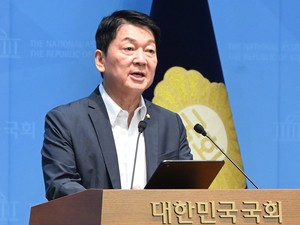
Ahn Cheol-soo says government 'accepted' deletion of North Korea contact safeguard, abandoning security responsibility
Unification Ministry offers no replacement safeguard, raising fears of security gaps 'Opening civilian exchanges and closing the state's eyes are entirely different matters' The National Intelligence Service and the Ministry of Justice have shifted their positions from "careful review" to "acceptance" of a proposal to delete a legal provision that allows authorities to block contacts with North Koreans deemed a threat to national security, it has been confirmed. Opposition lawmakers have raised concerns that removing the safeguard without a replacement could leave a dangerous gap in national security. According to documents submitted to People Power Party lawmaker Ahn Cheol-soo of the National Assembly's Foreign Affairs and Unification Committee, the Ministry of Unification, the NIS and the Ministry of Justice have all agreed to accept a proposed National Assembly amendment that would delete Article 9-2, Paragraph 3 of the Inter-Korean Exchange and Cooperation Act. The provision allows the minister of unification to refuse a prior notification of contact with a North Korean resident when there is a clear risk that such contact could harm inter-Korean exchange and cooperation, national security, public order or public welfare. An analysis of documents submitted by the Unification Ministry shows that 86 prior notifications of contact with North Korean residents were rejected under the provision between 2022 and the first half of 2025 — four in 2022, 40 in 2023, 26 in 2024 and 16 in the first half of this year. The Unification Ministry has been implementing a policy of "fully permitting private-sector contact with North Korea" since last July. In line with that policy, it had already accepted the amendment to delete the legal safeguard that had served as the basis for rejecting those 86 contacts. The Ministry of Justice and the NIS had initially been cautious about deleting the provision. Last year, the Justice Ministry submitted an opinion to the National Assembly stating that "it would be desirable to specify the grounds for refusal more concretely," while the NIS said "consideration should be given to the fact that abolishing the indirect-contact notification requirement would heighten the risk of exploitation by North Korea's operations against the South, posing a threat to national security." However, an interagency meeting convened by the Unification Ministry in February led the Justice Ministry and the NIS to reverse their positions, deferring to the ministry's "acceptance" stance. If the provision is deleted, the Unification Ministry would lose its direct legal basis for rejecting a prior notification of contact — even when the contact involves a North Korean intelligence operative or an unidentified individual — on the grounds that it poses a clear risk to national security. Gaps in the management of North Korea contacts have persisted even under the current notification system. According to documents submitted by the Unification Ministry, 33 violations of laws and regulations related to contact with North Korean residents were detected between July 2021 and June 2026, resulting in 10 fines and 23 written warnings. Five of the cases subject to fines involved unauthorized contact with members of Chongryon, the pro-Pyongyang General Association of Korean Residents in Japan, with at least eight individuals implicated. The government intends to remove the legal basis that previously allowed it to screen out 86 contacts on national security grounds. Critics say, however, that no alternative mechanism has been proposed to preemptively block dangerous contacts involving North Korean intelligence operatives or unidentified individuals. In response, the Unification Ministry said it would "respond strictly in accordance with relevant laws and regulations if actual security-threatening acts are confirmed during the contact process" — in effect signaling a shift to reactive measures only after problems or harmful acts have already occurred. Ahn said the NIS and the Ministry of Justice "must explain why they reversed course and agreed to delete the legal safeguard, and whether they conducted their own independent security and legal reviews." He added that "if they simply followed the Unification Ministry's position, they have abandoned their responsibility for independent review as agencies charged with protecting national security and the rule of law." Ahn went on to say that "opening and expanding the door to civilian exchanges is an entirely different matter from the state closing its eyes," and that "before stripping away the legal authority to preemptively block contacts that pose obvious risks, the government must first present the public with concrete countermeasures."
Sept. 17, 2026
-

National Assembly approves nomination of Supreme Court Justice nominee Kim Sung-su
Sept. 17, 2026
-
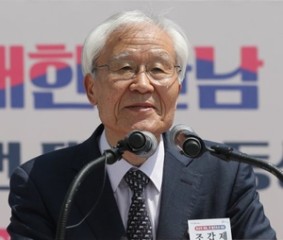
Cho Gab-je warns Lee's approval rating could fall to 20s if Democratic Party 'degenerates' go unchecked
Conservative commentator Cho Gab-je, head of Chogabje.com, urged President Lee Jae Myung ahead of a press conference scheduled for Friday to withdraw the nomination of Kim Seung-won as justice minister candidate and to make clear that no criminal charges will be dropped. Cho wrote on his Facebook page Thursday that the affair amounted to "a case of lobbying for a toxic new drug, a case of suppressing a public-interest whistleblower — Han Dong-hoon — and a case of threatening public health." He said the "Lee Jae Myung Democratic Party administration has abandoned its duty to protect law-abiding citizens and is siding with wrongdoers," adding that "civic action is now needed at the level of national survival." He warned that if the situation escalates into state suppression of the public, "the right of popular resistance may be called for," and added that "rational citizens who oppose Yoon Suk Yeol and the theory of a by-election conspiracy will take the lead." Cho urged that the president's press conference on Friday produce four clear positions: first, that no criminal charges will be withdrawn; second, that the nomination of Kim as justice minister candidate will be rescinded; third, that the clinical administration of a toxic new drug to 93 patients will be immediately investigated and the Ministry of Food and Drug Safety audited; and fourth, that the Democratic Party's threats against the public-interest whistleblower will be stopped. He said that if Lee fails to take a clear stance, the president could face a backlash similar to the one that befell Lee Ki-bung, the former Liberal Party vice-presidential candidate. "Lee Ki-bung, the Liberal Party's vice-presidential candidate-elect, said of the incident in which police opened fire on protesters in Masan, killing and wounding dozens, 'Guns weren't given to be played with,'" Cho wrote. "That remark enraged the public and brought on the April 19 Revolution. If the president cannot rein in the Democratic Party degenerates who are now stoking public fury, his approval rating will fall into the 20s — and if that happens, serious internal strife will break out within the Democratic Party," he warned. He added that a prediction made three months ago by lawmaker Han Dong-hoon — that the Jung Chung-rae faction might move to impeach Lee Jae Myung — "has begun to feel real." He also said, "Naive Koreans will applaud if President Lee makes a U-turn. People may curse, but no one prays for the country to collapse."
Sept. 17, 2026
-
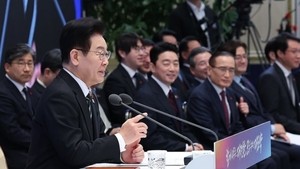
Lee buries himself in prep work day before press conference
Presidential press conference set for Friday Lee reviews expected questions, works on model answers ahead of event President Lee Jae Myung has entered full preparation mode ahead of a press conference scheduled for Friday. According to Cheong Wa Dae, Lee has no outside engagements Thursday and is expected to spend the day in his office focused entirely on preparing for the event. He is reviewing lists of anticipated questions compiled by each senior secretariat office, refining his responses and working through model answers in a final push before the conference. Cheong Wa Dae had initially considered holding the press conference Wednesday morning, sources said. However, Lee's packed diplomatic schedule — including a state visit to France followed by the Korea-Central Asia Summit — left insufficient time to prepare and thoroughly review expected questions, prompting the decision to push the event back by one day. The press conference will open with remarks from Lee on recent issues before moving to an open question-and-answer session with reporters. The order of questions is expected to be determined on the spot, with a Cheong Wa Dae official serving as moderator and calling on reporters who raise their hands. At a previous press conference on the 30th day of his presidency, questioners were selected by lottery to demonstrate that no prior coordination had taken place — but that format drew criticism for potentially leaving out questions on issues the public most wanted addressed. This press conference was called abruptly, with Lee seeking to address a range of issues head-on as his approval rating has fallen to its lowest point since taking office. Cheong Wa Dae is deliberating over how to select questioners in a way that draws out candid responses from the president. The prevailing sentiment inside the presidential office is to surface unfiltered public concern over the approval rating decline and other pressing issues, and to elicit clear answers from Lee. Within the ruling camp, voices are calling for the press conference to include not only self-reflection on the administration's conduct but also concrete plans for reform going forward. A first-term lawmaker from the ruling bloc said they hoped the conference would address the personnel vetting and recommendation process. "I want to hear the president's thoughts on how he plans to do better with future appointments," the lawmaker said. Democratic Party of Korea lawmaker Yun Geon-yeong also weighed in during a radio appearance Thursday morning. "If the public wants 10, I hope the president gives 11," Yun said, adding that Lee should leave nothing unsaid. Yun said the press conference was essential "to create a turning point that stops the slide in approval ratings and secures the momentum needed to drive the administration forward."
Sept. 17, 2026
MOST READ
- 1KAIST develops high-performance bio-based adhesive using E. coli instead of petroleum
- 2Pope Leo XIV declines French honors and banquet, accepts only private meeting with Macron
- 3Daimler Truck unveils next-generation transport solutions at IAA 2026
- 4What was Rachmaninoff's performance fee? A 1928 price list tells all
- 5Samsung Biologics union's show of force backfires at the bargaining table
- 6APR says hair-loss treatment research published in international journal
-
WORLD
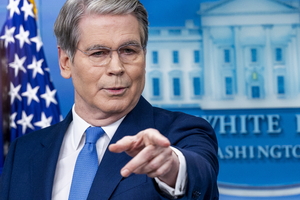
US warns of punishment for anyone enabling Iran's Strait of Hormuz toll scheme
-
INDUSTRY
Toyota union puts productivity first; Hyundai Motor union demands bigger share of profits
-
FINANCE

National Growth Fund to invest $531M in FuriosaAI, which rebuffed Meta's $800M takeover bid
-
INDUSTRY
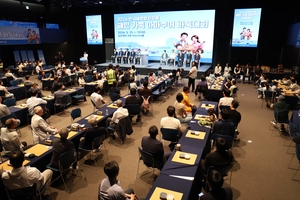
Korea Shipowners' Association holds amateur baduk tournament for Maritime Day