Kim Moon-su: 'The student sitting next to you is best positioned to notice'
PPP: 'This reveals the government and ruling party's complacent attitude'
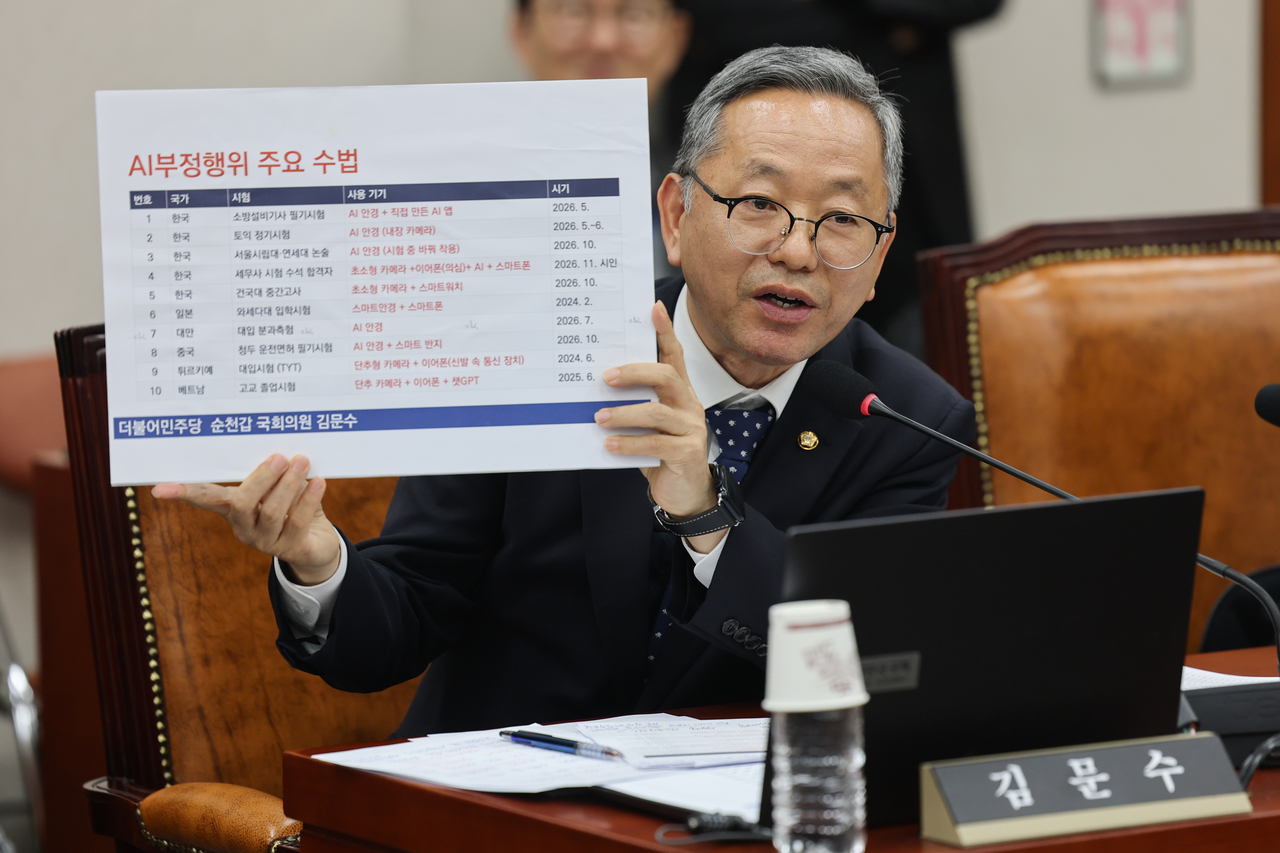
Rep. Kim Moon-su, chair of the Democratic Party of Korea's special committee on education, suggested that exam takers monitor one another for AI-assisted cheating, saying "my last appeal would be that test takers have no choice but to mutually supervise each other — because they are each other's competitors."
Kim made the remarks Tuesday on CBS Radio's "Park Sung-tae's News Show," two days before this year's College Scholastic Ability Test, saying he found the situation "truly daunting in terms of countermeasures."
"While it may seem like a distraction from focusing on the exam, the student sitting right next to you is actually best positioned to notice," Kim said.
Asked whether the idea was for students to flag a peer who seemed to be acting suspiciously, Kim said, "Yes — if something seems off or suspicious, report it."
Kim said only two proctors enter each exam room and that "the biggest problem right now is that only about one specialist capable of detecting AI cheating is deployed per exam site, and everything has to be handled with the naked eye."
On countermeasures, Kim said proctors plan to scrutinize eyeglasses more closely, but noted widespread concern that proctors could face lawsuits for how they handle students. He called on the Ministry of Education to provide legal support, such as access to lawyers, and said the ministry should actively respond by rewarding or promoting proctors who successfully catch cheaters.
Kim also said that under current rules, students caught cheating on the CSAT are barred from sitting the exam only in the year of the offense and the following year. "I am in the process of introducing legislation that would impose stricter bans — five years, 10 years, or even a permanent disqualification — given how many students retake the exam two or three times," he said.
Kim added that he is preparing legislation that would share information on exam cheaters the way information on sex offenders is shared, barring them from taking tests at other institutions or schools entirely.
"I believe this should be treated as a serious crime with severe punishment," Kim said, adding that the bill would include a retroactive provision to apply the new rules to this year's exam.
The People Power Party pushed back sharply against Kim's remarks. PPP spokesperson Jo Yong-sul said in a statement Tuesday that the proposal amounted to "now, on top of everything else, putting students in charge of monitoring the person next to them for cheating," calling it an "absurd claim that students should surveil one another."
Jo said Kim's reasoning — that students are best placed to spot cheating because they are each other's rivals — made no sense. "Does it make any sense to tell students who should be focused on their exam to instead catch cheaters? I cannot help but laugh at such an absurd alternative," the spokesperson said.
Jo said the proposal amounted to "shifting onto students the responsibility for countermeasures the government should be providing," adding: "How is that any different from telling a robbery victim to catch the robber themselves? Telling students to watch each other is all they have to offer against cheating methods that now involve AI and electronic devices — this statement lays bare the complacent attitude of the government and the ruling party."
Jo said the CSAT "is not a place for students to monitor one another, but a place where they should be entirely focused on proving their own abilities," and demanded that "this administration immediately stop its irresponsible politics of shifting the blame for its own poor management onto blameless students."
bigroot@heraldcorp.com