Gyeonggi Province Governor Choo Mi-ae has assembled a cooperative framework bringing together the National Assembly, local governments, companies, universities and research institutions to carry out her administration's first official policy directive — an innovation plan aimed at cementing the province's lead in the global semiconductor industry.
The province plans to enter the government's semiconductor cluster designation competition while moving quickly to supply the power, water and transportation infrastructure that such clusters require.
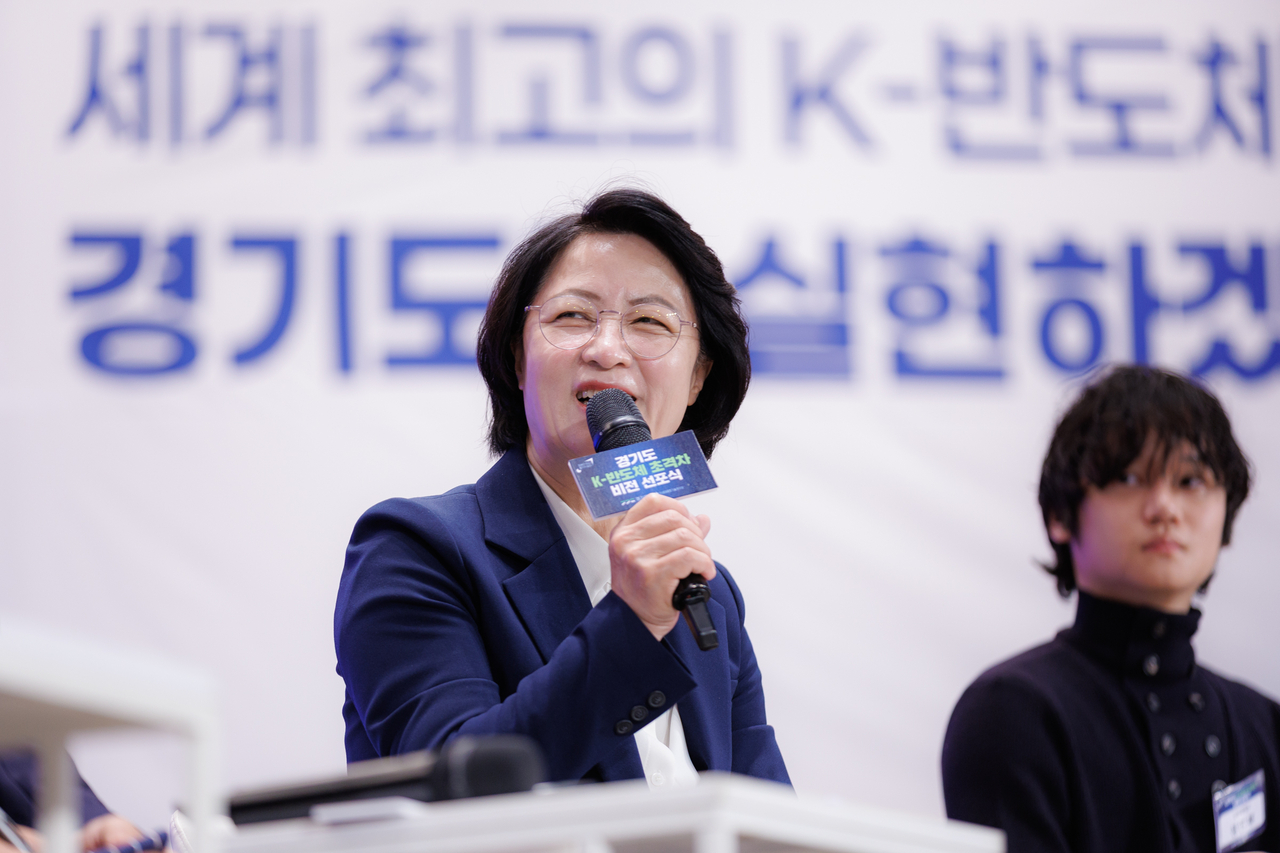
Choo held two back-to-back events Tuesday at the Gyeonggi Business and Science Accelerator: the inaugural meeting of the Gyeonggi Province Semiconductor Superadvantage Strategy Committee, and a vision proclamation ceremony for the K-semiconductor initiative. At both events, she unveiled the "K-Semiconductor Superadvantage Innovation Plan" and a strategy for developing a semiconductor cluster in the province.
At the strategy committee meeting, held in the facility's Vision Hall, Choo appointed 27 semiconductor experts to serve on three subcommittees covering planning and coordination, infrastructure, and the industrial ecosystem.
The committee elected Park Jae-keun, a distinguished professor at Hanyang University, as co-chair alongside Choo. Park joined Samsung Electronics in 1985 and served as a general manager in the semiconductor materials technology group and as a technical adviser at the Giheung production technology center. After moving to Hanyang University in 1999, Park led a next-generation nonvolatile memory chip development program and served on the National Science and Technology Council's steering committee and the National Intellectual Property Commission. Park currently chairs the Korean Institute of Electrical and Electronic Engineers' semiconductor and display technology division.
"Semiconductors have become a core strategic asset that determines national security, economic sovereignty and future competitiveness," Choo said. "We must turn the current boom into an opportunity to secure next-generation technology and upgrade our industrial structure." She added that Gyeonggi Province — home to world-class semiconductor production facilities, research and development capabilities, and a concentration of fabless and materials, parts and equipment companies centered on Samsung Electronics and SK hynix — is the strongest foundation from which to achieve that goal.
The strategy committee is a policy cooperation body co-led by the governor and private-sector experts.
The vision proclamation ceremony, held in Gwanggyo Hall, drew about 100 attendees including lawmakers, city mayors, provincial assembly members, semiconductor industry executives and students. The program covered a briefing on the K-semiconductor innovation plan, a presentation of the cluster development strategy, a formal vision proclamation and an open dialogue session.
Gyeonggi Province announced the K-Semiconductor Superadvantage Innovation Plan, built around three strategic pillars — accelerating semiconductor production hubs, upgrading the industrial ecosystem, and strengthening the foundation for future growth — and 14 detailed tasks.
To accelerate production hubs, the plan calls for streamlining permits and approvals for large-scale production sites in Yongin and Pyeongtaek, and ensuring the timely supply of power, water and transportation infrastructure. The province also plans to support technology development and demonstration for fabless and materials, parts and equipment companies, strengthen advanced packaging competitiveness, train specialist workers, and improve living conditions for young talent — all aimed at building a sustainable industrial ecosystem.
The province also released a semiconductor cluster development strategy in preparation for the cluster designation competition under the Special Semiconductor Act.
Gyeonggi Province intends to enter the competition by integrating the semiconductor industrial base spread across eight cities — Suwon, Yongin, Hwaseong, Seongnam, Anseong, Pyeongtaek, Osan and Icheon — into a single ecosystem. The province plans to establish a wide-area cooperation framework spanning design, research and development, demonstration and verification, advanced manufacturing and mass production, joint development of materials, parts and equipment, and workforce training.
The province and the eight cities are jointly preparing the application and plan to submit it once the Ministry of Trade, Industry and Resources opens the competition. The province will also work with relevant agencies to ensure that the power, water and transportation infrastructure needed for large-scale investment is delivered on schedule, and will accelerate administrative support — including permitting — to keep corporate investment plans on track.
During the open dialogue session, Choo heard directly from semiconductor company executives and students about their challenges and policy requests. Participants focused on practical needs: shared access to expensive testing and analysis equipment, support for technology development and demonstration, employment and education opportunities for young talent, and improvements to living conditions.
When a graduate student researching semiconductors asked whether Gyeonggi Province could take the lead in providing more opportunities to work with actual semiconductor equipment, Choo said the Advanced Institute of Convergence Technology already offers students training space and hands-on practice opportunities, and that regional cooperation research centers run programs where students conduct research alongside industry. "We will continue to work to connect students with more companies going forward," she said.
fob140@heraldcorp.com