Repayment capacity of small business owners takes direct hit
Default rates on low-interest refinancing, COVID-era guarantee programs surge
Korea Credit Guarantee Fund's subrogation payments reach 1.78 trillion won as of end-July
Multiple-debt burden worsens as high-rate environment persists
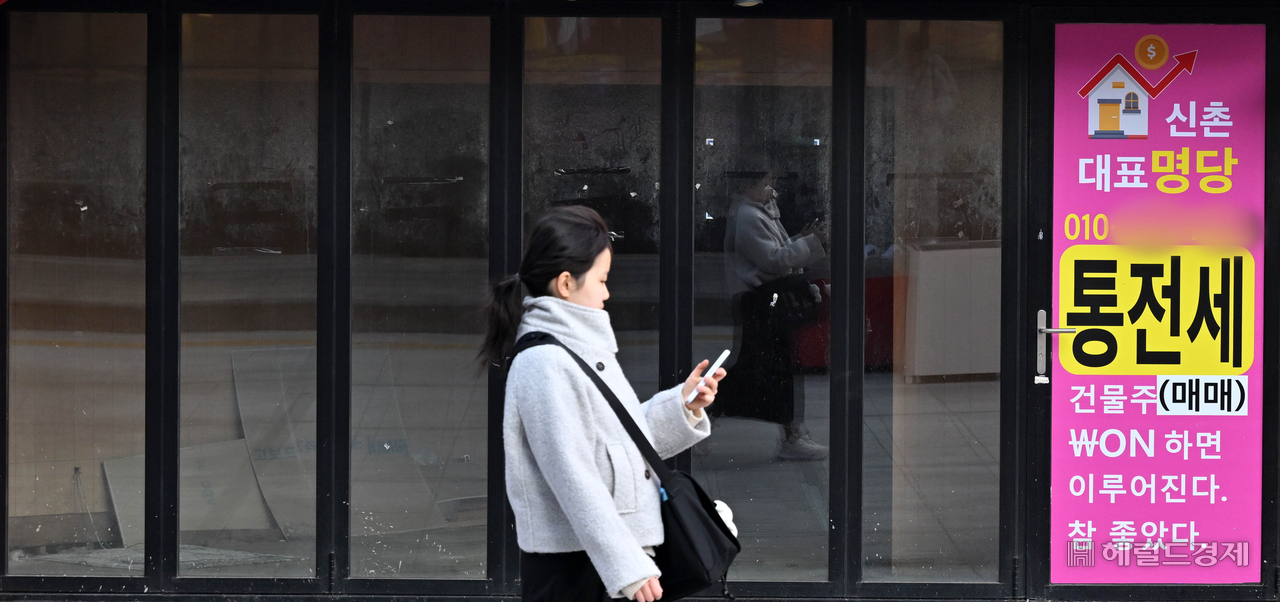
As a so-called "K-shaped polarization" — in which a semiconductor boom coexists with sluggish domestic demand — tightens its grip on the South Korean economy, the quality of policy-backed loan guarantees extended to small business owners and self-employed workers is deteriorating sharply. Subrogation payments made by the Korea Credit Guarantee Fund on behalf of small business owners have reached nearly 1.8 trillion won ($1.32 billion). Experts say the government should shift away from blanket support that amplifies financial risk and instead focus on sorting viable businesses from those with little chance of recovery, guiding the latter toward a soft exit.
According to data submitted to the office of People Power Party lawmaker Park Sung-hoon of the National Assembly's Political Affairs Committee by the Korea Credit Guarantee Fund, the cumulative default rate on the "small business low-interest refinancing trust guarantee" program — which ran from September 2022 through December 2024 — stood at 26.6 percent as of the end of July this year. The rate was 5.2 percent at the end of 2023, climbed to 12.7 percent by the end of 2024, then surged to 22.1 percent in 2025.
The low-interest refinancing trust guarantee program converts high-interest loans — those carrying annual rates of 7 percent or more — held by self-employed individuals and sole proprietors into lower-rate loans. Introduced to support small business owners struggling in the wake of the COVID-19 pandemic, the program stopped accepting new applications in December 2024. Of the total 1.66 trillion won disbursed, the outstanding guarantee balance stood at 1.09 trillion won as of the end of July this year.
As defaults have spread, the subrogation payments the fund has made on borrowers' behalf have snowballed. Cumulative subrogation payments under the low-interest refinancing trust guarantee rose from 24.8 billion won in 2023 to 329.5 billion won in 2025, reaching 406.7 billion won as of the end of July this year. The subrogation rate climbed from 2.2 percent in 2023 to 12.2 percent by the end of July.
The amount the fund has been unable to recover after exercising its right of recourse grew from 20.4 billion won to 235.6 billion won over the same period.
The default rate on the "small business financial support trust guarantee" program — which ran from May 2020 through January 2021 during the height of the COVID-19 outbreak — is also rising. Its cumulative default rate climbed from 5.2 percent in 2022 to 18.2 percent in 2024, reaching 19.5 percent as of the end of July this year. The program disbursed a total of 7.43 trillion won; the current outstanding guarantee balance stands at 282.8 billion won.
Cumulative subrogation payments under that program were 183.1 billion won in 2022, 690.5 billion won in 2023, 1.16 trillion won in 2024, and 1.38 trillion won as of the end of July. Unrecovered amounts approached 613.4 billion won.
Combined subrogation payments made by the Korea Credit Guarantee Fund under both the low-interest refinancing trust guarantee and the small business financial support trust guarantee programs totaled 1.78 trillion won as of the end of July this year.
The period during which policy guarantee defaults accelerated coincides with a sharp deterioration in key indicators of financial risk among self-employed workers. According to the Bank of Korea, the share of "vulnerable borrowers" — defined as multiple-debt holders who are also low-income, low-credit, or self-employed — rose from 10.5 percent at the end of 2022 to 12.8 percent in the first quarter of this year. Over the same period, the delinquency rate among this group jumped from 5.91 percent to 12.68 percent, far exceeding the overall self-employed delinquency rate of 2.04 percent.
Analysts say a prolonged high-interest-rate environment following the COVID-19 pandemic, combined with a structural shift toward contactless consumption, has left a growing number of small business owners unable to adapt.
Particularly this year, the acceleration of K-shaped polarization — in which gains from the semiconductor boom have failed to filter through to domestic consumption — has deepened the financial strain on self-employed workers.
According to the Bank of Korea, closure rates among self-employed workers in manufacturing and construction remained largely unchanged, moving from 7.0 percent and 9.5 percent respectively in 2021 to 7.0 percent and 9.4 percent in 2024. By contrast, closure rates in accommodation and food services rose from 16.3 percent to 18.2 percent, while those in wholesale and retail trade climbed from 15.4 percent to 17.5 percent.
The Bank of Korea warned that delinquency rates "could rise again or remain elevated for an extended period due to delayed improvements in repayment capacity and the lingering effects of higher interest rates."
Voices in the financial sector have consistently called on the government to move away from broad-based "dragnet" support through policy guarantees and instead distinguish between businesses with genuine recovery potential and those without. Japan, for instance, prioritizes helping low-viability self-employed workers wind down smoothly or resolve their guarantee obligations rather than extending further financial support. France offers an unemployment benefit system for the self-employed, while Spain has strengthened their integration into the social security system — both approaches aimed at building safety nets for those who exit economic activity.
Similar calls have emerged in political circles, with some urging the government to focus not on debt forgiveness but on tightening the screening and recovery processes for existing policy guarantees. "If the government takes on the debt through policy guarantees, then pays it off when defaults occur, and now forgives the principal as well, the bill ultimately falls on the public," Park said. "Rather than populist debt relief, the government must properly assess repayment capacity and fix the way policy guarantee defaults are managed and recovered."
hyuk@heraldcorp.com