
- HOME
- ECONOMY
-
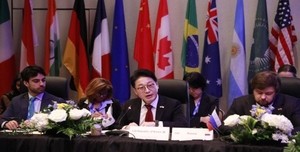
S. Korea proposes 'resilient power grid partnership' to G20
Deputy minister calls for joint response on transformer, battery and cable supply chains, linked to Korea's 2028 G20 presidency; energy dialogue with US formalized; visits to ExxonMobil, AMOGY and Hyosung Heavy Industries South Korea has proposed that G20 nations share their power grid investment plans and establish a multilateral forum bringing together governments, utilities, grid operators and equipment manufacturers. The proposal draws a parallel to how oil stockpiling once underpinned energy security, arguing that stable supply chains for critical power equipment must serve the same role in an era of electrification. According to the Ministry of Climate, Environment and Energy, Second Vice Minister Lee Ho-hyun attended the G20 Energy Ministers' Meeting in Houston, Texas, from Monday through Wednesday (local time) as South Korea's chief delegate and put forward the proposal under the name "Resilient Power Grid Partnership." The core of the proposal is for G20 countries to share their grid investment plans and create a cooperation platform involving governments, power companies, grid operators and electrical equipment manufacturers. Lee framed the challenges posed by rising electricity demand around three "Cs": capacity, connection and chain. He argued that even as countries expand generation capacity through renewable energy and nuclear power plants, grid expansion could be delayed if grid interconnection and the supply of key equipment — transformers, batteries and cables — fail to keep pace. He proposed building a "Resilient Power Grid Partnership" at the G20 level, with participation from governments, utilities, grid operators and equipment makers across member states. South Korea is set to hold the G20 presidency in 2028. Lee also conducted a series of bilateral outreach meetings to advance Korea-US energy cooperation. He held talks with Doug Burgum, chair of the White House National Energy Council and secretary of the interior, and with Kyle Houseknecht, under secretary of energy, proposing expanded cooperation in areas including power and small modular reactors. The entry of Korean companies into the US power market was also on the agenda. The ministry highlighted the US investments and local partnerships of domestic power equipment and ESS firms — citing HD Hyundai Electric among others — to underscore their potential participation in grid modernization projects. A roundtable in Houston brought together representatives from Hyundai Engineering, Hanwha Energy, Samsung C&T, HD Hyundai Electric, Doosan Turbomachinery, Hanwha Ocean, HD Hyundai Heavy Industries, HD Hyundai Marine Solution, LNG Americas (SK IES) and POSCO International to share updates on the US energy market and discuss business challenges. Low-carbon technology cooperation with local companies and research institutions was also on the table. Lee visited ExxonMobil to explore potential collaboration on lithium development, carbon capture and storage, and hydrogen and ammonia projects. ExxonMobil said it plans to invest $20 billion in related projects by 2030. Lee also visited AMOGY, a company developing ammonia-cracking technology. AMOGY is developing a system that converts ammonia into hydrogen to generate electricity via fuel cells, and is participating in a distributed energy project in Pohang. The city is pursuing a green ammonia-based distributed power generation project. At Rice University's Baker Institute for Public Policy, Lee discussed Middle East developments and the global energy market outlook, and proposed expanding exchanges with the Korea Institute of Energy Technology. On the sidelines of the G20 meeting, participants also discussed policies for recycling wastewater in response to rising water demand from the AI and semiconductor industries, as well as information sharing on critical mineral supply chains, technology innovation, and measures to expand the circular economy and investment. Lee also held separate meetings with Germany's federal minister for economic affairs and energy and with the UK's minister of state for energy security and net zero. Lee also visited a high-voltage circuit breaker joint venture operated by Hyosung Heavy Industries in Canonsburg, Pennsylvania, on Wednesday. Hyosung Heavy Industries has been expanding its US production capacity through an extra-high-voltage transformer factory in Memphis, Tennessee, acquired in 2020. In July, it established a high-voltage circuit breaker manufacturing joint venture with Quanta Services, the largest energy infrastructure company in the United States. "The proactive US investment and local production network that Hyosung Heavy Industries has built not only contributes to the stability of the American power grid but also serves as an excellent model for Korea-US cooperation in the energy and power equipment sector," Lee said. "We will spare no policy support to help our companies build stable supply chains and expand their market presence in the United States."
Sept. 17, 2026
-
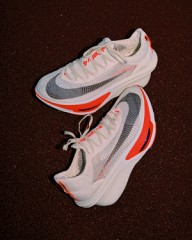
Nike launches Alphafly 4 after 33 months: 'biggest leap' in franchise history
New Alphafly arrives nearly 3 years after its predecessor Weight cut by 10g (5%), energy return boosted by 10% "The Alphafly 4 represents the biggest performance leap in the history of the Alphafly franchise — bigger than the jump from 1 to 2, and bigger than the jump from 2 to 3," said Brett Schoolmeester, Nike's senior vice president of running footwear. Nike announced Thursday that it will release the Alphafly 4, the latest model in its top-tier running shoe franchise, at the end of next month — 2 years and 9 months after the Alphafly 3. The new shoe was developed to deliver peak performance, cutting weight by 5 percent and boosting propulsion by 10 percent compared with its predecessor. The Alphafly line features a carbon plate embedded in the midsole to enhance energy return and propulsion. The shoe gained widespread attention — and helped spark the carbon-plate running shoe craze — when marathon great Eliud Kipchoge wore it during the 2019 INEOS 1:59 Challenge, in which he became the first person in history to run a marathon in under two hours. Nike has typically released a new Alphafly model roughly every two years: the Alphafly 1 in June 2020, the Alphafly 2 in November 2022, and the Alphafly 3 in January 2024. The 2-year-9-month gap before the Alphafly 4 is the longest in the franchise's history, reflecting the extensive development work Nike put into the new model, the company said. The Alphafly 4 retains the same core architecture — Air Zoom units, a carbon fiber Flyplate and ZoomX foam — while refining each component. Nike incorporated feedback from elite athletes and everyday runners, as well as findings from its Nike Sport Research Lab (NSRL). The Air Zoom units are now welded at the seams using radio-frequency vibration, making them 30 percent lighter and softer than the previous generation while also reducing landing noise. The carbon Flyplate features a wider base for improved stability. The upper midsole uses the new ZoomX LT foam, which is 17 percent lighter and delivers 8 percent greater energy return than before. The upper is constructed with Atomknit 2.0, a lightweight, breathable material that provides a secure fit. Emily Farina, a senior biomechanics researcher at the NSRL, said at a Zoom press briefing on Tuesday that the Alphafly 4 delivers 10 percent greater energy return than the Alphafly 3 while weighing 10 grams — or 5 percent — less. Biomechanical testing confirmed improvements in both traction and stability, she said. Schoolmeester said the new shoe was particularly exciting because it achieved the largest performance gain since the Alphafly line was first introduced. "It would be easy to assume that with each successive generation, the rate of improvement slows and it becomes harder to find additional gains — but this time, the performance improvement was actually larger, and the pace of development was faster," he said.
Sept. 17, 2026
-
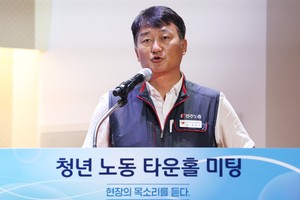
KCTU agrees to join social dialogue on mega special zones for first time in 6 years
Union demands labor exemptions be discussed from scratch; seeks to block 52-hour exceptions KCTU sets three conditions for joining Economic, Social and Labor Council Yang Kyung-soo to convene delegate assembly in early October for final decision The Korean Confederation of Trade Unions has agreed to participate in a government-proposed "single-issue social dialogue" on the special law governing mega special economic zones — the first time the KCTU has joined a government-initiated social dialogue in six years, since a labor-management-government representatives' meeting convened in 2020 to address the COVID-19 crisis. The decision does not, however, mean an immediate return to the Economic, Social and Labor Council, known as the Gyeongsa-nowi. The KCTU said it will join the council only if three core conditions are met: consensus-based decision-making, guaranteed participation by industry-level unions, and a change to the council's name. The KCTU announced Thursday that its central executive committee had met and decided to take part in the social dialogue on the mega special zone legislation. The union has consistently demanded that labor exemption provisions be stripped from the special zone bill and that any discussions start from scratch without presupposing the introduction of such exemptions. The government's proposed agenda is reported to include exempting high-income semiconductor research and development workers from the 52-hour workweek cap and extending the permitted employment period for fixed-term workers. The KCTU said it concluded it needed to join the talks and voice its opposition directly in order to block deregulation of working hours and rules governing non-regular employment. "The KCTU needs to make its opposition clearly known in order to stop labor exemptions and any rollback of labor rights," KCTU Chairman Yang Kyung-soo said. "We will enter the social dialogue to block the 52-hour exemption and the push for a white-collar exemption, and we will push for the introduction of a four-and-a-half-day workweek." The KCTU also plans to propose restricting the use of non-regular workers within mega special zones, countering the government's push to expand the scope of dispatched and fixed-term employment. The union said it will also call for profits and operating profit generated through corporate tax benefits to be returned to society. The KCTU reaffirmed Thursday its broader push to pursue social bargaining, including eventual participation in the Economic, Social and Labor Council. The plan calls for consultations based on the three conditions — consensus-based operations, guaranteed industry-union participation, and a name change — with formal legal and institutional procedures to follow once an agreement is reached. Earlier, at a central executive committee meeting on July 23, the KCTU had decided to maintain its boycott of the council in its current form, judging that participation would be ineffective. It called instead for the council to be restructured — with a new name, a revised voting framework, and a deliberative, consensus-based operating model that allows industry-level unions to participate directly in labor-management-government discussions. The final decision on joining the council will be made at a KCTU delegate assembly. After disagreements over the relevant procedures emerged at Thursday's central executive committee meeting, Chairman Yang said he would use his authority as chairman to convene a delegate assembly between Oct. 6 and Oct. 8.
Sept. 17, 2026
-
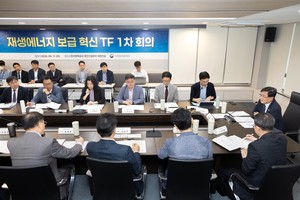
Pan-government TF launched to hit 100 GW renewable energy target by 2030
Six ministries, 19 public institutions and 16 regional governments to cooperate on land use and regulatory reform A pan-government task force has been launched to achieve the Lee Jae Myung administration's core energy policy goal of reaching 100 GW of renewable energy generation capacity by 2030. The Ministry of Climate, Environment and Energy held the first meeting of the Renewable Energy Deployment Innovation TF on Thursday at Korea Electric Power's Gyeongin Construction Headquarters in Jung-gu, Seoul. The TF is chaired by the climate minister and includes six other ministries — the Ministry of National Defense, Ministry of Land, Infrastructure and Transport, Ministry of Agriculture, Food and Rural Affairs, Ministry of Trade, Industry and Energy, Ministry of Oceans and Fisheries, and Ministry of Interior and Safety — along with 19 public institutions including Korea Electric Power and Korea Water Resources Corporation, and local governments across 16 cities and provinces. The government plans to expand renewable energy capacity by tapping large tracts of state and public land — including reclaimed land and border areas — as well as idle land held or managed by public institutions. Recognizing that the climate ministry could not pursue this alone, it formed the pan-government TF. The need to revise numerous laws and regulations to support that expansion was also a key reason for establishing the TF, which plans to hold monthly meetings chaired by the climate minister. "The 100 GW target by 2030 is not one any single ministry can achieve on its own," Climate, Environment and Energy Minister Kim Sung-hwan said. "Through this dedicated TF, related ministries, public institutions and local governments will work as one team to make maximum use of available idle sites and push forward regulatory improvements at pace."
Sept. 17, 2026
-
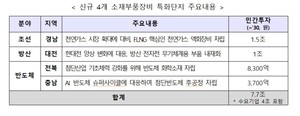
Geoje, Daejeon, Gunsan, Cheonan named 3rd-generation materials and parts special zones with W8tr investment
Ministry of Trade, Industry and Energy to focus on shipbuilding, defense and semiconductors The government has designated four new specialized clusters for materials, parts and equipment — in Geoje, South Gyeongsang Province (shipbuilding and offshore plants), Daejeon (defense electronics and optical components), Gunsan and Iksan in North Jeolla Province (semiconductor chemical materials), and Cheonan and Asan in South Chungcheong Province (semiconductor back-end processes) — and plans to invest a combined 8 trillion won ($5.85 billion) together with the private sector. The Ministry of Trade, Industry and Energy said it made the decision Thursday at the 18th meeting of the Materials, Parts and Equipment Competitiveness Reinforcement Committee, held at the Export-Import Bank of Korea and chaired by Minister Kim Jung-kwan. The third-generation clusters were selected from 16 development plans submitted by 11 cities and provinces during a one-month open call that ran from March 23. Evaluators assessed each bid on criteria including clustering effects, infrastructure availability and regional connectivity. Each of the four newly designated clusters will anchor supply chain completeness in line with its region's core growth drivers. Geoje, designated as the shipbuilding and offshore plant cluster, will use Hanwha Ocean as its anchor company and pursue domestic production of key equipment for the liquefaction process of floating LNG facilities. Private investment planned through 2030 stands at 1.5 trillion won. Daejeon will host a defense electronics and optical components supply chain. LIG D&A and Hanwha Aerospace, among others, will develop precision electronic and optical components for platforms including the KF-21 fighter jet and K9 self-propelled howitzer. Private investment is set at 1 trillion won. Gunsan-Iksan and Cheonan-Asan will focus on strengthening supply chains for semiconductor chemical materials and back-end processes, respectively. In Gunsan-Iksan, companies including Dongwoo Fine-Chem, Hansol Chemical, OCI and PKC will advance ultra-high-purity chemical material technologies used in cleaning, etching and deposition processes while expanding production capacity. Private investment totals 830 billion won. Cheonan-Asan will build capabilities in back-end semiconductor processing, a field critical to AI chip competitiveness. Hana Micron and TSE will pursue self-sufficiency in HBM packaging equipment and test components, respectively. Private investment amounts to 370 billion won. The government will inject about 40 billion won per cluster — a total of 160 billion won over five years — to foster inter-company cooperation and secure technological competitiveness. In addition, the central government and local authorities plan to form a unified support team to facilitate timely delivery of 7.7 trillion won in total private investment, including 4 trillion won from demand-side companies, by providing streamlined permitting and policy financing. The government previously designated five clusters each in the first generation in 2021 and the second generation in 2023. With four more added this round, the total number of specialized materials, parts and equipment clusters nationwide rises to 14. By sector, semiconductors account for the most with five clusters, followed by automobiles with two, and one each for machinery, displays, secondary batteries, biotech, defense, shipbuilding and carbon materials. Across the existing first- and second-generation clusters, 15 core technology development projects are under way and investment worth 11.5 trillion won is being carried out with government support. "The new specialized clusters are set to serve as core production bases and regional growth hubs that will establish us as an indispensable industrial powerhouse amid the reshaping of global supply chains and industries," Minister Kim said. "The government will provide full backing to help our leading industries secure and advance their technology edge and to ensure private investment flows smoothly."
Sept. 17, 2026
-
Personal data of 140 customers leaked from Kakao Games
Personal data belonging to 140 Kakao Games customers has been leaked. The company is investigating the hacking incident, and the scope of the damage could expand depending on the findings. Kakao Games announced on its website that it detected unauthorized access to its Partners and RINK services at 10:44 p.m. on Saturday and confirmed Monday that the personal information of 140 customers of those services had been leaked. The compromised data includes third-party identification codes or IDs used for external linkage through the Partners service, as well as the company's own identification codes and, in some cases, country codes. Kakao Games said the identification codes for external linkage, its own identification codes and country codes "are personal information with a low risk of misuse, as they make it difficult to identify specific individuals." It added that even in cases where external-linkage IDs were leaked, passwords were not compromised. The company said it has taken a series of response measures: blocking the unauthorized external access route and related accounts; blocking further access to the affected systems and strengthening security; securing logs and evidence related to the incident; inspecting and patching vulnerabilities; investigating whether additional personal data was leaked; enhancing monitoring for anomalies in related systems; reporting the incident to the Personal Information Protection Commission and relevant authorities; and conducting an investigation into the cause and scope of the incident with an external cybersecurity firm. As the hacking investigation is still ongoing, the possibility that the scope of damage could expand cannot be ruled out. Kakao Games said an investigation into whether additional personal data was leaked is underway as part of its response measures, adding that it is "conducting an investigation into the cause of the incident and the precise scope of the damage."
Sept. 17, 2026
-
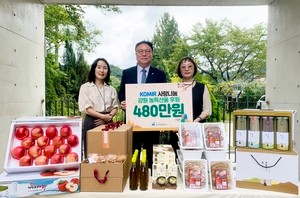
Korea Mine Rehabilitation Corp. buys local produce, donates to child welfare facility ahead of chuseok
Employees of the Korea Mine Rehabilitation and Mineral Resources Corp. carried out a dual act of goodwill Thursday, supporting both local children and regional merchants one week before the chuseok holiday. The employees purchased 4.8 million won ($3,510) worth of clean Gangwon Province agricultural products and local specialties from producers and retailers in Wonju and surrounding areas, then visited Seongage Won, a child welfare facility in Wonju, to deliver the goods. The initiative was designed to support the daily lives of children in the community while also promoting the local economy by sourcing products grown and made in the region. While delivering the donated items, the employees spoke with facility staff and gathered a range of perspectives on child welfare work on the ground. The donated goods will be used to support the daily lives and welfare of the children at Seongage Won. Kim Jun-seop, the corporation's standing auditor, said continued community attention is needed "so that children can nurture their dreams and potential in a better environment." He added that he hoped the visit would go beyond a simple donation and become "an opportunity to hear directly from those on the ground and think together about what support is truly needed."
Sept. 17, 2026
-
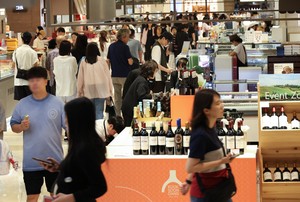
Large retailers must pay suppliers faster under revised law
Payment deadline for special purchase, consignment deals cut from 40 to 20 days Exemptions available with Fair Trade Commission approval during financial crises Department stores, hypermarkets, online shopping malls and other large retailers will be required to pay suppliers in half the time currently mandated by law. The Korea Fair Trade Commission said Thursday that the National Assembly passed an amendment to the Large-Scale Retail Business Act at a plenary session. The revised law will take effect one year after promulgation, following cabinet approval and other required procedures. Under the amendment, the payment deadline for special purchase, consignment and lease transactions will be cut from 40 days to 20 days after the monthly sales closing date. A government survey found that the average payment period for such transactions was already around 20 days, and the time needed to complete settlements was also taken into account. For direct-purchase transactions, the deadline will be shortened from 60 days to 35 days after the date goods are received. The Fair Trade Commission had initially planned to set the limit at 30 days, citing an industry average payment period of 27.8 days, but adjusted it to 35 days during National Assembly deliberations to account for the burden on retailers and the feasibility of compliance. The adjustment also reflected the fact that direct-purchase arrangements may require payment even for goods that have not yet been sold. An exception will allow direct-purchase transactions settled once a month to make payments within 20 days of the monthly purchase closing date. Exemptions will also apply when delays stem from circumstances beyond the retailer's control, such as natural disasters or the seizure of a supplier's bonds. In direct-purchase transactions, retailers facing urgent financial concerns — such as bankruptcy proceedings, corporate rehabilitation or a sharp deterioration in cash flow — may apply to the Fair Trade Commission for approval to be exempted from the payment deadline. The commission said it will grant such approval only in cases where the inability to make payment is objectively clear, to prevent abuse of the exemption. Specific grounds for exemptions and the procedures involved will be incorporated into subordinate regulations during the one-year grace period, following consultations with stakeholders and expert advisory reviews. The revised law will apply to goods received or sold after it enters into force.
Sept. 17, 2026
-

South Korea's first food-tech research center for cooking robots opens in Pohang
Center equipped with 17 types of advanced devices covering stir-frying, deep-frying, noodle cooking and serving; startups can test prototypes and pursue US NSF certification under one roof South Korea has opened its first dedicated research facility for developing and testing food robots — machines capable of stir-frying, deep-frying, boiling noodles, preparing beverages and serving customers. Small and medium-sized food and restaurant companies, as well as startups that cannot afford expensive equipment on their own, can use the center to test prototypes and receive support in obtaining overseas hygiene and safety certifications. The Ministry of Agriculture, Food and Rural Affairs held an inauguration ceremony Thursday at the Pohang Convergence Technology Industrial Complex in Pohang, North Gyeongsang Province, marking the official launch of the Food Robot Food-Tech Research Support Center. The Pohang center is the first completed facility among the research support centers the ministry is building across 10 key food-tech sectors. Food robots combine AI and robotics to automate cooking, beverage preparation, serving and sanitation management. The center features a shared research equipment room and a living lab — a shared kitchen where prototypes can be tested in real cooking environments. It is also equipped with startup office space, a co-working area, an international standards certification testing laboratory and 17 types of advanced devices. The setup allows small and medium-sized enterprises and startups to carry out everything from technology development to prototype testing without purchasing costly equipment themselves. The center also supports companies seeking overseas certifications after completing product development. It has introduced testing and certification equipment from NSF (National Sanitation Foundation), a US hygiene and safety certification body. The ministry plans to develop the Pohang center into Asia's first food robot certification support hub by building networks among companies, enabling domestic firms to receive integrated support from technical consulting through to certification. The center will also draw on the robotics research and industrial infrastructure concentrated in Pohang. Pohang University of Science and Technology, known as POSTECH, has operated a food-tech contract graduate program under the ministry since 2024, training food robot specialists from among workers already in the food industry. The Korea Institute of Robotics and Technology Convergence will provide smart kitchen models and robot operation technology, while the Pohang Institute of Metal Industry Advancement and Gyeongbuk Technopark will support materials analysis and commercialization. The center also plans to build ties with Pohang-based robotics and food-tech companies including Neuromeka, Graphene Square, Polaris3D and Beyond Honeycomb. Starting with the Pohang food robot center, the ministry plans to establish research support centers for each of the 10 core food-tech sectors by 2030, covering areas such as plant-based foods, cell-cultured foods, personalized nutrition, three-dimensional food printing and food upcycling. Kim Jeong-wook, director general for agricultural industry innovation policy at the ministry, said the Pohang center "will serve as a model for industry-academia-research collaboration, bringing together outstanding university research, institutional robotics technology and real-world industry demand." He added that the ministry "will spare no policy support — including one-stop regulatory reform, the creation of an innovation fund and the training of specialized talent."
Sept. 17, 2026
-

ABC Mart completes Folder acquisition, sets sights on Musinsa rival
ABC Mart wraps up Folder takeover Q1 sales up 13%, operating profit up 25% Musinsa Kicks closes in fast ABC Mart, South Korea's largest multi-brand shoe retailer, has completed its acquisition of Folder and is moving to unlock synergies from the deal. According to industry sources, ABC Mart recently finished transferring Folder's online and offline stores, inventory and staff. ABC Mart Korea, the domestic operator of the chain, signed an acquisition agreement with E-Land World in January and has since cleared the necessary regulatory steps, including approval from the Korea Fair Trade Commission. Folder is a shoe concept store that E-Land World launched in 2012 and has been generating annual sales of around 100 billion won ($73.1 million). By 2025 sales, it ranked third in the multi-brand shoe retail segment, behind ABC Mart at 660.7 billion won and S-Market at 113.7 billion won. ABC Mart aims to cement its industry lead through the acquisition. The company surpassed 660 billion won in domestic annual sales last year, its highest since entering the Korean market in 2002. Although it trimmed Folder's store count from 35 to 20 before completing the deal, combined sales this year are expected to exceed 700 billion won. ABC Mart kept up its growth momentum in the first quarter. According to a disclosure by its Japanese parent company, sales in the Korean market reached 17.9 billion yen ($115 million) from January through March, up 13.1 percent from the same period a year earlier. Operating profit rose 25.9 percent to 769 million yen. Converted at the average won-yen exchange rate for the first quarter — 932.96 won per 100 yen — that translates to roughly 167 billion won in sales. With the Folder transfer now complete, the full impact of the acquisition is expected to materialize from the third quarter onward. In a June disclosure, ABC Mart's parent said it would combine the know-how and infrastructure of both companies to strengthen partnerships with global brands and expand its business scale over the medium to long term. Competition with fashion platform Musinsa is also looming. Musinsa launched its first multi-brand shoe store, Musinsa Kicks, in January and has since expanded to locations in Hongdae, Seongsu and Starfield Goyang, with a Jeju store also on the way. The company is targeting more than 10 openings by year-end. Transaction volume at the Hongdae and Seongsu stores has more than doubled since their opening days. Musinsa Kicks has secured global sportswear brands as partners and stocks limited-edition sneakers and rare models. Its stores are larger than ABC Mart's and organized by category — running, outdoor and others — setting it apart from the competition. The company also plans to open combined stores that integrate Musinsa Kicks with other platforms such as Musinsa Beauty. "ABC Mart is solidifying its top position through the Folder acquisition, but Musinsa is closing in fast," an industry official said. "Musinsa is rapidly expanding into major commercial districts, drawing on a base of young consumers and foreign customers."
Sept. 17, 2026
-

2,000 drones to light up Chuncheon lake in season finale of K-drone art show
'Autumn night in Chuncheon, draped in starlight' A festival of doing nothing — and doing it together From gazing at water to gazing at drones, the final drone light show of the year Performers from Britain and China who claim to lead the world in drone art have often seen their events go badly wrong — with around 1,000 of 2,000 drones crashing or catching fire mid-show. K-drone art, by contrast, has delivered flawless performances at the Han River in Seoul, Gwangalli in Busan and Chuncheon in Gangwon Province without a single accident, earning recognition as the world's best in the field. While drone shows at the Han River and Gwangalli have dazzled urban waterfronts, the Chuncheon Lake Drone Light Show weaves together nature and culture against the clean skies above the city. Chuncheon city will launch 2,000 drone dancers into the air Saturday at 8 p.m. for the final edition of the 2026 Chuncheon Lake Drone Light Show, staged across the Culture Plaza Forest and the Hwadong 2571 area. The theme is "Autumn night in Chuncheon, draped in starlight." The show will close out this year's series with a display of varied colors and movements inspired by autumn and the night sky. Alongside the drone show, the Hwadong 2571 venue will host an outdoor pub and food trucks from 4 p.m. and a live DJ set from 6 p.m., giving tourists who make the trip to Chuncheon plenty to enjoy around Uiam Lake before the main event begins. On the same day, the 2026 Seomyeon Lake Starlight Festa will open at the Seomyeon Animation Museum and Chuncheon Literature Park. Running through Sunday, the festival offers a range of wellness programs set amid the natural surroundings of Uiam Lake — yoga, meditation, singing bowl sessions, a waterside rest area, a book lounge, a lakeside market and a slow-walking program designed for unhurried rest and lingering. On the festival's opening day, a starlight performance at 5 p.m. and a wellness film festival at 6 p.m. will lead into the drone light show at 8 p.m., completing a full evening of autumn tourism at Uiam Lake from dusk to night. Elsewhere in Chuncheon during the same week, a series of events will run in parallel — the Korea Reading Convention, the Chuncheon Puppet Festival and the World Taekwondo Poomsae Championships. Chuncheon city plans to strengthen the link between daytime festivals and nighttime drone shows to extend how long tourists stay in the city. "As this is the final drone light show of the year, we plan to capture Chuncheon's autumn and starlight in the night sky above Uiam Lake with 2,000 drones," a city official said. "We hope visitors will spend a full day in Chuncheon, taking in the various autumn events from daytime onward."
Sept. 17, 2026
-
Civil servants to get dedicated fertility treatment leave from December
Amendments to civil service appointment decrees put out for public comment Personnel authorities must approve fertility leave requests in principle A dedicated fertility treatment leave system for civil servants will take effect Dec. 3. Under the new system, civil servants who need fertility treatment will be able to apply for fertility leave rather than sick leave, and will be entitled to take the leave unless special circumstances apply. The Ministry of Interior and Safety and the Ministry of Personnel Management announced Thursday that they have put proposed amendments to the Civil Service Appointment Decree and the Local Civil Service Appointment Decree out for public comment. The amendments set out the details needed ahead of the launch of fertility leave — newly established as a separate category of personal leave — following revisions to the State Public Officials Act and the Local Public Officials Act passed in June. Civil servants who needed time off for fertility treatment had previously been required to use sick leave, but the legislative changes will allow them to apply under the newly created fertility leave category instead. The presidential decree amendments will specify that fertility leave may be applied for when a civil servant undergoes fertility treatment, including assisted reproductive procedures, due to infertility. Personnel authorities must in principle approve fertility leave requests. However, they may exercise discretion over whether to grant leave when "special circumstances" exist. The amendments define those circumstances as cases where total fertility leave taken for a given child would reach two years or more, or where denial is specifically necessary for the efficient use of personnel. In such cases, the personnel authority may seek advice from a committee that includes relevant specialists on whether the leave is warranted, helping inform the approval decision. The Ministry of Personnel Management and the Ministry of Interior and Safety also plan to revise related administrative rules — including the Civil Servant Appointment Rules and the Local Civil Service Personnel System Operating Guidelines — in the second half of the year, in line with the effective dates of the two acts. The revisions will clarify the supporting documents required when applying for or returning from leave, as well as rules on managing attendance during leave, with the aim of ensuring civil servants who need fertility treatment can take the leave while preventing abuse. Civil servants who need fertility treatment before the effective date may continue to use sick leave under the current rules.
Sept. 17, 2026
-
Chuncheon dakgalbi set to charm Parma, Italy's gastronomic capital
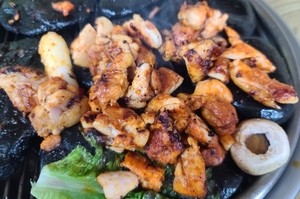
Ahead of the Chuncheon Makguksu Dakgalbi Festival (Oct. 14–18), Chuncheon is sending an international delegation to Parma, Italy's renowned gastronomic city, from Oct. 16 to Oct. 23 to showcase the best of Chuncheon dakgalbi. The delegation, led by Deputy Mayor Hyun Jun-tae, will visit Chuncheon's sister city of Parma to promote Chuncheon's food and culture as part of the K-Gastronomic Road — a curated selection of standout K-food offerings — during Parma's "Settembre Gastronomico" food festival. The visit will also include exchange activities in gastronomy, education and tourism. Chuncheon honorary city ambassador Alberto Mondi and local dakgalbi restaurant chefs will join the delegation. On Friday (local time), the delegation will take part in a "Korea: Culture and Flavors (Corea: cultura e sapori)" event at the San Paolo cultural complex in Parma. Following a special lecture by Mondi, Chuncheon chefs will prepare and serve dakgalbi live for Parma residents. Students from Liceo Romagnosi will also perform music at the event. On Monday (local time), a four-hands dinner — "Cena a Quattro Mani" — will be held at Al Vedel restaurant in Parma, bringing together chefs from both cities. Executive Chef Enrico Bergonzi of Parma and the culinary team from Chuncheon's Tongnamu-jip Dakgalbi will present dishes that blend ingredients and cooking techniques from both cities. The delegation will also take part in a fresh pasta-making workshop with Parma chef Luca Pardini, and will visit a Parmigiano Reggiano cheese production facility, a salumi and cheese academy, and global food company Barilla to explore the foundations of Parma's food industry. Official meetings to strengthen ties between the two cities are also on the agenda. On Friday (local time), the delegation will visit Parma City Hall to meet Mayor Michele Guerra and discuss cooperation between the sister cities. They will then visit ALMA, the International School of Italian Cuisine, to explore possibilities for expanding ongoing exchanges with Chuncheon and Gangwon Province Life Science High School. On Monday (local time), Chuncheon and Parma will hold a working-level meeting on international exchange to discuss future cooperation projects, including the 2027 "Ciao Italia" program. Exchange programs between Liceo Romagnosi and high schools in Chuncheon are also expected to be on the agenda. "Through this visit, we will introduce Chuncheon's food and culture directly to the people of Parma and work to develop concrete exchange projects the two cities can pursue together," a Chuncheon city official said. "We will ensure that the discussions held on the ground lead to sustained exchanges in gastronomy, education, culture and tourism."
Sept. 17, 2026
-
How to use Chuseok Onuri gift vouchers: 10% discount and up to 20,000 won back
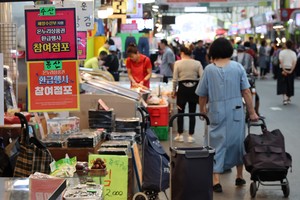
Ahead of Chuseok, the Korean autumn harvest holiday, a cashback event has launched at traditional markets across the country, offering shoppers up to 30 percent of their purchase price back in Onuri gift vouchers when they buy agricultural, livestock or seafood products. The government organized the event to ease the financial burden of Chuseok shopping and boost spending at traditional markets. Running from Wednesday through Sunday, the event is being held at 300 markets nationwide — 100 more than last year — making it the largest such event on record. In Seoul, the cashback program is available at 44 seafood markets — including Noryangjin Fisheries Wholesale Market, Mapo Agricultural and Marine Products Market, Garak Market, Tongin Market and Cheongnyangni General Market — and at 49 agricultural and livestock markets, including Gyeongdong Market, Namdaemun Market, Majang Livestock Market, Mangwon Market and Yeongdeungpo Traditional Market. Customers who purchase domestically produced agricultural or livestock products, or domestic or deep-sea seafood, can receive up to 30 percent of their purchase price back, capped at 20,000 won ($15) per person. Those who spend between 34,000 won and 66,999 won receive 10,000 won back, while those who spend 67,000 won or more receive 20,000 won. Cashback counters operate from 10 a.m. to 7 p.m. Shoppers should bring their purchase receipt and a form of identification to the designated cashback counter inside the market. Cashback procedures, event periods and minimum purchase thresholds may vary by market, so visitors are advised to check the details for their intended market before heading out. Full event information is available on the websites of the Ministry of Oceans and Fisheries and the Ministry of Agriculture, Food and Rural Affairs. Separately from the cashback event, Seoul is also running a Chuseok discount program at 61 traditional markets and alley shopping districts, offering up to 30 percent off holiday staples and agricultural, livestock and seafood products. At 42 of those venues, shoppers can receive an additional cashback of up to 30 percent of their purchase in Onuri gift vouchers on top of the in-store discount. Using discounted digital Onuri gift vouchers or Seoul Love gift vouchers at these locations can reduce the holiday shopping bill even further. Through Sunday, digital Onuri gift vouchers can be purchased at a 10 percent discount on amounts up to 200,000 won. Amounts above that threshold carry the standard 7 percent discount, up to the existing cap of 1 million won. During the promotional period, the purchase limit rises by an additional 200,000 won, bringing the total cap to 1.2 million won ($877). Meanwhile, the government is also running agricultural, livestock and seafood discount events through hypermarkets and online shopping platforms, not just traditional markets. The Ministry of Oceans and Fisheries is holding a "Korea Seafood Festival — Chuseok Special" from Sept. 9 through Oct. 4, offering up to 50 percent off major seafood products at 56 marts and online platforms nationwide. The event is backed by a record 44 billion won ($32.2 million) in seafood discount support funding.
Sept. 17, 2026
-
Hojeong Food finds new path on Temu, breaking free from holiday-only sales
Temu's 'discovery commerce' model helps brand build loyal base among shoppers in their 40s and 50s; orders have surged since launch, with Chef Aechan among other success stories For Hojeong Food, a regional food company with a 30-year history, traditional Korean confections known as "hangwa" had long been a seasonal product — bought mainly around the holidays and rarely otherwise. Searching for ways to drive repeat purchases and build everyday demand, the company recently found a new opening on Temu, the global e-commerce platform that has opened its marketplace to Korean sellers. Orders that numbered just five in the company's first month on the platform have since grown consistently to around 400 a month, putting the business on a stable footing. The growth has been driven by strong repeat purchases of a nutrition bar — a reinterpretation of traditional hangwa as a meal-substitute snack, individually packaged for daily consumption. Yoo Su-jin, a director at Hojeong Food, credited Temu's distinctive shopping ecosystem for the results. Conventional online marketplaces are built around "intent-based shopping," where consumers search for specific items they already want — meaning hangwa barely registers outside the holiday season. On Temu, by contrast, the company's products began appearing naturally in the feeds of shoppers browsing for everyday essentials, leading to purchases and, crucially, repeat orders. "On Temu, customers stumble across our products while shopping for everyday items," Yoo said. "When a second order follows, it's not because a special occasion is coming up — it means the product has become part of their daily routine." Hojeong Food is not alone. Other brands have also built loyal customer bases through the platform. Chef Aechan, a brand specializing in banchan and ready-to-eat meals, has recorded a repeat-purchase rate of about 23 percent on Temu. "Temu is a platform that gets consumers to try our products for the first time and then come back for more," said Park Woo-yeon, CEO of Chef Aechan. Beauty brand Rokkiss has similarly observed a pattern in which shoppers discover its cosmetics while browsing the platform and go on to buy them repeatedly. Hojeong Food, which produces more than 150 varieties of traditional food at two factories in Damyang, South Jeolla Province, is one of the largest hangwa manufacturers in the country. When it entered Temu, the company led with a "small-package strategy" aimed squarely at attracting new customers. "The key was lowering the barrier to entry so consumers could try our products without feeling like they were taking a risk," Yoo said. The strategy paid off: the share of small-package products in Hojeong Food's Temu sales now far outpaces that of any other retail channel the company uses. Dedicated support from a Temu account manager also contributed to the momentum. The manager suggested popular search terms in the snack category that suited the nutrition bar, and when the company incorporated them into the product name and ran tests, visibility in Temu's discovery feed jumped sharply, translating directly into more orders. "It wasn't generic advice — it was specific, immediately actionable tips that made a real difference," Yoo said. Now in its first full year on the platform, the nutrition bar has become Hojeong Food's best-seller on Temu. A traditional confection that once depended on a single annual holiday rush is finding its way onto consumers' tables every week as an everyday snack.
Sept. 17, 2026
-

Chungcheong leaders unite behind bid to bring integrated power company HQ to South Chungcheong Province
Four Chungcheong governors and mayors adopt joint statement Thursday, calling the move 'a starting point for national energy policy and balanced growth' The leaders of four Chungcheong region municipalities have united behind a shared call to locate the headquarters of a planned integrated state power company in South Chungcheong Province, declaring it "by far the most suitable site." South Chungcheong Province Governor Park Soo-hyun, Daejeon Mayor Heo Tae-jeong, Sejong Mayor Jo Sang-ho and North Chungcheong Province Governor Shin Yong-han convened the inaugural Chungcheong Metropolitan Union Council on Thursday at Independence Hall in Cheonan, where they adopted a joint statement calling for the integrated headquarters to be established in South Chungcheong Province. In the statement, the four leaders said South Korea faces the urgent challenge of responding to the climate crisis and transitioning to a carbon-free power system. They said the government has announced plans to merge five state power companies into a single entity tentatively named Korea Power, and described the consolidation as "a core pillar of national energy policy that answers the demands of the times." The choice of location, they added, "goes beyond a simple relocation of a public institution — it is a critical decision that will determine the success or failure of future energy security and balanced national development." The leaders said the headquarters site "must serve as a hub capable of supplying stable electricity to the high-tech industrial belt connecting the Chungcheong region and Greater Seoul, and must be a place that can overcome the job losses and economic contraction caused by the closure of power plants." South Chungcheong Province, they said, "is by far that optimal location." The four leaders declared that establishing the integrated headquarters in South Chungcheong Province "is a national task that must be carried out without delay, reflecting the aspirations of 5.6 million people in the Chungcheong region." They jointly affirmed that locating the headquarters in South Chungcheong Province would serve as a starting point for simultaneously advancing national energy policy and achieving balanced national development. They also described it as an essential condition for realizing a "just transition" and the surest path to successfully building a state-led renewable energy ecosystem. The leaders strongly urged the government and the National Assembly to "promptly confirm the establishment of the integrated headquarters in South Chungcheong Province in keeping with the legislative intent of supporting regions affected by coal power plant closures." They pledged to use the headquarters as a catalyst to strengthen inter-regional energy cooperation across the Chungcheong area and lead South Korea's energy transition. South Chungcheong Province has been mounting an all-out campaign to secure the headquarters. Since July, Park has met in succession with the chair of the National Assembly's climate, energy, environment and labor committee, negotiators from both parties on the committee, the minister of the Ministry of Climate, Environment and Energy, and the ruling and opposition party leaders to press the case for South Chungcheong Province, while also urging the government to act through the Central-Local Cooperation Council and a meeting with the prime minister.
Sept. 17, 2026
-

Korea Labor Foundation shifts focus to preventive labor-management coaching, supporting 97 workplaces
Kooksoondang's contractor cooperation model serves as benchmark Foundation moves beyond financial aid to introduce on-site expert coaching Second workshop planned at Vitzrocell next month on long-hours reform The Korea Labor Foundation has overhauled its labor-management cooperation program, shifting from financial assistance to on-site coaching and conflict prevention, and has extended support to 97 workplaces. The foundation said Thursday it would hold a best-practice benchmarking workshop over two days starting Thursday, visiting Kooksoondang in Hoengseong, Gangwon Province, with representatives from workplaces participating in its 2026 Win-Win Partnership Comprehensive Support Project. Revamped this year for the first time in three years, the Win-Win Partnership project's defining feature is the full introduction of "on-site support coaching," in which experts visit workplaces directly to facilitate dialogue between labor and management. The aim is to reduce the sources of conflict in advance through direct communication on the ground, rather than responding after disputes have already broken out. Financial support has already reached its target of 100 workplaces. On-site coaching has been provided to 97 workplaces, putting the program on the verge of hitting its own 100-workplace goal. The scope of support has also expanded beyond individual workplaces to include industry- and regional-level councils. Kooksoondang, where the workshop is being held, won an excellence award at the 2021 Labor-Management Partnership Competition. The company has continued its contractor cooperation activities this year, including improving communication with suppliers and enhancing working conditions. Participants examined Kooksoondang's primary contractor-subcontractor cooperation model, its approach to labor-management communication, and its record of improving working conditions. On Friday, the program will feature sessions on sharing best practices in workplace labor culture and strengthening conflict-resolution capabilities. Representatives from participating workplaces will discuss ways to bridge differences between labor and management and design preventive partnership frameworks suited to their individual workplace conditions. Park Jong-pil, secretary-general of the Korea Labor Foundation, said the key to breaking through gridlock on the ground is "a partnership that accepts the other side as they are," adding that "efforts are needed to create a space where labor and management can sit down and talk, and to start by finding even small areas of common ground." The foundation plans to hold a second benchmarking workshop next month at Vitzrocell, sharing the company's experience using flexible work arrangements to reduce long working hours. Vitzrocell received the presidential award at the 2024 Labor-Management Culture Grand Prize.
Sept. 17, 2026
-
Hong Ji-yun, Park Ji-hyun, Kim Ki-tae to headline Korea's largest folk arts festival in Pyeongchang
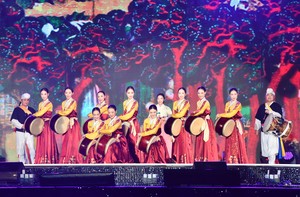
Hosted by the Ministry of Culture, Sports and Tourism, Gangwon Province and Pyeongchang-gun Organized by Pyeongchang-gun and the Traditional Performing Arts Foundation 21 teams to compete, with a youth division drawing attention The 67th Korean Folk Arts Festival, the country's largest folk arts event, opens Friday at Jinbu-myeon Sports Park in Pyeongchang-gun, Gangwon Province. Running through Sunday, the three-day festival is hosted by the Ministry of Culture, Sports and Tourism, Gangwon Province and Pyeongchang-gun, and organized by Pyeongchang-gun and the Traditional Performing Arts Foundation. Some 5,000 people are expected to gather, including representative competition teams from 16 cities and provinces nationwide as well as the five provinces of North Korea. Thursday's opening ceremony will feature a procession of the 21 general-division competition teams and a pre-ceremony performance by the Pyeongchang Arari Preservation Society. Singers Hong Ji-yun, Park Ji-hyun, Shin Seung-tae and Kim Ki-tae will perform throughout the event, and busking stages will bring together local and professional artists. A range of hands-on programs will also be on offer, including traditional crafts, folk game experiences and special exhibitions. The local food courtyard will let visitors sample regional dishes and Pyeongchang's signature buckwheat pancakes. The general-division competition runs Friday and Saturday at a natural-grass soccer field, where city and provincial representative teams from across the country will showcase vanishing regional folk games, nongak percussion music, folk songs and folk dances. On the festival's final day, Sunday, the youth division will hold its opening ceremony, competition and awards presentation before the closing ceremony brings the three-day event to a close. The top prize — the Presidential Award — will be presented to the winning team. Park Seo-woo, head of the culture and arts division, described the festival as "a place where you can encounter the very best of Korean folk arts all in one spot," adding, "We have prepared not only the excitement of competition but also plenty to see, eat and experience — we hope many people will visit Pyeongchang and take home unforgettable autumn memories."
Sept. 17, 2026
-
Gangwon Province promotes local food ahead of chuseok with up to 30% discounts
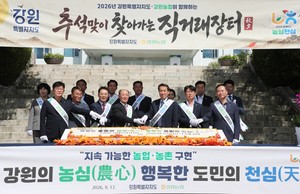
Direct-sales market co-hosted with NH Agri Business Holdings' Gangwon branch Gangwon Special Self-Governing Province, the Gangwon Provincial Assembly and NH Agri Business Holdings' Gangwon branch have teamed up to bring locally grown food from the region to chuseok tables across the country. A chuseok direct-sales market opened Thursday at the fountain plaza of the provincial government building, drawing a lively crowd. The event was jointly organized by the province and NH Agri Business Holdings' Gangwon branch to boost consumption of Gangwon agricultural and specialty products ahead of the holiday. More than 50 local food producers and organizations from Chuncheon, Wonju, Hongcheon, Hoengseong, Yanggu, Goseong and other areas took part. Participating producers included member farms of the Dong-Chuncheon Agricultural Cooperative's local food distribution association, Gangwon flower farms, Manna Grapes, Wonju Mushroom Agricultural Corporation, Hongcheon Dal's Farm, Hoengseong Yedawon, Yanggu Kkulsarang and Goseong Jinburyeong Tongil Deokjang. Producer organizations included NH Agri Business Holdings' Gangwon branch, Dong-Chuncheon Agricultural Cooperative and Gangwon Hanwoo Cooperative Joint Corporation. Items on sale included new-harvest rice, fruit, wild greens, mushrooms and other ritual food offerings, as well as fresh vegetables, processed agricultural products and Gangwon hanwoo beef — all priced 15 to 30 percent below regular market rates. Governor Woo Sang-ho, Provincial Assembly Speaker Park Gil-seon, Agriculture and Fisheries Committee Chairman Kang Jeong-ho, NH Agri Business Holdings Gangwon branch head Kim Byeong-yong and Chuncheon branch head Jeon Seong-yeol were among the officials who attended, encouraging participating farms and organizations while promoting Gangwon's agricultural products to provincial government employees and residents. NH Agri Business Holdings' Gangwon branch operated promotional booths showcasing representative agricultural products from each county and city, and ran events including tiered local food giveaways based on purchase amounts and a lucky roulette draw to raise awareness of local food's value. Jeon Jae-seop, director of the Gangwon Special Self-Governing Province's agricultural policy bureau, said local food — where produce grown in a region is also consumed there — is key to raising the value of Korean agriculture. "We will continue to pay close attention and provide ongoing support to direct-sales markets and local food initiatives that bring producers and consumers together," he said.
Sept. 17, 2026
-

South Korea's knowledge services deficit hits second-worst on record as Netflix, ChatGPT spending surges
Knowledge services deficit reaches $6.44 billion in first half Surging spending on overseas streaming services and AI platforms pushed South Korea's knowledge services trade deficit to its second-largest on record for any half-year period in the first half of this year. According to the Bank of Korea's "2026 First-Half Knowledge Services Trade Statistics" released Thursday, the knowledge services deficit came to $6.44 billion in the first half of the year, widening by $1 billion from $5.44 billion in the second half of last year. The figure is the second-largest half-year deficit since the second half of 2010, when it reached $7 billion. Breaking down the figures by category, the intellectual property royalties deficit grew by $900 million — from $4 billion in the second half of last year to $4.9 billion in the first half of this year. Multimedia copyright fees, which include streaming subscription costs, swung from a $290 million surplus to a $40 million deficit. The deficit in computer and mobile software copyright fees, which cover AI service charges, widened from $2.31 billion to $2.84 billion, hitting a record high. On the surplus side, the cultural and leisure services surplus expanded from $530 million to $720 million. The surplus in performance and exhibition services, which reflects K-pop concert revenues, rose from $240 million to $330 million. The surplus in multimedia production services — covering dramas produced for overseas streaming platforms — also grew from $290 million to $380 million. Park Seong-gon, head of the Bank of Korea's balance of payments team, said the intellectual property royalties deficit widened as payments for overseas industrial software related to semiconductors and digital services such as games increased. "The consistent growth in purchases and subscriptions to online services such as overseas streaming platforms and AI has also contributed to the widening deficit," he added. Park said that while the absolute amounts tied to AI remain relatively modest, the pace of growth is extraordinary. "Based on simple card transaction data, the category that includes AI has doubled compared to a year ago," he said. Park also said the continued global success of K-content drove cultural and leisure services exports to record highs for two consecutive half-year periods. "Exports of performance and exhibition-related services set records for four consecutive half-year periods starting from the second half of 2024, and multimedia production service exports ranked second-highest on record," he said. The information and communications services surplus narrowed from $2.87 billion to $2.42 billion over the six-month period, while the professional and business services deficit shrank from $4.84 billion to $4.67 billion. The contraction in the information and communications services surplus was partly due to a base effect from the record surplus posted in the second half of last year. Even so, the first-half surplus this year ranked second-highest on record for any half-year period. By region, South Korea posted a surplus of $2.62 billion with Asia, while recording deficits of $3.32 billion with North America and $2.25 billion with Europe.
Sept. 17, 2026
MOST READ
- 1KAIST develops high-performance bio-based adhesive using E. coli instead of petroleum
- 2Pope Leo XIV declines French honors and banquet, accepts only private meeting with Macron
- 3Daimler Truck unveils next-generation transport solutions at IAA 2026
- 4What was Rachmaninoff's performance fee? A 1928 price list tells all
- 5Samsung Biologics union's show of force backfires at the bargaining table
- 6APR says hair-loss treatment research published in international journal
-
WORLD

US warns of punishment for anyone enabling Iran's Strait of Hormuz toll scheme
-
INDUSTRY
Toyota union puts productivity first; Hyundai Motor union demands bigger share of profits
-
FINANCE
National Growth Fund to invest $531M in FuriosaAI, which rebuffed Meta's $800M takeover bid
-
INDUSTRY
Korea Shipowners' Association holds amateur baduk tournament for Maritime Day