
- HOME
- OPINION
-
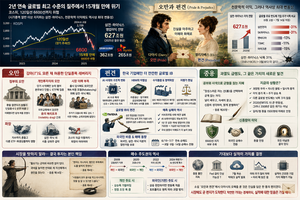
'Pride and Prejudice' grips the market — why Samsung, SK hynix and SpaceX are treated differently
The Kospi, which had been running at the top of global markets for two consecutive years, has found itself threatened for the first time in 15 months by its long-term trend line — the 120-day moving average at 6,600. The irony is striking: Samsung Electronics and SK hynix, which together account for more than half of total market capitalization, are signaling astronomical profits, yet the index is showing some of the most extreme volatility in global stock market history. Jane Austen's classic "Pride and Prejudice" comes to mind. The novel follows the arrogant Mr. Darcy and the prejudiced Elizabeth as they clash before ultimately confronting the truth and finding reconciliation. Pride: single-stock leveraged ETFs approved without understanding gamma The first act of pride belongs to the government, which hastily approved single-stock leveraged ETFs on Samsung Electronics and SK hynix in a bid to stabilize the dollar-won exchange rate. Anyone who understood the basic principle of gamma hedging — the sensitivity of an option's delta to changes in the underlying asset price — would never have so easily approved leveraged and inverse ETFs on mega-cap stocks that together represent more than half of total market cap. The sheer size of these two names means their moves ripple through the broader index, affecting not only other ETFs but derivatives as well. That is why other large-cap stocks beyond Samsung Electronics and SK hynix also tumbled sharply. A significant amount of capital is estimated to have migrated from Kosdaq into these single-stock leveraged ETFs. The fallout has been wide. Some domestic investors were equally arrogant, fixating on single-stock leveraged ETFs in Samsung Electronics and SK hynix rather than on the underlying shares. The mandatory education course required to qualify for single-stock leveraged ETF investing placed the greatest emphasis on "volatility drag" — the negative compounding effect. Leveraged investments carry extreme risk when asset prices move contrary to expectations. Notably, even at the time these single-stock leveraged ETFs launched, foreign investors were already continuously selling Samsung Electronics and SK hynix to rebalance their portfolios. The environment was one in which their selling pressure could intensify the higher prices climbed. Unfortunately, this kind of market dynamic was absent from the mandatory education curriculum. Prejudice: global investment banks holding Korean companies to a harsher standard Recent overseas commentary still judges Samsung Electronics and SK hynix by outdated metrics, despite the fundamental transformation both companies have undergone. The prevailing view is that global semiconductor demand will continue to grow, driven by increasingly sophisticated AI services, autonomous driving and physical AI. AI data centers also cycle through semiconductors faster than conventional servers, meaning replacement demand is substantial on top of new demand. HBM is not the same as commodity DRAM. With commodity DRAM, unsold inventory piles up and crushes margins. HBM is made to order — volumes and prices are locked in advance with customers such as Nvidia — so the amplitude of price-collapse cycles driven by oversupply is far smaller. The earnings visibility of HBM resembles that of a foundry, not a commodity like DRAM. Samsung Electronics is expanding beyond memory into vertically integrated foundry and packaging operations, while SK hynix is pushing into a new category of NAND called HBF after its HBM success. Yet the 12-month forward price-to-earnings ratios of the two companies sit at roughly six times and five times, respectively — well below the upper end of the multiples they commanded in their commodity DRAM days (13 times for Samsung Electronics, 10 times for SK hynix). The two companies' push to expand long-term supply contracts reflects a deliberate effort to reduce earnings volatility. Their recently announced large-scale investment plans serve the same purpose. Without adequate capital expenditure to match growing demand, they risk ceding market share to rivals such as China's CXMT. Global investment banks surely cannot be unaware of these changes — so is their stance simply arbitrary? The semiconductor profits being generated today are the direct result of hyperscalers such as Microsoft, Google and Amazon pouring money into AI and buying chips. The same cash-flow structure commands a premium valuation when it sits inside Nvidia, but that premium evaporates once the money arrives at a Korean company. It is a "prejudice" — the belief that no matter how much Samsung Electronics and SK hynix earn, it is never quite enough for those who consider themselves superior. The contrast with the treatment of SpaceX — an unproven narrative to which the market freely attaches its imagination — could not be starker. Would the two Korean chipmakers be valued the same way if they were American companies? Foreign investors are not all sages. Global investment banks have a far from impressive forecasting record — they failed to foresee the subprime mortgage crisis they themselves helped create, and they only recognized the AI semiconductor supercycle after it had already begun in the second half of last year. The combined operating profit forecast for Samsung Electronics and SK hynix that global banks issued a year ago was 79 trillion won ($52.5 billion) — barely one-eighth of the current consensus of 627 trillion won. Domestic securities firms appear to have a better grasp of semiconductors and manufacturing than their global counterparts. The golden mean: whether overheated or suddenly cooled, the end is always the rediscovery of value Pride and prejudice are both one-sided. Only through study and reflection can one find the middle way. "The sincere person chooses what is good and holds it firmly. Study broadly, inquire carefully, think prudently, and discern clearly." (Doctrine of the Mean, Chapter 20) The recent sharp declines in the Kospi and in Samsung Electronics and SK hynix represent an amplified, temporary shock — the product of exaggerated fears colliding with excessive one-sided positioning. The average combined operating profit forecast for Samsung Electronics and SK hynix stands at 627 trillion won this year — 362 trillion won for Samsung Electronics and 265 trillion won for SK hynix — with next year expected to surpass that figure. Share prices have risen considerably over the past year, but earnings have grown by an even larger margin. If concerns about a peak in semiconductor investment were truly serious, other players in the same ecosystem that trade at higher multiples — Nvidia, TSMC and Micron — should be falling just as hard. They are not. The decline from the June peak to Tuesday's intraday low reached 31%, deeper than the volatility recorded during the COVID-19 outbreak from January through March 2020. Is the current level of uncertainty truly comparable to that period? Or does it resemble the crisis of 2008, when share prices were cut in half from their peaks? In 2020, the pain was broadly shared between the United States and South Korea; this time, the damage is concentrated in Korea alone. In a market where volatility has become unusually extreme, caution is a virtue over rash action. For now, watch whether the long-term support line at 6,600 holds. That level, maintained since Donald Trump declared his tariff war last April, briefly broke intraday on Tuesday before recovering. Foreign investors, who recorded net selling for consecutive sessions from June 19 through last Tuesday, posted net purchases on Wednesday, Thursday and again on Tuesday. Corporate foreign-exchange conversions have also pushed the dollar-won rate back below 1,500 won. Every tunnel has an end. Do not blame the market — ultimately, investing is your own responsibility "Archery has something in common with the way of the gentleman. When the archer misses the mark, he turns and seeks the cause within himself." (Doctrine of the Mean, Chapter 14) The crash and the investment losses that followed stemmed from the government's misjudgment, the greed of some individual investors and the bias of foreign players — but the failure to avoid those pitfalls ultimately rests with each investor. "The wise overshoot it; the foolish fall short. That is why the Way is not made clear." (Doctrine of the Mean) "People all eat and drink, yet few can truly appreciate the taste." (Doctrine of the Mean) In hindsight, it will be all too clear that the launch of single-stock leveraged ETFs marked the top. Take this as a hard-won lesson in market reality. Foreign investors have sold what they needed to sell — earnings, not expectations, will determine value In the aftermath of the global financial crisis in 2009, during the COVID-19 pandemic in 2020 and amid the Federal Reserve's aggressive tightening in 2022, the dominant buying force in the Korean market shifted — from retail to foreign investors, then back to retail, then back to foreign investors again. Since the second half of last year, the AI semiconductor boom has shifted that leadership once more, from foreign investors to retail. When retail investors hold the upper hand, market rallies are steep but corrections from the peak are severe. The pattern has been one in which retail drives prices up and foreign investors take profits. Conversely, when foreign investors lead, the pace of gains is more gradual but swings are smaller. Foreign investors, who are mostly institutions, rebalance according to portfolio rules and rarely trigger market overheating. The situation in the Middle East has become murky again. The probability of a Federal Reserve benchmark interest rate hike is rising once more. In late July, US big-tech hyperscalers are expected to report second-quarter earnings, and there is speculation they may signal a moderation in AI investment spending. All of these are headwinds — but share prices have already fallen sharply, so in a sense the market has taken its punishment in advance. Once these headwinds are fully digested, price discovery will resume, and there is ample reason to believe that chipmakers continuing to deliver solid earnings will be revalued accordingly. Markets sometimes deliver despair, but they always leave room for hope. In "Pride and Prejudice," it was a single letter containing the truth that dissolved Mr. Darcy's misunderstanding. A letter is on its way to the market as well. This is the time to stay alert to vague expectations — while holding firm to confidence in the earnings.
July 15, 2026
-
![[CONTRIBUTOR] Before chasing US warship contracts, Korea must design a true 'shipbuilding alliance'](https://wimg.heraldcorp.com/news/cms/2026/07/14/news-p.v1.20260714.19c8840553e7475a961c2e6aa68dafcf_T1.jpg?type=h&h=240)
[CONTRIBUTOR] Before chasing US warship contracts, Korea must design a true 'shipbuilding alliance'
Discussions on building US warships in Korea, first raised at the G7 summit, carried over into follow-up talks at the NATO summit. This is not simply a matter of shipbuilding cooperation. It signals that America's need to rebuild naval power, its effort to revive its shipbuilding industry, and the strategic value of Korea's shipbuilding sector have converged at a single point. With the opening of a Korea-US Shipbuilding Cooperation Center now scheduled, the MASGA initiative is also moving beyond declaration into implementation. What matters most right now is not the immediate prospect of winning contracts, but the fact that this issue has acquired enough strategic weight to be discussed repeatedly at the level of the two countries' leaders. Yet it is too early to let expectations run ahead of reality. The request for information, or RFI, that the US Defense Department and Navy sent to Korean shipbuilders is not a contract. It is not a procedure for confirming orders — it is a preliminary probe to assess design and construction capabilities for combat vessels and replenishment ships. Still, the fact that this RFI covered both combat ships and oilers together should not be taken lightly. If the leaders' discussions were a political signal, the RFI is the signal that translates it into operational terms. It means the United States has officially begun evaluating Korea's shipbuilding industry as a realistic option for building US Navy capacity. That does not mean the overseas construction of combat vessels will become reality anytime soon. Warships are not ordinary commercial vessels. The obstacles go beyond technology — US law, Congress, security requirements, combat systems integration, supply chains, and American jobs are all bound up in the question. Federal law generally prohibits constructing US military vessels and their major hull and superstructure components at foreign shipyards. That is the barrier of 10 U.S.C. § 8679. Even if the president invokes a national security exception, the process requires notifying Congress and waiting 30 days. The fact that leaders have talked and an RFI has been issued does not mean Korean shipyards can immediately begin building US Navy combat ships. That is precisely why the Senate Armed Services Committee's deliberations on the fiscal year 2027 National Defense Authorization Act matter. The provision allowing limited procurement of non-combat auxiliary vessels — bulk fuel ships and strategic sealift ships — from allied shipyards, conditioned on capital investment in the US shipbuilding and maritime industry, is no small change. This is not a blanket authorization for building combat ships abroad. It is closer to an institutional experiment: verifying the utility of allied shipbuilding capacity in non-combat auxiliaries first, without circumventing the barriers of US domestic law. In other words, auxiliary vessels are not a substitute for combat ships — they are a bridge toward the conversation about combat ship participation. This is where the strategic significance of auxiliary vessels becomes clear. The road to combat ships does not begin with combat ships. To clear the wall of the US Congress, Korea must first demonstrate the value of allied shipbuilding through non-combat auxiliaries. Bulk fuel ships, strategic sealift vessels, and logistics support ships are not simply contracts to be won. They are a proving ground for delivery schedules, quality, cost, security, and the ability to localize supply chains. Only by passing that test can the future discussion of combat ship construction gain the political and institutional credibility it needs. Korea must also change how it makes its case to Congress. The argument that "we will build American warships for you" risks provoking a backlash. What Congress wants to hear is not how superior a foreign shipyard is, but how the US shipbuilding industry can be revived. Korea's argument must therefore be framed around using Korean shipbuilding technology and speed to revitalize American industry, expand jobs and supply chains within the United States, and reduce gaps in US Navy readiness. The goal is not to win contracts for their own sake, but to participate as an ally in rebuilding America's shipbuilding foundation. The Philadelphia shipyard acquired by Hanwha is the most visible platform for that argument. It represents more than a foreign asset held by a single company — it is a concrete example of how Korea's shipbuilding industry can make a real contribution to reviving American shipbuilding. Hanwha has put forward plans for large-scale infrastructure investment at the yard, with significant expansion of production capacity through additional dry docks, quay walls, and block assembly facilities. The ambition extends well beyond commercial vessel construction. The plan envisions expanding America's shipbuilding base to cover LNG carriers, naval modules and blocks, and ultimately naval vessel production. If participation in the US Navy's Next Generation Logistics Ship or T-AOL tanker program is added to that, the Philadelphia yard becomes not merely an asset on the books but a proving ground for building credibility within the US Navy's procurement ecosystem. The Philadelphia yard is not an immediate answer to building US Navy combat ships. Doing so would require further facility upgrades, security systems, combat systems integration capability, compliance with US Navy quality standards, and a skilled workforce. But that is precisely why the yard's significance is greater, not lesser. In the near term, it offers a path to building trust through maintenance, repair and overhaul, auxiliary vessels, module production, and co-design work. Over the longer term, it accumulates the American-based foundation from which a conversation about combat ship participation can grow. This leverage extends beyond the Philadelphia yard alone. HD Hyundai is also expanding cooperation with US shipbuilders, including Huntington Ingalls Industries. What Korea can offer the United States is not simply construction capacity. It is a shipbuilding revival package — modernizing American yards, supplying blocks and modules, co-designing vessels, providing MRO services, training workers, and rebuilding supply chains. Without that package, Congress cannot accept the use of allied shipbuilding capacity as a strengthening of American jobs and the industrial base. Ultimately, the core of this discussion lies in not overstating the opportunity while not losing sight of the strategic direction. The debate over building US warships is a genuine opportunity for Korea's shipbuilding industry. But opportunity is not the same as a contract. Korea must build trust through auxiliary vessels, help grow America's domestic shipbuilding base, and create an alliance-based production system that Congress can accept. Korea's goal is not to become the country that builds American warships on America's behalf. It is to become the core partner in a shipbuilding alliance that revives both US naval power and the US shipbuilding industry together. The road to combat ships begins with auxiliary vessels — but the most concrete lever for opening that road comes from rebuilding the shipbuilding base inside the United States, starting with the Philadelphia yard.
July 14, 2026
-
![[Biz Insight] How brick-and-mortar retail should respond to its crisis](https://wimg.heraldcorp.com/news/cms/2026/07/10/news-p.v1.20260710.a836649a0ac9492a80218f3849e49176_T1.jpg?type=h&h=240)
[Biz Insight] How brick-and-mortar retail should respond to its crisis
Traditional markets and hypermarkets both function as brick-and-mortar retailers, but they are fundamentally different in nature — neither competitors nor substitutes for each other. The experiences and value they offer are worlds apart. The customer experience at a traditional market differs sharply from that at a hypermarket, and the value consumers perceive from each is equally distinct. Admittedly, the strong subjectivity involved makes it difficult to establish objective metrics for either. Their service environments — including physical surroundings — are also poles apart. They may appear to sell similar products, but the service itself is different. Consumers perceive and internalize even quality subjectively. The placebo effect is a prime example. The same applies to price. Price perception, too, is far removed from objectivity. Consumers process the prices set by sellers through their own beliefs, moods and financial circumstances, arriving at very different conclusions. Even for identical products, the effort required to gather price and quality information differs entirely between a traditional market and a hypermarket. The customer value derived from that process varies from situation to situation and from person to person. Treating the two as competitors and subjecting them to regulation was therefore misguided — a product of ignorance about the nature of the service industry. The regulation produced no positive effect. The Distribution Industry Development Act is a case in point. If anything, it has damaged two distinct and valuable retail experiences. Traditional markets offer a uniquely dynamic atmosphere with elements of empathy and play, while hypermarkets provide orderly convenience and a comfortable shopping environment. Both should have been allowed to develop and strengthen their own characteristics. The two are, in fact, complementary. Counterintuitive as it may seem, they share a heterogeneous, complementary relationship — not a substitutive one. That distinction deserves attention. A thriving rice-cake shop does not put a bakery out of business. Consider, too, the mutually beneficial relationship between beer and soju. The approach was simply wrong. What has since been proven is that e-commerce and brick-and-mortar retail are locked in fierce competition. The case of Homeplus, facing a bankruptcy ruling, makes the right crisis response for brick-and-mortar retailers readily apparent.
July 10, 2026
-
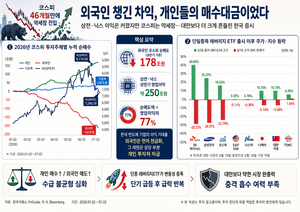
Foreign investors cashed out as retail buyers fueled the rally — and single-stock leveraged ETFs made it worse
Samsung Electronics topped the world in operating profit in the second quarter and South Korea's current-account surplus hit a record high — yet the Kospi has fallen into a bear market for the first time in four years. The root cause is the government's failure at sensemaking. Chasing a surging exchange rate, authorities rushed single-stock leveraged ETFs to market, but attaching leverage to Samsung Electronics and SK hynix — which together account for half the Kospi's market cap — only exploded volatility. Foreign investors took profits at the peaks that retail buyers had propped up, leaving many individual investors nursing losses. Products already on the market are hard to pull back. The time has come to build a deeper, more resilient market that can share its gains with the public for the long term. Kospi breaks 60-day line, enters bear market for first time in 46 months South Korea's current-account surplus for May, released Wednesday, set yet another all-time record. The day before, Samsung Electronics reported the world's highest operating profit among all companies for the second quarter. Yet the Kospi plunged 22.8 percent from its June 19 peak of 9,385.59, falling back below its medium-term trend line — the 60-day moving average. The index's entry into bear-market territory, defined as a drop of 20 percent or more from a peak, is the first since September 2022, nearly four years ago. None of this makes sense. So what exactly happened? The late organizational psychologist Karl E. Weick, one of the towering figures in his field, is best known for the concept of "sensemaking." Weick argued that in a crisis, the problem is not a lack of information but an overabundance of contradictory information. What matters, he believed, is not the ability to know the right answer but the ability to construct a workable interpretation. For Weick, a leader is not someone who predicts the future with precision but someone who learns by acting, catches weak signals early and keeps an organization from becoming trapped in a flawed reading of reality — someone who helps an organization see things as they actually are. Foreign investors sold as much as Samsung Electronics and SK hynix earned The Kospi's decline is a story of foreign selling. As part of portfolio rebalancing, foreign investors recorded net selling of 178 trillion won ($117 billion) on the Kospi in the first half of this year alone. Extending the period through Wednesday, the figure exceeds 193 trillion won. Samsung Electronics' preliminary operating profit for the first half came to roughly 147 trillion won, while SK hynix is expected to post around 102 trillion won. Foreign net selling amounted to about 77 percent of the two companies' combined first-half operating profit of roughly 250 trillion won. Compare that with Taiwan, whose current-account surplus has also surged on the back of a semiconductor boom. Foreign net selling on the Taiwan exchange in the first half totaled about $29.6 billion — roughly 68 percent of TSMC's estimated operating profit of $43.6 billion. Yet the Taiwan Weighted Index currently stands at 45,479, down only about 5 percent from its June 23 peak of 48,219. TSMC, which hit a record 2,535 New Taiwan dollars on June 23, now trades around 2,440 New Taiwan dollars — a pullback of roughly 4 percent from its high, even amid concerns about an AI bubble. Why has the Korean market fallen so much more than Taiwan's? Single-stock leveraged ETFs: the main culprit behind volatility in Samsung Electronics, SK hynix and the Kospi Part of the answer is that the Kospi's ascent was steeper than Taiwan's to begin with. Single-stock leveraged ETFs — products that track a single company's share price with leverage — widened the gap further. In less than a month after their launch on May 27, SK hynix and Samsung Electronics surged as much as 40.1 percent and 25.2 percent, respectively. The Kospi itself climbed as much as 16.6 percent. Over a comparable period, US markets — the S&P 500 and Nasdaq — were roughly flat, while Japan and Taiwan rose at most 10.7 percent. TSMC's gain was limited to 6.4 percent. Neither Taiwan nor Japan has single-stock leveraged ETFs. The United States does not have the same degree of concentration in a handful of names. Taiwan caps the daily price movement of sector-type leveraged ETFs at 10 percent. The exchange rate is the other factor. Taiwan's currency has held steady against the US dollar all year, trading in a narrow 31–32 range. The won-dollar rate, by contrast, was below 1,440 won at the end of last year and recently surpassed 1,550 won. A weakening currency represents currency-loss risk for foreign investors. Taiwan's foreign-exchange management is superior to South Korea's in several respects. [See the June 6 column: 'The curse of success' and the exchange-rate turmoil it caused — and how Taiwan, in a similar position, avoided it (Hwaseok Yeoljeon, No. 897)] The standard playbook calls for reducing exposure to a depreciating currency. With rebalancing demand on top of that, it is little wonder that selling pressure has been intense. Government tried to stabilize the exchange rate but only amplified market volatility Consider the sequence of events. Why did South Korea introduce single-stock leveraged ETFs in the first place? On Jan. 28, Financial Services Commission Chairman Lee Bok-hyun announced plans to allow them, citing the existence of similar products overseas. Two days later, a legislative notice was issued, and by April 21 — less than three months later — the relevant enforcement decree under the Capital Markets Act had been amended. The first products hit the market on May 27, exactly four months after the announcement. Late January was a period of alarm over a surging exchange rate. The government rolled out a raft of measures, including foreign-exchange hedging by the National Pension Service and the introduction of a domestic equity return account. The Kospi had also just broken through the 5,000 level on Jan. 27. The apparent intent was to use single-stock leveraged ETFs to discourage overseas investment, stabilize the exchange rate and draw more money into domestic equities to push the Kospi higher. Did it work as planned? When war broke out involving Iran at the end of February, foreign selling and exchange-rate pressure continued through March. Hopes for an end to the conflict brought foreign selling under control in April and pulled the won-dollar rate back below 1,400. But conditions shifted starting in early May, just before the leveraged ETF launch. As US-Iran ceasefire negotiations progressed, the market rebounded, and retail investors net-bought a staggering 42 trillion won in May alone, driving the index higher. The Kospi stood at around 7,000 in early May. After the single-stock leveraged ETFs launched, retail net purchases in June exceeded 56 trillion won, and the Kospi surged to the 9,400 level on June 19, powered by sharp gains in Samsung Electronics and SK hynix. Retail buying money became the source of foreign investors' profits Share prices rose as retail investors bought, and foreign investors sold into the rally, converting the proceeds into dollars. The won-dollar rate, which had rebounded in May, briefly approached 1,560 won after the leveraged ETF launch. Retail investors net-bought more than 133 trillion won on the Kospi in the first half of this year, concentrated in Samsung Electronics and SK hynix. Extending the period through Wednesday, the figure exceeds 147 trillion won. Of the roughly 59 trillion won attributed to financial investment firms, a substantial portion also represents retail money that flowed in through ETFs. The shares retail investors bought were the shares foreign investors sold. Most of the profits foreign investors pocketed came, in effect, from retail investors' money. Had single-stock leveraged ETFs not been launched, the Kospi and the two stocks would likely have risen less. When massive leveraged investment concentrates in a short period on two names that together account for half the Kospi's market cap, it is only natural for the index to overreact. Foreign investors who sold during that period would have reaped smaller gains; retail investors who bought would have paid lower prices. The government's stated goals in introducing single-stock leveraged ETFs were to stabilize the exchange rate and strengthen the Kospi's upward momentum. Instead, foreign investors walked away with the equivalent of 77 percent of Samsung Electronics' and SK hynix's combined operating profit, the exchange rate rose further against the government's intentions, and the Kospi's volatility expanded so abnormally that The Wall Street Journal ran a column on Monday comparing it to "Squid Game." The piece argued that speculative retail participation was amplifying swings and driving the market's wild gyrations. About 117 trillion won of retail money invested above 7,000 is now at risk of loss Despite record corporate earnings, the Kospi has lost momentum as foreign selling has intensified, and customer deposits held at brokerages — which once reached 140 trillion won — have fallen to around 110 trillion won. Retail net purchases made at or above Wednesday's closing level of 7,246 are estimated at roughly 117 trillion won, meaning that amount of capital is currently sitting at a loss. Foreign investors, by contrast, still hold large positions despite their aggressive selling, and nearly all of those holdings remain in profitable territory. Compared with the end of the first half of last year, foreign ownership of SK hynix fell 5 percentage points to 50.06 percent as of Wednesday's close, from 55.51 percent. Samsung Electronics saw foreign ownership decline by less than 3 percentage points, from 49.64 percent to 46.58 percent. Because foreign investors accumulated large positions at low prices long ago, selling at high prices has generated enormous proceeds while barely reducing the number of shares they hold. Foreign-exchange crisis trauma has blocked currency market reform One of the papers that made Weick famous was his 1993 study "The Collapse of Sensemaking in Organizations: The Mann Gulch Disaster," which analyzed a 1949 wildfire in Mann Gulch, Montana, in which 13 of 15 firefighters died. The firefighters needed to drop their equipment to escape, but they could not bring themselves to do it. Their shovels and axes were symbols of their identity. The exchange-rate instability that flared last year was not merely a question of dollar supply and demand — it was a question of the won's global credibility. Foreign-exchange market reform has been necessary since 2008, when MSCI placed South Korea on its watch list for potential upgrade to developed-market status, but the government has never fully escaped the trauma of the 1997-98 foreign-exchange crisis. It has been unable to abandon a trade-centric, 20th-century foreign-exchange system. That failure of perception led authorities to fixate on immediate supply-and-demand pressures and ultimately reach for the dangerous tool of single-stock leveraged ETFs. South Korea's 20th-century foreign-exchange system may have been its shovel and axe. Government failed to examine the consequences of allowing leverage on mega-cap stocks The government's sensemaking failures did not end there. It also failed to properly assess the consequences of permitting single-stock leveraged ETFs. Outside the United States — which has the deepest liquidity and the broadest derivatives market in the world — almost no country allows them. Even in the US, single-stock leveraged ETFs must meet fairly stringent conditions. It defies common sense to allow leverage on stocks that account for more than half the market's total capitalization and have already surged sharply in price. The reasoning that "similar products exist overseas, so we should allow them here" is also flawed. Overseas and domestic products do not have the same reach. For overseas products, taxes, currency conversion, time-zone differences and transaction costs all act as barriers to entry. In hindsight, at a moment when the market needed a brake pedal and a seatbelt to manage overheating and concentration risk, the government instead pressed the accelerator, amplifying speed and volatility alike. Regulating products already on the market is difficult — the focus must shift to building market resilience Realistically, it is difficult to regulate single-stock leveraged ETFs that are already on the market. Financial authorities say they will tighten oversight, but no clear remedy is in sight. When there is no cure, the only option is to build up strength and immunity to outlast the symptoms. Reducing volatility requires drawing more long-term investment capital into the market and deepening the market further than it is today. Household assets concentrated in real estate must be redirected toward equities, and a wider range of products and vehicles must be developed to improve investment stability. In Taiwan, 20 percent of household assets are in marketable securities and 30 percent in deposits; real estate accounts for only 30 percent. In South Korea, more than 75 percent of household assets are in real assets such as real estate, deposits account for roughly 20 percent, and marketable securities represent less than 6 percent. Attracting foreign capital also matters. Channels must be developed to give global investors easier access to the Korean market. Inclusion in the MSCI Developed Markets Index should be pursued with greater urgency. These may sound like abstract principles, but realizing them requires creating and reforming a great many systems and regulations. With that in mind, there is one thing — borrowing Weick's words — that this column would ask of the government and the National Assembly. "Argue for what you believe to be right, but listen as though you might be wrong."
July 9, 2026
-
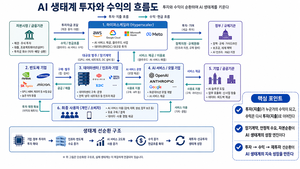
How to navigate the wild swings in Samsung and SK hynix shares: Understanding the AI ecosystem
Semiconductor share prices have been dizzying. Even companies worth more than 1 quadrillion won can swing more than 10 percent in a single day. Will they come crashing down, or will they eventually stand tall again? The most important factor, to put the answer plainly, is investor psychology. In the historical novel "Lieh-kuo Chih," Jian Shu — the celebrated chief minister of Duke Mu of Qin during the Spring and Autumn period — offered three principles of governance. "Do not be greedy, do not be angry, do not be hasty." The elaboration goes: "Greed brings great loss; anger drives people away; haste invites repeated failure." The Kospi has experienced far steeper rallies and deeper corrections than most other major markets, partly because some of the retail investors who drove the index higher were greedy, angry and hasty. Many sought to trade volatility using leverage rather than betting on structural growth. A speculative approach inevitably carries the cost of volatility. To improve the odds of investment success, it is important to understand the AI and semiconductor ecosystem clearly. How did the AI bubble narrative begin? The story behind the rise in semiconductor share prices goes like this. First, AI requires data centers, and data centers require semiconductors. Second, whoever builds data centers fastest can capture the AI market first — so securing semiconductors takes priority, whatever the cost. As hyperscalers — the large-scale data center operators — began buying semiconductors at prices several times higher than before, the profits of Samsung Electronics, SK hynix and Micron surged. Rising profits naturally pushed share prices higher. The engine driving those prices up, however, was profit growth, not profit stability. Semiconductor prices have historically tended to fall just as quickly as they rise. From late last year, hyperscalers — known for their strong earnings — began issuing corporate bonds, raising questions about whether they were spending too much on data centers. This year, they moved beyond bond issuance to equity raises, deepening those concerns. Consider the ratio of capital expenditure to operating cash flow: Amazon's ratio climbed from 51 percent in the second quarter of 2024 to 89 percent in the third quarter of last year, and has since exceeded 100 percent this year, pushing free cash flow into negative territory — meaning the company is spending more than it earns. Alphabet finds itself in a similar position. The 'Levy-Kalecki formula' and the power of investment Operating profit margins at memory chip makers have reached as high as 80 percent. Such margins are difficult to sustain when the coffers of their main customers — the hyperscalers — are running dry. If high chip prices cause hyperscalers to pull back on investment, chipmakers will suffer as well. In that environment, the right response is to manage prices rationally while locking in stable supply volumes through long-term contracts to grow the overall profit base. That is why Samsung Electronics and SK hynix have recently drawn up large-scale capacity expansion plans. "Corporations (capitalists) earn what they spend; households (workers) spend what they earn." This is the core insight from a paper on the principle of effective demand published by Polish economist Michał Kalecki — three years before John Maynard Keynes released "The General Theory of Employment, Interest and Money" (1936), widely regarded as the bible of macroeconomics. Jerome Levy of the United States grasped this structure 25 years before Kalecki. Drawing on it, he predicted the Great Depression of 1929 and liquidated his business and all his shareholdings months before the market crash. The Jerome Levy Forecasting Center, founded by his descendants, has since earned a reputation for accurately predicting major financial crises, including the dot-com bubble and the subprime mortgage crisis. The "Levy-Kalecki formula" — rarely covered in mainstream economics but widely used among professional investors — states: Corporate profits = Private investment (I) + Government deficit (G) + Net exports − Household savings + Dividends and other items Why Jensen Huang keeps traveling the world Nvidia CEO Jensen Huang visited South Korea twice — in November last year and again in June — meeting not only direct business partners Samsung and SK but also Hyundai Motor, LG Group, Naver and NCsoft, among other major Korean companies. Nvidia has also invested in OpenAI and is channeling more than one-third of its operating cash flow into external investments. Alliances and cross-investments have become routine across the AI ecosystem. OpenAI is in effect pursuing a strategic partnership with the US government by offering it a 5 percent stake. Some observers suspect a financial shell game, but viewed through the Levy-Kalecki lens, it looks more like an attempt to build a mutually beneficial structure — one person's investment becomes another's revenue, and another's spending becomes one's income. Investment by Samsung Electronics and SK hynix creates profit opportunities for semiconductor equipment makers and others. Building large-scale data centers domestically also generates demand for chips. Chip prices cannot rise indefinitely, but if robust demand takes hold, earnings become more predictable — and that predictability alone justifies a higher valuation. The semiconductor and AI growth story remains intact The sharp swings in AI chip stocks should not be read simply as a harbinger of a bubble bursting. Excess profits born of supply shortages are bound to normalize, and hyperscalers cannot sustain an ever-accelerating pace of investment. Price adjustments, supply increases and the spread of long-term contracts may represent not the collapse of the ecosystem but its search for equilibrium. For chipmakers, what matters is not short-term ultra-high margins but predictable long-term demand and a stable earnings base. A scenario in which hyperscalers cut data center investment, chip company profits fall and markets collapse seems unlikely. News that Meta plans to lease out computing power has revived talk of a data center glut, and reports have emerged that many companies are hesitant to adopt AI because of the cost. This feeds the argument that hyperscalers will reduce investment, deflating the chip stock bubble. Yet the data center business itself is booming. Google CEO Sundar Pichai announced at the first-quarter earnings call in April that cloud revenue surpassed $20 billion in a single quarter for the first time. The cloud backlog — contracts signed but not yet fulfilled — nearly doubled quarter-on-quarter to exceed $460 billion. To plug its own capacity shortfall, Google signed a contract to lease computing capacity equivalent to roughly 110,000 GPUs from Elon Musk's SpaceX (xAI) at $920 million (about 1.3 trillion won) per month. Even then, computing power remained scarce enough that Google was forced to throttle usage for one of its key customers, Meta. Markets read Meta's move to lease out data center capacity as a signal of oversupply, sending major semiconductor stocks tumbling worldwide. But Meta's computing lease closely resembles SpaceX's data center rental arrangement — it looks less like a symptom of excess supply and more like a company with insufficient in-house AI capability selling surplus assets back into the market. The reallocation of spare computing capacity through leasing may be part of the ecosystem finding its balance. Data center demand is likely to keep growing steeply. Jevons' paradox, sovereign AI, and the unrelenting growth of AI demand Anthropic's Mythos and Fable, and OpenAI's ChatGPT 5.6, are advanced enough that the US government has moved to regulate their distribution. According to Jevons' paradox, improvements in AI performance lead to greater data consumption, not less — and the token consumption of Fable or ChatGPT 5.6 is enormous. Once users experience the latest model, earlier versions quickly feel inadequate. As performance keeps improving, the share of paying users will inevitably rise, feeding revenue back to data centers and hyperscalers. US AI regulations have made sovereign AI a pressing topic among major nations. Not every country can build its own foundation models on the scale of ChatGPT, Gemini or Claude, but the case for domestic data centers is growing. That means the number of entities outside US hyperscalers investing in data centers — and needing semiconductors — could expand significantly. The initial public offerings of OpenAI and Anthropic also matter. These companies need to raise sufficient capital through their listings to keep paying data center fees. SpaceX, too, can be seen as having rushed toward a listing partly to fund its xAI investment. If they fail to list successfully, repaying the capital they have raised will become difficult, and their contracts with major data centers could be disrupted. Given the central role these companies play in the AI ecosystem, the fallout in a worst-case scenario would be hard to gauge. July checkpoints: second-quarter earnings and the Fed The second-quarter earnings releases due this month are critically important. The first priority is assessing the state of the hyperscalers. Even if AI has not yet generated sufficient returns, it would be reassuring if their core businesses remain healthy — and these are companies whose core operations are highly profitable. The Federal Reserve's interest rate decision also comes this month. A hold is widely expected, but market rates have risen sharply as inflation has been pushed up by the war involving Iran and compounded by strong investment demand from both corporations and governments. High interest rates have historically been a headwind for equities. Softening employment data has slightly reduced the probability of a Fed rate hike this year, which is not bad news for capital and money markets — but it is too early to relax. There is an old saying on Wall Street: "Bull markets don't die of old age — they are murdered." The most common murder weapon is a sharp rise in interest rates.
July 4, 2026
-
![Does the National Pension Service really need to cut its domestic stock holdings? [Hong Gil-yong's Hwasik Yeoljeon, No. 901]](https://wimg.heraldcorp.com/news/cms/2026/06/27/news-p.v1.20260627.60a91bdf09f049378b9b6f0a9df0d41d_T1.png?type=h&h=240)
Does the National Pension Service really need to cut its domestic stock holdings? [Hong Gil-yong's Hwasik Yeoljeon, No. 901]
NPS domestic stock weight smaller than Japan's, market share similar at around 6% Undervaluation overstates NPS's footprint — the room needs to get bigger, not the table smaller The National Pension Service's adjustment of its domestic stock allocation appears set to proceed in earnest from July, raising significant questions about the direction of a Kospi that has already seen sharp gains and rising volatility. Proper asset allocation to guard against concentration risk is a reasonable requirement for any manager of the public's retirement savings. But with foreign investors already dumping rebalancing sales and the exchange rate under pressure, is it truly rational for the NPS to join the selling queue and push even more money into overseas investments? Two questions follow. How are target allocations determined in the first place? And is the NPS's current domestic stock position actually too large relative to the size of the market? NPS domestic stock target raised to 20.8%; Japan's GPIF already at 25% On May 28, the NPS Fund Management Committee raised the domestic stock target allocation from 14.9% to 20.8%, a move designed to address the fact that the Kospi's surge had pushed the actual weighting well above the previous target. The committee did not disclose the revised strategic asset allocation (SAA) tolerance band, which had previously stood at plus or minus 5 percentage points. The overseas stock target was set at 34.7%. Market participants estimated that by end-May, the NPS's domestic stock holdings had grown to roughly 25% of the total stock market. Japan's Government Pension Investment Fund (GPIF) — the model most heavily referenced when the NPS was first designed in 1986 and 1987 — currently targets a 25% domestic stock allocation, with a permitted deviation of plus or minus 6 percentage points. That is roughly in line with the NPS's estimated current holding. The GPIF's overseas stock target stands at 25%, considerably lower than the NPS's equivalent figure. Pension funds' market share similar in Korea and Japan — no urgent need to sell heavily Public pension funds tend to accumulate large stakes in their home markets over decades of contributions. As their share of the stock market grows, the so-called "whale in a pond" effect means their trading moves markets. Just how large a whale is the NPS? As of Friday, the combined market capitalization of the Kospi and Kosdaq stood at approximately 7,400 trillion won ($4,790 billion). Estimating the NPS's domestic stock holdings at around 500 trillion won on the same date implies a market share of roughly 6.76%. That figure has ranged from 6.29% to a peak of 7.47% in 2020, fell to 5.79% in 2023, and recovered to 6.62% by end-2025. Is 6.76% actually high? Japan offers a useful comparison. According to the GPIF's fiscal year 2024 operations report, the fund held a 6.42% share of the Japanese stock market as of end-March 2025. Adjusting for share price gains and net inflows through Friday, the GPIF's domestic stock holdings are estimated at up to 85 trillion yen ($525 billion), implying a market share of at most 6.4%. The gap with the NPS is not particularly wide. (※ The difference between the Korean and Japanese governments' approaches to pension sustainability will be addressed in a future column.) A well-laid feast in a cramped room — time to move to a bigger house There is one more factor to examine: the valuation level of the market capitalization that forms the denominator. The Nikkei's 12-month forward price-to-earnings ratio stands at around 18 times, partly reflecting Japan's status as the second-largest market in the MSCI Developed Markets index. The Kospi's forward PER is around 8 times — below not only Taiwan and India, which trade at roughly 20 times within the MSCI Emerging Markets index, but also mainland China's CSI 300 at 13 times. The biggest factor is the explosive, short-cycle earnings growth of chipmakers, which account for more than half of the Korean market. At the same time, despite economic fundamentals that are by any measure on par with developed nations, the capital and financial market infrastructure still falls short of the global standard expected of peer countries — a gap that has kept the Kospi out of the MSCI Developed Markets index. It is as if a lavishly prepared banquet table has been set in a room too small to seat the guests. The right answer is to enlarge the room and welcome more visitors — not to clear away the food. Were the Korean stock market included in the MSCI World index, its weighting would be comparable to that of the United Kingdom or France, placing it among the top markets after the United States and Japan. A larger influx of global capital would resolve the undervaluation, allowing the NPS to hold more domestic stocks while minimizing supply-demand shocks when it does need to rebalance. If you can afford to move to a bigger house, why rearrange the furniture to fit a smaller one?
June 28, 2026
-
![[Opinion] Dongducheon Mayor Park Hyeong-deok: Policy consistency protects our children's future](https://wimg.heraldcorp.com/news/cms/2026/06/25/news-p.v1.20260625.45fed20a85c3474e82d05dc809b856cd_T1.jpg?type=h&h=240)
[Opinion] Dongducheon Mayor Park Hyeong-deok: Policy consistency protects our children's future
The Ministry of Education's recently announced plan to launch so-called "education innovation leading regions" has caused considerable confusion and disappointment among schools and local communities across the country. In 2024, the ministry designated 64 regions nationwide as pilot sites under its Education Development Special Zone program, promising to run the initiative for three years before conducting evaluations and granting full special zone status. Local governments invested in education reform on the strength of that commitment. It was a policy direction the central government and local authorities had agreed to pursue together. Yet the ministry has now announced plans to terminate the pilot program early and replace it with a new competitive grant scheme called "education innovation leading regions." The plan calls for selecting only around 40 regions nationwide for continued support, leaving local governments and schools struggling to hide their dismay. An abrupt policy reversal made without adequate consultation does not merely disrupt schools — it undermines public trust in national policy itself. Since 2023, Dongducheon has worked to transform its education environment under the vision of "Dream-Fulfilling Glocal Dongducheon" in pursuit of Education Development Special Zone designation. The city government, district education office, schools, universities, businesses and the broader community formed a single education cooperative, working together to reform public education and nurture future talent. Despite strained fiscal conditions, the city committed a total budget of more than 16.2 billion won ($10.5 million) in national, provincial and municipal funds following its pilot designation in 2024. As a result, Dongducheon's own model of education innovation — encompassing after-school care, safe commuting support, software and AI education, and the introduction of the International Baccalaureate curriculum — has begun to show results. The "DDC Saessak Care Classroom" after-school program and the smart safety shuttle bus known as "Dongtuli" have earned high satisfaction ratings from parents. An overseas exchange program called the "Dream-Fulfilling Club" and the expansion of IB education are laying the groundwork for students' future competitiveness. Yet Dongducheon's education reform, which has only just begun to bear fruit, now stands at a critical crossroads because of this policy shift. If the Education Development Special Zone program ends early, the damage will extend far beyond administrative burdens — it will mean fewer educational opportunities for students and greater childcare burdens for parents. First, a unilateral policy reversal by the central government destroys trust in education administration. Education is not a short-term experiment. Local governments, schools and parents built their plans around the Education Development Special Zone policy, committing budgets and personnel accordingly. To reverse course without adequate consultation or alternatives nullifies the efforts of those on the ground and erodes confidence in central government policy. Education policy must be driven by children's futures, not administrative convenience. Second, the costs of policy failure must not be passed on to students and parents. If national funding is cut, hard-won core programs — after-school care, commuting support, software and AI education, and global competency programs — face serious cutbacks. That means fewer educational opportunities for students and a return of childcare and commuting burdens to parents. Communities that already lack educational infrastructure will inevitably suffer the most. Third, consolidating small schools without regard for local realities is not education policy — it is administrative convenience. Schools are not merely educational facilities; they are where children learn and the institutions that hold local communities together. Under the ministry's criteria, six elementary schools and two middle schools in Dongducheon would come under review. If consolidation proceeds without sufficient public input and alternatives, students will face longer commutes and regional decline will accelerate. This is precisely why similar policies in the past ran into fierce local opposition and practical limitations. Education is a generational undertaking. Policy continuity and predictability are paramount. The central government must listen to voices from the field. Because educational environments and conditions differ from region to region, policy must reflect local characteristics rather than impose uniform standards. Above all, the government must provide adequate support and institutional safeguards so that regions already producing results through the Education Development Special Zone program can continue their work without disruption. Dongducheon will continue to do everything in its power to protect children's right to education and build a better learning environment. Local communities must thrive for the nation to thrive. And education is the most powerful bulwark against regional depopulation. If education policy can be reversed on a whim to suit the central government's convenience, no local government can trust the central government enough to plan for the future. The central government must not take lightly this urgent call — one on which the very survival of local communities depends.
June 25, 2026
-
Mr. President, MSCI developed-market inclusion is a prerequisite for Korea's next great leap
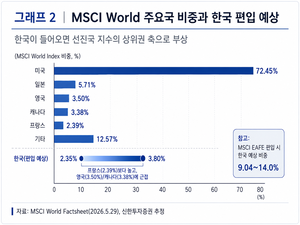
"Hong Gil-yong's Hwasik Yeoljeon," which launched in August 2008 just before the global financial crisis, has reached its 900th installment. From its beginnings as "Hong Gil-yong's Money Story" to its current form, this column has endured thanks to the unwavering support of its readers. There is still much room for improvement. Whether it can reach the rare milestone of 1,000 installments — something almost unheard of in Korean economic commentary — remains to be seen. Your encouragement means everything. I will continue to give my best. Thank you. Dear President Lee Jae-myung, I have been writing "Hong Gil-yong's Hwasik Yeoljeon" since 2008, and this piece marks the column's 900th installment after 18 years. I gave considerable thought to what this milestone entry should say. The question of Korea's inclusion in the MSCI developed-market index has grown increasingly urgent, and while it may not happen this year, I believe it is a task that must be accomplished within your term. That conviction is why I have chosen to write this column as an open letter to you. This month is a watershed moment. On June 24, MSCI's annual market classification review will determine whether Korea is placed on the watch list for potential reclassification as a developed market. Even if Korea makes the watch list this year, the path forward is gradual. Missing the cut means waiting another year — but the timeline still falls within your term. This is a goal that can realistically be completed before you leave office. You have just returned from the G7 summit. Korea is not a formal member, but it has been invited to the G7 table repeatedly in recent years — a sign that the world recognizes Korea as a core partner among advanced economies. Semiconductors, defense, shipbuilding, batteries, automobiles, K-pop and drama series have become indispensable to the global economy and culture. And yet one anomaly remains. Korea is a developed nation in every practical sense, but on the global financial map it is still classified as an emerging market. The final piece of Korea's transformation into a fully developed country is its capital market. Inclusion in the MSCI developed-market index is not simply a positive catalyst for stocks. It is a rare, historic reclassification event that would redirect enormous flows of global capital — and a prerequisite for the structural leap that could dramatically transform the fundamentals of the Korean economy. The fastest route to a Kospi 20,000 era Korea's stock market has recently climbed to among the top six in the world by market capitalization. Korea's weight in the MSCI Emerging Markets index stood at 23 percent at the end of May, and securities industry estimates incorporating the recent market rally put that figure as high as 26 percent. A Korean reclassification would be on an entirely different scale from past cases such as Greece or Israel. A market of Korea's size moving out of the emerging-market category would shift the balance between developed and emerging markets globally. Korea's entry into the developed-market index would substantially alter the composition of that index as well. Particularly significant is what reclassification would mean for Korean corporate valuations. Korea's forward return on equity stands at 28.9 percent — more than 50 percent above the emerging-market average of 18.3 percent and the developed-market average of 18.9 percent. Yet its forward price-to-earnings ratio hovers around 8 times, roughly 31 percent below the emerging-market average and 57 percent below the developed-market average. Korea is not a market trading cheaply because of weak fundamentals. It is a market generating strong profits while being priced as if it were not. Reclassification as a developed market could normalize that abnormal discount. If corporate earnings growth follows, Kospi levels of 15,000 or even 20,000 move from slogan territory into the realm of arithmetically plausible targets. These are not index targets per se — they are symbols of a market where Korean companies finally receive fair value. According to estimates by Shinhan Investment strategist Noh Dong-gil on Monday, Korea could account for approximately 3.8 percent of the MSCI World index upon inclusion, making it the third-largest constituent after the United States and Japan. Its weight in the EAFE index — which covers developed markets excluding the US — could reach as high as 14 percent. These estimates are based on current prices, which still reflect the emerging-market discount and foreign-exchange market restrictions. The moment Korea is reclassified, the prices themselves could change. Economic strength plus K-culture: Korea has earned its place The fundamentals are there. The United States holds an overwhelming lead in software, foundational technology and platforms. But technology alone — lines of code and patents — cannot reshape the world. It must be turned into semiconductors, connected through power grids, and realized in warships, satellites, batteries, automobiles, factories and data centers. In that physical execution and mass-production capability, Korean companies rank among the very best in the world. The Korean stock market is the market that holds that capability. AI requires HBM and memory chips, power equipment and cooling infrastructure. Space demands precision manufacturing, advanced materials, and satellite and defense technology. Defense needs mass production and on-time delivery, ammunition and ground weapons, warships and electronic systems. The energy transition cannot happen without nuclear power plants, power grids, batteries and energy storage systems. Korean companies are present on every one of these fronts. Korea rose from the ruins of war to achieve industrialization and democracy. It has no history of invading other nations. K-pop, drama series, film, food and beauty have won the affection of people around the world. Few countries in history have possessed both soft power and hard power at the same time. Korea is not a power the world fears — it is a power the world likes and trusts. Developed-market inclusion could ignite a global wave of K-investment. If K-culture has opened hearts around the world, K-investment is about opening portfolios. A key to solving the real estate, youth and aging crises This transformation connects directly to the lives of ordinary Koreans. The concentration of wealth in real estate is not greed — it is the memory of success. Previous generations built their way into the middle class through homeownership. They took out loans, bought homes, and watched rising prices turn into assets. For today's young people, however, real estate is less a ladder than a wall. Young Koreans need a new ladder — and that ladder must be corporate growth. It should be a path where a portion of each paycheck goes into quality companies and indexes, and where dividends, share buybacks and rising corporate value are shared by all. The concentration in real estate can ease naturally once a better investment alternative exists. Young people without homes, and salaried workers saving into pension funds, should all be able to ride the growth of Korean companies. A larger stock market raises returns across all types of pension funds. The long-term sustainability of public pensions, including the national pension, could improve as well. A more secure retirement for citizens reduces the government's future fiscal burden. Concerns about consumption slowdown driven by aging would also diminish. A resilient economy and sound public finances give the government the foundation to increase forward-looking spending. The foreign-exchange system: the biggest obstacle on the road to developed-market status Developed-market inclusion is not a project for foreign investors. It is a national asset project. So why has Korea's stock market not yet made it into the developed-market index? Corporate competitiveness and market size are already sufficient. Shareholder-oriented governance has advanced, in part because of the commercial law reforms you have championed. Kospi has posted the highest returns among major global indexes this year, as it did last year. Requirements such as English-language disclosures and global investor relations roadshows can be implemented quickly with sufficient political will. The biggest remaining bottleneck is the foreign-exchange system. The memory of the 1997 currency crisis left a deep wariness in economic policymakers and corporate executives alike. But that wariness has now reached the point where it is itself a discount embedded in Korea's capital markets. For the past 30 years, the logic governing the bureaucratic approach to foreign exchange has gone like this: "Korea is a small open economy with a high dependence on trade. Allowing offshore won trading could destabilize the foreign-exchange market." The reality of the Korean economy has changed. Sales at Korean companies tied to the AI revolution are growing rapidly. Trade volumes have expanded, and the stock market's sharp rally has elevated the capital market to an entirely different scale. A system built around trade settlement and bank-intermediated transactions — rooted in an outdated self-image as a "small open economy" — has reached its limits. Global capital must be able to convert won, buy and sell shares, settle transactions, hedge positions and exit — as smoothly as in any developed market. Foreign companies and investors holding won or won-denominated assets should not have to worry about excessive exchange-rate volatility. A foreign-exchange system befitting Korea's economic scale is not optional — it is essential Some worry that liberalizing the foreign-exchange market will increase volatility and trigger dollar liquidity crunches. But a restrictive foreign-exchange market is already generating costs. Foreign investors route around it through offshore non-deliverable forwards and other workarounds, and the price of that inconvenience shows up as a discount on Korean assets. When Korean companies are developed-market in scale but the foreign-exchange infrastructure remains stuck in emerging-market conventions, the discount persists. Because the won lacks sufficient autonomy, it is easily dragged along by moves in the yuan or the yen. The Korea discount is still very much alive. The 1997 currency crisis did not happen because Korea opened its foreign-exchange market. Before the crisis, the government controlled the exchange rate far more tightly. What matters is the capacity to manage foreign-currency liquidity and the credibility of the financial system. A recent report by the Korea Capital Market Institute found that extending foreign-exchange trading hours into the early morning actually stabilized exchange-rate volatility rather than amplifying it. When the 24-hour trading regime takes full effect on July 6, volatility could fall further. Lower volatility reduces currency risk for exporters and foreign investors alike, which in turn stabilizes the value of the won — a virtuous cycle. If foreign-exchange market reform leads to developed-market inclusion and draws larger global capital flows into Korean equities, the case for the United States, Europe and other reserve-currency nations to establish standing currency swap arrangements with Korea will grow stronger. Such swaps would not be favors extended to Korea — they would serve as safety valves for the capital those countries have invested in Korean markets. Kosdaq must be separated from Korea Exchange to stop companies from transferring their listings away The first wave of capital following developed-market inclusion will concentrate in mega-cap stocks such as Samsung Electronics and SK Hynix. That is to be expected. But the future of any nation's capital market grows not from companies that are already large, but from companies that will become large. That nursery is Kosdaq — and Kosdaq's governance structure needs to be redesigned from the ground up. Debuting on Kosdaq, growing, and then transferring to the main board has become standard practice. A market that serves as a waystation rather than a destination for growth companies cannot become a world-class technology exchange. Just as Nasdaq is not a second-tier market beneath the New York Stock Exchange, Kosdaq should not be a second tier beneath Kospi. Left on its current trajectory, the capital market will replicate the same concentration dynamic seen in Korea's geographic over-centralization around Greater Seoul. Kosdaq must be separated and made independent from Korea Exchange. A global K-investment wave is not out of reach K-investment is not a slogan. It is the set of institutions and culture that allows global investors to understand Korean companies, trust them and hold them for the long term. Foreign-exchange market access, English-language disclosures, global investor relations, shareholder returns, minority shareholder rights and an independent Kosdaq all point in the same direction: make it possible for the world to invest in Korea, and ensure that Korean citizens are the primary beneficiaries of that growth. Korea already has the industries the world needs. It has the culture the world loves. It has the democratic foundations and alliance relationships the world can trust. In industry, culture and alliances, Korea is already a developed nation. The one remaining box to check is the market. The moment that box is filled, Korea becomes a fully developed country in every sense. The era when real estate was the ladder is drawing to a close — and it should. The next generation's ladder must be the growth of Korean companies. The key that opens the door to a future where young Koreans without homes can become owners of Korean enterprise is in your hands, Mr. President. Developed-market inclusion for the Korean stock market is not a share-price event. It is a change in Korea's economic identity. For 18 years I have written about where money flows. One thing is clear: money goes where it is trusted. The world already trusts Korea. What remains is to let that trust flow into the Korean market. Within your term, Mr. President — please open that final door.
June 18, 2026
-
[Editorial] US-Iran ceasefire: Korea must prepare for market volatility and the North Korea nuclear question
The war between the United States and Iran has finally found its way to an exit. The two countries effectively made official on Monday their agreement to conclude a ceasefire memorandum of understanding. Donald Trump said in a social media post Sunday, local time, that "the deal with Iran is now finalized." Iranian Deputy Foreign Minister Kazem Gharibabadi confirmed the development in a television interview, saying "a permanent and immediate end to hostilities has been declared on all fronts, including Lebanon." Pakistan, which mediated the negotiations, also confirmed the agreement. A signing ceremony is scheduled for June 19 in Switzerland. Trump said the Strait of Hormuz "will be opened as soon as the deal is signed on Friday." The news is welcome — and a timely relief for the South Korean economy. The reopening of the Strait of Hormuz should stabilize international energy and raw materials markets. For an economy heavily dependent on crude oil imports, that translates into lower inflation and reduced costs for businesses. A weaker won and a recovery in global investor sentiment would also provide tailwinds for domestic capital markets. While the full terms of the ceasefire MOU have yet to be disclosed, the agreement is expected to include Iran's permanent renunciation of nuclear weapons and its consent to dismantle its nuclear program and dispose of nuclear materials, with the United States providing compensation — including the release of frozen overseas assets and sanctions relief — in line with Iran's compliance. As sanctions are lifted, South Korean companies could gain opportunities to participate in postwar reconstruction projects in Iran. Yet there is no room for complacency. Proactive preparation is essential. Authorities should closely monitor the progress of the ceasefire and oil price movements, and work to transition energy policy — including price caps — smoothly from emergency footing to a peacetime framework. Defense strategies are also needed against risks such as financial market volatility triggered by a sharp drop in oil prices or a prolonged low-price environment, as well as the impact on the refining and petrochemical industries. Over the medium to long term, South Korea should pursue a strategic realignment to reduce and diversify its dependence on the Middle East for crude oil supply and trade routes. Diplomacy and financial support plans for participation in reconstruction projects in Iran and Lebanon must also be set in motion. Volatility in US strategy toward North Korea and its nuclear policy remains the foremost security concern for South Korea. The day before Trump announced the ceasefire agreement, he posted on social media a photo of himself with North Korean leader Kim Jong-un — an image from their Singapore summit on June 12, 2018. While the post may simply mark the eighth anniversary of that meeting and highlight Trump's record, it could also signal his intention to address the North Korean nuclear issue in earnest following the Iran ceasefire, or to re-engage with Pyongyang. Whether Washington will seek to apply an Iran-style denuclearization model to North Korea is a matter of the gravest consequence. The South Korean government must reaffirm the bedrock of the alliance with the United States, strengthen communication and consultation with Washington, and develop proactive scenarios for North Korea's denuclearization going forward. From the full conclusion of the US-Iran war to the period that follows, not a moment of complacency can be afforded.
June 15, 2026
-
[Editorial] US AI export controls are real — Korea must build its own ecosystem now
The US government on June 12 banned foreign access to Mythos5 and Fable5, the cutting-edge AI models developed by Anthropic, blocking not only overseas users but also foreign nationals and foreign employees inside the United States. The sweeping restriction came just three days after Fable5's public release. As the first export control ever applied to an AI model, it signals that AI is now regarded — alongside semiconductors and military technology — as a domain directly tied to national security. The trigger was the discovery of a potential "jailbreak" — a method to bypass Fable5's built-in safety filters. The model was designed to block instructions that could be exploited for cyberattacks or the development of biological and chemical weapons, but researchers reportedly found ways around those guardrails. Washington concluded that malicious actors could exploit the vulnerability to pose a serious threat to national security. Some foreign media outlets also cited concerns that entities linked to China may have accessed the model as part of the regulatory backdrop. When Anthropic declined a White House request to suspend the service, the administration escalated to export controls. The severity of the response reflects the raw power of the Mythos and Fable models. Both are assessed to possess expert-level cybersecurity capabilities — able to identify software vulnerabilities, analyze security architectures and predict potential attack vectors. While that makes them valuable for auditing critical infrastructure and bolstering cyber defenses, the same capabilities could enable devastating attacks if misused. The era in which AI attacks and AI defends is becoming reality. The concern for Korea is that its AI competitiveness lags well behind the front runners. According to AI performance evaluator Artificial Analysis, Fable5 ranks first in the world, followed by OpenAI and Google. Behind them, Chinese firms — Alibaba, DeepSeek, Moonshot AI and Xiaomi — have clustered in the middle tier. Stanford University's Institute for Human-Centered AI has ranked Korea third globally, behind the United States and China, but its actual competitive standing remains a considerable distance from the leaders. The fact that Korea can sustain independent model development is encouraging, but much ground remains to be covered. Korea would do well to study how China has grown. Despite US semiconductor restrictions that have made it difficult to secure the most advanced chips, China has cultivated a thriving AI ecosystem through intense competition among numerous companies, low prices and open-source models — building competitiveness on its own terms. Korea must create an environment where more companies can compete, and expand its data and computing infrastructure. It should also move quickly to nurture an AI ecosystem that plays to its strengths in manufacturing, public services and the Korean language. AI technology now shapes both national competitiveness and national security.
June 15, 2026
-
SpaceX lands record IPO, but questions over valuation — and Musk's ultimate vision — linger
"The road to Shu is harder than climbing to the blue sky." The line comes from "Hard Road to Shu," a yuefu poem by the Tang dynasty poet Li Bai. The region around present-day Sichuan province is a vast basin ringed by mountains — in ancient times, one of the most inaccessible corners of the Chinese heartland. It was absorbed into China in 316 B.C., when Qin general Sima Cuo recognized the fertile Bashu region's enormous economic value and strategic geography and persuaded King Huiwen to launch a campaign of conquest. The victory freed Qin from chronic food shortages and opened a new avenue of attack against its great rival, Chu. A shift in thinking and a willingness to take risks changed the course of history. SpaceX completed the largest initial public offering in history on Friday (New York time). Shares opened at $150, about 10 percent above the $135 offering price, and closed at $160.95, a gain of 19 percent on the day. The debate that once swirled around the offering price has now shifted to whether the stock is fairly valued at current levels. Some market observers have likened valuing SpaceX less to conventional stock analysis and more to the prediction markets that have surged in popularity in the United States. The target prices on offer so far span a wide range: Oppenheimer has set a target of $195, while Morningstar puts fair value at $63 — implying either a nearly 50 percent gain from the offering price or a roughly 50 percent decline. Because SpaceX is still unprofitable, expectations rather than earnings will drive the stock. The market will eventually form a clearer view, but for now no one can predict the right number with confidence. In the face of that uncertainty, a solid grasp of where the company actually stands today is the most useful starting point. AI the main drag on profits; spacecraft and Starlink show clear strength SpaceX operates three main business segments: spacecraft, Starlink connectivity and AI. Based on 2025 figures, Starlink is the largest by revenue at $11.39 billion and also generates $4.42 billion in operating profit. The spacecraft segment is also in the red. The AI segment posts the smallest revenue at $3.2 billion and the largest operating loss at $6.36 billion. Because the company as a whole is unprofitable, a price-to-earnings ratio could not be used to set the offering price. Instead, bankers applied a price-to-sales ratio — a metric more commonly used for early-stage companies. Based on 2025 revenue of $18.7 billion, the PSR at the offering price works out to 94 times. Determining where value lies requires first identifying where revenue growth will be fastest. In its prospectus, SpaceX broke down its total addressable market by segment: $370 billion for spacecraft, $870 billion for Starlink and $26.46 trillion for AI. SpaceX's competitive position in the spacecraft and Starlink segments is overwhelming, and there is a credible case that those two divisions could eventually generate hundreds of billions of dollars in annual revenue. Starlink's operating margin already stands at roughly 40 percent. Under a highly optimistic scenario, if SpaceX captures half of the combined $1.24 trillion TAM for those two segments, the arithmetic yields roughly $240 billion in operating profit. Apply a price-to-earnings multiple of just 10 times, and the implied enterprise value approaches $2.4 trillion. The problem lies in the loss-making segments. In the spacecraft division, development costs for the Starship super-heavy launch vehicle are currently the main drag on profitability. SpaceX's track record gives reasonable grounds for confidence that Starship will ultimately succeed — and if it does, the company could generate new revenue streams from building AI data centers in orbit. The deeper concern is the AI segment. Goldman Sachs, the lead underwriter, projected in its institutional research that SpaceX's total revenue would reach $474 billion by 2030, with AI segment revenue growing nearly 100-fold — from $3.2 billion in 2025 to $322 billion in 2030. That would represent the steepest and largest increase of any of the three divisions. SpaceX recently signed chip-leasing contracts with Anthropic and Google worth a combined $26 billion a year — a result significant enough to drive the company's overall revenue growth this year, but not yet clearly profitable on its own. AI data center operations are capital-intensive, carrying heavy costs for power, cooling, GPU procurement and depreciation. Last year, SpaceX's capital expenditure for the AI segment totaled $12.73 billion, dwarfing the $3.83 billion spent on spacecraft and $4.18 billion on Starlink. Fierce competition in AI investment raises prospect of additional share issuances The AI segment's capital expenditure last year more than doubled from $5.63 billion in 2024. This year, SpaceX spent $7.72 billion on AI in the first quarter alone — a pace that implies more than $30 billion for the full year. The IPO raised up to $86 billion including the overallotment option, but a substantial portion of those proceeds will likely need to flow into the AI segment. SpaceX has not disclosed how it plans to allocate the offering proceeds across specific uses. Competition among hyperscalers in the AI data center market is fierce. Improving profitability will require stronger competitiveness across the broader ecosystem — semiconductors, power generation and beyond. That context helps explain why Elon Musk has signaled his intention to enter the semiconductor and power generation businesses. Doing so will require enormous capital, and internal cash flow alone seems unlikely to cover the bill in the near term. That is why talk of additional share issuances has already begun. Tesla, too, raised capital through multiple secondary offerings after its listing. Musk holds supervoting rights at SpaceX, so additional issuances would be unlikely to dilute his control. That makes supply-and-demand dynamics a critical variable for the SpaceX share price. Index inclusion effects and latent selling pressure both warrant close attention By the same token, investors should watch carefully how SpaceX is incorporated into major indexes and how passive fund flows develop. At the offering price, SpaceX's market cap of roughly $1.77 trillion places it among the top seven companies globally by total market capitalization — but the shares issued in the IPO represent only 4 to 5 percent of that total. Index inclusion and the resulting passive inflows are generally calculated on the basis of float-adjusted market cap rather than total market cap. On that measure, SpaceX ranks closer to 25th to 30th among large US stocks — meaning the passive money that flows in will reflect a 25th-place weighting, not a seventh-place one. The Nasdaq-100 and Russell 1000 relaxed their eligibility criteria to allow SpaceX to be added to their indexes quickly. The S&P 500, however — the largest index of all — has decided to maintain strict standards on minimum trading history, liquidity and profitability. SpaceX is expected to need at least a year before it can qualify for S&P 500 inclusion. Convertible preferred shares represent another potential headwind. The outstanding balance of convertible preferred shares, which stood at $38.8 billion at the end of 2025, fell to $7 billion in the first quarter of this year, suggesting a large portion has already been converted into common stock. When those converted shares become freely tradable will depend on lock-up conditions and how index providers treat them. The existing investor shares converted from preferred stock represent a potential overhang that could weigh on supply-and-demand dynamics going forward. Even as passive funds flow in gradually, sequential selling by existing investors could limit upward momentum in the stock price. Twenty-three global investment banks — including Goldman Sachs, Morgan Stanley, BofA Securities, Citigroup and JPMorgan — served as joint bookrunners for the offering. Because of conflicts of interest inherent in the underwriting role, those banks were unable to publish independent investment opinions during the listing process, meaning many of the institutions that examined SpaceX most closely have yet to release formal research. Now that the IPO is complete, they are expected to begin issuing recommendations — and those reports will be worth waiting for. Ultimately, a company is shaped by its CEO. Elon Musk's greatest strength is his willingness to take on challenges, and investing requires the courage to embrace optimism. Uncertainty in the AI segment is a genuine concern, but the spacecraft and Starlink divisions offer a more straightforward positive case. How the SpaceX share price evolves from here could ripple through global capital markets. Whether or not one invests directly, SpaceX is a company that anyone with an interest in capital markets would do well to watch closely.
June 13, 2026
-
[Editorial] Ruling and opposition party leaders consumed by power struggles — the most regressive forces in South Korea
Jung Chung-rae, leader of the Democratic Party of Korea, told a general assembly of lawmakers Thursday that "throughout history, we have won when united and lost when divided. What we must do is rally firmly around President Lee Jae-myung, make this government a success, and renew our mandate." Yet in the closed session that followed, multiple lawmakers reportedly called on him to resign. The June 3 local elections drew sharp criticism from within the party, with members describing the results as "an incomprehensible defeat" and "a failure beyond a psychological rout." That same day, calls arose within the People Power Party for leader Jang Dong-hyeok and the party leadership to step down and accept responsibility for the election outcome. Jang shrugged off the demands, saying that anyone seeking to force a choice on the leadership must first explain how the party's 110 lawmakers plan to address the ballot shortage crisis. Both ruling and opposition party leaders appear to be turning a blind eye to the unmistakable verdict voters delivered through the local elections. The ruling Democratic Party won 12 of 16 metropolitan governorships and mayoral races but lost key battleground contests. The People Power Party, which had held a 12-to-5 advantage in those races, suffered a dramatic reversal. Voters signaled support for the Lee Jae-myung government's call for political stability while sending a clear warning against the Democratic Party's unchecked dominance. At the same time, they handed the opposition the minimum counterweight needed to check the government and ruling party — even as they punished the People Power Party for its ineffectiveness in opposition and the failures of the previous administration. It would be more accurate to say this was an election with no real winner — a defeat for both sides. Yet neither party leadership has offered genuine self-reflection, sober assessment, or honest diagnosis. Immediately after the results came in, Jung said he was "deeply grateful to the people for delivering a great victory to the Democratic Party nationwide," adding only that "it hurts not to have retaken Seoul." Since then, only the political rhetoric has changed; there is little sign of any shift in his thinking. Without offering any concrete reading of what voters' choices actually meant, he drew criticism for a cryptic remark — "the people are eternal; governments are fleeting" — that sounded more like a riddle than a reckoning. Jang said he felt "regretful and sorry" about the results, but then framed them as "the people's order to stand against the arrogant and lawless Lee Jae-myung and the Democratic Party, and to defend the Republic of Korea" — showing no reflection on the majority of voters who backed the call for governmental stability. Does the leadership of both parties truly not understand what every citizen can plainly see — or are they simply ignoring it to protect their grip on power? The essence of politics is the rational allocation of resources and the mediation of conflict, with the competition for power serving those ends. The country now stands at a crossroads, and politics must play a critical role in deciding how to distribute resources for future growth, overcome polarization, and achieve social cohesion. Instead, both parties are mired in a power struggle with means and ends completely reversed — a regressive fight that serves no one. Forces that refuse to reform will inevitably face a harsh reckoning.
June 12, 2026
-
[Editorial] Manufacturing, youth job losses sound alarm over jobless growth
Semiconductor exports are hitting record highs, yet jobs are disappearing. According to the Ministry of Statistics, the number of employed workers stood at 29.12 million in May, down 40,000 from the same month last year. It was the first year-on-year monthly decline since December 2024, when employment fell by 52,000 as consumer sentiment froze in the aftermath of the emergency martial law declaration. Manufacturing shed 140,000 jobs — the steepest drop in seven years and three months — while youth employment fell by 255,000, the largest decline since the COVID-19 pandemic. The employment picture is deeply troubling. The prolonged war in the Middle East, which has kept oil prices elevated and pushed up raw materials costs, has weighed heavily on manufacturing jobs. Industries with strong employment multiplier effects — automobiles, chemicals, and rubber and plastics — have taken the hardest hit. External factors are clearly at play. But the freeze gripping youth employment is more complex. The drop in youth workers is more than six times the overall employment decline, and it shows no sign of being temporary. Youth employment fell by 147,000 in March, 194,000 in April and 255,000 in May — the losses accelerating with each passing month. The impact of AI cannot be ignored. Employment in professional, scientific and technology services — a category that includes research and development, consulting, and legal and accounting work — fell by 89,000. AI is taking over routine tasks, reducing the need for entry-level hires. The more fundamental problem is that growth and employment are moving in opposite directions. Exports reached $87.75 billion in May, a record high on a monthly basis and a 53.2 percent increase from a year earlier. Semiconductor exports also set an all-time record at $37.2 billion, jumping 169.4 percent. Riding the AI boom, semiconductors now account for more than 40 percent of total exports — yet semiconductor workers make up only about 4 percent of all manufacturing employees. Strong growth is simply not translating into more jobs. That gap is likely to widen. As AI advances and physical AI and robotic automation spread further, the divergence between growth and employment could deepen considerably. That is precisely why the government cannot afford to rely on cash handouts or short-term fixes. A structural response is needed. Young people being shut out of the workforce at the very age when they should be building experience is not just a personal hardship — it is an enormous national loss. Without jobs, young people cannot build income or assets, and the long-term consequences extend to marriage and childbirth as well. A recent Bank of Korea report found that the share of people in their 20s and 30s who rank in the bottom 20 percent for both net assets and income nearly doubled, from 7.9 percent in 2020 to 15.2 percent last year. Youth employment must be placed at the center of policy so that young Koreans can work and build a future with hope.
June 12, 2026
-
Incheon-Jeju domestic route revival opens new gateway for regional vitality
A business traveler returning from abroad, or a foreign tourist arriving in Korea full of anticipation, heads for Jeju Island — only to drag a heavy suitcase through bus and subway transfers for more than an hour to reach Gimpo Airport. It has long been a familiar scene, yet one that left travelers quietly frustrated every time. "Why is there no flight to Jeju from Incheon Airport, the world's best?" Many people have asked that question at least once. In May, an answer finally arrived: the Incheon-Jeju scheduled route resumed service after a 10-year hiatus. Korea's aviation network had long operated under a clear division of labor — Incheon Airport for international flights, Gimpo Airport for domestic ones. That structure helped sharpen the country's competitiveness in international aviation, but it also forced travelers arriving from abroad to switch airports before heading to Jeju or other regional destinations. The resumption of the Incheon-Jeju route began with a simple goal: removing that inconvenience. Passengers arriving from Paris, New York, Tokyo or Singapore can now board a connecting flight to Jeju without ever leaving the terminal. What may look like the elimination of a single transfer is, in practice, a meaningful step closer for travelers around the world who want to experience Korea. On the ground, the response has been encouraging. Transit demand — passengers flying in from overseas and continuing directly to Jeju — has risen noticeably, and the number of travelers treating Incheon Airport and Jeju as a single seamless journey is steadily growing. Time once spent shuttling between Incheon and Gimpo can now go toward travel, rest or business. The practical benefits in time and cost are proving real. The route's revival carries significance beyond the addition of a new service. It lays the groundwork for international visitors to reach Jeju and other regions more easily, and opens a new channel through which tourism and spending can spread across the country rather than concentrating in the Greater Seoul area. It also marks a broader shift in Incheon Airport's role — evolving into a gateway that connects the world not just to Seoul, but to Korea's regions as well. Sustaining that momentum matters as much as the first step. Expanding transit infrastructure to make connections smoother, and backing the route with differentiated tourism and transport policies capable of generating stable, recurring demand, will both be essential. The Ministry of Land, Infrastructure and Transport plans to treat the route's resumption not as a one-time achievement but as the start of ongoing collaboration with the aviation industry to improve transit convenience and secure lasting demand. Cooperation with local communities will also be strengthened. When the central government opens air routes and improves national connectivity, local governments become indispensable partners — filling those routes with distinctive cultural and tourism content that draws visitors from around the world. When central government policy execution and the creative capacity of local governments work in concert, Korea's air network will build a resilience that cannot easily be shaken. The Incheon-Jeju route revival is more than one additional flight. It is the start of a possibility — one where visitors from abroad can reach Jeju directly without passing through Seoul, and where more regions across Korea can eventually connect to the world on their own terms. The Ministry of Land, Infrastructure and Transport will build on this start to pursue uninterrupted innovation in transport networks: dramatically improving mobility for the public and raising the vitality of Korea's regions to a world-class level. The hope is that one day, the sight of international travelers landing at Incheon and fanning out to beautiful destinations across the country will be not a novelty, but an everyday scene. By Hong Ji-sun, Second Vice Minister of Land, Infrastructure and Transport
June 12, 2026
-
Descendants of Baekje's King Uija and their ties to Japan's imperial family
"When will we ever set foot on our homeland again?" In August 660, Silla's King Muyeol — Kim Chun-chu — allied with Tang China and brought Tang forces under General Su Dingfang to destroy the kingdom of Baekje. King Uija of Baekje had two sons stationed in Japan at the time: Pung and Seonggwang. When Baekje fell and Uija along with his eldest son Yung were taken to Tang as hostages, Pung returned home to lead a revival movement while his younger brother Seonggwang remained in Japan. Meanwhile, Japan's Empress Saimei and Crown Prince Naka no Ōe — later Emperor Tenji — dispatched a large military force to support Pung's restoration effort, mindful of the close ties between the two royal houses. When Japanese forces were routed by the Silla-Tang allied army at the mouth of the Geum River, Pung fled to Goguryeo. That engagement, fought in 663, is known as the Battle of Baekgang. The defeated Japanese army withdrew to Japan, and the Japanese chronicle "Nihon Shoki" records the anguish of the Baekje ruling-class elites who chose collective exile and accompanied them: "The name of Baekje has vanished as of today. When will we ever set foot on the land where our ancestors are buried?" The Baekje elite who crossed to Japan numbered an estimated 3,000. The Japanese court settled roughly 1,000 of them in the southeastern part of Omi Province — present-day Shiga Prefecture — and dispersed the remaining 2,000 or so across the northeastern regions. There they served as scholars and regional administrators, playing a central role in establishing Japan's ritsuryo state system across fields ranging from education and culture to architecture and national defense. The descendant who brought gold to Japan: Gyeongbok The Japanese court provided Prince Seonggwang and other Baekje royals with residential quarters in Katano District, Kawachi Province — present-day Hirakata, Osaka Prefecture — a settlement already home to a large community of Baekje-descended immigrants. Among the clans of Baekje origin in Japan at the time, several bore names evoking Baekje — Kudara no Ason, Kudara no Muraji, Kudara no Sukune — but the court granted the surname "Kudara no Konikishi," meaning "Baekje royal clan," exclusively to Seonggwang's lineage. In Japanese, "kudara" means Baekje, "konikishi" means king, and "uji" means clan. Seonggwang became the founding ancestor of this Kudara no Konikishi line. Seonggwang's grandson Nagu served as Daigaku no Kami — head of the highest educational institution of the day — overseeing scholarship and contributing to the cultivation of talent and the advancement of learning. Nagu's third son, Gyeongbok, a great-grandson of Seonggwang, distinguished himself even further. Appointed administrator of the northeastern region of Mutsu — covering parts of present-day Fukushima, Miyagi, Iwate and Aomori prefectures — he discovered Japan's first gold deposit in Oda District, Mutsu Province (present-day Toda District, Miyagi Prefecture) and presented Emperor Shomu with 900 ryo of mined gold. The emperor had been considering imports of gold from Tang to gild the great Buddha statue at Todaiji temple, as domestic supplies were running short. Overjoyed at the discovery, he promoted Gyeongbok seven ranks at once and appointed him to the senior third-rank post of Kunaikyo, head of the imperial household administration. The actual discoverer of the deposit was a mining engineer of Baekje descent serving under Gyeongbok. Over the following decade, Gyeongbok is said to have extracted 900 to 1,000 ryo of gold each year, for a total of 10,400 ryo. The Kudara no Konikishi clan's ties to today's imperial family Emperor Kanmu, who reigned from 781 to 806, is recorded as having said, "My mother's family is the royal house of Baekje." The Japanese chronicle "Shoku Nihongi" describes his mother, Takano no Niigasa, as "a descendant of Prince Sunta, son of Baekje's King Muryeong." Because his mother was of Baekje royal lineage, Kanmu in particular favored the Baekje-descended community in Japan. He appointed Myeongsin — a granddaughter of Gyeongbok — to the senior second-rank post of Naishi no Kami, the highest position among court ladies, and held her in great esteem. Myeongsin used that imperial favor to considerable political effect: she arranged for her younger sisters Myeongbon and Hyesin to enter Kanmu's inner court as consorts, and secured a place for her niece Gwimyeong as a consort of Emperor Saga, Kanmu's successor. Myeongsin's husband, Fujiwara no Tsugutada, was a great-great-grandson of Fujiwara no Kamatari, the founding ancestor of the Fujiwara clan. Kamatari had been a trusted confidant of Emperor Tenji — who led the Battle of Baekgang in 663 — and a key figure in the pro-Baekje faction. Myeongsin is said to have been a powerful force behind her husband's advancement as well; Tsugutada is credited with rising to the post of Daijo-kan — equivalent to prime minister — largely through his wife's influence. In this way, Myeongsin played a central role in bringing the Kudara no Konikishi clan to the height of its influence during Emperor Kanmu's reign. The entry of the Kudara no Konikishi line into the imperial family, begun with Myeongsin, continued through the Heian period — through the consort of Emperor Shirakawa and the lineage of Emperor Horikawa — and the descendants of King Uija are said to retain a connection to today's Japanese imperial family. Japan opened its doors to the Baekje elite who arrived en masse after their kingdom's fall, allowing them to bring with them advanced technology and sophisticated culture. As a result, Japanese society grew richer and achieved a remarkable leap in development. This stands as proof of history's iron law: nations that drive out talent decline, while those that welcome it flourish. Much of the Western world today is moving in precisely the opposite direction — erecting barriers at borders, expelling immigrants, turning away from openness. That path leads to decline. We would do well to recognize that following their example out of habit could bring us the same fate.
June 12, 2026
-
[Editorial] With rate hikes looming, 40% of Korean firms can't cover interest — structural reform is urgent
The United States consumer price index for May rose 4.2 percent year-on-year, according to data released Wednesday, the highest increase since April 2023. The figure raised the likelihood that the Federal Reserve will hold or raise interest rates before the year is out. In Japan, markets widely expect one or two rate hikes this year, including at the Bank of Japan's monetary policy meeting June 15-16. Bank of Korea Gov. Shin Hyun-song has also repeatedly said the path toward a benchmark interest rate increase is "clear," citing rising inflation and South Korea's strong economic growth following the monetary policy committee meeting on May 28. Against this backdrop, the share of domestic "zombie firms" — companies whose operating profit cannot cover their interest expenses — approached 40 percent last year, hitting a record high. Heavily indebted companies face sharply greater insolvency risk in a rising-rate environment, raising the likelihood of risk spreading through the financial system. This is a warning light flashing for the Korean economy. The Bank of Korea's "2025 Corporate Management Analysis," released Wednesday, laid bare both the light and shadow of the semiconductor boom. Record earnings at semiconductor giants Samsung Electronics and SK Hynix lifted the overall operating profit margin for the manufacturing sector, but the revenue growth rate for all companies fell from the previous year, signaling a clear slowdown in momentum. The operating profit margin gap between large companies and small and medium-sized enterprises widened, and the share of zombie firms rose. According to the Bank of Korea data, the operating profit margin on sales for 34,456 externally audited corporations stood at 6.2 percent last year, up 0.8 percentage points from 5.4 percent the year before. Excluding Samsung Electronics and SK Hynix, however, the figure was unchanged at 4.9 percent. Large companies saw their margin rise from 5.6 to 6.6 percent, while small and medium-sized enterprises saw theirs slip from 4.8 to 4.6 percent. The overall revenue growth rate fell from 4.2 percent in 2024 to 2.5 percent last year, and the share of zombie firms climbed from 38.5 to 39.9 percent. These figures reflect the structural vulnerabilities of the Korean economy — an overconcentration in semiconductors and a deepening polarization in sales and operating profit across company size and industry. Particularly alarming is the fact that nearly four in 10 companies cannot cover their interest payments through operating activities, exposing the inefficiency of an industrial and financial structure in which capital remains tied up in unproductive sectors. Sweeping structural reform is urgently needed. Industrial restructuring must open fast-track rehabilitation pathways for viable companies while providing clear exit routes for those with no prospect of survival. Policy financing must also become more selective in distinguishing strong companies from weak ones. Among OECD member countries, South Korea has the highest ratio of government-guaranteed loans to small and medium-sized enterprises relative to GDP. Standards for listing and delisting on capital markets must be tightened as well. Alongside this, labor market flexibility should be expanded, and companies with genuine growth or recovery potential should receive expanded national support for AI adoption so they can build the competitiveness needed to survive.
June 11, 2026
-
[Editorial] Education subsidy overhaul must boost fiscal efficiency and invest in future talent
The government has begun overhauling the local education finance subsidy system as it drafts next year's budget — marking the first serious reform of a mechanism introduced in 1972. This year's education subsidy stood at 71.7 trillion won (about $47.1 billion) in the original budget, but rose to 76.4 trillion won after an April supplementary budget. If surplus tax revenue from the semiconductor boom is factored in, the total could surpass 80 trillion won for the first time in history, with some projections putting next year's figure at 86 trillion won. Meanwhile, the number of elementary, middle and high school students this year is expected to fall below 5 million for the first time, to roughly 4.837 million. A situation in which the student population shrinks while education funding keeps growing can no longer be left unaddressed. The education subsidy is automatically allocated at 20.79 percent of domestic tax revenue — a system designed in an era when the school-age population exceeded 10 million and classrooms were overflowing, to ensure education would never suffer from budget shortfalls. Half a century later, the school-age population has been cut in half, yet the system remains unchanged. As a result, the per-student subsidy has grown every year, estimated to exceed 16 million won ($11,500) this year, up from 14.02 million won last year. Unspent subsidies amount to roughly 20 trillion won annually. It is little wonder that education superintendent election campaign pledges such as "1 million won for every high school senior" and "40 percent support for hagwon fees" have begun to appear. Universities, by contrast, are struggling financially. Disputes over tuition increases recur year after year, and the shortage of research funding is serious. Primary and secondary schools cannot spend their money fast enough, while higher education — which actually determines national competitiveness — is starved of resources. This perverse structure should have been fixed long ago. The government plans to remove the firewall confining these funds to primary and secondary education, allowing universities to draw on them as well — a direction that is clearly right. The success of advanced industries such as AI, semiconductors and biotech ultimately depends on the talent and research capacity that universities and graduate schools produce. Directing the subsidy toward developing future talent and funding research and development is the appropriate use of these funds. The formula linking the subsidy to domestic tax revenue also needs to be made more rational. Virtually no other country automatically earmarks a fixed share of domestic taxes for education the way South Korea does. Major economies including the United States, Japan and Germany adjust their education budgets based on demand and fiscal conditions. Maintaining a system designed for the overcrowded-classroom era of the 1970s in an age of low birth rates makes no sense. The education subsidy has long been treated as untouchable. Even as the school-age population plummeted and the economy transformed, successive governments shied away from fundamental reform out of concern over backlash from the education sector. The waste of national resources has been considerable. Changing an entrenched system is never easy. This overhaul of the education subsidy should serve as the starting point for correcting the outdated systems and regulations that persist throughout Korean society.
June 11, 2026
-
[Editorial] Record nominal GDP growth in 50 years — but three stubborn headwinds stand in the way
South Korea's real gross domestic product expanded 1.8 percent quarter-on-quarter in the first quarter of this year, coming in 0.1 percentage point above the preliminary estimate released two months ago. The upward revision provides grounds for the Bank of Korea's annual growth rate outlook of 2.6 percent to be raised to at least 2.7 percent. Nominal GDP — which captures rising export prices including semiconductor unit prices — grew 10.5 percent quarter-on-quarter, the fastest pace in 50 years since the first quarter of 1976, when petrodollars poured in during the Middle East construction boom. Some analysts now project that annual nominal GDP growth could exceed 10 percent this year. Recording double-digit nominal growth — a feat last seen during the high-speed expansion of the 20th century — is a genuine source of national pride. Yet for the warmth of double-digit nominal growth to reach ordinary households, South Korea must clear three stubborn hurdles: a high exchange rate, high inflation and high interest rates. Last year's per capita gross national income stood at $36,963, keeping the country in the $30,000 range for the 12th consecutive year and falling behind Taiwan and Japan once again. In won terms, GNI per capita rose 4.6 percent to 52.57 million won (about $34,600) from 50.27 million won the year before, but a sharp weakening of the won against the dollar meant the dollar-denominated figure grew just 0.3 percent. The weak won has deepened further this year, with a rate above 1,500 won per dollar hardening into a new normal. Dollars flowing out through stock markets and other overseas channels are now outpacing the dollars earned through semiconductor and other trade exports. A sustained export boom led by semiconductors means South Korea's per capita GNI could approach $40,000 this year, potentially ahead of the previously expected timeline of 2028. The direction of the won-dollar exchange rate will be the deciding factor. Taiwan, whose currency has been more stable, already crossed the $40,000 threshold last year. Failure to rein in the high exchange rate risks widening the gap with Taiwan, which has set its growth rate outlook at 9.64 percent this year. Also worth noting is that real household gross disposable income — adjusted for inflation — grew just 0.3 percent quarter-on-quarter, suggesting that export earnings are not translating into household income or domestic consumption. Because the semiconductor industry generates fewer jobs than traditional manufacturing, the economic gains have yet to be felt on the ground. Adding to the pressure, consumer prices rose 3.1 percent in May, the highest reading in 26 months. If South Korea cannot navigate the wave of high inflation driven by elevated oil prices stemming from the war in the Middle East, the significance of double-digit nominal growth will inevitably be diluted. A high exchange rate pushes up import prices, fuels inflation and drives up interest rates — all of which erode living standards, overseas purchasing power and new investment. The task now is to manage these three pressures effectively so that strong nominal growth translates into real gains for the people.
June 10, 2026
-
A promise to protect the lives and workplaces of Korea's farmers
June is the busiest month of the year in South Korea's farming communities. With rice transplanting complete, full-scale field work is underway, and farm households are inspecting machinery and facilities in preparation for the monsoon season and summer heat. Yet the daily rhythms of rural life that produce such abundance are never far from unexpected danger. In practice, accidents involving overturned cultivators and tractors, entanglement in farm machinery, and falls and suffocation inside livestock barns occur with troubling regularity. Last year alone, 297 farmers lost their lives and more than 50,000 were injured. The agricultural sector's accident rate is roughly seven times the national average across all industries, and its fatality rate is three times higher. The reality that the workplaces of the people who feed the nation still carry such grave risks is one we all must confront. The rural population is aging rapidly even as farm work grows more mechanized. Extreme heat, typhoons and torrential rains have become routine hazards in an era of climate crisis. The growing role of women farmers and foreign workers has also broadened both the scope and the methods required for effective safety management. Protecting the lives and safety of farmers has moved beyond a matter of personal responsibility — it is now an essential condition for the long-term sustainability of Korean agriculture. To minimize on-site accidents and create a safer working environment, the government has recently drawn up a comprehensive safety management plan for the agriculture and forestry sector. The plan aims to cut the rate of deaths and injuries by 25 percent by 2030, with measures spanning improved safety standards for farm machinery and facilities, stronger protections for vulnerable groups — including elderly farmers, women farmers and foreign workers — and a broader push to embed a culture of safety and reinforce the legal framework underpinning it. Above all, the plan shifts the emphasis from compensating victims after accidents occur to preventing accidents in the first place. For cultivators, which account for a disproportionate share of accidents, the government will reform the system to allow clutch-type steering mechanisms to be replaced with easier-to-operate handlebar controls, and will support the scrapping of aging machines. To prevent the high-fatality rollovers and tip-overs that claim many lives each year, mandatory installation of protective structures will be expanded to cover forklifts and excavators, and ride-on farm machinery will be required to carry audible seatbelt warning alarms. A network of accident-detection devices will also be rolled out so that emergency information is automatically relayed to the 119 rescue service when a farm machinery accident occurs. Alongside this, safety measures for livestock facilities — where suffocation and fall accidents are frequent — will be strengthened. The government will support the purchase of safety equipment such as ventilation fans, ducts and air-supply masks, focusing initially on pig farms, to deliver tangible improvements on the ground. In addition, the government plans to enact dedicated legislation on farm work safety promotion and accident prevention to put the safety management system on a firmer legal footing. Every meal we sit down to each day is made possible by the sweat and hard work of countless farmers. When they can work with peace of mind, our tables remain full and stable food production becomes possible. Safe agriculture is the starting point for sustainable agriculture. The government will continue to examine even the smallest hazards on the farm and work to build an environment where farmers can do their jobs without worry. We will press steadily forward toward the goal of "a safe workplace guaranteed by the state, and a prosperous Korea built together with healthy farmers." Protecting the lives of those who nurture life — that is the government's duty and its promise to the people. By Kim Jong-gu, Vice Minister of the Ministry of Agriculture, Food and Rural Affairs
June 10, 2026
-
Samsung tops global chip investment; new factory planned for Gwangju
Samsung Electronics led all global chipmakers in total investment last year, according to data released Wednesday by corporate research firm CEO Score. Samsung's combined capital expenditure of 52.15 trillion won (about $34.3 billion) and research and development spending of 37.74 trillion won put its total at 89.89 trillion won — ahead of TSMC at 69.41 trillion won, Intel at 40.45 trillion won, SK Hynix at 35.05 trillion won and Nvidia at 34.94 trillion won among the world's top 10 semiconductor companies. Samsung is also expected to announce plans as early as this month to build a new regional semiconductor factory, with Gwangju and the broader Honam region under consideration as candidate sites. Industry watchers also expect SK Hynix to expand its facilities in the Honam and Chungcheong regions. That Samsung and SK Hynix ranked first and fourth among the world's top 10 chipmakers by investment is a clear answer to what has driven South Korea's remarkable manufacturing resurgence. Samsung's commitment is particularly striking: even as its operating profit fell 85 percent year-on-year to 6.57 trillion won in 2023 amid a severe industry downturn, the company still deployed 88.87 trillion won in investment — 13.5 times that profit figure. Without the sustained investment of these two chipmakers through the global industry's harshest stretch, South Korea's economy would look very different today. The thought of Korean exports and stock markets stripped of semiconductors is sobering. The forward-looking investments of Korean companies have ushered in a broad revival across manufacturing and advanced industries, but the road ahead offers little room for complacency. Difficult external conditions aside, there are pressing domestic challenges to address. The planned semiconductor investment and facility expansion centered on the Honam and Chungcheong regions is partly about securing new production bases beyond Pyeongtaek and Yongin in Gyeonggi Province and building regional industrial ecosystems — but it also carries significant weight as a corporate response to the Lee Jae-myung administration's regional balance policy. If political considerations of geographic distribution displace rigorous economic and efficiency criteria as the basis for investment decisions, global competitiveness could erode with alarming speed. The message Nvidia CEO Jensen Huang left during his recent visit to South Korea was unmistakable: he intends to anchor Korea's semiconductor and AI industries firmly within Nvidia's ecosystem. Meanwhile, the planned US listings of OpenAI and Anthropic are intensifying the global race for AI leadership. South Korea's goals must be squarely focused on strengthening manufacturing capabilities, widening the competitive gap in semiconductors and securing AI sovereignty. Investment on this scale cannot be sustained by corporate effort alone. The government must provide support through deregulation, talent development and infrastructure. Labor, too, must pursue a mature model of cooperation that accounts for companies' long-term competitiveness and investment needs. Investment for future growth is a national imperative from which no one is exempt — and it demands the concerted backing of government, the political establishment, labor and civil society alike.
June 10, 2026
MOST READ
- 1KAIST develops high-performance bio-based adhesive using E. coli instead of petroleum
- 2Pope Leo XIV declines French honors and banquet, accepts only private meeting with Macron
- 3Daimler Truck unveils next-generation transport solutions at IAA 2026
- 4What was Rachmaninoff's performance fee? A 1928 price list tells all
- 5Samsung Biologics union's show of force backfires at the bargaining table
- 6APR says hair-loss treatment research published in international journal
-
WORLD
US warns of punishment for anyone enabling Iran's Strait of Hormuz toll scheme
-
INDUSTRY
Toyota union puts productivity first; Hyundai Motor union demands bigger share of profits
-
FINANCE
National Growth Fund to invest $531M in FuriosaAI, which rebuffed Meta's $800M takeover bid
-
INDUSTRY
Korea Shipowners' Association holds amateur baduk tournament for Maritime Day