
- HOME
- OPINION
-

North America's World Cup: A new arena for Korean business
The largest FIFA World Cup in history kicks off this month across 16 cities in North America, with 48 nations competing in 104 matches. Dallas, where this writer is based, will host nine games, including a semifinal. Amid the festival atmosphere, Korean companies see a fresh opening to deepen their foothold in the American market. Korean investment is rapidly reshaping the industrial landscape of the United States, which has become Korea's single largest destination for outbound investment. Korean companies have emerged as key drivers of American manufacturing job creation. An advanced semiconductor valley is taking shape in Texas, large-scale electric vehicle factories have begun operation in Georgia, and battery production bases have been established across the industrial belt of Ohio, Indiana and neighboring states. Korean shipbuilders have also entered the US Navy's maintenance, repair and overhaul market in earnest. Last year, the two countries agreed on a $350 billion strategic investment package spanning shipbuilding, energy and semiconductors. The United States secures advanced manufacturing supply chains while Korea builds a base in the world's largest market — a partnership that is now entering a new phase. Security and economics are now inseparable. As the US-China technology rivalry intensifies, supply chain restructuring aimed at reducing dependence on China is accelerating. In strategic industries the United States is seeking to develop — semiconductors, shipbuilding and nuclear power plants — Korea is recognized as a core partner with both the technical capability and the trust to deliver. This is the moment for Korea to fully leverage its position as both a treaty ally and an advanced manufacturing powerhouse. Energy cooperation is another pillar linking the two economies. South Korea relies on the Middle East for roughly 70 percent of its crude oil imports, and with risk in the Strait of Hormuz now a real concern, diversifying supply sources has become an urgent priority. Last year, the share of US crude in Korea's imports exceeded 17 percent, making the United States Korea's second-largest oil supplier after Saudi Arabia. Korea has also committed to purchasing $100 billion worth of American energy over the next four years. With US energy export infrastructure expanding along the Gulf Coast, that momentum is set to grow. Underpinning this broad industrial cooperation is the continued spread of Korean culture. The cultural affinity built by K-pop and Korean drama series is translating into growth in consumer goods exports. Last year the United States became Korea's top export market for both agricultural food products and cosmetics, with K-food exports reaching $1.8 billion and cosmetics hitting $2.2 billion — both all-time highs. Korean products on the shelves of major American retailers are no longer a novelty. Beyond ramyun and dried seaweed, frozen kimbap, mandu and Korean-style fried chicken are all carving out a growing presence in the US market. The North America World Cup is a stage on which Korea can showcase its industrial and cultural strengths to the world at once. At festival venues packed with fans, Korean food and beauty brands have the chance to win over consumers directly; beyond the stadiums, Korea must demonstrate that its advanced technology is helping shape the future of the American economy. In a trade environment full of turbulence, the winning strategy lies in moving quickly to claim the spaces the market has left open. Just as Korean fans will be cheering on the national football team, it is time to cheer just as loudly for K-industry and K-culture competing on the vast playing field of the United States. Kim Kyung-hoon is director of the Korea International Trade Association's Dallas office.
June 9, 2026
-
[Editorial] Surplus tax revenue should seed Korea's next growth engines
President Lee Jae Myung used his first anniversary press conference Monday to lay out four national goals for his second year in office, vowing to make this year "the bold beginning of an irreplaceable Korea that no other country in the world can substitute." Topping the agenda was the ambition to build an "ultra-gap industrial powerhouse" — a Korea so far ahead in key industries that rivals cannot close the distance. Lee pledged to soon unveil a large-scale investment project that would deliver what he called "a great transformation of growth strategy," a phrase that signals the direction of the second-half economic policy blueprint due at the end of this month. Any such transformation will require enormous public funding. Korea's fiscal position has run an average deficit of roughly 100 trillion won (about $64.7 billion) a year for years, yet this year's outlook has shifted. A global AI boom has sent chipmaker profits surging, and analysts project that if Korea's nominal GDP growth rate reaches double digits this year, excess corporate tax revenue could generate up to 70 trillion won in windfall receipts. The prospect sparked controversy when Kim Yong-beom, the Cheong Wa Dae policy chief, floated the idea of distributing the surplus as a national dividend to citizens. Lee settled the debate Monday, saying the government intends "to make bold investments in areas the private sector cannot handle — such as discovering new growth engines like semiconductors — and to focus on long-term investment in restoring potential growth so we can give hope to the younger generation." How a country spends a windfall born of a temporary boom can determine its long-term competitiveness and the fate of future generations. Norway channeled vast revenues from North Sea oil development into its sovereign wealth fund, the GPFG, steadily building it over 30 years to an average annual return of 6.6 percent and a total asset base of roughly 3,000 trillion won. The approach shielded Norway's industrial competitiveness from the distortions of resource wealth while allowing future generations to share in the benefits of energy revenues. Mongolia offers a cautionary contrast. After discovering one of the world's largest copper and gold deposits — the Oyu Tolgoi mine — in the early 2000s, it distributed the windfall as cash dividends to all citizens. When mineral prices later fell, the country faced a serious fiscal crisis and came close to sovereign default. It is encouraging that the Lee administration has decided against scattering the boom's gains as cash handouts and instead plans to build them into assets for future growth engines. Deputy Prime Minister Koo Yun-cheol said last month that the government intends to channel surplus tax revenue into a sovereign wealth fund and create "a virtuous cycle in which that money earns more money." Whether the vehicle is a sovereign wealth fund or a dedicated investment fund, the surplus must be designed with precision so that it genuinely serves as seed capital for Korea's ambition to lead the world in the industries that matter most.
June 9, 2026
-
Jensen Huang's Korea visit opens new chapter for AI partnership — now comes the hard part
Nvidia CEO Jensen Huang's four-day visit to South Korea demonstrated that the country is emerging as a core partner in the physical AI era. Meeting in succession with the heads of SK Corp, LG Corp, Hyundai Motor Co, Naver and Doosan, Huang discussed ways to deepen AI cooperation and declared, "Now is Korea's moment." His message was clear: as the world moves beyond generative AI toward physical AI — robots, self-driving cars and smart factories that operate in the real world — South Korea's value as a manufacturing powerhouse has never been greater. The visit produced a range of concrete cooperation plans. SK Hynix will work with Nvidia on next-generation AI memory chips and AI factory construction, while SK Telecom will pursue an AI cloud project. Samsung Electronics will strengthen collaboration on next-generation HBM and autonomous driving semiconductors, and LG Corp will expand its work in physical AI, smart manufacturing and robotics. Hyundai Motor will advance its autonomous driving and robotics technology, while Naver is pushing to build an Nvidia platform-based AI factory and expand overseas. Taken together, the agenda stretches well beyond the semiconductor supply chain to encompass AI infrastructure, manufacturing and mobility. Particularly notable is Nvidia's plan to establish an AI technology center in South Korea. The company has already begun recruiting for the facility and intends to expand collaboration with Korean researchers in digital twin, robotics and humanoid robot AI. When Hyundai Motor Group Chairman Euisun Chung proposed that Nvidia participate in the Saemangeum advanced industry cluster, Huang responded positively to the idea of developing Saemangeum into an "AI Valley" — a signal that substantive expansion of AI research, development and advanced manufacturing cooperation could be on the horizon. Skeptics may talk of an AI bubble, but the broader AI transformation is an irreversible tide. American big-tech companies are pouring vast capital into AI and data center construction, and China and Middle Eastern nations are scaling up state-level investment as well. AI competitiveness is fast becoming national competitiveness. If South Korea can leverage its world-class semiconductor and manufacturing capabilities to move up the AI value chain, it could offer a genuine way out of the country's prolonged low-growth cycle. However, the partnership with Nvidia must not slide into excessive dependence. Korea should make full use of Nvidia's technology and platform while simultaneously building its own AI models, software and next-generation semiconductor capabilities. In manufacturing, robotics and mobility, it must accumulate proprietary data and applied technology to secure a leading position in AI. The government has an equally important role to play. It must resolve the power supply and site constraints that stand in the way of data center construction, and accelerate both talent development and regulatory reform. Competition in the AI era is a race in technology and in speed. The hope is that Huang's visit translates into lasting, substantive results — not a one-time event.
June 9, 2026
-
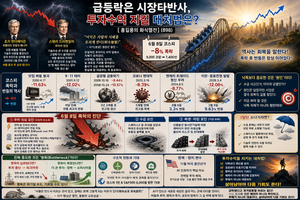
Kospi's crash and comeback history — sell now or hold on?
George Vanderheiden, the legendary portfolio manager at Fidelity, grew so worried about the dot-com bubble's excesses that he began trimming his technology holdings in the late 1990s. But after portfolio rebalancing left his fund unable to capture the tech rally's gains, client complaints and management pressure mounted. Vanderheiden ultimately announced his retirement in February 2000 at the age of 55. Just one month after he left, the dot-com bubble began to collapse in late March 2000 — and his portfolio finally came into its own. Stanley Druckenmiller — the investment legend now drawing fresh attention as a backer of Treasury Secretary Scott Bessent and Federal Reserve Chair Kevin Warsh — also had a bruising encounter with the dot-com bubble. He had invested in tech stocks early and booked substantial gains, but unable to resist a market that kept climbing, he jumped back in near the peak and took a direct hit when the bubble burst. Rather than retire, Druckenmiller moved to his private firm Duquesne Capital and recouped his losses through short positions. That allowed him to maintain a record of never posting a negative annual return, a streak he holds to this day. "Profit clouds a person's judgment." (利令智昏) The line comes from the "Biography of Lord Pingyuan" in Sima Qian's "Records of the Grand Historian." Even legendary investors have had their judgment clouded by profit. Markets bring despair, but they also open new opportunities. Stay in the game and you can seize them. Responding well to present reality matters more than trying to predict a future that is easy to get wrong. Sharp drops are part of the market... start with the cause The Kospi tumbled more than 8 percent on Monday. Just a week earlier it had been within reach of 9,000; now it had slid to the 7,400 level. Wild swings are a normal part of market life, and drops of more than 8 percent are not without precedent. Consider the history of Kospi crashes and recoveries. √ Dot-com bubble collapse: down 11.63 percent on April 17, 2000; rebounded to about 90 percent of the prior peak within a year. √ Sept. 11 attacks: down 12.02 percent on Sept. 12, 2001; rebounded to the year's high within three months. √ Global financial crisis: down 9.44 percent on Oct. 16, 2008, and down 10.57 percent on Oct. 24, 2008; surpassed the prior peak 27 months later. √ COVID-19 pandemic: down 8.39 percent on March 19, 2020; recovered the prior peak within five months. √ Yen carry-trade unwind fears: down 8.77 percent on Aug. 5, 2024; rebounded 3.3 percent the following day. √ Iran-Middle East war outbreak: down 12.06 percent on March 4, 2026; rebounded 9.63 percent on March 5, 2026. The causes of each crash differed, but the market ultimately found its way back. What matters now is not the size of the drop but its cause — whether this sell-off reflects a supply-and-demand disruption or a crack in corporate earnings. The Monday plunge can be traced to a handful of factors. √ AI data center construction delays due to inadequate power and other infrastructure; fears of a peak-out in AI semiconductor earnings. √ Doubts about hyperscalers' capacity to keep investing in AI, given that some are resorting to rights offerings on top of corporate bond issuance. √ The need to trim semiconductor weightings in portfolios after a sharp share price run-up; concerns about foreign-exchange losses from a stronger dollar. √ A liquidity black-hole effect from mega-listings such as SpaceX and rights offerings by big tech companies. √ Rollover risk and forced selling tied to leveraged derivatives on the futures and options simultaneous expiration date. The first three factors are concerns or suspicions. If they materialize, their severity could make them structural problems on the scale of a full-blown crisis. If semiconductor demand is delayed or contracts, the first clues should emerge in second-quarter earnings reports due out in early July and in subsequent guidance. Evidence bearing on hyperscalers' investment capacity should also surface in those same results. Paradoxically, if semiconductor demand is delayed, hyperscalers may actually find themselves with more financial headroom. And the pressure from surging share prices eases when those prices fall sharply. The factor most worth watching is the bottleneck in AI infrastructure — power supply, transmission and distribution grids, and community opposition. AI is not just a semiconductor story. Data centers consume enormous amounts of electricity, and where power is scarce, transmission and distribution networks must be built out. Where those networks are lacking, the problems of securing power plants, energy storage systems, cooling facilities and land follow in turn. A Federal Reserve Bank of St. Louis study released in January found that AI-related investment accounted for as much as 38 percent of US GDP growth. If problems emerge with US AI investment, South Korea and other East Asian countries linked through supply chains will not be immune. The remaining two factors are supply-and-demand issues. SpaceX's offering is expected to raise $86 billion, and Alphabet's rights offering $85 billion. OpenAI and Anthropic are expected to raise $60 billion and $50 billion, respectively, through initial public offerings this year. Whether market liquidity can absorb all of that is a critical question. US household net worth stands at $184 trillion, with equity holdings reaching $68 trillion. One encouraging sign is that investors around the world, not just in the United States, want exposure to all four companies. OpenAI and Anthropic have already raised $160 billion and $110 billion, respectively, through pre-IPO rounds over the past 15 months. Even as hundreds of billions of dollars flowed into unlisted companies during that period, US equity markets continued their AI tech rally. This is a market that moves on extreme concentration anyway. If SpaceX, OpenAI and Anthropic trade well after listing, the liquidity black-hole concern may not grow any larger. This sell-off is largely supply-and-demand driven — but there are things to watch The most likely primary culprit behind the crash is derivatives and leveraged investing — confirmed by the fact that the Korean market's decline on Monday was unusually steep. Market volatility has increased since leveraged products tied to Samsung Electronics and SK Hynix as individual stocks were permitted, following the earlier approval of KODEX Leverage. The volatility of Samsung Electronics and SK Hynix is, in effect, the volatility of the Kospi. The key question is what trigger effect leveraged derivatives will produce on Thursday, when futures and options expire simultaneously. If derivatives push share prices below a certain threshold, margin calls cascade from leveraged accounts, driving the market lower still in a vicious cycle. If this is just a passing storm, the supply-and-demand problem will be the first to clear, and much of it could be absorbed by next week. There is also no shortage of voices saying SpaceX's valuation — 100 times sales — is excessive. If its post-listing share price disappoints, broader concerns about overheating in tech stocks could cool as well. But supply and demand is not what really matters. What matters are the underlying concerns and suspicions. Investors need to watch whether the semiconductor earnings outlook changes, whether hyperscalers' investment plans waver, and whether the bottleneck around power, transmission and distribution grids, and data center site acquisition deepens. The bottleneck is particularly the crux of the current debate. If it halts investment, that is a peak-out. If it instead triggers larger investment and policy responses to resolve it, that is a supercycle. Many observers appear to agree that the global economy has entered a vast structural transition — one where AI, renewable energy, defense and security, and manufacturing realignment are all converging, rather than a simple technology boom. If a long-term investment cycle drawing enormous capital from around the world plays out, corporate earnings could surge and production efficiency could improve dramatically. A difficult trade — if you sell now, at what price can you buy back in? Expectations for Kospi 10,000 and S&P 500 8,000 spring from the same premise: that a massive investment cycle driven by AI, renewable energy, defense and manufacturing realignment is reshaping the global economy. The power shortages and infrastructure bottlenecks the market fears today could, from a different angle, be signals pointing to the next investment opportunity. In the November US midterm elections, all House seats, one-third of Senate seats and 39 governorships will be on the ballot. AI infrastructure has already become a central issue in American politics. Solutions that expand data center and power grid investment while minimizing higher electricity bills and job insecurity for local communities are a real possibility. A decline of more than 20 percent from the peak is a bear market; a drop in the 10 percent range is a correction. The short-term moving average (20-day) has been broken, but the medium-term line (60-day) is still holding. Technical analysis is statistics, and those statistics are grounded in the collective reactions of market participants. From that perspective, the trend is still pointing upward. Even Druckenmiller bought back in well above the price at which he had sold — and paid the price for it. Excessive optimism causes people to overlook risk. With optimism running high, a cautious posture is called for. There is no reason to panic just because the market has sold off sharply. Look at the cause, not the size of the drop — and instead of fearing the fear itself, ask how long that fear is likely to last. "Things must arrive somewhere, and events have reasons why they turn out as they do." (物有必至,事有固然) The line comes from strategist Feng Huan in the "Biography of Lord Mengchang" in the "Records of the Grand Historian," as he taught the lesson of the three burrows of the cunning hare. The new world that AI is building will ultimately arrive somewhere. The road there, however, is neither straight nor smooth. Bubbles and crashes, bottlenecks and investment, fear and greed all travel it together. A sharp drop is no reason to act rashly.
June 8, 2026
-
![[Biz Insight] Tap into your customers' capabilities](https://wimg.heraldcorp.com/news/cms/2026/06/08/news-p.v1.20260605.c8204bbc9f59490594bff9885168aff6_T1.jpg?type=h&h=240)
[Biz Insight] Tap into your customers' capabilities
The term "prosumer" once captured a simple idea: a consumer who takes part in a company's production process. In the service sector — as opposed to physical products — that consumer role becomes even more participatory. Trace the chain from customer to customer experience to purchase to customer value, and an invisible thread of participation runs through it all. This is what draws customers' own capabilities into the heart of a business. That being the case, companies would do well to actively encourage and accommodate customers' desire to get involved. The trend is rooted in a culture that prizes experience. The ease with which people can now acquire knowledge and information has amplified it further. People today want to try things for themselves — a phenomenon sometimes called the "experience economy." The primary tool for tapping into customer capabilities is robust interaction. To make that work, companies must build interactive communication structures with customers and maximize real-time points of contact. The result is a relationship in which customers co-create value alongside the company. In practical terms, this means drawing on customers' capabilities as a business resource — filling gaps the company cannot cover on its own. In return, customers must receive meaningful rewards for their contribution. Sustaining active interaction and securing customer touchpoints does place a burden on companies. The payoff, however, is more precise marketing. Efficiency and effectiveness rise at the same time — efficiency measured by how well resources are used, effectiveness by how fully goals are met. Hansik, or Korean cuisine, is a clear example of a service that naturally draws customer capabilities inward. Its appeal lies in the rich experiential world it opens up. Westerners in particular are drawn to the idea of participating in the cooking process to finish a dish to their own taste. By letting diners add various ingredients according to their preferences, hansik brings the customer directly into the preparation — unintentional, perhaps, but a seamless integration of customer capability into the service itself. "Service is the activity of solving customers' problems through interaction with them." Even Jack Welch, chairman of GE — a company overwhelmingly focused on manufacturing — said as much during his tenure.
June 8, 2026
-
[Editorial] Korea's potential growth rate hits record low — time to build an environment where businesses want to invest
The OECD projects South Korea's potential growth rate at 1.66 percent this year and 1.52 percent next year, with the figure expected to slide further to 1.46 percent in the fourth quarter of next year — the lowest level on record under OECD measurement standards. The rate stood at 1.85 percent last year and has been declining annually. The potential growth rate measures the maximum pace at which an economy can expand without stoking inflation. Strong semiconductor exports have lifted this year's headline growth forecast to 2.6 percent, but the underlying strength of the economy is moving in the opposite direction. Just six months ago, the OECD estimated Korea's potential growth rate at 1.71 percent this year and 1.57 percent next year, with the fourth quarter of next year still expected to hold just above 1.5 percent at 1.52 percent. Instead, the organization cut both estimates by 0.05 percentage points and trimmed the fourth-quarter figure for next year by 0.06 percentage points. Korea's ranking among 47 major economies is also slipping. As recently as 2024, the country sat in the mid-teens; last year it fell 13 places to 28th. It is projected to drop further, to 31st this year and 32nd next year. The low birth rate and aging population — the most frequently cited causes of the decline — cannot be fixed quickly. That leaves business investment and productivity gains as the only viable remedies. The investment climate, however, is deteriorating. Domestic companies have been diversifying their production bases toward the United States and Southeast Asia in response to global supply chain realignment, an unavoidable shift that inevitably reduces the share of investment staying at home. On top of that, the so-called Yellow Envelope Act threatens to deepen the chill. By broadening the scope of collective bargaining and industrial action against prime contractors, it significantly raises the burden on businesses. Calls for companies to share a portion of operating profits with workers could also weigh on investment decisions. Businesses go where conditions favor investment, and Mexico's trajectory offers a telling lesson. Mexico once posted a lower potential growth rate than Korea, but of late the picture has changed. As US-China tensions intensified and global supply chains were redrawn, Mexico absorbed a surge of production relocations, driving a rapid rise in foreign direct investment. Geographic proximity to the United States, combined with a business-friendly regulatory environment, powered the turnaround. As its manufacturing base broadened, so did its growth momentum. The OECD projects that if current trends continue, Mexico's potential growth rate could surpass Korea's around 2027. The government has pledged to make this year the starting point for a rebound in potential growth. More business investment means more jobs, higher productivity and, ultimately, a recovery in growth capacity. Above all, what matters is creating conditions in which companies can commit to long-term investment in Korea. Regulatory reform that loosens the constraints on business can no longer afford to move slowly.
June 8, 2026
-
[Editorial] NEC chief is a Supreme Court justice, but the work is administrative — investigation, legal reform and constitutional revision all needed
The ballot shortage that marred the June 3 local elections was a democratic catastrophe — an inexcusable violation of citizens' right to vote. Protests demanding a re-election have blockaded the Jamsil vote-counting center for four consecutive days. The political establishment has also moved to demand accountability and reform of the National Election Commission. Both the Democratic Party of Korea and the People Power Party adopted parliamentary investigations as official party positions. The Democratic Party said it would consider constitutional reform if necessary, while the People Power Party announced plans to introduce a comprehensive special prosecutor bill targeting the NEC. President Lee Jae Myung said Sunday on social media that he had urged the National Assembly to pursue a parliamentary investigation and discuss fundamental institutional reform of the NEC. He added that he had directed the government to "form a joint investigative task force involving prosecutors and police to clearly establish responsibility and thoroughly uncover the full truth of the incident." The first priority must be a thorough accounting of the NEC's failures and responsibilities, followed by appropriate disciplinary action, punishment and corrective measures. The legislative, executive and judicial branches must also mobilize their full capacity and authority to devise a sweeping overhaul of the NEC system. A parliamentary investigation and special prosecutor are necessary — but so are legislative amendments and constitutional revision. That said, neither the ruling and opposition parties nor any other political force must resort to partisan conflict or demagoguery that destabilizes the state and the community. Rigorous investigation must lay bare the full truth, leaving no room for reckless demands for re-elections or conspiracy theories about rigged elections, and institutional reform must be achieved at a level befitting the democratic maturity of the Korean people. The dysfunction and electoral mismanagement within the NEC are not problems that emerged overnight. A string of controversies preceded Sunday's crisis: the so-called "basket ballot" incident during the 2022 presidential election, a 2023 scandal over preferential hiring of senior NEC officials' children, and a dispute that same year over the commission's refusal to allow a National Intelligence Service security audit. The NEC's incompetence, irresponsibility, misconduct and corruption are serious problems in themselves, but the root cause lies in structural defects. The heads of the Central Election Management Committee have traditionally been Supreme Court justices, yet the work they oversee is administrative in nature. In an era demanding complex administrative capabilities — information technology, cybersecurity, data analysis, logistics management and crisis response — the NEC's constitutional standing, composition, personnel practices and operational mandate have exposed fundamental limitations. An institution born as a constitutionally independent body to prevent fraudulent and government-manipulated elections has ended up with deep deficiencies in its administrative functions. Under the Constitution, the president, the National Assembly and the chief justice of the Supreme Court each appoint, elect or nominate three commissioners, with the chairperson chosen from among them. Whether this structure remains appropriate today is worth examining. The convention of having a Supreme Court justice serve as chairperson also deserves scrutiny in light of the principle of separation of powers. The statutory framework of "non-standing" commissioners and chairperson must be revised as well. The position and qualification requirements of the secretary-general — who typically rises through the NEC's internal ranks and oversees day-to-day operations — should also be redefined by law. External audit and oversight mechanisms must be made mandatory. The ruling and opposition parties need to put their heads together, starting with the basic question of whether these problems can be fixed through immediate legislative amendment or whether they require constitutional change.
June 8, 2026
-
![[Biz Insight] Tap into your customers' capabilities](https://wimg.heraldcorp.com/news/cms/2026/06/08/news-p.v1.20260608.70c8f7a547ec4e99a0193171bc0b4fe2_T1.jpg?type=h&h=240)
[Biz Insight] Tap into your customers' capabilities
Biz Insight The term "prosumer" was once in vogue — a consumer who takes an active role in a company's production process. In the service sector particularly, the consumer's role is far more participatory than in product-based industries. Mapping out the chain from customer to customer experience to purchase to customer value, an invisible thread of "participation" runs through every link. As a result, customers' own capabilities are drawn into the business itself. That being the case, companies would do well to actively encourage and accommodate customers' desire to get involved. The trend is rooted in a growing emphasis on experience. The ease with which people can now acquire knowledge and information has also played a major role. People today want to try everything for themselves — a phenomenon sometimes called the "experience economy." The key tool for tapping into customer capabilities is robust interaction. To that end, companies must maximize interactive communication structures and real-time touchpoints with their customers. This turns customers into co-creators of value alongside the company — a dynamic that allows businesses to draw on customer capabilities as a resource, effectively filling gaps the company could not fill on its own. In return, customers must receive appropriate rewards. Companies do bear the burden of maintaining active interaction and securing customer touchpoints. The payoff, however, is more precise marketing. Both efficiency and effectiveness improve at the same time — efficiency measured by how well resources are used, effectiveness by the degree to which goals are achieved. Hansik, or Korean cuisine, is a prime example of a service that naturally draws customer capabilities inward. Its appeal lies in the rich experiential world it opens up. Western diners in particular are captivated by the idea that they participate in the cooking process and complete the dish to their own taste. By allowing customers to add various accompaniments according to their preferences, hansik partly involves them in the preparation — unintentionally, perhaps, but effectively pulling customer capability into the service itself. "Service is the activity of solving customers' problems through interaction with them." Those words came from Jack Welch, chairman of GE — a company whose manufacturing operations were overwhelmingly dominant — during his tenure.
June 8, 2026
-
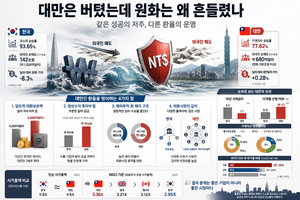
The 'Curse of Success': Why Korea's Won Stumbled Where Taiwan's Dollar Held Firm
Exchange rate volatility this year: Taiwan 0.28% vs. Korea 8.3% The Kospi has surged 93.65% this year. Yet foreign investors have been selling. Their cumulative net selling through Friday reached 142 trillion won (approximately $92.9 billion) — roughly $100 billion when average exchange rates are applied. Over the same period, the won fell 8.3% against the dollar. Taiwan tells a similar story. The Taiwan Weighted Index climbed 77.62% this year, and foreign investors net sold roughly $68 billion worth of Taiwanese shares — more than 100 trillion won. Yet the Taiwan dollar barely moved. The dollar-Taiwan dollar exchange rate fluctuated by just 0.28%. Korea and Taiwan are the most comparable markets this year. Both rank among the biggest beneficiaries of the AI semiconductor rally. Share prices have surged, and foreign investors have been locking in gains at scale through portfolio rebalancing — adjusting positions swollen by rising valuations — a phenomenon sometimes called the "Curse of Success." What stands out is how differently the two currencies have responded. The won has swung sharply while the Taiwan dollar has held its ground, a difference that comes down to each market's capacity to absorb foreign selling and the resulting dollar demand. Dollar liquidity shortage in the foreign exchange market triggers sharp rate moves Does this signal a serious problem with the Korean economy? Not necessarily. Korea runs a current account surplus. The cumulative surplus through May this year, including estimates, is believed to be around $140 billion. Semiconductor exports remain strong, and the Kospi's market capitalization has climbed to roughly sixth in the world. This looks nothing like a typical crisis. The issue is not a shortage of dollars — it is that dollars have not been reaching the market quickly enough. Foreign investors' net selling of 142 trillion won this year amounts to around $100 billion at current exchange rates — comparable to the foreign exchange reserves of many countries. Domestic investors are also channeling more money abroad: the national pension fund is raising its overseas asset allocation, while individual investors are buying US stocks and ETFs. All of this creates dollar demand. Meanwhile, Korean companies are in no hurry to convert their export earnings back into won. The dollar-earning capacity is strong, but the pace at which those dollars flow back into the market has slowed, leaving it unable to keep up with rising demand. Taiwan's well-developed mechanisms for balancing dollar supply and demand Taiwan is different. Despite heavy foreign selling, its exchange rate barely moved — thanks to several shock-absorbing mechanisms. The first is foreign exchange reserves. Taiwan holds more than $600 billion in reserves — more than Korea despite having a smaller economy. Taiwan cannot easily secure a standing currency swap with the US Federal Reserve the way Japan can, partly because of constraints on formal diplomatic relations. So instead of relying on a dollar credit line, Taiwan has built a large dollar stockpile. Over the past 15 years, while Korea's reserves have hovered around $400 billion, Taiwan has doubled its foreign currency holdings. The second is the strength of its current account surplus. Taiwan's current account surplus is large relative to the size of its economy. Dollars earned from semiconductor exports flow in consistently. When exchange rates become unstable, Taiwanese exporters tend to supply those dollars to the market. Korean companies, by contrast, are reluctant to convert their export earnings. With the won already volatile and domestic interest rates lower than in the United States, there is little incentive to exchange dollars for won. The third is the currency-hedging structure of overseas investment. Taiwan's financial institutions — including insurers — invest heavily abroad, and they hedge a high proportion of their currency exposure, which reduces one-sided dollar demand in the foreign exchange market. In Korea, much overseas investment goes unhedged. Leaving foreign investment unhedged can be a deliberate strategy, but when large pools of capital move without hedging, the impact on the broader foreign exchange market grows — and so does the case for hedging, particularly to limit exposure to exchange rate volatility when those investments are eventually unwound. The fourth is market depth. Neither the won nor the Taiwan dollar is traded on global markets. But while Korea's foreign exchange market is narrow and bank-dominated, Taiwan's draws participation from a wider range of financial institutions and investment firms. Greater diversity of participants deepens trading and improves the market's ability to absorb shocks. Exchange rates ripple into bond markets and valuations — Taiwan leads emerging markets Exchange rate movements reach into the bond market as well. A weaker won pushes up import prices. With oil-related product prices already rising amid tensions in the Middle East, further currency depreciation adds to inflationary pressure. This year's real economic growth rate is forecast at around 7% for Taiwan and around 3% for Korea, yet the 10-year government bond yield stands at 1.7% in Taiwan and 4.2% in Korea. Lower interest rates are generally more conducive to economic growth. Lower rates also support higher equity valuations. On a 12-month forward basis, Korea's price-to-earnings ratio stands at 8 to 9 times, while Taiwan's is 18 to 22 times. Korea's semiconductor rally began in the second half of last year, but TSMC's share price moved earlier — meaning foreign investors began rebalancing out of Taiwan first. Taiwan's domestic capital absorbed that selling well. Household assets in Taiwan are allocated roughly 20% to marketable securities and 30% to deposits, with real estate accounting for just 30%. In Korea, more than 75% of household assets are tied up in real estate and other physical assets, with deposits at around 20% and marketable securities at less than 6%. Taiwan also has the edge in market depth. As of May, Taiwan accounted for 25 to 26% of the MSCI Emerging Markets Index by country weight, ranking first, while Korea stood at 21 to 22%, in second place — a gap of more than 3 to 4 percentage points. MSCI country weights are determined not by GDP but by free float-adjusted market capitalization, which captures roughly 85% of large- and mid-cap shares available to the public after excluding controlling shareholder and government stakes. Total market capitalization is similar for both countries at around $5 trillion, but on the MSCI measure Taiwan stands at $3.36 trillion against Korea's $2.95 trillion. On that same measure, the United Kingdom ($3.21 trillion) and Canada ($3.12 trillion) also rank ahead of Korea. Modernizing capital and foreign exchange markets is essential for a wealthier Korea The AI investment boom has driven a semiconductor supercycle that has sharply lifted the earnings and share prices of Korean companies in the sector. Amendments to the Commercial Act and related reforms have also gone some way toward addressing concerns about the marginalization of minority shareholders. Yet the state of Korea's capital and foreign exchange markets still does not match the country's economic standing — they remain trapped in a 20th-century regulatory mindset. Advanced economies are ones where capital has accumulated and is put to work efficiently — where returns on capital can outpace those from labor. When a country that boasts the world's sixth-largest stock market and one of the world's largest current account surpluses has underdeveloped capital and foreign exchange markets, the cost to capital efficiency is severe. Both foreign and domestic investors are likely to look elsewhere. That is how the Curse of Success keeps repeating itself. Ultimately, the problem is not the quality of the companies — it is the quality of the market. Hong Kong and Tokyo are not markets that trade only domestic companies. They are markets that global capital seeks out on its own terms. In those markets, success breeds more success rather than a curse. For those who hope to see the Kospi reach 10,000 and stay there, the goal need not be New York — but surely Korea should be able to close the gap with Hong Kong and Tokyo.
June 7, 2026
-
[Editorial] Won hits 1,540 per dollar — Korea must shore up its economic weak points
The won-dollar exchange rate, which had hovered above 1,500 won for three weeks, surged past 1,540 won during trading Thursday — the first time since the global financial crisis. Financial authorities convened an emergency "F4" meeting — bringing together the deputy prime minister for economic affairs, the Bank of Korea governor, the Financial Services Commission chairman and the Financial Supervisory Service chief — and issued forceful verbal warnings, but to no avail. The prolonged Middle East war, heavy foreign selling of Korean equities and mounting US tariff risks combined to drive the won lower. Alarming forecasts have begun to circulate that the rate could climb into the 1,600-won range. Because a weak won is a trigger for higher inflation and higher interest rates, the government must treat this situation with exceptional vigilance. On Thursday, the won opened at 1,530.0 per dollar in the Seoul foreign exchange market, up 13.6 won from the previous session. That was the first time it had started above 1,530 won since March 2009, during the global financial crisis — a gap of 17 years and three months. After the after-hours session opened, the rate broke through 1,540 won, also a first since 2009. Judged by the exchange rate alone, the Korean economy is in a state of emergency. However, as Kim Yong-beom, the Cheong Wa Dae policy chief, said, the current won weakness does carry some character of "friction from a leap forward." Corporate earnings and exports, riding a semiconductor supercycle, are setting all-time highs, and foreign investors who had poured into the Korean stock market as it shed its Korea Discount have been taking profits — a dynamic that has itself weakened the won. Adding to the pressure, US-Iran end-of-war negotiations have stalled, and the Office of the United States Trade Representative announced it would impose an additional 12.5 percent tariff on Korea after including it on a list of trading partners that allow goods produced with forced labor. The exchange rate is shaped by a complex web of variables — from external shocks beyond Korea's control, such as a war-driven oil shock and the interest rate gap between Korea and the United States, to assessments of the Korean economy's underlying fundamentals. In the near term, authorities need to manage effectively the factors driving foreign exchange volatility. The anticipated mega initial public offerings of so-called big-tech giants — SpaceX, valued at $2 trillion, and Anthropic, valued at $1 trillion — are emerging as a fresh source of downward pressure on the won. When those companies list, a large outflow of domestic investment capital is likely to push the won even lower. Monetary authorities have deployed a range of measures to counter the high exchange rate — including a foreign exchange swap arrangement with the national pension fund and a domestic equity return account, or RIA, that offers retail investors an exemption from capital gains tax on overseas holdings — but the impact has been limited. At a broader level, the government is also exploring a Korea-US monetary swap, though no tangible results have emerged. Short-term tools are running up against their limits, and no game-changing card has been found to shift market sentiment, leaving the 1,500-won range looking increasingly like a new normal. This is a moment that calls for creative policy to break the impasse. Ultimately, the fundamental remedy must be to raise Korea's potential growth rate and secure the confidence of international markets.
June 5, 2026
-
![[Lee Young-man's World] Memories of Mexico](https://wimg.heraldcorp.com/news/cms/2026/06/05/news-p.v1.20260605.114edff2ef544b17bcc547d1ab18cfb6_T1.jpg?type=h&h=240)
[Lee Young-man's World] Memories of Mexico
That morning, South Korea was buzzing. A strange excitement hung in the air. Companies pushed back their start times to let the mood linger. Fourteen minutes into the match, Kim Jong-bu's shot found the net — 1-0, a goal that felt like a dream. It was the morning of June 15, 1983, a semifinal at the FIFA World Youth Championship in Mexico. South Korea's young footballers faced the world's best, Brazil — and scored first. Could they really be heading to the final? The thought was almost too much to dare. They would not even have been there had North Korea not been banned from international competition for two years after a referee-assault incident. It was a lucky substitute berth, with little attention and a brutal draw: European powerhouse Scotland, Australia — who had won all five qualifying matches — and host Mexico, who had their eyes on the title, were all in the same group. The opening match against Scotland ended in a 0-2 defeat, as expected. But that was when the miracle began. Despite missing a penalty kick, South Korea beat Mexico 2-1, then subdued Australia 2-1 as well. They were young, but it was South Korea's first FIFA quarterfinal. Hope surged, yet the road ahead was uncertain. Next up was Uruguay, a two-time World Cup champion. Still, they ran and ran, forcing extra time and winning 2-1 to reach the semifinals. The last hurdle before the final was Brazil. South Korea struck first but lost 2-1 in a comeback defeat. The football world was stunned. It was a swarming, relentless style of play that overcame South American technique and European physicality through sheer fighting spirit. Foreign media praised the players in their red jerseys — surging like an angry tide without pause — calling them the "Red Devils" and the "Red Demon Corps," paying tribute to their remarkable combativeness. They were the forerunners of the "Red Devils" who carried South Korea to the semifinals of the 2002 FIFA World Cup. On June 19, South Korea faces host Mexico in their second Group A match of the World Cup in Guadalajara. If they carry on the spirit of those young players from 43 years ago and win, a place in the round of 32 is all but assured — but even if they fall short, Mexico has been a place of good fortune for South Korea, and the road there is not entirely forbidding. South Korea's football ties with Mexico run deep. At the 1948 London Olympics — the first Games South Korea entered under its current name — the team beat Mexico 5-3 in the round of 16. But in two World Cup meetings, South Korea lost both times: 1-3 in France in 1998, and 1-2 in Russia in 2018. In Russia, Mexico owed South Korea a debt. Mexico were on the brink of elimination after losing 0-3 to Sweden, but South Korea's 2-0 victory over Germany gave them a lifeline. Mexico shouted "gracias" in South Korea's direction and never forgot Son Heung-min, who scored the second goal. This will be South Korea's second World Cup in Mexico. Their first, in June 1986, came 32 years after the 1954 Switzerland tournament and featured legends such as Cha Bum-kun, Choi Soon-ho and Huh Jung-moo. But defending champion Argentina and previous winner Italy proved too tall an order. Still, South Korea drew with Bulgaria to claim their first World Cup point and scored four goals across three matches. Mexico — a place of promise and a stubborn thread of fate. The group draw has been kind. Not only is Pot 1's Mexico (FIFA 15th) one of the weaker options in its tier, but Pot 3's Czech Republic (41st) and Pot 4's South Africa (60th) are also among the softer picks in their respective pots. FIFA rankings have their gaps, but the good omens are there — and both countries have devoted BTS fan bases. What's more, the third match against South Africa will be played in Monterrey, the very city where South Korea beat Uruguay in 1983 to reach the semifinals. The blazing atmosphere of June 2002 feels close again. Lee Young-man, former chief executive
June 5, 2026
-
[Editorial] Oh wins fifth term, but Seoul voters demand cooperation
People Power Party candidate Oh Se-hoon won a fifth term as Seoul mayor in Wednesday's local elections. In the Seoul Metropolitan Council race, Democratic Party candidates claimed 81 of the 118 seats (68.6 percent) while People Power Party candidates won 37 (31.4 percent). In the 25 Seoul district mayor contests, the Democratic Party won 17 (68 percent) and the People Power Party eight (32 percent). The message from Seoul voters is unmistakable. They chose Oh as mayor — sending a warning against unchecked dominance by the central government and the ruling party — while entrusting the Democratic Party with legislative and district-level administrative power to monitor and check a People Power Party mayor. In short, Seoul voters have issued a clear mandate: the city government and the central government, the mayor and the council and district offices, must work together. Seoul voters have now elected Oh Se-hoon mayor an extraordinary five times. To hold public trust for that long is a remarkable record. It is also significant that he held the post in an election held just one year after a Democratic Party government took power, following the martial law declaration and impeachment of a People Power Party president. Yet his margin over the second-place candidate was barely one percentage point, and overall, slightly more voters did not support him than did. To be mayor for all Seoulites, Oh must embrace and represent even those who did not vote for him. The government and the ruling party must read accurately what Seoul voters expressed through Oh's election: a warning against unilateral dominance in governance and legislation. Oh himself must take seriously the fact that the Democratic Party won nearly seven in 10 seats in the Seoul council and district mayor races. He should keep in mind that this result is a check on fears of one-sided city administration. The challenges that the central government, the Seoul Metropolitan Government, the city council and district offices must tackle together — vertically and horizontally — are vast. Housing and real estate supply policy tops the list. The ruling and opposition parties have long prescribed different remedies on reconstruction, redevelopment, deregulation, speculation curbs, expanded public supply and high-density urban development, yet it has already been proven that no single approach solves the problem. Housing and real estate policy must not be approached through ideology. Public safety and transportation must not become fodder for political battles either. The Itaewon crowd crush, the recent Seosomun overpass collapse and the missing rebar discovered in the GTX-A Samsung station construction section all carry the same lesson: when the three-tier cooperative structure of central, metropolitan and local government breaks down, public safety is inevitably put at risk. Beyond that, every domain — from economic growth and employment to welfare, and from urban development to heritage preservation — requires social consensus spanning all levels of government. Seoul deserves bipartisan cooperation aimed at genuinely solving problems and building social cohesion, not political conflict driven by the pursuit of the next election.
June 5, 2026
-
![[Crypto Insight] Asset tokenization is reshaping the US capital markets landscape](https://wimg.heraldcorp.com/news/cms/2026/06/04/news-p.v1.20260604.8bc3dee95c324118914fe0846ab5ef0d_T1.jpg?type=h&h=240)
[Crypto Insight] Asset tokenization is reshaping the US capital markets landscape
Asset tokenization spans real estate, government bonds, funds, raw materials and private credit, but in US capital markets the conversation has sharpened around tokenized securities. When shares, bonds and fund interests are tokenized, the central question is which infrastructure will connect rights records, transfers, settlement, custody, collateral and regulatory reporting. The SEC set out its position in January: tokenized securities fall within the existing securities framework. Even when shares or bonds are represented as tokens, dividend rights, voting rights, redemption claims, transfer restrictions and investor-protection obligations remain intact. The SEC distinguishes between issuer-led and third-party-led tokenized securities. Third-party-led structures can involve arrangements in which the listed company plays no direct role, raising questions about underlying security ownership, investor rights, dividend and voting treatment, and custody and insolvency risk. Nasdaq received SEC approval in March to process tokenized securities within its existing exchange infrastructure. Securities eligible for Depository Trust & Clearing Corp. (DTCC) settlement will share the same security identifiers and ticker symbols as conventional securities and settle through DTCC. Order routing, execution, market surveillance and market data will all follow existing frameworks. The US tokenized-securities market is developing by adding a tokenized record format inside the existing securities market and managing it under the same order book, surveillance and settlement rules. The New York Stock Exchange is also advancing a tokenized-securities platform and standards for digital transfer agents — the function that manages shareholder registries and rights transfers. For tokenized securities to become genuine capital-market products, shareholder registry management, dividend and voting processing, transfer restrictions and investor eligibility verification must all work before 24-hour trading becomes the headline feature. Digital asset exchange Bullish agreed in May to acquire transfer agent Equiniti for $4.2 billion, underscoring the growing value of shareholder registry, dividend and rights-transfer infrastructure. The DTCC's moves illustrate this shift clearly. Working with more than 50 financial institutions, DTCC is building a tokenization service it aims to launch in October. The service is designed to add tokenized rights records and cross-chain interoperability to the existing depository and settlement structure. Competitive advantage in asset tokenization will come down to who controls the standards for rights and settlement. Collateral infrastructure is moving in the same direction. DTCC's appchain collateral infrastructure project, developed in partnership with Chainlink, aims to connect collateral providers, receivers, managers, tri-party collateral agents and custodians on a single shared platform. Real-time visibility into collateral location, ownership, availability and transfer history can reduce overcollateralization and liquidity buffers. Tokenization, in other words, is reshaping not just trading but the standards for collateral movement and liquidity management as well. South Korea risks missing the core market if it approaches tokenized securities solely through the lens of fractional-investment products. What is needed is a redesign of the connective structure linking canonical records, rights determination, transfer agency, custody, settlement, collateral management and regulatory reporting. The roles of the Korea Securities Depository, exchanges, brokerages, banks and custodians also need to be redistributed. The United States is designing asset tokenization as a digital upgrade of existing capital-market infrastructure. South Korea, too, should focus first on restructuring its capital-market operating framework rather than on tokenized products themselves. — Kim Jong-seung, CEO of Xcrypton
June 4, 2026
-
[Editorial] After local elections, closing Korea's K-shaped divide is the real test
The OECD raised its growth forecast for South Korea this year from 1.7 percent to 2.6 percent on Wednesday, a 0.9 percentage point upward revision that was the largest among all G20 economies. The upgrade amounts to a broadly positive assessment of the Lee Jae-myung administration as it enters its second year. The new government, which took office after the turmoil of martial law and impeachment, has navigated major shocks — including tariff negotiations with the United States and the ongoing Middle East war — and delivered solid results. South Korea's first-quarter GDP growth of 1.7 percent ranked among the top performers in the developed world, and the stock market shed its long-standing "Korea discount" stigma as the country's total market capitalization climbed to sixth in the world. Samsung Electronics broke into the global top 10 by market cap, rewriting a chapter in South Korean economic history. The OECD credited semiconductor exports for continuing to drive growth and private investment, and said consumer spending would stage a gradual recovery supported by fiscal policy. Yet every bright side casts a shadow. The OECD flagged a prolonged energy supply crunch stemming from the Middle East conflict, industrial labor disputes and export restrictions as downside risks to the Korean economy. In practice, the US Trade Representative announced Tuesday that it would impose an additional 12.5 percent tariff on South Korea and other countries it accused of failing to adequately block imports made with forced labor. The announcement was a renewed signal that Washington will not overlook the widening trade imbalance driven by semiconductor flows. Seoul will need a sophisticated response to fend off what amounts to a coercive offensive. The AI-driven semiconductor boom is undeniably a windfall, but it is also generating problems of a different order. The wave of outsized performance bonuses set off by SK Hynix and Samsung Electronics has spread beyond manufacturing sectors such as automobiles and shipbuilding into the platform economy, raising fears that this summer's labor disputes could turn particularly ugly. The stronger the grip of large-company and public-sector unions on their entrenched privileges, the deeper the sense of exclusion felt by young workers and employees at small and medium-sized enterprises. The broader economy is simultaneously facing three pressures — high inflation, a weak won and elevated interest rates — compounded by rising global oil prices from the Middle East conflict. Consumer prices rose 3.1 percent last month, the first time they have exceeded 3 percent since March 2024. Raising interest rates further to rein in inflation and the exchange rate has been constrained by fears of slowing growth, but the record-breaking semiconductor export surge has now removed that dilemma. The concern is that higher rates will deepen the pain for ordinary households burdened by debt, as well as for the self-employed and small-business owners. Sustained growth is hard to achieve when the gains concentrate at the top while the costs fall on the vulnerable — the K-shaped polarization that now defines the Korean economy. Structural reform across industry, labor and asset markets is essential to translate the semiconductor boom into a foundation for long-term growth.
June 4, 2026
-
Editorial: Local elections deliver a split verdict — warnings for both parties
The Democratic Party of Korea, the ruling party, swept a commanding majority of metropolitan governorships in Wednesday's local elections. Final vote counts Thursday showed the Democratic Party winning 12 of 16 mayoral and gubernatorial races nationwide, while the People Power Party held on to four. The previous 5-to-12 split in favor of the PPP reversed to 12-to-4 in the Democratic Party's favor — a dramatic turnaround in four years. On the surface, voters appeared to shift the center of gravity in local government toward the Democratic Party, lending momentum to the Lee Jae Myung administration as it marks its first year in office. Yet the PPP won Seoul, where the Democratic Party had been widely expected to cruise to victory, and no upsets materialized in Daegu or South Gyeongsang Province, which had been cited as bellwethers for the scale of a Democratic sweep. In the National Assembly by-election in Pyeongtaek, Gyeonggi Province, PPP candidate Yoo Eui-dong — considered the longest of long shots — defeated Democratic Party candidate Kim Yong-nam and Cho Guk Innovation Party candidate Cho Guk. In Busan's Buk-gu A district, independent candidate Han Dong-hoon defeated Democratic Party candidate Ha Jung-woo. The ruling party rode a strong wave of sentiment for governmental stability, yet lost or struggled in the most consequential battlegrounds, including Seoul. The PPP benefited from a late-stage rally among conservative voters but could not escape an overall drubbing. The National Election Commission's shoddy management of the vote also exposed serious problems: in Seoul alone, at least 14 polling stations ran out of ballots and were forced to suspend voting — an unprecedented breakdown. In that sense, it is fair to say this was an election with no winners, only the wounded. Above all, responsibility for the election's failure to become a genuine contest over the nation's future and regional development rests squarely with the leadership of both parties. The Democratic Party under Jung Chung-rae and the PPP under Jang Dong-hyeok stumbled through the candidate nomination process amid relentless controversy. Party leaders fixated on political slogans — "rooting out insurrection" on one side, "blocking the withdrawal of indictments" on the other — rather than governing visions. Within the Democratic Party, tensions flared between factions loyal to former President Moon Jae-in and those aligned with Lee Jae Myung, as well as between the traditional base and newer supporters. Inside the PPP, feuding between pro-Yoon and pro-Han factions, and between the party establishment and its critics, dragged on without resolution. Critics within both parties charged that their leaders were more consumed by the next intraparty leadership race than by the local elections themselves. Missing entirely were visions and policies on how to spread the gains of a buoyant stock market, rising exports and economic growth to the regions; where and how to build infrastructure for future industries such as semiconductors, AI and advanced manufacturing; and how to ease the concentration of resources in the greater Seoul area and achieve balanced national development. The ruling and opposition parties must take seriously the public sentiment this election has laid bare. Voters checked the ruling party's dominance and punished the conservative opposition's regression. They also issued a clear mandate: break from entrenched forces and stale political discourse, innovate, and govern cooperatively. The Democratic Party must not only exercise its reclaimed local power responsibly but also work in concert with opposition-led local governments. The PPP, for its part, must put its internal divisions and backward-looking controversies behind it and focus solely on the national interest in its dealings with the central government.
June 4, 2026
-

Herald Square: How to resolve the 'generational management' paradox of 40 million indemnity insurance holders
Private indemnity health insurance — held by 40 million Koreans and often called a "second national health insurance" — draws starkly divided opinions. Critics call it the chief driver of medical waste, arguing it encourages overuse of non-covered services and entrenches moral hazard. Defenders counter that it fills the gaps left by national health insurance and shields patients with serious illnesses from financial ruin, making it an indispensable social safety net. Strictly speaking, both sides are right. The same system can simultaneously generate excessive medical consumption for some and serve as the last financial lifeline for others. The right question, therefore, is not "is it a culprit or a bulwark?" but rather "how do we reduce waste while preserving its social value?" For years, the government and the insurance industry have focused on "generational management" — successive product overhauls from the first through fourth generations that raised cost-sharing requirements and introduced premium surcharges. Yet the results have exposed clear limits. Older and chronically ill policyholders resist switching to newer products because of higher premiums, while healthier young enrollees migrate freely, driving up the risk profile of older-generation products in a classic adverse-selection spiral. By the fourth generation, loss ratios on covered services had also risen, creating the perverse effect of encouraging overuse. Non-covered medical services are growing at more than 10 percent a year, and supplier-induced demand is increasingly visible in areas with high indemnity insurance penetration. Overuse by a minority pushes up premiums for all policyholders, and as the insured pool ages and accumulates higher risk, the cycle could ultimately end in market collapse. The generational management paradox is, at its core, a systemic failure — one in which the medical supply structure, the regulatory and supervisory framework, and policyholder incentives have never been made to work in concert. The fifth-generation indemnity product marks meaningful progress: it sharply narrows coverage for non-serious non-covered services and ties outpatient cost-sharing to national health insurance contribution rates. Even so, history shows that providers reliably develop new non-covered services or bundle them with covered treatments to sustain utilization — a balloon effect that has repeated itself across every reform cycle. Product restructuring alone has its limits; a robust non-covered services management regime must accompany any structural change. Two fundamental shifts are needed as a lasting solution. The first is a thorough overhaul of the non-covered services management regime. More non-covered items should be brought under national health insurance coverage, prices should be standardized, and a real-time data-sharing system linking hospitals' non-covered billing records to insurers should be built. Problematic non-covered services should be reclassified quickly as managed-benefit items to block the balloon effect, and legislation should mandate information-sharing between public and private insurers. The second is a paradigm shift from after-the-fact controls to upfront incentives. By linking indemnity insurance to prevention-oriented digital health management and rewarding policyholders who make rational healthcare choices with tangible social and financial benefits, the industry can build a cooperative ecosystem that naturally curbs moral hazard. When insurers move beyond a passive role and become active contributors to public health and the efficient allocation of medical resources, a three-way virtuous cycle becomes possible: policyholders gain better health, insurers stabilize their loss ratios, and society averts the depletion of medical resources. It is time for indemnity insurance — held by 40 million Koreans — to shed its reputation as the chief driver of medical waste and reestablish itself as a genuine national healthcare safety net. By Jeong Seong-hee, vice president of the Korea Insurance Research Institute
June 4, 2026
-
South Korea's AI edge in science hinges on shared supercomputing
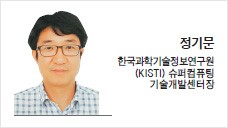
AI has moved well beyond search, translation and image recognition to become a core tool in scientific research. It now identifies new drug candidates, predicts climate patterns and disasters, and designs next-generation battery materials. It analyzes vast datasets from large research instruments and surfaces scientific possibilities that human researchers might never have found on their own. This shift represents a fundamental change in how research is done. Where scientists once formed hypotheses and worked through repeated experiments and calculations, AI trained on data now proposes new hypotheses and supercomputers rapidly validate them. Scientific competitiveness no longer rests on researchers' ideas alone. It requires national research infrastructure capable of computing, training and verifying those ideas at scale. Major economies have already made this a national strategy. The United States has moved to build an integrated research environment linking supercomputers, research data, experimental facilities and AI models through programs such as the Genesis Mission and ACCESS. Europe pools resources across member states through EuroHPC, while Japan has developed a single-portal system under HPCI that lets researchers apply for and use supercomputing resources — including the Fugaku supercomputer — through one unified channel. What these efforts share is not simply an expansion of hardware. Each country is building a shared-use ecosystem that connects dispersed national resources, lowers barriers to access and pairs computing power with domain-specific expert support. South Korea has begun mobilizing its national AI capabilities in science through initiatives such as "AI for Science" and "K-Moonshot," and discussions around building the sixth national supercomputer and shared GPU use point in the same direction. Demand for AI-driven research is growing rapidly, yet building large-scale GPU infrastructure from scratch carries steep practical constraints — power supply, cooling, space and operational staffing. What is ultimately needed is not piecemeal scale-up of individual resources but a shared framework that efficiently connects and collectively deploys the nation's entire computing capacity. A clear bottleneck already exists in domestic research. Demand for AI model training and GPU-based simulation is surging, but resources remain fragmented across institutions. Researchers must navigate separate accounts, application procedures and software environments for each facility they want to use. While demand concentrates on certain resources, others sit idle — an inefficiency that goes beyond inconvenience and represents a structural drag on national R&D productivity. A shared-use platform for supercomputing resources, including GPUs, is therefore essential. Researchers should be able to access high-performance computing nationwide as easily as borrowing from a library — checking available capacity in real time through a single portal, submitting requests and starting work immediately without complex setup. That platform must be backed by secure large-volume data transfer, efficient allocation policies and specialized support tailored to the distinct needs of fields such as biotech, materials science and space research. Only then can researchers focus on the scientific questions that matter rather than on learning how to operate equipment. In the AI era, supercomputing is not a massive machine reserved for a handful of specialists — it is public infrastructure for scientific and technological innovation. South Korean science can take a genuine leap forward when a platform that connects dispersed GPU and supercomputing resources and broadens access is in place. What is needed now is not simply more capacity, but a shared-use framework capable of converting that capacity into national research power. How quickly that foundation is built will determine the pace of South Korea's AI-driven scientific revolution. Jeong Ki-moon is director of the Supercomputing Technology Development Center at the Korea Institute of Science and Technology Information (KISTI).
June 4, 2026
-
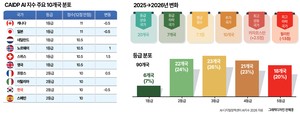
Two Roads to the Top: South Korea and Japan's Diverging Paths on AI Governance
Since 2020, the Center for AI and Digital Policy (CAIDP) has published the CAIDP AI Index, the most comprehensive assessment of national AI policy and practices, grounded in democratic values and fundamental rights. From the outset, two East Asian nations have consistently ranked at the very top of the global standings: Japan and South Korea. That two neighboring countries have charted meaningfully different paths toward the same destination — AI governance — carries significant implications for how the world responds to the challenge. In 2021, then-Minister of Science and ICT Lim Hye-sook announced that South Korea had been rated a Tier 1 country in the CAIDP AI Index. By the time CAIDP released its 2026 edition, however, Japan had retained its Tier 1 status while South Korea dropped to Tier 2 for the first time. One significant factor in Japan's continued standing was its signing of the Council of Europe's AI convention — the first international AI treaty addressing human rights, democracy and the rule of law. This shift should not be read as a negative verdict on South Korea's AI governance record. The country has, after all, passed landmark AI legislation — a critical achievement. The change is better understood as a signal that AI policy is a highly dynamic field and that countries must move beyond declaratory commitments to actual implementation. More important is the question of why both nations have held top positions in the CAIDP AI Index for so long, and what lessons the rest of the world can draw from them. What CAIDP Measures and Why It Matters The CAIDP AI Index does not measure AI model performance, investment volume or the number of semiconductor chips a country produces. It is original research analyzing the policies and commitments of 90 countries against a methodology grounded in democratic values — alignment with the UNESCO Recommendation on the Ethics of AI, commitment to human rights, algorithmic transparency, meaningful human oversight, public participation in policymaking, and engagement in international governance. In short, CAIDP asks: does a country treat AI governance as a matter of public responsibility, or merely as a question of industrial strategy? Japan: Consistency as Strategy Japan's standing is the result of deliberate, multi-year positioning at the intersection of innovation and governance. When Japan held the G7 presidency in 2016, it became the first country to bring AI governance onto the global stage. Current Prime Minister Takaichi Sanae, then a minister, introduced the AI governance agenda at G7 meetings — a discussion that ultimately led to the OECD AI Principles, adopted in 2019. Japan also led the Hiroshima AI Process during its 2023 G7 presidency, an international framework for governing advanced AI systems that CAIDP has explicitly cited as a meaningful contribution to global governance architecture. Japan enacted the AI Promotion Act in 2025. The legislation deliberately preserves a light-touch regulatory framework, requiring developers and service providers to adopt AI governance frameworks and ensure their systems are fair and safe, but without mandating specific compliance methods or imposing strong sanctions for violations. This soft-law-first approach can leave gaps in individual protection and carries less enforcement weight than the EU AI Act — particularly for foreign companies operating in Japan. At the same time, it aligns well with Japanese corporate culture's emphasis on safety and compliance. The CAIDP AI Index recognizes Japan's consistent engagement with international norm-setting bodies — G7, OECD, UNESCO and the Council of Europe — and its demonstrated role in building multilateral AI governance. Korea: Landmark Legislation South Korea's story in this period is more instructive. In December 2024, the National Assembly passed the AI Basic Act with broad bipartisan support — a remarkable achievement. The law took effect in January 2026, making South Korea the second jurisdiction in the world, alongside the EU, to enforce a comprehensive AI regulatory framework. The act is architecturally ambitious, folding three distinct policy levers — national strategy, industrial promotion and risk regulation — into a single framework. It establishes a National AI Strategy Committee and an AI Safety Institute, mandates human rights impact assessments for high-risk AI systems, and imposes transparency obligations on generative AI outputs. The CAIDP AI Index values such policy vision while continuing to assess whether algorithmic transparency, contestability and independent oversight mechanisms to enforce AI-related rules are present in practice. CAIDP also urges the South Korean government to sign and ratify the Council of Europe's AI convention. The Shared Foundation Japan and South Korea share a quietly remarkable common ambition: both have declared aspirations to lead global AI. Japan aims to become the world's most AI-friendly nation, while South Korea has set its sights on joining the United States and China as one of the world's top three AI powers. What separates them is method. Japan is betting on leadership in international rulemaking, broader AI adoption across its economy, and autonomy in decision-making, operational capability and negotiating power — what Japanese policymakers call "AI sovereignty." South Korea, by contrast, is investing heavily in owning the full AI stack end-to-end, a model it calls "Sovereign AI." Despite this difference in approach, the two countries share a governance DNA. Both treat fairness, safety and trustworthy AI as core legal values. Both have established AI safety institutes that engage with global counterparts on evaluation standards and risk assessment, and both are investing in long-term institutional capacity rather than short-term regulatory performance — precisely what CAIDP rewards. Both have engaged substantively with the UNESCO Recommendation on the Ethics of AI and participate actively in multilateral AI governance. Most importantly, both governments understand that the benefits and prosperity AI promises are not automatic, and that trust lies at the heart of social acceptance. Neither has fallen into the Big Tech narrative that AI regulation is at odds with innovation. They recognize that AI cannot diffuse deeply into an economy if citizens and consumers remain uneasy or concerned about its impact. A Lesson for Other Countries The trajectory of Japan and South Korea through the CAIDP AI Index offers a clear lesson for policymakers and researchers: governance credibility is earned through real action, not simple announcements. We live in an era when public concern about AI's impact on daily life is growing steadily — when college graduates boo commencement speakers who tell them to simply embrace AI, and when CEOs insist that AI's supremacy is inevitable. People want agency. They want to understand AI better, to see its benefits distributed fairly, to hold companies accountable, and to trust that governments will put guardrails in place to protect their rights, opportunities and livelihoods. Two Roads to the Top: South Korea and Japan's AI Governance Trajectories in the CAIDP AI Index Since 2020, the Center for AI and Digital Policy (CAIDP) has published the CAIDP AI Index — the most comprehensive analysis of national AI policy and practices, with a particular focus on democratic values and fundamental rights. From the outset, two East Asian nations have occupied the very top of the global rankings: Japan and South Korea. That two neighboring countries chart meaningfully different paths to the same destination is a striking signal about the global response to AI governance. In 2021, then-Minister of Science and ICT Lim Hye-sook announced that the CAIDP Index had ranked South Korea as a Tier 1 country. By the time CAIDP released its 2026 edition, Japan had retained its Tier 1 status while South Korea moved to Tier 2 for the first time. One significant factor in Japan's continued ranking was its signing of the Council of Europe's AI treaty — the first international AI convention addressing human rights, democracy and the rule of law. This difference is by no means a negative assessment of South Korea's AI governance achievements. The country has, after all, passed landmark AI legislation — a critical achievement. The change should be read more as a signal that AI policy is highly dynamic and that countries need to move from commitments to implementation. What matters more is why these two countries have remained at the top of the CAIDP AI Index for so many years, and what lessons the rest of the world can draw from them. What CAIDP Measures and Why It Matters The CAIDP AI Index is not a measure of AI models, investment volume or the number of chips a country produces. It is original research analyzing the commitments and policies of 90 countries. The index evaluates national AI policies and practices against a methodology grounded in democratic values: alignment with the UNESCO Recommendation on the Ethics of AI, commitment to human rights, algorithmic transparency, meaningful human oversight, public participation in policymaking, and engagement in international governance. In short, CAIDP asks: does a country treat AI governance as a matter of public responsibility, or merely of industrial strategy? Japan: Consistency as Strategy Japan's position is the result of deliberate, multi-year positioning at the intersection of innovation and governance. In 2016, when Japan held the G7 presidency, it became the first country to bring AI governance to the global stage. Current Prime Minister Takaichi Sanae, then a minister, introduced the AI governance agenda at G7 meetings — an initiative that ultimately led to the OECD AI Principles, adopted in 2019. During its 2023 G7 presidency, Japan led the effort to establish the Hiroshima AI Process, a landmark international framework for governing advanced AI systems that CAIDP has explicitly cited as a meaningful contribution to global governance architecture. Japan enacted the AI Promotion Act in 2025. The legislation deliberately preserves a light-touch framework, requiring developers and deployers to adopt AI governance frameworks and ensure their systems are fair and safe, but without prescribing specific compliance methods or imposing hard sanctions for non-compliance. This soft-law-first stance can leave gaps in protecting individuals and provides fewer enforceable obligations than the EU AI Act — particularly for foreign companies operating in Japan. Yet it also aligns with the safety- and compliance-oriented culture of Japanese business. The CAIDP AI Index recognizes Japan's consistent engagement with international norm-setting bodies — G7, OECD, UNESCO and the Council of Europe — and its demonstrated role in building multilateral AI governance. Korea: Landmark Legislation South Korea's story in this period is more instructive. In December 2024, the National Assembly passed the AI Basic Act with overwhelming bipartisan support — a remarkable achievement. The law took effect in January 2026, making South Korea the second jurisdiction in the world, alongside the EU, to enforce a comprehensive AI regulatory framework. The act is architecturally ambitious, folding three distinct policy levers — national strategy, industrial promotion and risk regulation — into a single framework. It establishes a National AI Strategy Committee and an AI Safety Institute, mandates human rights impact assessments for high-impact AI systems, and imposes transparency obligations on generative AI outputs. The CAIDP AI Index values such policy vision while continuing to assess whether algorithmic transparency, contestability and independent oversight mechanisms to enforce AI-related rules are present in practice. CAIDP also urges the South Korean government to sign and ratify the Council of Europe's AI convention. The Shared Foundation Japan and South Korea share a quietly remarkable common ambition: both have declared aspirations to lead global AI. Japan aims to become the world's most AI-friendly nation, while South Korea's goal is to rank among the top three AI powers alongside the United States and China. What separates them is method. Japan is betting on leadership in international rulemaking, deeper AI adoption across its economy, and autonomy in decision-making, operational capability and negotiating power — what Japanese policymakers call "AI sovereignty." South Korea, by contrast, is investing heavily in owning the full AI stack end-to-end, a model it calls "Sovereign AI." Despite this difference in approach, Japan and South Korea share a governance DNA. Both treat fairness, safety and trustworthy AI as core legal values. Both have established AI safety institutes that engage with global counterparts on evaluation standards and risk assessment, building institutional capacity that CAIDP rewards because it reflects long-term commitment rather than regulatory theater. Both have engaged substantively with the UNESCO Recommendation on the Ethics of AI and participate actively in multilateral AI governance. Most importantly, both governments understand that the promise of AI benefits and prosperity is not automatic, and that trust lies at the heart of social acceptance. Neither has fallen into the Big Tech narrative that AI regulation is at odds with innovation. They understand that AI cannot diffuse deeply into an economy if citizens and consumers remain uneasy or concerned about its impact. A Lesson for Other Countries The trajectory of Japan and South Korea through the CAIDP AI Index offers a lesson for policymakers and researchers: governance credibility is earned through real action, not simple announcements. We live at a time when survey after survey shows growing public concern about AI's impact on daily life — when college graduates boo commencement speakers who tell them to simply embrace AI, and when CEOs insist that AI's supremacy is inevitable. People want agency. They want to understand AI better, to see its benefits distributed fairly, to hold companies accountable, and to trust that governments will put guardrails in place to protect their rights, opportunities and livelihoods.
June 4, 2026
-
[Editorial] With exports nearing $1 trillion, Korea must sustain its semiconductor edge and industrial innovation
South Korea's exports are surging on the back of a semiconductor boom. According to the Ministry of Trade, Industry and Energy, exports reached $87.75 billion in May, the highest monthly figure on record. After breaking the $80 billion monthly threshold for the first time in March, exports have exceeded that mark for three consecutive months, and the daily average export value surpassed $4 billion for the first time. The cumulative trade surplus for January through May stood at $101.9 billion, already exceeding the previous annual record of $95.2 billion set in 2017. At this pace, annual exports of $1 trillion are within reach. Semiconductors have been the driving force. Semiconductor exports jumped 169.4 percent year-on-year in May to $37.16 billion, setting an all-time monthly record. The surge reflects explosive demand for HBM, DRAM and NAND flash as American and Chinese tech giants race to invest in AI infrastructure. Computer exports also climbed more than 290 percent, driven by rising demand for AI server SSDs. The semiconductor boom has more than offset headwinds from the war in the Middle East and the spread of protectionism, firmly anchoring South Korea's export performance. Semiconductors have long been regarded as a cyclical industry, but the AI revolution has transformed their standing. Global tech giants are signing multi-year supply contracts to secure HBM and high-performance memory chips for AI data centers. HBM in particular is designed and produced to each customer's specifications, making it difficult to replace once a supplier enters the supply chain. Meanwhile, the expanding use of AI across applications — AI agents, physical AI, self-driving cars and robots — means supply is struggling to keep pace with demand. Yet with semiconductors now accounting for more than 42 percent of total exports, excessive dependence warrants caution. The current surge in memory demand is underpinned by massive AI infrastructure investment from American and Chinese tech companies. Should that investment enthusiasm cool or profitability fall short of expectations, semiconductor demand will inevitably feel the impact. The challenge from Chinese memory makers is also a serious threat. CXMT and YMTC are rapidly expanding production capacity with government support and are set to begin full-scale mass production next year. If low-cost Chinese memory chips flood the market, the boom could quickly fade. This rare semiconductor moment must be channeled into broader structural reform and innovation across industry. R&D, talent development and industrial infrastructure must be accelerated to sustain Korea's commanding lead in HBM and AI semiconductors. Efforts are also needed to strengthen the competitiveness of next-generation growth industries — future mobility, batteries, biotech and robotics — to broaden the export base, while raising the technological capabilities of small and midsize enterprises. This is an opportunity for the Korean economy to make a genuine leap forward.
June 2, 2026
-
[Editorial] Rate hike grows more likely as inflation tops 3% — brace for the fallout
Consumer prices rose 3.1 percent in May, the sharpest year-on-year increase in two years and two months. A surge in global oil prices driven by the Middle East war pushed petroleum product prices up 24.2 percent — their highest level in three years and ten months — pulling the broader index higher. The gain in petroleum prices was the steepest since July 2022 (35.2 percent), early in the Ukraine war. After falling from 2.3 percent in December last year to 2.0 percent in January and February, the consumer price inflation rate climbed to 2.2 percent in March and 2.6 percent in April before jumping another 0.5 percentage point the following month. Bank of Korea Gov. Shin Hyun-song held the benchmark interest rate at 2.50 percent at his first Monetary Policy Board meeting after taking office on May 28, but signaled a rate hike in the second half of the year, saying the path forward was "relatively clear" whether one looked at prices, growth, the exchange rate or real estate. With consumer prices now above 3 percent, the prospect of an early rate hike — at the July board meeting — has grown considerably stronger. Beyond consumer prices, other key economic indicators are also building the case for a rate increase. Exports, the engine of South Korea's economic growth, have exceeded $80 billion for three consecutive months through last month, posting record highs. The won-dollar exchange rate, which hovered around 1,440 won in early May, has broken through 1,510 won, with the 1,500-won range hardening into a new normal. Housing prices have also been unsettled since the suspension of the capital gains tax surcharge on multi-home owners. Seoul apartment sale prices rose for four consecutive weeks through the fourth week of May. The stock market, which has extended its rally past the 8,700 mark, is another variable that could stoke inflation through improved consumer sentiment driven by the wealth effect. Household debt is at a dangerous level as well. Household loans reached a record 1,993 trillion won (approximately $1.32 trillion) at the end of March — the result of all-in borrowing to buy homes and debt-fueled stock investment. Speaking Monday at the 2026 BOK Conference at the Bank of Korea, Gov. Shin said in a conversation with European Central Bank Executive Board member Isabel Schnabel that "strong semiconductor exports have boosted the growth rate despite rising global oil prices, removing the dilemma associated with monetary policy." Rising global oil prices typically push inflation up while dragging growth down, often leaving central banks unable to raise the benchmark interest rate even as inflation concerns mount. This year, South Korea's semiconductor sector has cleared that obstacle. That is the backdrop to the Bank of Korea raising its growth forecast for this year from 2 percent to 2.6 percent. Even so, the downsides of a rate hike deserve careful attention. South Korea's household debt-to-GDP ratio stands at 89 percent, among the highest of any major economy. A one-percentage-point rise in lending rates would add 12.9 trillion won to households' annual interest burden. The impact on ordinary citizens, the self-employed and small-business owners would be especially severe. Policymakers must take care to ensure that across-the-board tightening does not deepen the financial hardship of the most vulnerable.
June 2, 2026
MOST READ
- 1KAIST develops high-performance bio-based adhesive using E. coli instead of petroleum
- 2Pope Leo XIV declines French honors and banquet, accepts only private meeting with Macron
- 3Daimler Truck unveils next-generation transport solutions at IAA 2026
- 4What was Rachmaninoff's performance fee? A 1928 price list tells all
- 5Samsung Biologics union's show of force backfires at the bargaining table
- 6APR says hair-loss treatment research published in international journal
-
WORLD
US warns of punishment for anyone enabling Iran's Strait of Hormuz toll scheme
-
INDUSTRY
Toyota union puts productivity first; Hyundai Motor union demands bigger share of profits
-
FINANCE
National Growth Fund to invest $531M in FuriosaAI, which rebuffed Meta's $800M takeover bid
-
INDUSTRY
Korea Shipowners' Association holds amateur baduk tournament for Maritime Day