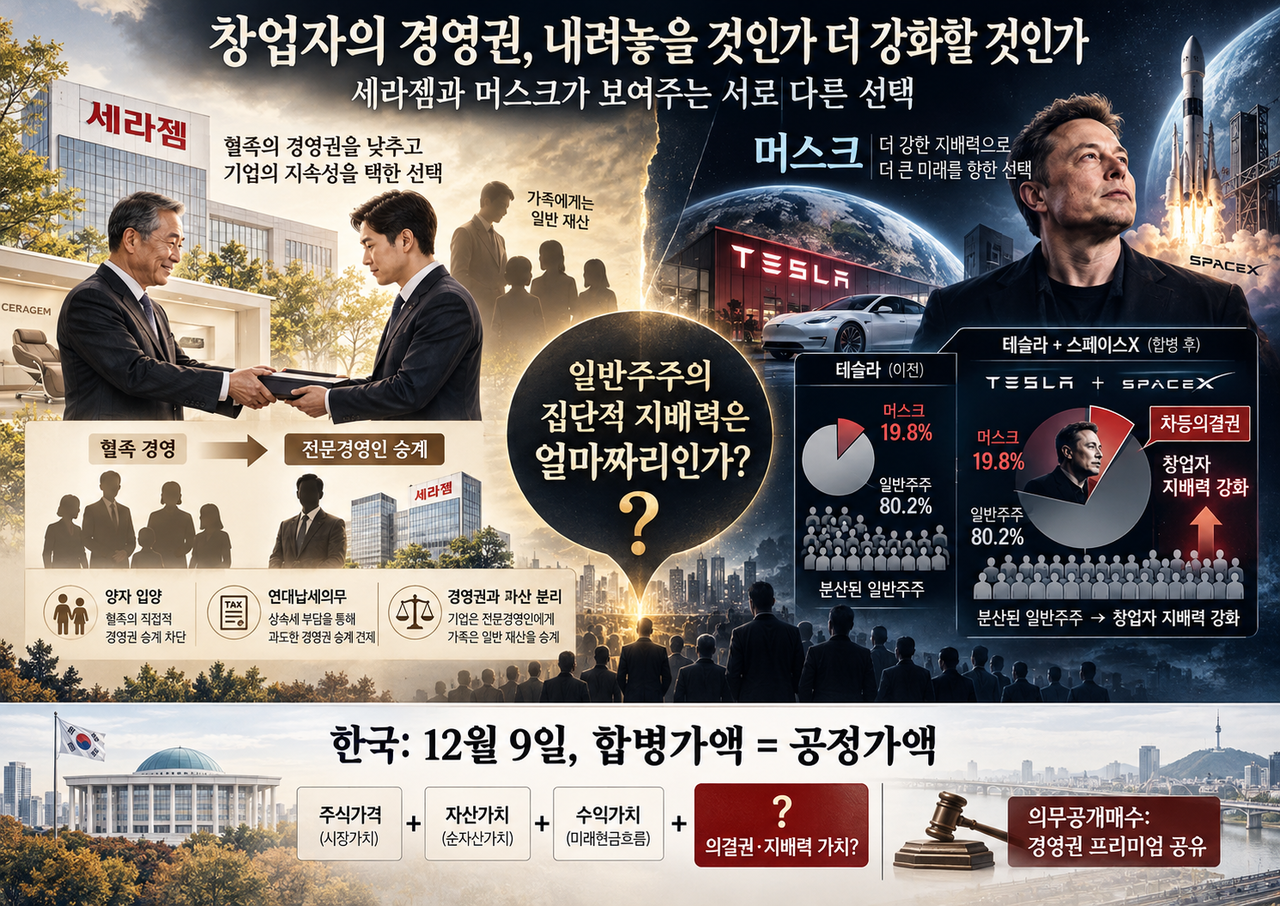
Two notable succession moves — one in South Korea, one in the United States — have recently drawn attention. Cerajem is attempting to replace family management with a professional executive, while Elon Musk is moving to transform a publicly listed company into one effectively controlled by his own family.
Cerajem's case carries lessons for mid-sized and small and medium-sized enterprises that struggle with succession and inheritance when no obvious heir exists. Musk's move offers another window into the US startup and technology ecosystem, where founders are routinely granted outsized voting rights. It raises the question of how far a founder's dominance should extend, and how ordinary shareholders on the other side of that equation should be protected. It also invites reflection on South Korea's own debate over dual-class shares, which has so far focused almost exclusively on defending against hostile takeovers.
Why Cerajem chose adoption over a gift — joint inheritance tax liability
There is a little-known principle embedded in South Korea's inheritance tax law: co-heirs bear joint and several liability for one another's inheritance tax obligations. Each heir can pay another heir's tax bill, up to the value of the estate they themselves received or stand to receive.
With that in mind, the reasoning behind Cerajem's unusual succession structure becomes clearer.
Cerajem founder and Chairman Lee Hwan-seong adopted the company's professional CEO, Lee Kyung-su, as an adult heir last year. The chairman has an only daughter, who is understood not to be involved in running the company. A straightforward gift of shares was an option, but the company chose adoption instead. Under civil law, an adopted child holds the same inheritance rights as a biological child, making Lee Kyung-su a co-heir alongside the chairman's existing family — and bringing him within the scope of joint tax liability.
Separating business control from family assets — LG Group set the precedent
If company shares make up a large portion of the estate, Lee Kyung-su would face a substantial inheritance tax bill on those shares. He could also cover other co-heirs' tax obligations, up to the value of what he himself inherits — and such payments on behalf of co-heirs are not treated as a separate taxable gift. The model, in essence, uses adoption to separate the person who inherits the business from those who inherit other assets, with the business successor absorbing the tax burden for the rest.
There is already a precedent. LG Group Chairman Koo Kwang-mo was registered as the adopted son of the late Chairman Koo Bon-moo and inherited most of the LG Corp. shares tied to management control. He is understood to have agreed to cover the inheritance tax obligations of the other co-heirs. The key difference with Cerajem is that it adopted someone from outside the family.
How Lee Kyung-su will fund his inheritance tax bill remains an open question. Cerajem is understood to have explored an initial public offering several years ago, and if a listing is pursued again, monetizing shares could provide the necessary funds.
Tesla + SpaceX = a Musk family company
Where Cerajem has chosen to preserve management continuity over bloodline, the world's wealthiest person is taking an entirely different path. Elon Musk is pushing to merge Tesla and SpaceX.
As of Thursday, Tesla's market cap stood at approximately $1.48 trillion and SpaceX's at approximately $1.97 trillion. Based on those figures, SpaceX's existing shareholders would hold roughly 57 percent of the combined company's economic interest, with Tesla's existing shareholders holding roughly 43 percent.
Musk owns approximately 19.8 percent of Tesla; the remaining roughly 80.2 percent belongs to ordinary shareholders. He is both CEO and the largest single shareholder, but he cannot act unilaterally — in theory, if that 80.2 percent were to act collectively, it could check him.
SpaceX, by contrast, grants Class B shares 10 votes each. Through that structure, Musk exercises voting power far exceeding his economic stake. Class B shares automatically convert to Class A if transferred to anyone else, except in permitted circumstances — a structure that makes his control difficult to dilute.
If the merger is priced purely on market cap, Tesla's ordinary shareholders would effectively surrender the collective voting power they hold over the company's direction. Individually they are minority shareholders, but together they own 80.2 percent — making them, as a group, Tesla's ultimate controlling force. The central question of any merger, then, is what price to put on that collective control.
The premium on Tesla shareholders' collective control is the key variable
The United States and South Korea use different frameworks for setting merger ratios. In the US, the share price before a merger announcement and average prices over a given period are important reference points, but not the final word. Valuations draw on discounted cash flow analysis, comparable company multiples, precedent transactions, and assessments of business outlook and synergies.
There are cases where ordinary shareholders' voting rights have been assigned significant value. When Paramount merged with Skydance in 2024, Paramount had approximately 40.7 million Class A shares carrying voting rights and approximately 611 million Class B shares that carried no voting rights in principle. The negotiated terms offered Class A holders either $23 in cash or 1.5333 shares in the combined company, while Class B holders were offered either $15 in cash or one share in the new company.
Class A shares — those with voting rights — were offered a price 53.3 percent higher than Class B. That gap cannot be attributed entirely to voting rights, however; it also reflects differences in liquidity, governance changes and opportunity costs.
Markets are already pricing in a premium of as much as 35 percent. Using Tesla's closing price of $374.58 on Thursday and SpaceX's current market cap as a baseline, a simple calculation shows that at a 10 percent premium, each Tesla share would be worth $412.04 in the merger and Tesla's existing shareholders would hold a 45.3 percent economic stake in the combined company. At 20 percent, those figures rise to $449.50 and 47.5 percent; at 30 percent, to $486.95 and 49.5 percent; and at 35 percent, to $505.68 and 50.4 percent.
South Korea is also moving toward a US-style merger valuation standard — but what about voting rights?
Many Korean investors hold Tesla shares, so the merger ratio is far from an abstract foreign matter.
Starting Dec. 9, South Korea will significantly overhaul the way merger valuations are calculated for listed companies. Rather than mechanically anchoring the price to a share's value at a specific point in time, companies will be required to apply a "fair value" standard that weighs share price alongside asset value, earnings value and other factors. Boards will need to prepare a written opinion reviewing the merger's purpose, expected benefits and the appropriateness of the valuation, while external appraisers will be required to assess not just the price but the fairness of the overall transaction terms. The specific merger pricing formulas previously set out in the enforcement decree will be removed.
The intent is to ensure that a company's intrinsic value is properly assessed — and to prevent parties from suppressing a share price at a strategic moment to engineer a favorable merger ratio. The question now becomes: what counts as "fair value"?
The revised law specifies "share price, asset value, earnings value and other factors" — the word "other" meaning the list is not exhaustive. Since external appraisers are required to examine the fairness of transaction terms as a whole, there is room to consider additional forms of economic value. What remains absent, however, is any explicit standard for calculating the value of the collective voting power or control that ordinary shareholders hold as a group, or for reflecting that value in merger terms.
The government is separately pursuing a mandatory tender offer regime, designed to give ordinary shareholders a share of the control premium when a company changes hands. The specific threshold has not been finalized, but the direction is to set the statutory floor — the minimum the presidential decree may require — at more than 50 percent plus one share.
That raises an obvious question about mergers: if ordinary shareholders must be given a slice of the control premium when management control is sold, should the collective control they surrender through a merger go unvalued? If voting rights are recognized as having worth, it could also help address the persistent "Korea discount" in domestic equity markets.
kyhong@heraldcorp.com