
- HOME
- OPINION
-
[Biz Insight] Tap into your customers' capabilities
Biz Insight The term "prosumer" was once in vogue — a consumer who takes an active role in a company's production process. In the service sector particularly, the consumer's role is far more participatory than in product-based industries. Mapping out the chain from customer to customer experience to purchase to customer value, an invisible thread of "participation" runs through every link. As a result, customers' own capabilities are drawn into the business itself. That being the case, companies would do well to actively encourage and accommodate customers' desire to get involved. The trend is rooted in a growing emphasis on experience. The ease with which people can now acquire knowledge and information has also played a major role. People today want to try everything for themselves — a phenomenon sometimes called the "experience economy." The key tool for tapping into customer capabilities is robust interaction. To that end, companies must maximize interactive communication structures and real-time touchpoints with their customers. This turns customers into co-creators of value alongside the company — a dynamic that allows businesses to draw on customer capabilities as a resource, effectively filling gaps the company could not fill on its own. In return, customers must receive appropriate rewards. Companies do bear the burden of maintaining active interaction and securing customer touchpoints. The payoff, however, is more precise marketing. Both efficiency and effectiveness improve at the same time — efficiency measured by how well resources are used, effectiveness by the degree to which goals are achieved. Hansik, or Korean cuisine, is a prime example of a service that naturally draws customer capabilities inward. Its appeal lies in the rich experiential world it opens up. Western diners in particular are captivated by the idea that they participate in the cooking process and complete the dish to their own taste. By allowing customers to add various accompaniments according to their preferences, hansik partly involves them in the preparation — unintentionally, perhaps, but effectively pulling customer capability into the service itself. "Service is the activity of solving customers' problems through interaction with them." Those words came from Jack Welch, chairman of GE — a company whose manufacturing operations were overwhelmingly dominant — during his tenure.
June 8, 2026
-
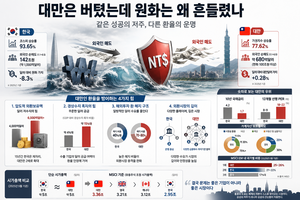
The 'Curse of Success': Why Korea's Won Stumbled Where Taiwan's Dollar Held Firm
Exchange rate volatility this year: Taiwan 0.28% vs. Korea 8.3% The Kospi has surged 93.65% this year. Yet foreign investors have been selling. Their cumulative net selling through Friday reached 142 trillion won (approximately $92.9 billion) — roughly $100 billion when average exchange rates are applied. Over the same period, the won fell 8.3% against the dollar. Taiwan tells a similar story. The Taiwan Weighted Index climbed 77.62% this year, and foreign investors net sold roughly $68 billion worth of Taiwanese shares — more than 100 trillion won. Yet the Taiwan dollar barely moved. The dollar-Taiwan dollar exchange rate fluctuated by just 0.28%. Korea and Taiwan are the most comparable markets this year. Both rank among the biggest beneficiaries of the AI semiconductor rally. Share prices have surged, and foreign investors have been locking in gains at scale through portfolio rebalancing — adjusting positions swollen by rising valuations — a phenomenon sometimes called the "Curse of Success." What stands out is how differently the two currencies have responded. The won has swung sharply while the Taiwan dollar has held its ground, a difference that comes down to each market's capacity to absorb foreign selling and the resulting dollar demand. Dollar liquidity shortage in the foreign exchange market triggers sharp rate moves Does this signal a serious problem with the Korean economy? Not necessarily. Korea runs a current account surplus. The cumulative surplus through May this year, including estimates, is believed to be around $140 billion. Semiconductor exports remain strong, and the Kospi's market capitalization has climbed to roughly sixth in the world. This looks nothing like a typical crisis. The issue is not a shortage of dollars — it is that dollars have not been reaching the market quickly enough. Foreign investors' net selling of 142 trillion won this year amounts to around $100 billion at current exchange rates — comparable to the foreign exchange reserves of many countries. Domestic investors are also channeling more money abroad: the national pension fund is raising its overseas asset allocation, while individual investors are buying US stocks and ETFs. All of this creates dollar demand. Meanwhile, Korean companies are in no hurry to convert their export earnings back into won. The dollar-earning capacity is strong, but the pace at which those dollars flow back into the market has slowed, leaving it unable to keep up with rising demand. Taiwan's well-developed mechanisms for balancing dollar supply and demand Taiwan is different. Despite heavy foreign selling, its exchange rate barely moved — thanks to several shock-absorbing mechanisms. The first is foreign exchange reserves. Taiwan holds more than $600 billion in reserves — more than Korea despite having a smaller economy. Taiwan cannot easily secure a standing currency swap with the US Federal Reserve the way Japan can, partly because of constraints on formal diplomatic relations. So instead of relying on a dollar credit line, Taiwan has built a large dollar stockpile. Over the past 15 years, while Korea's reserves have hovered around $400 billion, Taiwan has doubled its foreign currency holdings. The second is the strength of its current account surplus. Taiwan's current account surplus is large relative to the size of its economy. Dollars earned from semiconductor exports flow in consistently. When exchange rates become unstable, Taiwanese exporters tend to supply those dollars to the market. Korean companies, by contrast, are reluctant to convert their export earnings. With the won already volatile and domestic interest rates lower than in the United States, there is little incentive to exchange dollars for won. The third is the currency-hedging structure of overseas investment. Taiwan's financial institutions — including insurers — invest heavily abroad, and they hedge a high proportion of their currency exposure, which reduces one-sided dollar demand in the foreign exchange market. In Korea, much overseas investment goes unhedged. Leaving foreign investment unhedged can be a deliberate strategy, but when large pools of capital move without hedging, the impact on the broader foreign exchange market grows — and so does the case for hedging, particularly to limit exposure to exchange rate volatility when those investments are eventually unwound. The fourth is market depth. Neither the won nor the Taiwan dollar is traded on global markets. But while Korea's foreign exchange market is narrow and bank-dominated, Taiwan's draws participation from a wider range of financial institutions and investment firms. Greater diversity of participants deepens trading and improves the market's ability to absorb shocks. Exchange rates ripple into bond markets and valuations — Taiwan leads emerging markets Exchange rate movements reach into the bond market as well. A weaker won pushes up import prices. With oil-related product prices already rising amid tensions in the Middle East, further currency depreciation adds to inflationary pressure. This year's real economic growth rate is forecast at around 7% for Taiwan and around 3% for Korea, yet the 10-year government bond yield stands at 1.7% in Taiwan and 4.2% in Korea. Lower interest rates are generally more conducive to economic growth. Lower rates also support higher equity valuations. On a 12-month forward basis, Korea's price-to-earnings ratio stands at 8 to 9 times, while Taiwan's is 18 to 22 times. Korea's semiconductor rally began in the second half of last year, but TSMC's share price moved earlier — meaning foreign investors began rebalancing out of Taiwan first. Taiwan's domestic capital absorbed that selling well. Household assets in Taiwan are allocated roughly 20% to marketable securities and 30% to deposits, with real estate accounting for just 30%. In Korea, more than 75% of household assets are tied up in real estate and other physical assets, with deposits at around 20% and marketable securities at less than 6%. Taiwan also has the edge in market depth. As of May, Taiwan accounted for 25 to 26% of the MSCI Emerging Markets Index by country weight, ranking first, while Korea stood at 21 to 22%, in second place — a gap of more than 3 to 4 percentage points. MSCI country weights are determined not by GDP but by free float-adjusted market capitalization, which captures roughly 85% of large- and mid-cap shares available to the public after excluding controlling shareholder and government stakes. Total market capitalization is similar for both countries at around $5 trillion, but on the MSCI measure Taiwan stands at $3.36 trillion against Korea's $2.95 trillion. On that same measure, the United Kingdom ($3.21 trillion) and Canada ($3.12 trillion) also rank ahead of Korea. Modernizing capital and foreign exchange markets is essential for a wealthier Korea The AI investment boom has driven a semiconductor supercycle that has sharply lifted the earnings and share prices of Korean companies in the sector. Amendments to the Commercial Act and related reforms have also gone some way toward addressing concerns about the marginalization of minority shareholders. Yet the state of Korea's capital and foreign exchange markets still does not match the country's economic standing — they remain trapped in a 20th-century regulatory mindset. Advanced economies are ones where capital has accumulated and is put to work efficiently — where returns on capital can outpace those from labor. When a country that boasts the world's sixth-largest stock market and one of the world's largest current account surpluses has underdeveloped capital and foreign exchange markets, the cost to capital efficiency is severe. Both foreign and domestic investors are likely to look elsewhere. That is how the Curse of Success keeps repeating itself. Ultimately, the problem is not the quality of the companies — it is the quality of the market. Hong Kong and Tokyo are not markets that trade only domestic companies. They are markets that global capital seeks out on its own terms. In those markets, success breeds more success rather than a curse. For those who hope to see the Kospi reach 10,000 and stay there, the goal need not be New York — but surely Korea should be able to close the gap with Hong Kong and Tokyo.
June 7, 2026
-
[Editorial] Won hits 1,540 per dollar — Korea must shore up its economic weak points
The won-dollar exchange rate, which had hovered above 1,500 won for three weeks, surged past 1,540 won during trading Thursday — the first time since the global financial crisis. Financial authorities convened an emergency "F4" meeting — bringing together the deputy prime minister for economic affairs, the Bank of Korea governor, the Financial Services Commission chairman and the Financial Supervisory Service chief — and issued forceful verbal warnings, but to no avail. The prolonged Middle East war, heavy foreign selling of Korean equities and mounting US tariff risks combined to drive the won lower. Alarming forecasts have begun to circulate that the rate could climb into the 1,600-won range. Because a weak won is a trigger for higher inflation and higher interest rates, the government must treat this situation with exceptional vigilance. On Thursday, the won opened at 1,530.0 per dollar in the Seoul foreign exchange market, up 13.6 won from the previous session. That was the first time it had started above 1,530 won since March 2009, during the global financial crisis — a gap of 17 years and three months. After the after-hours session opened, the rate broke through 1,540 won, also a first since 2009. Judged by the exchange rate alone, the Korean economy is in a state of emergency. However, as Kim Yong-beom, the Cheong Wa Dae policy chief, said, the current won weakness does carry some character of "friction from a leap forward." Corporate earnings and exports, riding a semiconductor supercycle, are setting all-time highs, and foreign investors who had poured into the Korean stock market as it shed its Korea Discount have been taking profits — a dynamic that has itself weakened the won. Adding to the pressure, US-Iran end-of-war negotiations have stalled, and the Office of the United States Trade Representative announced it would impose an additional 12.5 percent tariff on Korea after including it on a list of trading partners that allow goods produced with forced labor. The exchange rate is shaped by a complex web of variables — from external shocks beyond Korea's control, such as a war-driven oil shock and the interest rate gap between Korea and the United States, to assessments of the Korean economy's underlying fundamentals. In the near term, authorities need to manage effectively the factors driving foreign exchange volatility. The anticipated mega initial public offerings of so-called big-tech giants — SpaceX, valued at $2 trillion, and Anthropic, valued at $1 trillion — are emerging as a fresh source of downward pressure on the won. When those companies list, a large outflow of domestic investment capital is likely to push the won even lower. Monetary authorities have deployed a range of measures to counter the high exchange rate — including a foreign exchange swap arrangement with the national pension fund and a domestic equity return account, or RIA, that offers retail investors an exemption from capital gains tax on overseas holdings — but the impact has been limited. At a broader level, the government is also exploring a Korea-US monetary swap, though no tangible results have emerged. Short-term tools are running up against their limits, and no game-changing card has been found to shift market sentiment, leaving the 1,500-won range looking increasingly like a new normal. This is a moment that calls for creative policy to break the impasse. Ultimately, the fundamental remedy must be to raise Korea's potential growth rate and secure the confidence of international markets.
June 5, 2026
-
[Lee Young-man's World] Memories of Mexico
That morning, South Korea was buzzing. A strange excitement hung in the air. Companies pushed back their start times to let the mood linger. Fourteen minutes into the match, Kim Jong-bu's shot found the net — 1-0, a goal that felt like a dream. It was the morning of June 15, 1983, a semifinal at the FIFA World Youth Championship in Mexico. South Korea's young footballers faced the world's best, Brazil — and scored first. Could they really be heading to the final? The thought was almost too much to dare. They would not even have been there had North Korea not been banned from international competition for two years after a referee-assault incident. It was a lucky substitute berth, with little attention and a brutal draw: European powerhouse Scotland, Australia — who had won all five qualifying matches — and host Mexico, who had their eyes on the title, were all in the same group. The opening match against Scotland ended in a 0-2 defeat, as expected. But that was when the miracle began. Despite missing a penalty kick, South Korea beat Mexico 2-1, then subdued Australia 2-1 as well. They were young, but it was South Korea's first FIFA quarterfinal. Hope surged, yet the road ahead was uncertain. Next up was Uruguay, a two-time World Cup champion. Still, they ran and ran, forcing extra time and winning 2-1 to reach the semifinals. The last hurdle before the final was Brazil. South Korea struck first but lost 2-1 in a comeback defeat. The football world was stunned. It was a swarming, relentless style of play that overcame South American technique and European physicality through sheer fighting spirit. Foreign media praised the players in their red jerseys — surging like an angry tide without pause — calling them the "Red Devils" and the "Red Demon Corps," paying tribute to their remarkable combativeness. They were the forerunners of the "Red Devils" who carried South Korea to the semifinals of the 2002 FIFA World Cup. On June 19, South Korea faces host Mexico in their second Group A match of the World Cup in Guadalajara. If they carry on the spirit of those young players from 43 years ago and win, a place in the round of 32 is all but assured — but even if they fall short, Mexico has been a place of good fortune for South Korea, and the road there is not entirely forbidding. South Korea's football ties with Mexico run deep. At the 1948 London Olympics — the first Games South Korea entered under its current name — the team beat Mexico 5-3 in the round of 16. But in two World Cup meetings, South Korea lost both times: 1-3 in France in 1998, and 1-2 in Russia in 2018. In Russia, Mexico owed South Korea a debt. Mexico were on the brink of elimination after losing 0-3 to Sweden, but South Korea's 2-0 victory over Germany gave them a lifeline. Mexico shouted "gracias" in South Korea's direction and never forgot Son Heung-min, who scored the second goal. This will be South Korea's second World Cup in Mexico. Their first, in June 1986, came 32 years after the 1954 Switzerland tournament and featured legends such as Cha Bum-kun, Choi Soon-ho and Huh Jung-moo. But defending champion Argentina and previous winner Italy proved too tall an order. Still, South Korea drew with Bulgaria to claim their first World Cup point and scored four goals across three matches. Mexico — a place of promise and a stubborn thread of fate. The group draw has been kind. Not only is Pot 1's Mexico (FIFA 15th) one of the weaker options in its tier, but Pot 3's Czech Republic (41st) and Pot 4's South Africa (60th) are also among the softer picks in their respective pots. FIFA rankings have their gaps, but the good omens are there — and both countries have devoted BTS fan bases. What's more, the third match against South Africa will be played in Monterrey, the very city where South Korea beat Uruguay in 1983 to reach the semifinals. The blazing atmosphere of June 2002 feels close again. Lee Young-man, former chief executive
June 5, 2026
-
[Editorial] Oh wins fifth term, but Seoul voters demand cooperation
People Power Party candidate Oh Se-hoon won a fifth term as Seoul mayor in Wednesday's local elections. In the Seoul Metropolitan Council race, Democratic Party candidates claimed 81 of the 118 seats (68.6 percent) while People Power Party candidates won 37 (31.4 percent). In the 25 Seoul district mayor contests, the Democratic Party won 17 (68 percent) and the People Power Party eight (32 percent). The message from Seoul voters is unmistakable. They chose Oh as mayor — sending a warning against unchecked dominance by the central government and the ruling party — while entrusting the Democratic Party with legislative and district-level administrative power to monitor and check a People Power Party mayor. In short, Seoul voters have issued a clear mandate: the city government and the central government, the mayor and the council and district offices, must work together. Seoul voters have now elected Oh Se-hoon mayor an extraordinary five times. To hold public trust for that long is a remarkable record. It is also significant that he held the post in an election held just one year after a Democratic Party government took power, following the martial law declaration and impeachment of a People Power Party president. Yet his margin over the second-place candidate was barely one percentage point, and overall, slightly more voters did not support him than did. To be mayor for all Seoulites, Oh must embrace and represent even those who did not vote for him. The government and the ruling party must read accurately what Seoul voters expressed through Oh's election: a warning against unilateral dominance in governance and legislation. Oh himself must take seriously the fact that the Democratic Party won nearly seven in 10 seats in the Seoul council and district mayor races. He should keep in mind that this result is a check on fears of one-sided city administration. The challenges that the central government, the Seoul Metropolitan Government, the city council and district offices must tackle together — vertically and horizontally — are vast. Housing and real estate supply policy tops the list. The ruling and opposition parties have long prescribed different remedies on reconstruction, redevelopment, deregulation, speculation curbs, expanded public supply and high-density urban development, yet it has already been proven that no single approach solves the problem. Housing and real estate policy must not be approached through ideology. Public safety and transportation must not become fodder for political battles either. The Itaewon crowd crush, the recent Seosomun overpass collapse and the missing rebar discovered in the GTX-A Samsung station construction section all carry the same lesson: when the three-tier cooperative structure of central, metropolitan and local government breaks down, public safety is inevitably put at risk. Beyond that, every domain — from economic growth and employment to welfare, and from urban development to heritage preservation — requires social consensus spanning all levels of government. Seoul deserves bipartisan cooperation aimed at genuinely solving problems and building social cohesion, not political conflict driven by the pursuit of the next election.
June 5, 2026
-
[Crypto Insight] Asset tokenization is reshaping the US capital markets landscape
Asset tokenization spans real estate, government bonds, funds, raw materials and private credit, but in US capital markets the conversation has sharpened around tokenized securities. When shares, bonds and fund interests are tokenized, the central question is which infrastructure will connect rights records, transfers, settlement, custody, collateral and regulatory reporting. The SEC set out its position in January: tokenized securities fall within the existing securities framework. Even when shares or bonds are represented as tokens, dividend rights, voting rights, redemption claims, transfer restrictions and investor-protection obligations remain intact. The SEC distinguishes between issuer-led and third-party-led tokenized securities. Third-party-led structures can involve arrangements in which the listed company plays no direct role, raising questions about underlying security ownership, investor rights, dividend and voting treatment, and custody and insolvency risk. Nasdaq received SEC approval in March to process tokenized securities within its existing exchange infrastructure. Securities eligible for Depository Trust & Clearing Corp. (DTCC) settlement will share the same security identifiers and ticker symbols as conventional securities and settle through DTCC. Order routing, execution, market surveillance and market data will all follow existing frameworks. The US tokenized-securities market is developing by adding a tokenized record format inside the existing securities market and managing it under the same order book, surveillance and settlement rules. The New York Stock Exchange is also advancing a tokenized-securities platform and standards for digital transfer agents — the function that manages shareholder registries and rights transfers. For tokenized securities to become genuine capital-market products, shareholder registry management, dividend and voting processing, transfer restrictions and investor eligibility verification must all work before 24-hour trading becomes the headline feature. Digital asset exchange Bullish agreed in May to acquire transfer agent Equiniti for $4.2 billion, underscoring the growing value of shareholder registry, dividend and rights-transfer infrastructure. The DTCC's moves illustrate this shift clearly. Working with more than 50 financial institutions, DTCC is building a tokenization service it aims to launch in October. The service is designed to add tokenized rights records and cross-chain interoperability to the existing depository and settlement structure. Competitive advantage in asset tokenization will come down to who controls the standards for rights and settlement. Collateral infrastructure is moving in the same direction. DTCC's appchain collateral infrastructure project, developed in partnership with Chainlink, aims to connect collateral providers, receivers, managers, tri-party collateral agents and custodians on a single shared platform. Real-time visibility into collateral location, ownership, availability and transfer history can reduce overcollateralization and liquidity buffers. Tokenization, in other words, is reshaping not just trading but the standards for collateral movement and liquidity management as well. South Korea risks missing the core market if it approaches tokenized securities solely through the lens of fractional-investment products. What is needed is a redesign of the connective structure linking canonical records, rights determination, transfer agency, custody, settlement, collateral management and regulatory reporting. The roles of the Korea Securities Depository, exchanges, brokerages, banks and custodians also need to be redistributed. The United States is designing asset tokenization as a digital upgrade of existing capital-market infrastructure. South Korea, too, should focus first on restructuring its capital-market operating framework rather than on tokenized products themselves. — Kim Jong-seung, CEO of Xcrypton
June 4, 2026
-
[Editorial] After local elections, closing Korea's K-shaped divide is the real test
The OECD raised its growth forecast for South Korea this year from 1.7 percent to 2.6 percent on Wednesday, a 0.9 percentage point upward revision that was the largest among all G20 economies. The upgrade amounts to a broadly positive assessment of the Lee Jae-myung administration as it enters its second year. The new government, which took office after the turmoil of martial law and impeachment, has navigated major shocks — including tariff negotiations with the United States and the ongoing Middle East war — and delivered solid results. South Korea's first-quarter GDP growth of 1.7 percent ranked among the top performers in the developed world, and the stock market shed its long-standing "Korea discount" stigma as the country's total market capitalization climbed to sixth in the world. Samsung Electronics broke into the global top 10 by market cap, rewriting a chapter in South Korean economic history. The OECD credited semiconductor exports for continuing to drive growth and private investment, and said consumer spending would stage a gradual recovery supported by fiscal policy. Yet every bright side casts a shadow. The OECD flagged a prolonged energy supply crunch stemming from the Middle East conflict, industrial labor disputes and export restrictions as downside risks to the Korean economy. In practice, the US Trade Representative announced Tuesday that it would impose an additional 12.5 percent tariff on South Korea and other countries it accused of failing to adequately block imports made with forced labor. The announcement was a renewed signal that Washington will not overlook the widening trade imbalance driven by semiconductor flows. Seoul will need a sophisticated response to fend off what amounts to a coercive offensive. The AI-driven semiconductor boom is undeniably a windfall, but it is also generating problems of a different order. The wave of outsized performance bonuses set off by SK Hynix and Samsung Electronics has spread beyond manufacturing sectors such as automobiles and shipbuilding into the platform economy, raising fears that this summer's labor disputes could turn particularly ugly. The stronger the grip of large-company and public-sector unions on their entrenched privileges, the deeper the sense of exclusion felt by young workers and employees at small and medium-sized enterprises. The broader economy is simultaneously facing three pressures — high inflation, a weak won and elevated interest rates — compounded by rising global oil prices from the Middle East conflict. Consumer prices rose 3.1 percent last month, the first time they have exceeded 3 percent since March 2024. Raising interest rates further to rein in inflation and the exchange rate has been constrained by fears of slowing growth, but the record-breaking semiconductor export surge has now removed that dilemma. The concern is that higher rates will deepen the pain for ordinary households burdened by debt, as well as for the self-employed and small-business owners. Sustained growth is hard to achieve when the gains concentrate at the top while the costs fall on the vulnerable — the K-shaped polarization that now defines the Korean economy. Structural reform across industry, labor and asset markets is essential to translate the semiconductor boom into a foundation for long-term growth.
June 4, 2026
-
Editorial: Local elections deliver a split verdict — warnings for both parties
The Democratic Party of Korea, the ruling party, swept a commanding majority of metropolitan governorships in Wednesday's local elections. Final vote counts Thursday showed the Democratic Party winning 12 of 16 mayoral and gubernatorial races nationwide, while the People Power Party held on to four. The previous 5-to-12 split in favor of the PPP reversed to 12-to-4 in the Democratic Party's favor — a dramatic turnaround in four years. On the surface, voters appeared to shift the center of gravity in local government toward the Democratic Party, lending momentum to the Lee Jae Myung administration as it marks its first year in office. Yet the PPP won Seoul, where the Democratic Party had been widely expected to cruise to victory, and no upsets materialized in Daegu or South Gyeongsang Province, which had been cited as bellwethers for the scale of a Democratic sweep. In the National Assembly by-election in Pyeongtaek, Gyeonggi Province, PPP candidate Yoo Eui-dong — considered the longest of long shots — defeated Democratic Party candidate Kim Yong-nam and Cho Guk Innovation Party candidate Cho Guk. In Busan's Buk-gu A district, independent candidate Han Dong-hoon defeated Democratic Party candidate Ha Jung-woo. The ruling party rode a strong wave of sentiment for governmental stability, yet lost or struggled in the most consequential battlegrounds, including Seoul. The PPP benefited from a late-stage rally among conservative voters but could not escape an overall drubbing. The National Election Commission's shoddy management of the vote also exposed serious problems: in Seoul alone, at least 14 polling stations ran out of ballots and were forced to suspend voting — an unprecedented breakdown. In that sense, it is fair to say this was an election with no winners, only the wounded. Above all, responsibility for the election's failure to become a genuine contest over the nation's future and regional development rests squarely with the leadership of both parties. The Democratic Party under Jung Chung-rae and the PPP under Jang Dong-hyeok stumbled through the candidate nomination process amid relentless controversy. Party leaders fixated on political slogans — "rooting out insurrection" on one side, "blocking the withdrawal of indictments" on the other — rather than governing visions. Within the Democratic Party, tensions flared between factions loyal to former President Moon Jae-in and those aligned with Lee Jae Myung, as well as between the traditional base and newer supporters. Inside the PPP, feuding between pro-Yoon and pro-Han factions, and between the party establishment and its critics, dragged on without resolution. Critics within both parties charged that their leaders were more consumed by the next intraparty leadership race than by the local elections themselves. Missing entirely were visions and policies on how to spread the gains of a buoyant stock market, rising exports and economic growth to the regions; where and how to build infrastructure for future industries such as semiconductors, AI and advanced manufacturing; and how to ease the concentration of resources in the greater Seoul area and achieve balanced national development. The ruling and opposition parties must take seriously the public sentiment this election has laid bare. Voters checked the ruling party's dominance and punished the conservative opposition's regression. They also issued a clear mandate: break from entrenched forces and stale political discourse, innovate, and govern cooperatively. The Democratic Party must not only exercise its reclaimed local power responsibly but also work in concert with opposition-led local governments. The PPP, for its part, must put its internal divisions and backward-looking controversies behind it and focus solely on the national interest in its dealings with the central government.
June 4, 2026
-
Herald Square: How to resolve the 'generational management' paradox of 40 million indemnity insurance holders
Private indemnity health insurance — held by 40 million Koreans and often called a "second national health insurance" — draws starkly divided opinions. Critics call it the chief driver of medical waste, arguing it encourages overuse of non-covered services and entrenches moral hazard. Defenders counter that it fills the gaps left by national health insurance and shields patients with serious illnesses from financial ruin, making it an indispensable social safety net. Strictly speaking, both sides are right. The same system can simultaneously generate excessive medical consumption for some and serve as the last financial lifeline for others. The right question, therefore, is not "is it a culprit or a bulwark?" but rather "how do we reduce waste while preserving its social value?" For years, the government and the insurance industry have focused on "generational management" — successive product overhauls from the first through fourth generations that raised cost-sharing requirements and introduced premium surcharges. Yet the results have exposed clear limits. Older and chronically ill policyholders resist switching to newer products because of higher premiums, while healthier young enrollees migrate freely, driving up the risk profile of older-generation products in a classic adverse-selection spiral. By the fourth generation, loss ratios on covered services had also risen, creating the perverse effect of encouraging overuse. Non-covered medical services are growing at more than 10 percent a year, and supplier-induced demand is increasingly visible in areas with high indemnity insurance penetration. Overuse by a minority pushes up premiums for all policyholders, and as the insured pool ages and accumulates higher risk, the cycle could ultimately end in market collapse. The generational management paradox is, at its core, a systemic failure — one in which the medical supply structure, the regulatory and supervisory framework, and policyholder incentives have never been made to work in concert. The fifth-generation indemnity product marks meaningful progress: it sharply narrows coverage for non-serious non-covered services and ties outpatient cost-sharing to national health insurance contribution rates. Even so, history shows that providers reliably develop new non-covered services or bundle them with covered treatments to sustain utilization — a balloon effect that has repeated itself across every reform cycle. Product restructuring alone has its limits; a robust non-covered services management regime must accompany any structural change. Two fundamental shifts are needed as a lasting solution. The first is a thorough overhaul of the non-covered services management regime. More non-covered items should be brought under national health insurance coverage, prices should be standardized, and a real-time data-sharing system linking hospitals' non-covered billing records to insurers should be built. Problematic non-covered services should be reclassified quickly as managed-benefit items to block the balloon effect, and legislation should mandate information-sharing between public and private insurers. The second is a paradigm shift from after-the-fact controls to upfront incentives. By linking indemnity insurance to prevention-oriented digital health management and rewarding policyholders who make rational healthcare choices with tangible social and financial benefits, the industry can build a cooperative ecosystem that naturally curbs moral hazard. When insurers move beyond a passive role and become active contributors to public health and the efficient allocation of medical resources, a three-way virtuous cycle becomes possible: policyholders gain better health, insurers stabilize their loss ratios, and society averts the depletion of medical resources. It is time for indemnity insurance — held by 40 million Koreans — to shed its reputation as the chief driver of medical waste and reestablish itself as a genuine national healthcare safety net. By Jeong Seong-hee, vice president of the Korea Insurance Research Institute
June 4, 2026
-
South Korea's AI edge in science hinges on shared supercomputing
AI has moved well beyond search, translation and image recognition to become a core tool in scientific research. It now identifies new drug candidates, predicts climate patterns and disasters, and designs next-generation battery materials. It analyzes vast datasets from large research instruments and surfaces scientific possibilities that human researchers might never have found on their own. This shift represents a fundamental change in how research is done. Where scientists once formed hypotheses and worked through repeated experiments and calculations, AI trained on data now proposes new hypotheses and supercomputers rapidly validate them. Scientific competitiveness no longer rests on researchers' ideas alone. It requires national research infrastructure capable of computing, training and verifying those ideas at scale. Major economies have already made this a national strategy. The United States has moved to build an integrated research environment linking supercomputers, research data, experimental facilities and AI models through programs such as the Genesis Mission and ACCESS. Europe pools resources across member states through EuroHPC, while Japan has developed a single-portal system under HPCI that lets researchers apply for and use supercomputing resources — including the Fugaku supercomputer — through one unified channel. What these efforts share is not simply an expansion of hardware. Each country is building a shared-use ecosystem that connects dispersed national resources, lowers barriers to access and pairs computing power with domain-specific expert support. South Korea has begun mobilizing its national AI capabilities in science through initiatives such as "AI for Science" and "K-Moonshot," and discussions around building the sixth national supercomputer and shared GPU use point in the same direction. Demand for AI-driven research is growing rapidly, yet building large-scale GPU infrastructure from scratch carries steep practical constraints — power supply, cooling, space and operational staffing. What is ultimately needed is not piecemeal scale-up of individual resources but a shared framework that efficiently connects and collectively deploys the nation's entire computing capacity. A clear bottleneck already exists in domestic research. Demand for AI model training and GPU-based simulation is surging, but resources remain fragmented across institutions. Researchers must navigate separate accounts, application procedures and software environments for each facility they want to use. While demand concentrates on certain resources, others sit idle — an inefficiency that goes beyond inconvenience and represents a structural drag on national R&D productivity. A shared-use platform for supercomputing resources, including GPUs, is therefore essential. Researchers should be able to access high-performance computing nationwide as easily as borrowing from a library — checking available capacity in real time through a single portal, submitting requests and starting work immediately without complex setup. That platform must be backed by secure large-volume data transfer, efficient allocation policies and specialized support tailored to the distinct needs of fields such as biotech, materials science and space research. Only then can researchers focus on the scientific questions that matter rather than on learning how to operate equipment. In the AI era, supercomputing is not a massive machine reserved for a handful of specialists — it is public infrastructure for scientific and technological innovation. South Korean science can take a genuine leap forward when a platform that connects dispersed GPU and supercomputing resources and broadens access is in place. What is needed now is not simply more capacity, but a shared-use framework capable of converting that capacity into national research power. How quickly that foundation is built will determine the pace of South Korea's AI-driven scientific revolution. Jeong Ki-moon is director of the Supercomputing Technology Development Center at the Korea Institute of Science and Technology Information (KISTI).
June 4, 2026
-
Two Roads to the Top: South Korea and Japan's Diverging Paths on AI Governance
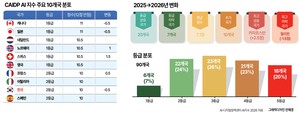
Since 2020, the Center for AI and Digital Policy (CAIDP) has published the CAIDP AI Index, the most comprehensive assessment of national AI policy and practices, grounded in democratic values and fundamental rights. From the outset, two East Asian nations have consistently ranked at the very top of the global standings: Japan and South Korea. That two neighboring countries have charted meaningfully different paths toward the same destination — AI governance — carries significant implications for how the world responds to the challenge. In 2021, then-Minister of Science and ICT Lim Hye-sook announced that South Korea had been rated a Tier 1 country in the CAIDP AI Index. By the time CAIDP released its 2026 edition, however, Japan had retained its Tier 1 status while South Korea dropped to Tier 2 for the first time. One significant factor in Japan's continued standing was its signing of the Council of Europe's AI convention — the first international AI treaty addressing human rights, democracy and the rule of law. This shift should not be read as a negative verdict on South Korea's AI governance record. The country has, after all, passed landmark AI legislation — a critical achievement. The change is better understood as a signal that AI policy is a highly dynamic field and that countries must move beyond declaratory commitments to actual implementation. More important is the question of why both nations have held top positions in the CAIDP AI Index for so long, and what lessons the rest of the world can draw from them. What CAIDP Measures and Why It Matters The CAIDP AI Index does not measure AI model performance, investment volume or the number of semiconductor chips a country produces. It is original research analyzing the policies and commitments of 90 countries against a methodology grounded in democratic values — alignment with the UNESCO Recommendation on the Ethics of AI, commitment to human rights, algorithmic transparency, meaningful human oversight, public participation in policymaking, and engagement in international governance. In short, CAIDP asks: does a country treat AI governance as a matter of public responsibility, or merely as a question of industrial strategy? Japan: Consistency as Strategy Japan's standing is the result of deliberate, multi-year positioning at the intersection of innovation and governance. When Japan held the G7 presidency in 2016, it became the first country to bring AI governance onto the global stage. Current Prime Minister Takaichi Sanae, then a minister, introduced the AI governance agenda at G7 meetings — a discussion that ultimately led to the OECD AI Principles, adopted in 2019. Japan also led the Hiroshima AI Process during its 2023 G7 presidency, an international framework for governing advanced AI systems that CAIDP has explicitly cited as a meaningful contribution to global governance architecture. Japan enacted the AI Promotion Act in 2025. The legislation deliberately preserves a light-touch regulatory framework, requiring developers and service providers to adopt AI governance frameworks and ensure their systems are fair and safe, but without mandating specific compliance methods or imposing strong sanctions for violations. This soft-law-first approach can leave gaps in individual protection and carries less enforcement weight than the EU AI Act — particularly for foreign companies operating in Japan. At the same time, it aligns well with Japanese corporate culture's emphasis on safety and compliance. The CAIDP AI Index recognizes Japan's consistent engagement with international norm-setting bodies — G7, OECD, UNESCO and the Council of Europe — and its demonstrated role in building multilateral AI governance. Korea: Landmark Legislation South Korea's story in this period is more instructive. In December 2024, the National Assembly passed the AI Basic Act with broad bipartisan support — a remarkable achievement. The law took effect in January 2026, making South Korea the second jurisdiction in the world, alongside the EU, to enforce a comprehensive AI regulatory framework. The act is architecturally ambitious, folding three distinct policy levers — national strategy, industrial promotion and risk regulation — into a single framework. It establishes a National AI Strategy Committee and an AI Safety Institute, mandates human rights impact assessments for high-risk AI systems, and imposes transparency obligations on generative AI outputs. The CAIDP AI Index values such policy vision while continuing to assess whether algorithmic transparency, contestability and independent oversight mechanisms to enforce AI-related rules are present in practice. CAIDP also urges the South Korean government to sign and ratify the Council of Europe's AI convention. The Shared Foundation Japan and South Korea share a quietly remarkable common ambition: both have declared aspirations to lead global AI. Japan aims to become the world's most AI-friendly nation, while South Korea has set its sights on joining the United States and China as one of the world's top three AI powers. What separates them is method. Japan is betting on leadership in international rulemaking, broader AI adoption across its economy, and autonomy in decision-making, operational capability and negotiating power — what Japanese policymakers call "AI sovereignty." South Korea, by contrast, is investing heavily in owning the full AI stack end-to-end, a model it calls "Sovereign AI." Despite this difference in approach, the two countries share a governance DNA. Both treat fairness, safety and trustworthy AI as core legal values. Both have established AI safety institutes that engage with global counterparts on evaluation standards and risk assessment, and both are investing in long-term institutional capacity rather than short-term regulatory performance — precisely what CAIDP rewards. Both have engaged substantively with the UNESCO Recommendation on the Ethics of AI and participate actively in multilateral AI governance. Most importantly, both governments understand that the benefits and prosperity AI promises are not automatic, and that trust lies at the heart of social acceptance. Neither has fallen into the Big Tech narrative that AI regulation is at odds with innovation. They recognize that AI cannot diffuse deeply into an economy if citizens and consumers remain uneasy or concerned about its impact. A Lesson for Other Countries The trajectory of Japan and South Korea through the CAIDP AI Index offers a clear lesson for policymakers and researchers: governance credibility is earned through real action, not simple announcements. We live in an era when public concern about AI's impact on daily life is growing steadily — when college graduates boo commencement speakers who tell them to simply embrace AI, and when CEOs insist that AI's supremacy is inevitable. People want agency. They want to understand AI better, to see its benefits distributed fairly, to hold companies accountable, and to trust that governments will put guardrails in place to protect their rights, opportunities and livelihoods. Two Roads to the Top: South Korea and Japan's AI Governance Trajectories in the CAIDP AI Index Since 2020, the Center for AI and Digital Policy (CAIDP) has published the CAIDP AI Index — the most comprehensive analysis of national AI policy and practices, with a particular focus on democratic values and fundamental rights. From the outset, two East Asian nations have occupied the very top of the global rankings: Japan and South Korea. That two neighboring countries chart meaningfully different paths to the same destination is a striking signal about the global response to AI governance. In 2021, then-Minister of Science and ICT Lim Hye-sook announced that the CAIDP Index had ranked South Korea as a Tier 1 country. By the time CAIDP released its 2026 edition, Japan had retained its Tier 1 status while South Korea moved to Tier 2 for the first time. One significant factor in Japan's continued ranking was its signing of the Council of Europe's AI treaty — the first international AI convention addressing human rights, democracy and the rule of law. This difference is by no means a negative assessment of South Korea's AI governance achievements. The country has, after all, passed landmark AI legislation — a critical achievement. The change should be read more as a signal that AI policy is highly dynamic and that countries need to move from commitments to implementation. What matters more is why these two countries have remained at the top of the CAIDP AI Index for so many years, and what lessons the rest of the world can draw from them. What CAIDP Measures and Why It Matters The CAIDP AI Index is not a measure of AI models, investment volume or the number of chips a country produces. It is original research analyzing the commitments and policies of 90 countries. The index evaluates national AI policies and practices against a methodology grounded in democratic values: alignment with the UNESCO Recommendation on the Ethics of AI, commitment to human rights, algorithmic transparency, meaningful human oversight, public participation in policymaking, and engagement in international governance. In short, CAIDP asks: does a country treat AI governance as a matter of public responsibility, or merely of industrial strategy? Japan: Consistency as Strategy Japan's position is the result of deliberate, multi-year positioning at the intersection of innovation and governance. In 2016, when Japan held the G7 presidency, it became the first country to bring AI governance to the global stage. Current Prime Minister Takaichi Sanae, then a minister, introduced the AI governance agenda at G7 meetings — an initiative that ultimately led to the OECD AI Principles, adopted in 2019. During its 2023 G7 presidency, Japan led the effort to establish the Hiroshima AI Process, a landmark international framework for governing advanced AI systems that CAIDP has explicitly cited as a meaningful contribution to global governance architecture. Japan enacted the AI Promotion Act in 2025. The legislation deliberately preserves a light-touch framework, requiring developers and deployers to adopt AI governance frameworks and ensure their systems are fair and safe, but without prescribing specific compliance methods or imposing hard sanctions for non-compliance. This soft-law-first stance can leave gaps in protecting individuals and provides fewer enforceable obligations than the EU AI Act — particularly for foreign companies operating in Japan. Yet it also aligns with the safety- and compliance-oriented culture of Japanese business. The CAIDP AI Index recognizes Japan's consistent engagement with international norm-setting bodies — G7, OECD, UNESCO and the Council of Europe — and its demonstrated role in building multilateral AI governance. Korea: Landmark Legislation South Korea's story in this period is more instructive. In December 2024, the National Assembly passed the AI Basic Act with overwhelming bipartisan support — a remarkable achievement. The law took effect in January 2026, making South Korea the second jurisdiction in the world, alongside the EU, to enforce a comprehensive AI regulatory framework. The act is architecturally ambitious, folding three distinct policy levers — national strategy, industrial promotion and risk regulation — into a single framework. It establishes a National AI Strategy Committee and an AI Safety Institute, mandates human rights impact assessments for high-impact AI systems, and imposes transparency obligations on generative AI outputs. The CAIDP AI Index values such policy vision while continuing to assess whether algorithmic transparency, contestability and independent oversight mechanisms to enforce AI-related rules are present in practice. CAIDP also urges the South Korean government to sign and ratify the Council of Europe's AI convention. The Shared Foundation Japan and South Korea share a quietly remarkable common ambition: both have declared aspirations to lead global AI. Japan aims to become the world's most AI-friendly nation, while South Korea's goal is to rank among the top three AI powers alongside the United States and China. What separates them is method. Japan is betting on leadership in international rulemaking, deeper AI adoption across its economy, and autonomy in decision-making, operational capability and negotiating power — what Japanese policymakers call "AI sovereignty." South Korea, by contrast, is investing heavily in owning the full AI stack end-to-end, a model it calls "Sovereign AI." Despite this difference in approach, Japan and South Korea share a governance DNA. Both treat fairness, safety and trustworthy AI as core legal values. Both have established AI safety institutes that engage with global counterparts on evaluation standards and risk assessment, building institutional capacity that CAIDP rewards because it reflects long-term commitment rather than regulatory theater. Both have engaged substantively with the UNESCO Recommendation on the Ethics of AI and participate actively in multilateral AI governance. Most importantly, both governments understand that the promise of AI benefits and prosperity is not automatic, and that trust lies at the heart of social acceptance. Neither has fallen into the Big Tech narrative that AI regulation is at odds with innovation. They understand that AI cannot diffuse deeply into an economy if citizens and consumers remain uneasy or concerned about its impact. A Lesson for Other Countries The trajectory of Japan and South Korea through the CAIDP AI Index offers a lesson for policymakers and researchers: governance credibility is earned through real action, not simple announcements. We live at a time when survey after survey shows growing public concern about AI's impact on daily life — when college graduates boo commencement speakers who tell them to simply embrace AI, and when CEOs insist that AI's supremacy is inevitable. People want agency. They want to understand AI better, to see its benefits distributed fairly, to hold companies accountable, and to trust that governments will put guardrails in place to protect their rights, opportunities and livelihoods.
June 4, 2026
-
[Editorial] With exports nearing $1 trillion, Korea must sustain its semiconductor edge and industrial innovation
South Korea's exports are surging on the back of a semiconductor boom. According to the Ministry of Trade, Industry and Energy, exports reached $87.75 billion in May, the highest monthly figure on record. After breaking the $80 billion monthly threshold for the first time in March, exports have exceeded that mark for three consecutive months, and the daily average export value surpassed $4 billion for the first time. The cumulative trade surplus for January through May stood at $101.9 billion, already exceeding the previous annual record of $95.2 billion set in 2017. At this pace, annual exports of $1 trillion are within reach. Semiconductors have been the driving force. Semiconductor exports jumped 169.4 percent year-on-year in May to $37.16 billion, setting an all-time monthly record. The surge reflects explosive demand for HBM, DRAM and NAND flash as American and Chinese tech giants race to invest in AI infrastructure. Computer exports also climbed more than 290 percent, driven by rising demand for AI server SSDs. The semiconductor boom has more than offset headwinds from the war in the Middle East and the spread of protectionism, firmly anchoring South Korea's export performance. Semiconductors have long been regarded as a cyclical industry, but the AI revolution has transformed their standing. Global tech giants are signing multi-year supply contracts to secure HBM and high-performance memory chips for AI data centers. HBM in particular is designed and produced to each customer's specifications, making it difficult to replace once a supplier enters the supply chain. Meanwhile, the expanding use of AI across applications — AI agents, physical AI, self-driving cars and robots — means supply is struggling to keep pace with demand. Yet with semiconductors now accounting for more than 42 percent of total exports, excessive dependence warrants caution. The current surge in memory demand is underpinned by massive AI infrastructure investment from American and Chinese tech companies. Should that investment enthusiasm cool or profitability fall short of expectations, semiconductor demand will inevitably feel the impact. The challenge from Chinese memory makers is also a serious threat. CXMT and YMTC are rapidly expanding production capacity with government support and are set to begin full-scale mass production next year. If low-cost Chinese memory chips flood the market, the boom could quickly fade. This rare semiconductor moment must be channeled into broader structural reform and innovation across industry. R&D, talent development and industrial infrastructure must be accelerated to sustain Korea's commanding lead in HBM and AI semiconductors. Efforts are also needed to strengthen the competitiveness of next-generation growth industries — future mobility, batteries, biotech and robotics — to broaden the export base, while raising the technological capabilities of small and midsize enterprises. This is an opportunity for the Korean economy to make a genuine leap forward.
June 2, 2026
-
[Editorial] Rate hike grows more likely as inflation tops 3% — brace for the fallout
Consumer prices rose 3.1 percent in May, the sharpest year-on-year increase in two years and two months. A surge in global oil prices driven by the Middle East war pushed petroleum product prices up 24.2 percent — their highest level in three years and ten months — pulling the broader index higher. The gain in petroleum prices was the steepest since July 2022 (35.2 percent), early in the Ukraine war. After falling from 2.3 percent in December last year to 2.0 percent in January and February, the consumer price inflation rate climbed to 2.2 percent in March and 2.6 percent in April before jumping another 0.5 percentage point the following month. Bank of Korea Gov. Shin Hyun-song held the benchmark interest rate at 2.50 percent at his first Monetary Policy Board meeting after taking office on May 28, but signaled a rate hike in the second half of the year, saying the path forward was "relatively clear" whether one looked at prices, growth, the exchange rate or real estate. With consumer prices now above 3 percent, the prospect of an early rate hike — at the July board meeting — has grown considerably stronger. Beyond consumer prices, other key economic indicators are also building the case for a rate increase. Exports, the engine of South Korea's economic growth, have exceeded $80 billion for three consecutive months through last month, posting record highs. The won-dollar exchange rate, which hovered around 1,440 won in early May, has broken through 1,510 won, with the 1,500-won range hardening into a new normal. Housing prices have also been unsettled since the suspension of the capital gains tax surcharge on multi-home owners. Seoul apartment sale prices rose for four consecutive weeks through the fourth week of May. The stock market, which has extended its rally past the 8,700 mark, is another variable that could stoke inflation through improved consumer sentiment driven by the wealth effect. Household debt is at a dangerous level as well. Household loans reached a record 1,993 trillion won (approximately $1.32 trillion) at the end of March — the result of all-in borrowing to buy homes and debt-fueled stock investment. Speaking Monday at the 2026 BOK Conference at the Bank of Korea, Gov. Shin said in a conversation with European Central Bank Executive Board member Isabel Schnabel that "strong semiconductor exports have boosted the growth rate despite rising global oil prices, removing the dilemma associated with monetary policy." Rising global oil prices typically push inflation up while dragging growth down, often leaving central banks unable to raise the benchmark interest rate even as inflation concerns mount. This year, South Korea's semiconductor sector has cleared that obstacle. That is the backdrop to the Bank of Korea raising its growth forecast for this year from 2 percent to 2.6 percent. Even so, the downsides of a rate hike deserve careful attention. South Korea's household debt-to-GDP ratio stands at 89 percent, among the highest of any major economy. A one-percentage-point rise in lending rates would add 12.9 trillion won to households' annual interest burden. The impact on ordinary citizens, the self-employed and small-business owners would be especially severe. Policymakers must take care to ensure that across-the-board tightening does not deepen the financial hardship of the most vulnerable.
June 2, 2026
-

[Lee Hyung-seok column] Everyone returns to their place: Park Hae-young's world in 'We Are All Trying Here'
We live in an age when many people suffer from FOMO — Fear of Missing Out. It is the dread of being the one left behind, excluded from a group or an opportunity. Think of the embarrassment of playing tag late into the evening, only to realize your friends all went home without you. Or the bewilderment of arriving at school on what turns out to be a field trip day, finding the building empty. These are the kinds of situations most of us experienced or imagined in childhood — and they are the original template for FOMO. The feeling that you alone are falling behind. That everyone else is racing forward while you stand still. That other people's lives are working out while yours alone is tangled. That everyone else is in on something you were never told. As we grow older, the swamp of FOMO in our lives grows wider and deeper, and its blade cuts sharper. Evolution has designed the primate brain to experience pleasure and happiness in relative terms. Psychological and biological experiments have repeatedly confirmed a strong human tendency to prefer a world where nobody has anything over one where others have ten times as much as you. Giving up your own share simply because others receive more is not the "rational choice" of the "rational individual" assumed by classical economics. Modern behavioral economics, neuroscience and psychology have shown that people tend to be more sensitive to the relative size of rewards — happiness — than to the relative size of punishments — unhappiness. Stories circulate everywhere of dormant stock accounts suddenly hitting it big. Tales of someone making hundreds of millions of won, or tens of millions, in just a few months seem to come from every other household — except yours. In 2026, the stock market is the torrential source of FOMO. FOMO was rampant when housing prices soared and when Bitcoin surged, but not like this. Back then, it still felt like someone else's lucky story, something merely to envy from a distance. Now it has become a story of destiny — one in which you should have been the protagonist, and if you have not been yet, surely must become one starting now. The compulsion not to miss this fate. It was the Kospi's unprecedented surge over the past year that turned FOMO syndrome into everyday vocabulary for the entire nation, but it is really just a compressed, dramatic cross-section of the competitive meritocracy that has been steadily spreading and inflating throughout Korean society. Into this moment arrives writer Park Hae-young's drama series "We Are All Trying Here" (directed by Cha Young-hoon) — a work that offers comfort in the pandemic age of FOMO syndrome. The protagonist is Hwang Dong-man (played by Koo Kyo-hwan), a film director who has never made his debut while friends, seniors and juniors all thrive in the industry, leaving him steeped in jealousy. The series aired on JTBC twice a week for a total of 12 episodes from April 18 to May 24, and is available on Netflix. Characters fighting to prove their existence in 'We Are All Trying Here' Hwang Dong-man is a member of a group of eight people connected through the film world. Every other member has carved out a role — as a director, producer, executive or writer — but Hwang alone has never shot a debut feature, drifting from one part-time job to the next for 20 years. His constant complaints, grievances and sharp tongue make him a source of conflict wherever he goes, online or off, and virtually everyone tries to avoid him. Yet he finds someone who values him: Byeon Eun-a (Go Youn-jung), a film company producer who believes in his talent and individuality. Alongside the two leads, the drama places at its center Hwang's rival and embodiment of inferiority complex, director Park Gyeong-se (Oh Jung-se), and Park's wife and film company head Go Hye-jin (Kang Mal-geum). Woven into the story are Hwang's older brother Hwang Jin-man (Park Hae-jun) — a failed poet who works as a welder — top actress Oh Jeong-hee (Bae Jong-ok), who abandoned her young daughter Byeon Eun-a to pursue her own success, and Oh's stepdaughter, actress Jang Mi-ran (Han Sun-hwa). As the title suggests, every major character struggles in their own way to prove their existence and worth. It is a fight not to be erased — from other people's lives, from relationships, from the world. Hwang Dong-man cries out that his only goal is to make his debut and shed the label of "unemployed." If Hwang is a boxer who simply wants to climb into the ring and prove he is a fighter, Park Gyeong-se is a boxer who wants to stand in that same ring and show off his victories through box-office hits and critical acclaim. Their battles for recognition are just as desperate outside the ring. Hwang must become a brother his older sibling can be proud of. Park must prove he can succeed as a husband even without his wife as his producer. Go Hye-jin must be not only the producer behind director Park Gyeong-se but also the wife who inspires him. Byeon Eun-a must free herself from the curse of her estranged mother Oh Jeong-hee and a former lover — she must earn recognition as a producer and writer in her own right, not as the "ghost writer" hidden inside an ex-boyfriend director's screenplay. Oh Jeong-hee must hold on to her social success as a top actress while navigating her place as Jang Mi-ran's stepmother and Byeon Eun-a's birth mother. Hwang Jin-man must reclaim the daughter he lost by locking himself inside the castle of poetry, and prove he is a father. And both Byeon Eun-a and Jang Mi-ran must be convinced that they are someone's child — that they were not born unwanted. We are all walking bundles of emotion "When I look at people on the street, they're not just walking. They look like enormous bundles of emotion moving around. Every step, every expression is soaked in everything that person is feeling. Do you know what kind of emotional bundle Mom is? A bundle of contempt." These are the words Byeon Eun-a says to her birth mother Oh Jeong-hee's face — the greatest actress of her generation. Alongside "worthlessness," the other key word in this drama is "emotion." Hwang Dong-man and Byeon Eun-a each separately sign up for an experiment run by a technology company testing an "emotion watch," and only later discover that the other was also a participant. The emotion watch analyzes physical data — pulse, breathing, blood pressure, blood oxygen levels — and displays in real time what emotional state the user is in: joy, sadness, irritation, displeasure and so on. Negative emotions appear against a red background; positive ones against blue. Late in the series, during a psychiatric consultation arranged by the emotion watch company, Byeon Eun-a hears words that reveal another of the drama's central themes. The psychiatrist tells her that "the vividness of a story is made by emotion," and that "the moment a negative emotion is read accurately, it comes under control" — that it at least stops compounding delusion upon delusion and growing ever larger. "When emotion fades, the power of the story weakens," the doctor adds. The psychiatrist then advises Byeon Eun-a that she has spent so long practicing how to observe emotion through film and screenplays that she can now do it without the emotion watch, and encourages her to try reading her emotions on her own. Taken together, these lines suggest that "We Are All Trying Here" is a drama about learning to read one's own emotions accurately. If a person can "objectify" their feelings — Hwang Dong-man's jealousy toward successful peers, Byeon Eun-a's desire to punish the mother who abandoned her, Park Gyeong-se's inferiority complex that he is no different from the pathetic Hwang and succeeded only because of his wife — they can erase the "drama of the complex" that inflates inside the mind and ultimately swallows the self whole. Max Bennett, an AI entrepreneur and expert, explores the evolutionary origins of emotion in animals, primates and humans in his book on AI and neuroscience, "A Brief History of Intelligence," defining those origins as "avoidance" and "seeking." Emotion, he argues, arose from the survival instinct to avoid danger and find food. He therefore distinguishes the emotional traits inherited by modern humans from the earliest animal brains into "valence" and "arousal." Valence divides into positive and negative — good feelings and bad feelings. Arousal divides into high arousal, when the pulse quickens and muscles tense, and its opposite, low arousal. Most emotions thus fall into one of four quadrants formed by the intersection of positive or negative valence and high or low arousal. Excitement, happiness and elation, for instance, are positive valence and high arousal; contentment, calm and relaxation are positive and low; anxiety, tension and embarrassment are negative and high; and depression, sadness and boredom are negative and low. Ultimately, the drama suggests that "learning to read one's emotions accurately" means confronting the wounds and deficiencies within oneself. That is the first step toward escaping the complex — magnified by competition and comparison with others — and the private delusions that grow until they consume us. 'The landscape where everything returns to its place': solidarity and the recovery of community in Park Hae-young's world The feeling that everyone has gone somewhere and you alone are left behind. That others are far ahead while you stand frozen in place. Escaping this suffocating FOMO, alienation and sense of defeat is, paradoxically, something no one can do alone. Even looking inward at one's own wounds and deficiencies is a place one cannot reach in isolation. Every crisis originates in relationships, and healing and salvation must also come through relationships. Across her body of work — including earlier series "My Mister" and "My Liberation Notes" — Park Hae-young's dramas begin with characters in crisis: people struggling on the edge of elimination, failure and being left behind. In "My Mister," there was Park Dong-hoon (Lee Sun-kyun), passed over for promotion and betrayed by his wife, and Lee Ji-an (IU), cast to the very bottom of society. Park's brothers — the eldest (Park Ho-san), who took early retirement and is out of work, and the youngest (Song Sae-byeok), a film director whose debut turned out to be his last — were in the same position, as was Park's friend Gyeom-deok (Park Hae-jun), a monk who left his lover behind to enter the priesthood. In "My Liberation Notes," all three of the Yeom siblings (Lee El, Kim Ji-won, Lee Min-ki) are pushed to the margins at work and in love, ignored and overlooked. The Yeom family barely holds on at the far edge of Gyeonggi Province, far from Seoul. Their neighbor, known only as Gu (Son Suk-ku), is a man who fled Seoul in defeat and hides in the countryside, getting through each day on alcohol. The major male characters in Park's dramas tend to fall into one of two types: those who say almost nothing, and those who never stop talking. Park Dong-hoon, his monk friend Gyeom-deok, Gu and Hwang Dong-man's older brother Jin-man are men of few words. By contrast, Park's youngest brother, the youngest of the Yeom siblings, Hwang Dong-man and Park Gyeong-se cannot seem to keep their mouths still. Yet whether they are silent or voluble, they share one thing: they are, or were, beings on the verge of being pushed out of the world and falling. Anxiety and a sense of crisis drove some of them to shut their mouths entirely and others to pour out words without end. Their individual crises are also crises of relationships, of family and of community. Park arranges for her characters in crisis to reach out and support one another, so that each can stand their ground with greater strength. In this world — where, with the exception of Do Jun-yeong (Kim Young-min) in "My Mister," there are no absolute villains or saints — what ultimately sustains the individual, the family and the community is the goodness, friendship and compassion within each person. In Park's dramas, the positions characters occupy at the beginning and end of the story do not change dramatically. They are simply still standing there — but the self has grown, and the solidarity between people has deepened. In Park's world, adults ultimately fulfill the role of adults, the young the role of the young, parents the role of parents, children the role of children, siblings the role of siblings, and spouses the role of spouses. Everyone helps everyone else, and in the end each returns to their place and the community is restored. It is precisely the meaning captured in the lyrics of the song "Landscape" by the duo Siin and Chongjang: "The most beautiful landscape in the world — the landscape where everything returns to its place." Park's dramas typically trace with great delicacy the relationships between wounded, deficient individuals, moving toward an ending in which family and community are restored. Here, family and community represent the totality of relationships sustained across a shared time and place. Park offers remarkably creative characters and stories, yet in the end she reaffirms and re-establishes the values and structures of existing family and community — which makes her work less a text of social critique than a "conservative" one. If that is so, her dramas represent the most dignified and most creatively realized form of conservatism that popular art can achieve.
June 2, 2026
-
[Editorial] KEF says 'N% of operating profit' falls outside collective bargaining — government must set clear rules
The Korea Employers Federation recently sent a special advisory to its member companies, stating that union demands for performance bonuses tied to a fixed percentage of operating profit do not constitute a legitimate subject of collective bargaining. Citing Supreme Court precedent, the KEF said profit-sharing arrangements whose payment and scale vary with business performance do not qualify as wages, and that setting the criteria for distributing corporate earnings through a collective agreement falls within the domain of management judgment. Because the subjects of collective bargaining under the Trade Union Act are limited to working conditions — wages, working hours and welfare — the KEF argued that industrial action aimed at securing a share of operating profit also raises questions of legality. It marks the first time the business community has publicly challenged the "N% of operating profit" demands spreading across the industrial sector. The demands now coming from major conglomerate unions look markedly different from those of the past. Beyond wage increases and welfare expansion, unions are now asking for a direct share of corporate profits. After SK Hynix paid out performance bonuses worth hundreds of millions of won, Samsung Electronics agreed — following negotiations with its union — to use a portion of operating profit as a bonus pool, and the "N% of operating profit" demand has since spread across industry. The Kakao union secured the right to strike after demanding 13 to 14 percent of operating profit, while unions at HD Hyundai Heavy, LG Uplus and Kia are each demanding that 30 percent of operating profit be distributed as bonuses. The Hyundai Motor union has similarly called for 30 percent of net profit. That the compromise Samsung Electronics chose under the threat of production disruptions has now become a precedent is a regrettable development. The expansion of union demands into management prerogatives is not unrelated to the enactment of the so-called "Yellow Envelope Act" — the amendment to Articles 2 and 3 of the Trade Union Act. The revised law, which took effect in March, broadened the definition of employer and widened the scope for unions to demand bargaining over management decisions that affect working conditions. Unions are now pushing not only for a percentage of operating profit but also for veto power over business unit sales, direct negotiations with prime contractors, and advance consultations on AI adoption and the deployment of robots on production lines. The concern raised when the bill was passed — that the boundary between management judgment and working conditions would blur — has become reality. The encroachment on management rights and shareholder authority is substantial, and it risks chilling the autonomous decision-making companies need. Sharing the fruits of strong earnings with employees is both reasonable and necessary, but operating profit is also the source of investment for future growth. Companies cave to union demands to avoid the cost of strikes, and other unions then treat each settlement as a new floor from which to demand even more — a cycle that keeps repeating. This is not something the government can afford to leave alone under the banner of labor-management autonomy. It needs to set out clear standards defining what constitutes a legitimate bargaining subject and what falls within management judgment. Uncertainty and the cost of conflict on the shop floor will ultimately suppress investment and employment, and the burden will fall on the country's competitiveness.
June 1, 2026
-
[Editorial] Stock market and semiconductor booms widen inequality — reinvestment and broader asset access are the answer
The gap between high- and low-income households has widened further. In the first quarter of this year, the surplus income of top earners hit a four-year high, while the deficit of the lowest earners reached a record. These are the shadows cast by the semiconductor industry boom and the stock market rally. According to the National Statistics Portal, households in the bottom income quintile — the lowest 20 percent — posted a real monthly surplus of negative 438,000 won (about $291), the deepest deficit since the survey began in 2019. By contrast, households in the top quintile recorded a real monthly surplus of 3.445 million won, the highest for any first quarter since 2022. The Ministry of Statistics' household income and expenditure survey lays bare the deterioration in South Korea's income distribution indicators. Average monthly income for top-quintile households rose 4.2 percent year-on-year to 12.378 million won in the first quarter, while bottom-quintile households saw income grow just 2.7 percent to 1.17 million won. The equalized disposable income quintile ratio — a measure of how many times the top 20 percent's per-capita disposable income exceeds that of the bottom 20 percent — climbed to 6.59, up from 5.59 the previous quarter and the highest since the first quarter of 2020, when it stood at 6.89. A rising ratio signals worsening income distribution. The boom in semiconductors and advanced technology, driven by the spread of AI and surging investment, combined with the sharp Kosdaq rally, appears to be deepening income and asset inequality. The Ministry of Statistics attributed the worsening distribution indicators to holiday bonuses and performance pay disbursed in the first quarter, which disproportionately benefited top-quintile workers concentrated at large conglomerates. The extraordinary bonuses paid by Samsung Electronics and SK Hynix, and their ripple effect across related industries, suggest the income gap will widen further. Income figures also capture property income — from shares, deposits and real estate — meaning the Kosdaq surge will ultimately deepen the divide between upper and lower income groups as well. Government policy to prevent the self-reinforcing expansion of income and asset inequality is urgently needed. However, policymakers must not fixate on the short-term remedies of simply redistributing the fruits of growth or expanding welfare spending. Structural solutions are required. Reinvestment for sustained growth must be encouraged, and rigidity in the labor market must be dismantled. Through deregulation and labor market flexibility, the gaps in productivity and worker compensation across industries and firm sizes must be narrowed, and quality jobs must be created. Financial education, tax incentives and investment support should be expanded to give low-income households and young people greater opportunities to build assets, ensuring that the gains from capital market normalization and corporate revaluation are not captured by a privileged few. Growth without distribution leads to collective ruin; distribution without growth leads to division.
June 1, 2026
MOST READ
- 1Hyundai Mobis to develop robot semiconductors for Atlas humanoid
- 2Anpanman rolls out to all CJ Olive Young stores with limited-edition collabs from 30-plus brands
- 3Korean woman's mugshot goes viral in US after DUI arrest in Georgia
- 4‘Blockchain won’t replace banks — integration is the key‘: Bankfrick
- 5Theater actor Kim Hyun-i asks public to stop sharing her photos after mix-up with late stunt performer of same name
- 6Paper straws more harmful than plastic? Study finds 6 times higher cancer risk, double the acidification
-
WORLD
US warns of punishment for anyone enabling Iran's Strait of Hormuz toll scheme
-
INDUSTRY
Toyota union puts productivity first; Hyundai Motor union demands bigger share of profits
-
FINANCE
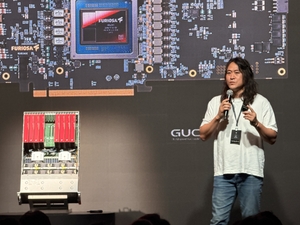
National Growth Fund to invest $531M in FuriosaAI, which rebuffed Meta's $800M takeover bid
-
INDUSTRY
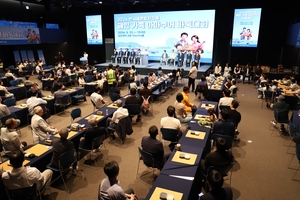
Korea Shipowners' Association holds amateur baduk tournament for Maritime Day