The Financial Services Commission and the Financial Supervisory Service on Thursday released the results of a special governance inspection of eight bank holding companies, focusing on problems surrounding chief executive officers — the chairs — and the outside directors who hold the power to appoint them. In every specific case cited, however, the regulators identified the companies only by letter codes such as "Holding Company A" or "Holding Company B."
For investors in bank holding companies, governance is a core basis for investment decisions. Which holding company had which problem is itself investment-relevant information.
Fortunately, the report is fairly detailed — it includes years, headcounts, amounts and dates. Cross-referencing the disclosures against corporate filings, news reports and National Assembly national audit materials allows a reasonable identification of the companies behind most of the letter codes. For investors, it amounts to a kind of exam.
What follows works through the report in quiz format, grouping questions by company. The questions are drawn directly from the regulators' report. The answers are reasonable inferences based on public records — they have not been confirmed by the regulators or the companies themselves.
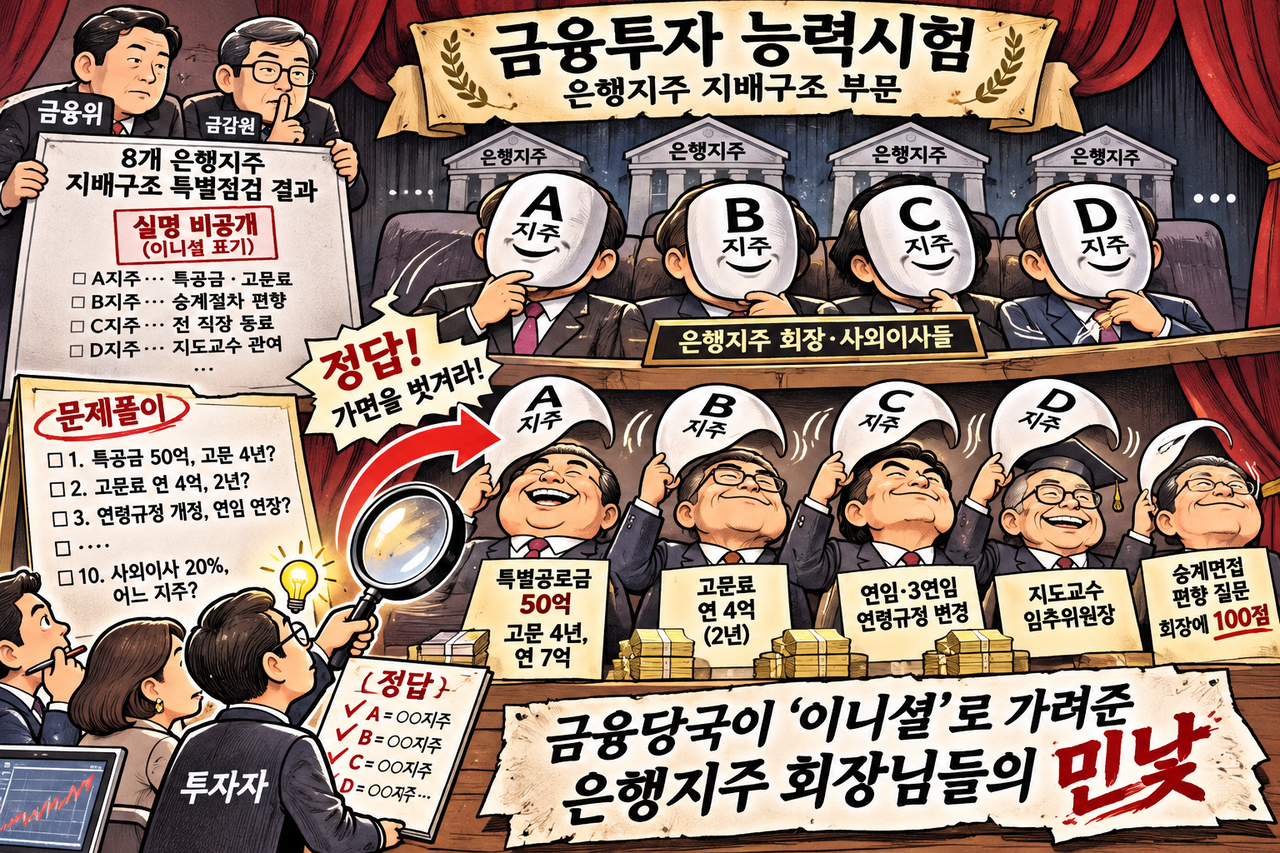
Bank holding company chairs: A financial investment aptitude test
Q1. Upon the retirement of its former chair, Holding Company A paid a large special merit bonus, then appointed him as an adviser — and for four years paid him an average of 700 million won per year without properly verifying his advisory performance. Which company is A? (Answer) Hana Financial Group (former Chair Kim Jung-tae)
Explanation: Hana Financial Group's 2022 annual report shows that Kim's total compensation that year was 4.28 billion won ($3.2 million). The report states that 2.5 billion won of his other income came from the first installment of a 5 billion won special merit bonus — approved by a shareholder vote in recognition of outstanding contributions during his tenure. His severance pay was listed separately at 420 million won.
Kim stepped down in March 2022 and continued as an adviser to both the holding company and the bank. Four years of advisory fees at 700 million won per year would amount to roughly 2.8 billion won through March 2026.
Q2. Holding Company B appointed its former chair as an adviser and paid an average of 400 million won per year over two years, but did not discuss or review whether extending the contract was appropriate. Which company is B? (Answer) KB Financial Group
Explanation: According to materials released Oct. 21 by the office of Democratic Party of Korea lawmaker Kim Yong-man, former KB Financial Group Chair Yoon Jong-kyoo's non-standing management advisory term runs from June 2024 to June 2026, with annual pay set at 400 million won — 80 percent of his base salary at the time of retirement. Both the two-year term and the 400 million won figure match the regulators' description exactly. Since 2023, KB Financial has appointed all 10 executives who retired from the holding company as management advisers within the group, with pay calculated by multiplying the base salary at retirement by a rate that varies by rank: 80 percent for the chair, 70 percent for vice chairs, and 50 to 60 percent for executive and senior vice presidents.
Q3. After launching its succession process, Holding Company A amended its internal governance rules the day before finalizing its long list of candidates — changing the maximum age for continued service and thereby extending the sitting chair's possible tenure. Holding Company B made the same type of age-limit change, also before its succession process began. Which companies are A and B? (Answer) A = Hana Financial Group (Chair Ham Young-joo), B = JB Financial Group (Chair Kim Ki-hong)
Explanation: On Dec. 2, 2024, Hana Financial amended its internal governance rules to change the tenure limit for a director who turns 70 while in office — from "until the first annual general meeting after that birthday" to "until the first annual general meeting after the current term ends." The amendment extended Ham Young-joo's possible tenure by one year, from March 2027 to March 2028. Ham was born in November 1956. The chair candidate recommendation committee finalized its long list the very next day. Assembly member Park Hong-bae noted at the Oct. 19 national audit that the amendment "was passed without prior notice, the day before the long list was announced."
JB Financial Group amended its internal rules in 2023 to allow a director who turns 70 during a term to complete that term. Chair Kim Ki-hong, born in 1957, was 68 when he secured a third consecutive term in March 2025; his current term runs through March 2028.
Q4. At Holding Company A, all newly appointed outside directors in 2023 were individuals recommended by the chair while still a chair-designate. One of them was later named chair of the executive candidate recommendation committee in 2025 and oversaw the chair's reappointment process. Which company is A? (Answer) BNK Financial Group
Explanation: Bin Dae-in was recommended as chair candidate in January 2023 and took office in March of that year. At the same March shareholder meeting, three new outside directors were appointed: Lee Gwang-ju, Kim Byeong-deok and Jeong Yeong-seok. Outside directors appointed in 2024 and 2025 came through external advisory firms. The 2023 cohort was the exception.
Outside director Jeong has served since March 2023 and became chair of the executive candidate recommendation committee in March 2025. The committee launched its succession process in October 2025 and on Dec. 8 recommended Bin as the sole candidate for another term.
Q5. At Holding Company B, an outside director was appointed who had been a senior official at an organization the chair had supported during his time as bank president, and who also headed a company that did business with the bank. This director immediately became chair of the outside director recommendation committee. At year-end, during the succession process, the director asked pointed negative questions of two competing candidates while giving the chair the highest score with no questions at all. Which company is B? (Answer) Shinhan Financial Group
Explanation: Among the holding companies that have an outside director recommendation committee and whose chair rose from the bank presidency, Shinhan Financial Group and iM Financial Group both fit the profile of appointing someone who immediately became committee chair. However, the description of that chair as "a senior official of an organization and head of a business" points more closely to Shinhan Financial Group. Outside director Yang In-jip served as CEO and chairman of Onicom and held positions including president of the 19th Korea Business Federation in Japan and vice chairman of the Korea-Japan Friendship Association. Chair Jin Ok-dong is a Japan specialist who served as head of the Osaka branch and president of SBJ Bank, and during his time as bank president from 2019 to 2022 had extensive ties to Korea-Japan exchange organizations. Shinhan Financial Group's corporate disclosures state that Yang has "no transactions with the company" — but that refers to the holding company. The Financial Supervisory Service's report refers to transactions with "the bank." Any transactions with Shinhan Bank would not appear in the holding company's disclosures.
Q6. At Holding Company C, an outside director who had worked alongside the chair at a previous employer chaired both the board and the executive candidate recommendation committee, leading the succession process for the chair's reappointment and third consecutive term. Which company is C? (Answer) JB Financial Group
Explanation: JB Financial Group's annual reports show that outside director Yu Gwan-u chaired the executive candidate recommendation committee for both of Chair Kim Ki-hong's reappointments. At a board meeting on March 28, 2024, Yu was again seated as board chair — giving one person control of both the board chairmanship and the candidate recommendation committee. Both Kim and Yu are alumni of the Financial Supervisory Service, where each rose to the rank of deputy governor.
Q7. During the initial selection of its chair, Holding Company D had the candidate's doctoral dissertation supervisor serve as chair of the executive candidate recommendation committee, overseeing the long-list selection and playing a partial role in the succession process. Which company is D? (Answer) iM Financial Group (formerly DGB Financial Group)
Explanation: Annual reports show that in the process to select Chair Hwang Byeong-u — a process that began in 2023 and concluded in 2024 — the chair of the candidate recommendation committee was outside director Choi Yong-ho, an emeritus professor at Kyungpook National University and the supervisor of Hwang's doctoral dissertation at the same university.
Q8. When appointing two outside directors, Holding Company A identified gaps in its board skill matrix but did not prioritize filling those gaps — instead appointing the two candidates put forward by the holding company's own support division. Both directors subsequently voted unanimously in favor of the chair's reappointment. Which company is A? (Answer) Woori Financial Group
Explanation: On Feb. 28, 2024, Woori Financial Group's executive candidate recommendation committee nominated two new outside directors: Lee Eun-ju, a professor of journalism and communication at Seoul National University, and Park Seon-yeong, a professor of economics at Dongguk University. The outside director who had served through 2023 and departed in 2024 was attorney Song Su-yeong — a legal expert whose seat was filled by professors of journalism and economics.
On Dec. 29, 2025, all seven outside directors on Woori Financial Group's executive candidate recommendation committee selected Chair Im Jong-ryong as the candidate for the next term.
Q9. Holding Company A required external candidates to submit a demanding succession application within five business days, causing most outside candidates to withdraw. Which company is A? (Answer) BNK Financial Group
Explanation: The chuseok holiday fell within the candidate application window set by the recommendation committee in October 2025, leaving only four effective business days. The external job posting went up just two days before the deadline. The Financial Supervisory Service conducted an on-site inspection of BNK Financial Group in January 2026.
Q10. The Financial Supervisory Service noted that while external recommendations account for a high share of the standing outside director candidate pool, the directors actually appointed tend to come from internal recommendations — and presented the table below. Which holding companies are A, B and C? (Answer) A = KB Financial Group, B = Shinhan Financial Group, C = Hana Financial Group

Explanation: The key to solving this question is working backward from the denominators. The "actually appointed" share equals the number of outside directors appointed through external recommendations divided by the total number of outside directors. A share of 22.2 percent implies 2 out of 9; 44.4 percent implies 4 out of 9; 14.3 percent implies 1 out of 7; and 71.4 percent implies 5 out of 7. Holding companies with nine outside directors are Shinhan Financial Group, Hana Financial Group and JB Financial Group; those with seven are KB Financial Group, Woori Financial Group, BNK Financial Group, iM Financial Group and NongHyup Financial Group.
KB Financial Group, the likely answer for A, is the only holding company where 100 percent of outside directors — every single one — came through external recommendations. Materials submitted to the National Assembly confirm that all seven current outside directors at KB Financial Group were first recommended by outside specialist firms.
Shinhan Financial Group, the likely answer for B, had 80.3 percent of its 2025 outside director candidate pool come from external specialist firms — matching the figure in the table down to the decimal point, according to Shinhan Financial Group's annual governance and compensation report.
Hana Financial Group, the likely answer for C, had four of its nine outside directors recommended by sitting outside directors at the time, and one identified by an internal support division. That leaves four appointed through external recommendations, or 44.4 percent.
Why the chair's seat is so coveted: three terms can mean hundreds of billions in pay
The regulators' findings show that a range of measures — difficult to characterize as transparent — were deployed to secure, retain and extend the tenures of bank holding company chairs. What makes the position worth such effort? As the CEO of a major banking group, the chair wields strong influence through personnel authority. Above all, the compensation earned during a term is substantial — and the longer the tenure, the larger it grows.
The Financial Supervisory Service's electronic disclosure system publishes the pay of executives and employees who receive 500 million won or more per year. Adding up only the disclosed figures tells the story.
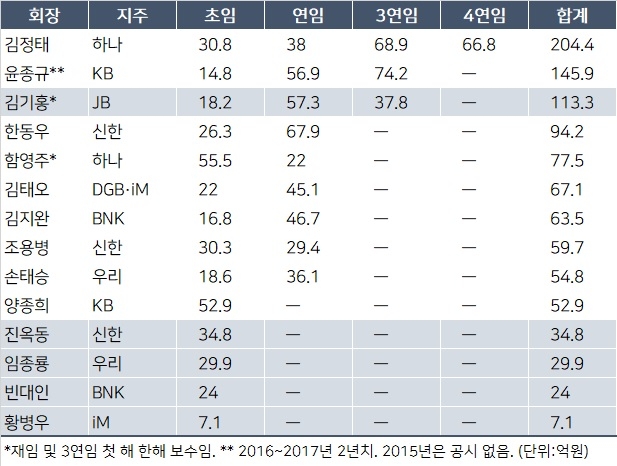
The longer a chair serves, the more compensation layers accumulate. Long-term performance bonuses tied to results three to four years out add considerably to the total. Even after retirement, merit bonuses and advisory fees continue. Financial regulators plan to require financial companies with assets of 2 trillion won or more to present and report individual executive pay plans to shareholders at annual general meetings. They also intend to pursue a clawback system for performance bonuses and broader disclosure of individual compensation.
In the Warring States period, there lived in the state of Qi a man named Zou Ji, who was quite confident in his own appearance. One day he asked his wife: "Who is more handsome — me, or Lord Xu who lives north of the city?" His wife naturally said her husband was. He asked his concubine the same question and received the same answer. A guest visiting the house also said Zou Ji was the more handsome. Then one day Zou Ji met Lord Xu in person and knew at once: "Ah — this man is far better looking than I am." He also understood why his wife, his concubine and his guest had answered as they did. "My wife said so because she loves me; my concubine said so because she fears me; my guest said so because he wants something from me." Zou Ji took this insight to King Wei of Qi as a remonstrance. The king offered rewards to those who would criticize him, and Qi grew strong. — Strategies of the Warring States, "Qi Strategies: Zou Ji Admonishes King Wei of Qi"
It remains to be seen what effect the remedies the financial regulators put forward will actually have.
kyhong@heraldcorp.com