In 1976, American social psychologist Donald T. Campbell made an unsettling discovery about government policy evaluation. His inquiry began with a deceptively simple question.
"If you measure performance with a number and reward people based on that number, how will they behave?"
The answer was telling. At first, people worked to improve actual performance. Over time, they shifted focus from the underlying goal to gaming the metric itself. Eventually, some took actions that directly undermined the original purpose — all in the name of making the number look better.
Campbell concluded that the more a quantitative indicator is used in social decision-making, the more it comes under pressure to be corrupted and the more likely it is to distort the very social process it was meant to measure. This is known as Campbell's Law.
A year earlier, in 1975, British economist Charles Goodhart reached a similar conclusion. When a central bank adopts a measure such as the money supply as a policy target, financial institutions change their behavior in ways that break down the existing relationship between that indicator and the broader economy. Goodhart's Law is commonly summarized as follows.
"When a measure becomes a target, it ceases to be a good measure."
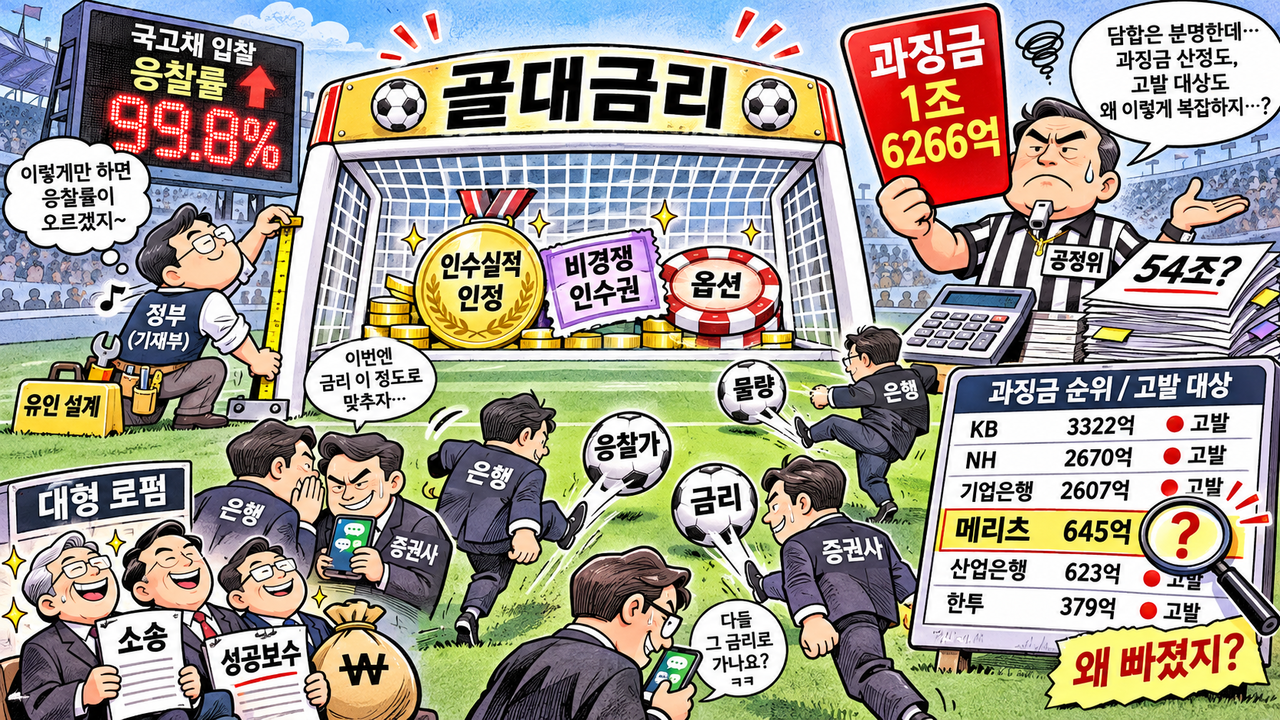
How the 'goalpost rate' was born — and why it rewarded collusion over competition
On June 11, 2009, the Ministry of Economy and Finance unveiled a plan to encourage financial firms to participate more actively in government bond auctions. The official then in charge of the government bond desk was Kim Jung-kwan, now the minister of trade, industry and resources. The bid-to-cover ratio for government bonds had fallen from 246 percent in 2002 to just 126 percent in the first four months of 2009. A low bid-to-cover ratio risks pushing up issuance rates and increasing the government's interest burden.
The solution was what became known as the "goalpost rate" system. Under the scheme, primary dealers that failed to win bonds at auction could still have their bids counted toward their performance record, provided they had submitted bids within 3 basis points — 0.03 percentage points — above the highest accepted rate. Like kicking a ball through the goalposts without scoring a direct hit, firms could earn credit for bids that fell just outside the winning range.
For example, if the highest accepted rate on a bond auction was 3.50 percent per annum, a financial firm that bid above 3.50 percent but no higher than 3.53 percent would receive partial performance credit even without winning any bonds.
Primary dealers accumulate performance scores based on their underwriting records, and higher ratings unlock greater benefits. The most valuable of these is the non-competitive purchase option, which allows a dealer to buy additional bonds at the highest accepted auction rate for up to three business days after the auction closes — within limits set by the volume actually underwritten and the dealer's rating. If bond prices rise in the interim, the option creates an opportunity for profit.
A goalpost-range bid alone does not automatically generate a non-competitive purchase option; actual winning bids are also required. But having unsuccessful bids counted toward the performance record can help a dealer achieve a more favorable rating and unlock greater incentives. In effect, bonds a firm never actually bought could translate into future economic benefits.
The key, then, was finding the goalpost — identifying where the final accepted rate would land. Knowing what rates rivals planned to submit was a clear advantage. The structure created conditions in which securing the non-competitive purchase option could become a more important objective than winning bonds outright.
Lucrative non-competitive options expanded further during COVID-19
The government's design appeared to work — at least on paper. The bid-to-cover ratio surged. From September 2009 through March 2010, the average ratio for five-year government bonds reached 223 percent, nearly double the 118 percent recorded in the same period a year earlier. Even then, some observers raised concerns that bids submitted purely to earn performance credit were artificially inflating the ratio.
When the COVID-19 pandemic hit, the government expanded the non-competitive purchase option limits from April 2020 to facilitate bond issuance. It extended the expansion temporarily in 2022 and kept the enlarged limits in place through the end of 2023. With the incentive structure around the goalpost rate and non-competitive options already in place, the value of those options grew even larger.
On Wednesday, the Fair Trade Commission announced it would impose a combined fine of 1.63 trillion won ($1.22 billion) on 15 banks and securities firms for colluding in government bond auctions — the largest penalty ever levied in a single case by the commission.
The commission found that in 150 of the 345 government bond auctions held between January 2020 and June 2023, competing firms had exchanged rate information or reached agreements. In 145 of those cases, it said, there was evidence of specific agreements on bid rates or volumes. Employees at financial firms exchanged rates by phone and messenger as late as one to two minutes before auction deadlines. In some instances, a rate was agreed upon in as little as five seconds. Firms even passed on contact information for rivals and instructions on how to exchange information when staff changed roles.
Estimating a competitor's likely rate is one thing; agreeing to coordinate rates is another entirely. If financial firms exploited a structural loophole for their own economic gain and went further by colluding, they cannot escape accountability. At the same time, the government that created the distorted goalpost rate system — and with it the incentive to collude — does not appear entirely free of responsibility either.
A record fine that raises more questions than it answers — and a windfall for law firms
The Fair Trade Commission does not emerge from this episode looking entirely beyond reproach, even after handing down the largest fine in its history.
The commission emphasized "artificial increases in accepted bond rates" and "losses to public finances," yet offered little detailed explanation of the extent of the harm or the specific basis for calculating the fine.
That leaves the appropriateness of the 1.63 trillion won penalty open to question. The commission calculated the relevant sales figure at around 54 trillion won, using the total value of government bond contracts awarded. It then applied a base rate of 4.5 percent and reduced the result by 30 percent to account for the special characteristics of the bond market and the uncertainty surrounding illicit gains.
Financial firms argue that treating the full value of bonds underwritten as equivalent to revenue or profit is unjustified. Underwriting 1 trillion won in bonds does not mean earning 1 trillion won. Actual profit depends on the price at which bonds are sold, funding costs, the holding period, hedging transactions and other factors. The economic benefit derived specifically from the goalpost rate mechanism also warrants separate calculation, they say.
In a 2012 case involving collusion in small-denomination bonds, the commission used operating profit from bond trading margins as the basis for its fine. In a case decided in January this year involving loan-to-value ratio collusion among four major banks, it used related interest income.
This case is different in that a special provision for calculating contract values in bid-rigging cases was applied. Even so, the commission owes a clear explanation of why using the full value of bonds underwritten as the calculation base is appropriate here.
The commission said it conducted a quantitative analysis of public finance losses attributable to the collusion during the review process, and that investigators had produced estimates of the rate impact. The full commission ultimately concluded, however, that those figures could not be determined with sufficient precision.
Imposing a fine does not require pinning down the exact profit from collusion or the precise loss to public finances — deterrence is as much a purpose of penalties as recovering illicit gains. Even so, a fine of record-breaking scale demands a credible explanation of what facts underpinned the calculation and how uncertainty was factored in.
Courts have previously ruled in bid-rigging cases that while using contract value as the basis for a fine is permissible, a final penalty disproportionate to the severity of the violation may run afoul of the principle of proportionality.
The sanctioned firms are expected to pursue litigation. Major law firms will be involved, and former Fair Trade Commission officials now in private practice stand to benefit substantially. If success fees are tied to the size of any reduction in the fine, the initial penalty figure directly affects what law firms stand to earn. The less transparent the fine calculation and the scarcer the information, the more firms may feel compelled to spend on legal challenges. One has to wonder: if the revolving door between the commission and private law firms did not exist, why would so many former commission officials head there?
Meritz Securities — which hired a former bond chief — escapes criminal referral
The criteria the commission used to decide which firms to refer for criminal prosecution also warrant a clearer explanation.
Meritz Securities was fined 64.56 billion won in the case but was not among the firms referred to the Serious Crimes Investigation Agency. Korea Development Bank and Korea Investment Securities, which received smaller fines, were referred. Samsung Securities and Shinhan Securities are understood to have received leniency reductions for self-reporting, and Daishin Securities for cooperating with the investigation, though the commission has not officially confirmed the leniency status or reduction levels for individual firms. The reason Meritz Securities was not referred for prosecution has not been explained.
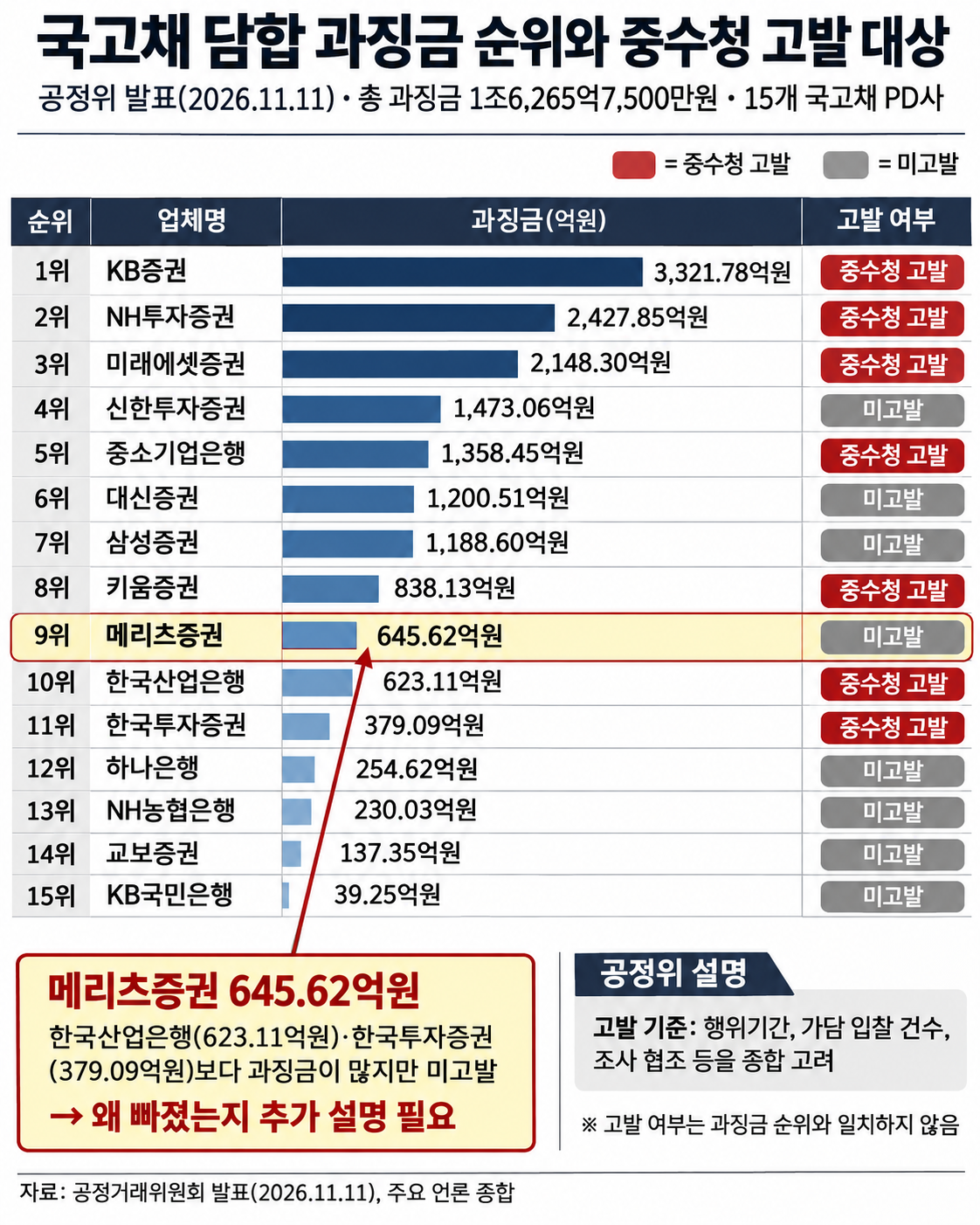
The commission said only that it weighed the degree of involvement, the duration of participation and cooperation with the investigation. The size of a fine and a decision to refer for criminal prosecution need not be strictly proportional. But if that is the case, the commission should explain what distinguished Meritz Securities from the firms that were referred.
The question sharpens given that in August this year, Meritz Financial Group hired Kwak Sang-hyun, a former head of the government bond division at the Ministry of Economy and Finance, as a managing director. Kwak took charge of the bond division after the collusion covered by the commission's findings had already begun, and oversaw government bond policy during the period when the commission's investigation was under way.
There is no evidence of any connection between that hire and the decision to exclude Meritz Securities from criminal referral. But when the fairness of a sanction is open to question, the commission would do more to dispel suspicion by explaining its reasoning in detail than by staying silent.
The K-Bond messenger is not the problem — the conduct is
Some have tried to shift blame for the episode onto the over-the-counter bond market's reliance on messenger platforms.
K-Bond, the messaging platform used in over-the-counter bond trading, was built and is operated by the Korea Financial Investment Association, a self-regulatory body. Conversations on the platform are logged. Overseas markets similarly rely on phone calls and platforms such as Bloomberg and Reuters for trading communication.
The Korea Financial Investment Association launched a predecessor platform called Prebond in 2010, shortly after the goalpost rate system was introduced, and rebuilt it as K-Bond in 2017. The association's messenger is not a simple chat application — it is market infrastructure designed to provide real-time bid and transaction data and to support trade negotiations among market participants. The problem is not the messenger but what it was used for. Conflating a tool that facilitates trading with the act of coordinating auction bids among competitors is a category error.
Bid-to-cover ratio rose after goalpost rate benefits were trimmed
The period of collusion the commission identified runs from January 2020 to June 2023. That raises an obvious question: was there truly no similar conduct in the decade from 2009 to 2019? Concerns about the system inflating bid-to-cover ratios were raised as early as 2010, pointing to a structural problem that predated the commission's findings. It is not obvious that collusion can be ruled out before 2020.
After the commission's investigation began in June 2023, the government announced reforms that gave greater weight to actual underwriting performance. From 2024, it normalized the non-competitive purchase option limits that had been expanded during the pandemic and raised the bonus points awarded for actual underwriting from three to nine. The average bid-to-cover ratio consequently rose from 271 percent in 2023 to 321 percent in 2024. It eased to 267 percent in 2025 but remained well above the levels seen in 2009. Even after trimming some benefits and rewarding actual underwriting more heavily, demand at government bond auctions did not weaken.
Yanying and Zigong
Yanying, the chief minister of the state of Qi during the Spring and Autumn period, traveled to the state of Chu as an envoy. The king of Chu, seeking to mock him, had a man from Qi who had been caught stealing brought before them and asked:
"Are people from Qi naturally inclined to steal?"
Yanying replied:
"A tangerine grown south of the Huai River is a tangerine. Grown north of it, it becomes a bitter orange. A man who did not steal when he lived in Qi steals when he comes to Chu. Is it not the soil of Chu that turns men into thieves?"
This is the story of the tangerine and the bitter orange, recorded in the Yanzi Chunqiu.
The Lüshi Chunqiu offers an equally instructive tale about Zigong, a disciple of Confucius.
At the time, the state of Lu had a policy of reimbursing anyone who ransomed a fellow citizen from slavery in a foreign land. Zigong, who was wealthy, ransomed a man from Lu but declined to accept the reimbursement.
Confucius rebuked him:
"From now on, the people of Lu will no longer ransom their countrymen."
Declining the payment might seem admirable in the moment. But if people less wealthy than Zigong felt ashamed to accept reimbursement, fewer would bother to ransom enslaved compatriots at all.
Confucius was not asking whether it was right or wrong to accept payment for a good deed. He was asking how that payment — or its absence — would shape the behavior of others going forward.
The warnings that Campbell and Goodhart issued were already understood by Eastern sages more than two millennia earlier.
kyhong@heraldcorp.com