
- HOME
- OPINION
'Family restructuring' rattles corporate Korea: the art of inheritance and divorce
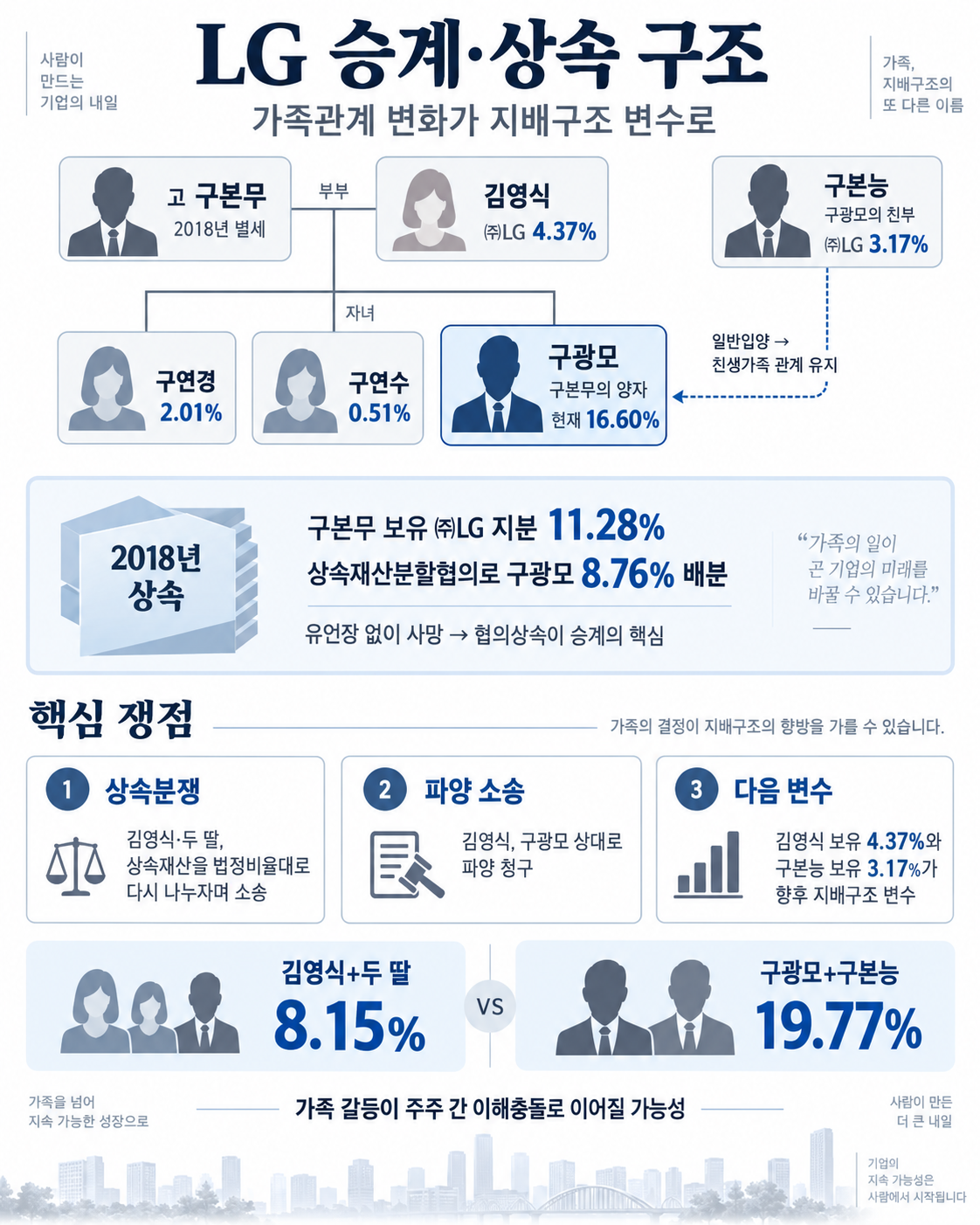
Inheritance is something most people face at least once in their lives, and long-marriage divorces are growing more common. Both carry major consequences for personal assets and household finances. Through landmark legal battles involving LG Group, SK Group and Smilegate, this column examines how family restructuring affects wealth — and why it can become a corporate governance issue for ordinary investors. The Wall Street Journal recently reported that Americans aged 55 and older hold assets worth $110 trillion — signaling that the largest wealth transfer in history is set to unfold over the coming decades. South Korea appears to be on a similar trajectory. According to Supreme Court data, the number of inheritance-division cases rose roughly 4.7-fold, from 771 in 2014 to 3,612 in 2025. South Korea recorded 88,000 divorces in 2025, down 3.3 percent from the previous year. Yet divorces in which both spouses were 60 or older numbered 13,743, accounting for 15.6 percent of the total. Particularly notable: divorces after 30 or more years of marriage made up 17.7 percent of all cases — the single largest group. As couples who have spent longer accumulating assets account for a growing share of divorces, the scale of property division is likely to grow as well. When a family is restructured, the effects ripple through to assets. At the corporate level, those effects can reach ordinary investors. What happens inside another family can become an event that moves your own portfolio. Several high-profile lawsuits involving business families have recently drawn public attention: the divorce and property-division case between SK Group Chairman Chey Tae-won and Noh So-young, director of Art Center Nabi, widely dubbed the divorce of the century; an inheritance dispute and adoption-dissolution suit within the family of LG Group Chairman Koo Kwang-mo; and the divorce and property-division case between Smilegate founder Kwon Hyuk-bin and Lee Hwa-jin. Wills are where inheritance begins — and inheritance-division agreements must be airtight LG Group has practiced eldest-son succession since its founding, with family decisions channeling controlling stakes to the designated heir. Under current law, however, being named an heir does not automatically entitle a person to all — or even a larger share — of an estate. A will can concentrate shares in the heir's hands, but it cannot fully extinguish the rights of other heirs: spouses and children hold a statutory right to claim their reserved portion, known as the "yuilbun." Corporate succession therefore requires more than a will. It demands coordination with other heirs, lifetime restructuring of shareholdings, and advance preparation of the financial resources needed to fund the transfer. This is why so many companies invest heavily in building a succession framework well before it is needed — and why the LG Group case offers instructive lessons. The succession picture at LG Group came into focus in 2004, when Koo Kwang-mo was adopted by then-Chairman Koo Bon-moo. Yet no shares changed hands at that point. Koo Bon-moo died in 2018 without leaving a legally valid will. The surviving immediate family members then reached an inheritance-division agreement, allocating 8.76 percent of the 11.28 percent stake in LG Corp. that Koo Bon-moo had held to Koo Kwang-mo. An inheritance-division agreement is a powerful instrument: when all co-heirs consent, assets can be distributed in proportions that differ from the statutory default — including concentrating a company's shares in a single heir. The catch is that such an agreement cannot be legally locked in before the inheritance opens. This is precisely why it matters to set out a basic framework in a will and to align family members thoroughly while still alive. In 2023, however, Koo Bon-moo's wife, Kim Young-sik, and their two daughters filed a suit to recover their inheritance, arguing that the division agreement had been flawed and seeking to redistribute the estate according to statutory ratios. A court of first instance ruled in Koo Kwang-mo's favor in February, finding that the agreement had been validly executed and that no fraud had occurred. The three women appealed. The final outcome remains to be seen, but the rift within the family already appears severe. Suits to strip inheritance rights or dissolve adoption can block reserved-portion claims In 2024, Kim filed a suit to dissolve her adoptive relationship with Koo Kwang-mo. Even if the dissolution were granted, it would not affect the already-established father-son relationship between Koo Bon-moo and Koo Kwang-mo. The real issue is Kim's 4.37 percent stake in LG Corp. As long as the legal mother-son relationship remains intact, Koo Kwang-mo stands as an heir to Kim's estate. Even if Kim were to leave a will bequeathing her shares solely to her two biological daughters, Koo Kwang-mo could still invoke his reserved-portion right and claim the monetary value of his statutory share. A will can set the direction of an inheritance, but it cannot erase an heir's rights entirely. Under current law, the primary mechanism for stripping inheritance rights is the inheritance-right forfeiture system. For adoptees, dissolution of adoption is another avenue. The two are distinct legal instruments, but the grounds required — such as a serious breach of the duty of support or grossly unjust treatment — overlap considerably. Inheritance-right forfeiture can also be pursued through a notarized will in which the deceased expresses the intent to disinherit, with the executor petitioning the court after death; but in either case, a court ruling is required. Even when a relationship has broken down in practice, ending it in law is a separate matter. From Koo Kwang-mo's perspective, avoiding dissolution of the adoption is essential to preserving his status as an heir to Kim's estate. Could the inheritance dispute shake LG Corp.'s ownership structure? Although Koo Kwang-mo was adopted by Koo Bon-moo, his legal relationship with his biological father, Koo Bon-neung — chairman of Heesung Group — remains intact. General adoption in Korea does not sever ties with the birth family. Koo Kwang-mo therefore retains inheritance rights over Koo Bon-neung's estate as well. Koo Bon-neung has a remarried spouse and a daughter from that marriage. While other assets — including Heesung Group shares — could pass to the spouse or daughter, LG Group's tradition of eldest-son succession suggests that the 3.17 percent stake in LG Corp. directly tied to group control is likely to go to Koo Kwang-mo, who is already the group's chairman. Kim and her two daughters together hold 8.15 percent of LG Corp. — well short of the 19.77 percent held by Koo Kwang-mo and Koo Bon-neung. Barring losses in both lawsuits, a decisive blow to Koo Kwang-mo's control appears unlikely. That said, if Kim and her daughters were to dissolve their current status as a jointly acting group of specially related persons and exercise their voting rights independently, the controlling shareholder's combined stake could fall to around 35 percent. Long marriages, long contributions: higher property-division ratios for homemaking and child-rearing The property-division case involving Smilegate founder Kwon Hyuk-bin is easier to understand when compared with the SK Group case. Looking at recent court rulings, when a spouse's contributions through homemaking and child-rearing over a long marriage are broadly recognized, there is a considerable likelihood that a division ratio exceeding one-third will be awarded. In the Chey Tae-won and Noh So-young case, the division ratio was set at roughly 67 percent to 33 percent — a figure reached even though Noh's direct contribution to business management was not recognized. The first-instance ruling in the Kwon Hyuk-bin and Lee Hwa-jin case came in at 65 percent to 35 percent. Lee's role in the company's early days and her contributions through homemaking and child-rearing were acknowledged, yet the 35 percent figure stands out. A divorce trial is also currently under way in New Jersey involving John Overdeck, co-founder of hedge fund Two Sigma, and his wife Laura. Overdeck proposed a settlement of $723 million, but Laura's side has argued that his stake in Two Sigma is worth approximately $6.2 billion and is seeking 35 percent of that — about $2.17 billion. The couple married in 2002 and have three children; Laura is a full-time homemaker. No less important than the division ratio is the question of when a share's value is assessed. In contested divorce proceedings, the standard reference point is in principle the state and value of assets at the close of oral arguments before the fact-finding court. In the retrial of the Chey Tae-won and Noh So-young case, SK Group's share price rose sharply afterward, but the value of SK shares was calculated based on the closing date of oral arguments in the appellate court in April 2024. For unlisted companies with no market price, enterprise value is assessed using financial statements, valuation methods under the Inheritance and Gift Tax Act, and discounted cash flow analysis, among other approaches. The company's earnings and financial position in the relevant year are therefore critical. When a divorce suit is filed — and when it concludes — can make a substantial difference to the outcome. Cash settlement beats receiving physical assets for the receiving spouse Yet there is an issue even more consequential than the ratio or the valuation date: the form of the property division itself. In the Chey Tae-won and Noh So-young case, a cash settlement was chosen. Noh's side requested cash, and the court — taking into account that the SK shares were the basis of management control — ordered a cash settlement. In the Kwon Hyuk-bin and Lee Hwa-jin first-instance ruling, by contrast, the court ordered the actual Smilegate shares to be divided. The fact that Smilegate is an unlisted company is also a significant distinction. For the receiving spouse, a cash settlement is generally the cleaner outcome. A properly executed divorce property division is in principle exempt from gift tax and capital gains tax. Receiving cash means there is no need to liquidate the asset afterward. For the spouse who must pay, however, the costs can be substantial. For Chey Tae-won to pay Noh 944 billion won ($705 million), he would need to raise cash by selling shares or through dividends. Any taxes arising in that process fall on Chey. To generate 944 billion won after tax through dividends alone — applying the top marginal rate on general financial income as a rough estimate — would require pre-tax dividend income of close to 1.9 trillion won. Selling shares would attract tax only on the capital gain rather than the full proceeds, and at a lower rate, but the tax burden would still be considerable. In short, a cash settlement is the cleanest outcome for the recipient but can be the most expensive for the payer. Receiving shares in kind, on the other hand, avoids a large immediate tax bill — but it also means inheriting the latent tax embedded in those shares. When an asset received through property division is later disposed of, the capital gain is in principle calculated using the original acquisition price paid by the transferring spouse. If Lee were to receive Smilegate shares and later sell them, the tax calculation would start from the price at which Kwon originally acquired those shares. If those shares were acquired at a low price at the time of founding, the enormous accumulated unrealized gain would come along with them. Unlisted shares also cannot easily be sold on the open market. Shares may be worth taking if they carry management control The calculus changes, however, if receiving shares means gaining management control as well. What Lee sought at the first-instance level was a 50 percent stake in Smilegate, arguing that she should be recognized as a co-founder. When the court chose an in-kind share division rather than a cash settlement, the economic significance of that 50 percent figure grew considerably. Even a 35 percent stake is powerful enough to block special resolutions — such as amendments to the articles of incorporation or mergers. At 50 percent, however, neither party could independently control the company, creating effective joint control or deadlock. The negotiating leverage when selling to a third party would also be far greater than with a 35 percent minority stake, and there would be room to discuss a control premium. Ultimately, restructuring a family means restructuring its assets — all the more so when that family owns a business. Ownership structure, management control, and the asset value of ordinary shareholders all become variables in play. In inheritance, the key questions are who receives which assets and how. In divorce, they are how jointly built wealth is valued, when that valuation is set, and what form the division takes. Through this process, a family relationship may end — but a shareholder relationship may be just beginning.
Hong Kil-yong Sept. 14, 2026
-
![[Herald Forum] Integrated care: a shield for residents in a super-aged society](https://wimg.heraldcorp.com/news/cms/2026/09/11/news-p.v1.20260911.ad4374d01df94280b89f8d42374fc354_T1.jpg?type=h&h=240)
[Herald Forum] Integrated care: a shield for residents in a super-aged society
Weaving together medical, health, long-term care, welfare and residential resources So people can live healthy, dignified lives where they already call home More than 4,000 people died alone across South Korea in 2024 — a 7.2 percent increase from the previous year, according to a Ministry of Health and Welfare survey on solitary deaths. Gyeonggi Province recorded the highest toll of any region, with 894 solitary deaths. The problem is no longer confined to individuals and their families. It is a question that confronts all of us: when someone needs care, how does the community reach out? Most older adults want to spend their final years at home, receiving care in familiar surroundings. According to the National Health Insurance Service, nearly eight in 10 people — 79.7 percent — prefer to receive end-of-life care at their own residence. Even when medical help is urgently needed, the deep wish is to remain in the home and community one knows. Integrated care was created to answer that wish. The system does not simply deliver medical, health management, long-term care, welfare and residential services in isolation — it connects them into a single, unified framework. It identifies residents who need help early, matches services to each person's health condition and living environment, and enables people to continue living where they are, as healthily and stably as possible. That is the essence of integrated care. The operational framework links public health centers, medical institutions, long-term care facilities, welfare agencies and the National Health Insurance Service in close coordination. It is designed so that when local government provides the backbone and the community participates, a care network that residents can genuinely feel takes shape. Integrated care is especially urgent in mixed urban-rural municipalities such as Yangpyeong-gun, Gapyeong and Yeoncheon. All three lie within the greater metropolitan area, yet as of June 2026 more than 34 percent of their populations are aged 65 or older — Gapyeong at 34.8 percent, Yeoncheon at 34.4 percent and Yangpyeong at 34.1 percent. More than one in three residents is an older adult, placing all three firmly in super-aged territory. At the same time, medical and welfare resources are scattered across townships and villages, and access to services varies depending on where people live and their circumstances. Integrated care is the solution these communities need most, precisely because it weaves medical, long-term care and welfare services into a tight, connected whole. Yangpyeong-gun held township-by-township training sessions for its community safety networks to coincide with the enforcement of the Integrated Care Support Act on March 27. A dedicated organizational unit was established to drive the initiative forward, and staffing was reinforced in July. The goal is not simply to add one more layer of assistance — it is to establish integrated care as the core care system that protects residents' lives. Experience so far has made one thing clear: integrated care cannot be completed by any single institution acting alone. Closing the gaps in care requires a system in which the whole community looks after one another and extends a hand at the moment it is needed. South Korea has already entered a super-aged society, and an even more deeply aged future is unavoidable. But we must not allow anxiety about care — or death in solitude — to be accepted as an inevitable fact of life. Every citizen, no matter how old or how ill, deserves to live a healthy and dignified life in the place they have always called home. People-centered integrated care, I believe, can be the solid foundation that opens a better future for us all. By Jeon Jin-seon, Yangpyeong-gun county chief
Sept. 11, 2026
-
![[Biz Insight] Why thinking of health as an asset pays off](https://wimg.heraldcorp.com/news/cms/2026/09/04/news-p.v1.20260904.3e208b0a752744d1980044bf6464a2f2_T1.jpg?type=h&h=240)
[Biz Insight] Why thinking of health as an asset pays off
It goes without saying that health is among the most valuable things a person can have — regardless of age or gender. Young people spend considerable sums chasing what is sometimes called "healthy pleasure" — the desire to live well and feel good. Middle-aged and older adults with greater spending power dream of anti-aging and slower aging. As the body's homeostasis, immunity and resilience naturally decline with age, that aspiration is entirely understandable, and the industries built around it will only keep growing. Good habits in exercise, sleep and diet — along with a sound mental state — are equally essential. Health means more than the absence of disease; it is a condition in which body and mind are both functioning well. Intangible in itself, health becomes tangible when expressed through physical vitality. At that point, it acquires the clear character of an asset. Understanding precisely why health has asset value makes it easier to appreciate that value more deeply — and motivates the effort needed to maintain and expand it. That makes framing health this way a genuinely useful exercise. In business, assets are resources with economic benefit deployed in operating and investment activities. They are funded by equity and borrowed capital — and health, it turns out, has its own equity component and its own debt element. The equity component is the health built through one's own efforts on top of favorable genetic factors. It is generally defined as the product of sound habits in exercise, sleep and diet. The debt component is the ill-health that erodes that equity — stemming from unfavorable genetics as well as obesity, stress and poor habits. It must be offset through fitness activities, regular checkups, treatment, health supplements and insurance. These draw down assets and reduce equity. Applying the concept of opportunity cost to health makes the framework even clearer. The money and time spent maintaining good health represent an opportunity cost — resources that could have gone toward income-generating activities but did not. Everyone accepts this trade-off. Health, thus understood, is recorded in the ledger of the body and kept ready for use. Once health is lost — when liabilities become excessive — recovery can be difficult even with heavy investment. The resources consumed in that effort are also sunk and gone. This leads to a clear insight: protecting your health while you are still healthy is the most valuable thing you can do. It also spares you the heavy costs and losses that poor health demands. Health is not only spent on pleasure and the satisfaction of desires — it also builds wealth through work and other productive activity. When that capacity is exchanged in the market, it generates added value as well. In practice, a recent survey found that a large majority — 76.1 percent — view the economic evaluation of health positively. Respondents said that assessing health as an asset would help with health management. The survey was conducted by Seoul National University Hospital in July.
Sept. 5, 2026
-
![[SPECIAL CONTRIBUTION] Build a 'K-defense chain' linking materials, components, AI and MRO](https://wimg.heraldcorp.com/news/cms/2026/09/01/news-p.v1.20260901.5f01dfde2a474065bf1c5e62c3167fcc_T1.jpg?type=h&h=240)
[SPECIAL CONTRIBUTION] Build a 'K-defense chain' linking materials, components, AI and MRO
The recent rise of South Korea's defense industry has been remarkable. From tanks and self-propelled artillery to missiles, aircraft and warships, Korean weapons systems are earning high marks in global markets. Yet the industry cannot afford to rest on its current success. For K-defense to grow into a sustainable national core industry, the focus must shift from how many finished products can be exported to how strong a defense ecosystem can be built. The first priority is rebuilding the supply chain needed to advance weapons systems. Cutting-edge weapons require rare earth elements, rare metals, high-purity materials and semiconductors. For South Korea, a country poor in natural resources, shifts in the international order or resource controls imposed by specific countries can quickly translate into production risks for the defense sector. Defense exports and resource security must therefore be bound together as a single strategy. When selling weapons to countries that hold strategic resources — rare earths, copper, tungsten, lithium — South Korea should use strategic countertrade arrangements to secure long-term resource supply rights and joint development opportunities. Existing offset agreements should also evolve beyond technology transfers and local production into "resource offsets" that lock in access to the partner country's strategic materials. The hardware base must be broadened as well. A truly powerful defense nation is not simply one that excels at assembling finished products. Research and development investment in advanced components — sensors, radar, semiconductors, electro-optics, communications, engines and specialty materials — must be expanded, and the barriers keeping small and medium-sized enterprises, venture firms, universities and research institutes out of the defense sector must be decisively lowered. Software matters even more. The outcome of future warfare will be decided by AI, data, software and command-and-control systems. Relying on foreign technology for these capabilities cannot be called true defense self-reliance. South Korea must build a "sovereign defense" AI and software system it controls entirely on its own, connecting defense AI, battlefield data, command-and-control networks (C4I), cloud infrastructure and cybersecurity into a single integrated ecosystem with its weapons systems. The export model must change as well. Rather than selling weapons alone, South Korea should export a full package: weapons systems plus AI and command-and-control, education and training, logistics support, maintenance, repair and overhaul (MRO), and continuous performance upgrades. I call this the "K-defense chain" — a strategy that links hardware and software, defense exports and resource acquisition, local production and MRO, and performance upgrades with follow-on weapons procurement. Ultimately, it is a strategy that turns a single export contract into a 30-year market. Achieving this requires pan-government prioritization and focus. A national strategy to expand the K-defense base — one that brings together not only the Ministry of National Defense and the Defense Acquisition Program Administration but also the industry, science and technology, and diplomacy sectors alongside companies, universities and research institutes — must be drawn up without delay. The Ministry of National Defense in particular must make a clear-eyed judgment about the priorities of the era. The world is locked in fierce competition over AI, unmanned systems, space, cyber capabilities and critical minerals. At such a moment, administrative energy and public attention should not be squandered on unproductive debates such as the integration of military academies. The ministry must direct its full capacity toward deciding what will sustain South Korea's military strength and defense industry over the next 20 to 30 years. If the first act of K-defense was the miracle of building excellent weapons, the second act must be the challenge of connecting and leading the global defense ecosystem. South Korea must leap beyond being a country that sells finished products to one that exports supply chains, technology, software and MRO alongside them. Now is the time to build the K-defense chain. Chae Woo-seok is chairman of the Korea Defense Industry Association.
Sept. 1, 2026
-
![[Expert Column] Where is Korea's robot industry headed?](https://wimg.heraldcorp.com/news/cms/2026/08/26/news-p.v1.20260825.43b4a1266dd44f049ea0637dfc799be4_T1.jpg?type=h&h=240)
[Expert Column] Where is Korea's robot industry headed?
A serious question demands an answer: Where does Korea's robot industry stand today, and where is it going? The 2026 World Robot Conference (WRC), the world's largest robot festival, ran in Beijing from Aug. 19 to Aug. 23. Co-organized by the Chinese Institute of Electronics and the World Robot Cooperation Organization, the event has grown well beyond a simple technology exhibition into a large-scale convergence platform encompassing forums, displays and competitions. The global robot industry on show there was innovating at a pace that exceeded all expectations. Most striking was the remarkable progress of humanoid robots. Having moved past the stage of merely walking or carrying objects, service-oriented humanoid robots equipped with emotion-recognition and interactive capabilities were engaging with the public in an approachable way. It was clear that humanoid robots have evolved beyond the general-purpose technology phase and are rapidly advancing toward practical deployment across specific industries — homes, factories, logistics and services. Industrial robots performed precision micro-processes faster and more accurately than ever in ultra-precise assembly, welding and machining automation. Smart logistics systems centered on autonomous mobile robots and automated guided vehicles evolved into hybrid AMR configurations integrated with humanoid robots, pushing logistics automation to new levels of completeness. Medical and healthcare robots spanning surgery, rehabilitation, nursing and elderly care are also working their way deeper into daily life. A comprehensive ecosystem of hardware components — actuators, sensors and machine vision systems — was on display under one roof. Witnessing the world's finest robot technologies from more than 1,240 exhibiting companies left me with feelings more complicated than mere alarm. As someone working in the same industry, I came away with four observations about what Korea's robot sector must do to survive and advance in this intensely competitive landscape. First, broaden the base of robots as culture, not just industry. The point is to make robots familiar and accessible to the general public. From the moment I joined the queue at the exhibition entrance, I was struck by interest in robots cutting across every age group — children, the elderly and everyone in between. WRC felt less like an industry event and more like a national festival. Unlike Korea, where interest in robotics depends largely on those already working in the field, China has built a cultural foundation in which society as a whole takes an interest in and feels affection for robot technology. This is a reminder that Korea needs to cultivate a "K-robot culture" — one that lets the public experience robots in everyday life and feel close to them. Walking a robot dog, listening to music, laughing and enjoying time with a humanoid robot — these are not scenes from the future. They are already reality abroad. Second, nurture talent defined by knowledge and capability, not just numbers. Korea has established and is implementing roadmaps across AI, robotics and semiconductors. Achieving genuine results will require structural changes in how talent is developed. Autonomy must be guaranteed for schools, research institutions and companies receiving government support — but that autonomy must be backed by tangible outcomes if it is to create the virtuous cycle that drives growth across the entire robotics ecosystem. Specifically, two types of talent are needed. One is a hardware-software convergence specialist capable of operating ROS2- and Linux-based robot operating systems, implementing control algorithms, designing high-density mechatronics suited to humanoid robots, analyzing the kinematics and dynamics of multi-joint robots, and handling thermal management and durability-focused structural design. The other is an AI specialist versed in reinforcement learning-based motion control, reasoning based on vision-language models and large language models, multimodal perception, and physical AI dynamics modeling. Robots and AI are incomplete without each other. The two talent pools must be brought together to research and grow on a single platform. Third, Korea needs a bold expansion of its global cooperation network. Domestic robot policy has until now placed excessive weight on development while remaining relatively passive about cooperating with global institutions in core materials, components, modules and software. Given the gap that currently exists between Korea and leading nations, multifaceted cooperation with pioneering institutions and companies in the United States, China and Japan is not optional — it is essential. The government must also offer far more generous support and incentives to domestic companies that actively participate in global supply chains and partner with overseas institutions. Nurturing domestic companies matters, but support that comes too late is not investment — it is waste. Expanding through global cooperation, growing the technology and industry base, and achieving economies of scale are the most urgent priorities for Korea's robot industry right now. Fourth, a deployment strategy for a field-ready "Korean-style humanoid robot" is also needed. Deploying humanoid robots directly and comprehensively on manufacturing floors still faces technological and cost constraints. The realistic path is to integrate humanoid robots with existing automation equipment and allow them to gradually take over some of the tasks currently handled by industrial robots. The field data accumulated through that process should then serve as the foundation for evolving toward fully autonomous humanoid robots — expanding from single tasks to complex ones, and ultimately to manufacturing-specialized humanoid robots capable of independently assessing conditions on the floor. There is no need to despair over other countries' robot ambitions. Korea may lag behind some nations in the foundational humanoid market, but it possesses a world-class manufacturing base along with outstanding process management systems such as manufacturing execution systems (MES) and warehouse management systems (WMS). When those strengths are linked with humanoid robots, the competitive advantage becomes formidable. Korea's manufacturing robot density is in fact the highest in the world at 1,220 units per 10,000 workers, according to the International Federation of Robotics' World Robotics 2025 report. That means Korea leads the world in the capacity to put robots to work. It will likely take a few more years before humanoid robots become fixtures on factory floors, in homes and across the service industry. Put another way, Korea still has time to prove its robot competitiveness. But it cannot afford to wait. Robots are no longer a technology of the future. They are a core growth engine that will determine national competitiveness. A clear policy direction from the government, bold ambition and cooperation from industry, and genuine public interest can make Korea a robot powerhouse.
Aug. 26, 2026
-
![[Biz Insight] Industrial ecosystem urgently needs trickle-down from excess profits and tax revenue](https://wimg.heraldcorp.com/news/cms/2026/08/24/news-p.v1.20260820.0b14ff4022b24da4b5d73402d7a892a9_T1.jpg?type=h&h=240)
[Biz Insight] Industrial ecosystem urgently needs trickle-down from excess profits and tax revenue
The semiconductor boom has set the stage for record-breaking bonus payouts at major conglomerates. National tax revenue in the first half of this year is projected to rise 33 trillion won ($23.5 billion), or 17.4 percent, from a year earlier. Beyond semiconductors, power equipment and HVAC companies have also seen their earnings swell. Much of this windfall traces back to aggressive AI data center investment by US hyperscalers locked in a race for AI dominance. The enormous spoils have drawn the attention of every corporate stakeholder group, with employees and government ministries each making little secret of their competing calculations. Left out of this feast, however, are the dozens to thousands of small and medium-sized materials, parts and equipment suppliers embedded in semiconductor, robotics and power supply chains. When excess profits materialize, executives and employees at large conglomerates collect performance bonuses, the government enjoys a surge in tax revenue, shareholders receive higher dividends, and local communities and consumers see some benefit as well. The contribution of supplier firms deserves recognition too. They operate in ordinary commercial relationships with parent companies — receiving payment in exchange for goods — but those relationships are sustained over long periods, creating a special interdependence. That sustained tie gives rise to a legitimate claim to compensation beyond the contract price, tied to the parent company's excess profits. Global competition is no longer a contest between individual firms; it has become a contest between supply chains and ecosystems. The outcome of the coming AI revolution will be decided not by one or two large conglomerates but by the quality of the ecosystem as a whole. The government's three mega-projects — 800 trillion won for semiconductors, 550 trillion won for data centers and more — have signaled over 1,500 trillion won in investment over the next decade. Yet semiconductors, physical AI and data centers are not isolated islands. That investment can translate into productivity and competitiveness only when materials, parts and equipment suppliers, along with power equipment, cooling systems, robot sensor and software companies, are connected through evenly developed capabilities. Sustaining the gains of the AI revolution as broad-based national economic growth for future generations will require the trickle-down effect of large conglomerates' performance to actually reach the wider ecosystem. The problem is that trickle-down is slow, and channels must be actively opened. For the time being, distributing large conglomerates' excess profits to contributors within the related ecosystem is not straightforward. Collective resistance from shareholders and employees is to be expected. At a minimum, excess tax revenue could be put to meaningful use as "patient capital" — directed at materials, parts and equipment firms in semiconductors, AI and robotics, particularly technology-focused small and medium-sized enterprises. Such suppliers must commit enormous capital to research and development, equipment and personnel well before orders arrive from large conglomerates. That leaves them chronically strained in terms of capital strength, liquidity and creditworthiness. Loan delinquency rates offer a telling indicator of this strain. As of the end of May this year, the delinquency rate on commercial bank loans to small and medium-sized enterprises stood at 1.00 percent, the highest in 11 years — nearly four times the 0.27 percent rate for large-company loans. Financial institutions can be expected to tighten their risk management further in response. A promising mechanism exists for channeling patient capital to technology firms: policy guarantees. Unlike direct subsidies, policy guarantees strengthen a company's creditworthiness to attract private funding. Institutions such as the Korea Technology Finance Corp., the Korea Credit Guarantee Fund and regional credit guarantee foundations play exactly this role. When excess tax revenue flows to policy guarantee institutions, their funds are reinforced. Excess profits from large conglomerates could also be channeled into those funds in the form of donations. Policy guarantees are generally analyzed to carry a multiplier effect of close to tenfold. "When assessments focus primarily on financial condition, technology firms have very few options for improving their liquidity," a venture industry official said. "Evaluating technological and business viability as the basis for guarantees is a realistic way to build patient capital and let the trickle-down effect of excess profits reach supplier firms as well."
Aug. 24, 2026
-

The hidden logic behind SK hynix's W40tr buyback and Samsung's W30tr dividend
SK hynix raised 40 trillion won through an ADR offering just over a month ago and has now announced a 40 trillion won share buyback and cancellation — a governance constraint means canceling shares is required before more ADRs can be issued. Samsung Electronics chose a 30 trillion won special dividend instead of a buyback, a structure that benefits the tax positions of major shareholders Samsung Life Insurance and Samsung Fire, as well as Samsung C&T. Both companies have pledged shareholder returns tied to free cash flow, but future capital expenditure guidance remains opaque — making the actual payout hard to predict. SK hynix, which raised 40 trillion won ($28.7 billion) in the United States through an American depositary receipt offering just over a month ago, has announced it will buy back and cancel 40 trillion won worth of its own shares. Samsung Electronics will distribute 30 trillion won in cash to shareholders first, with an additional 60 trillion to 80 trillion won in returns planned for the first half of next year. It is an unprecedented windfall, made possible by the AI semiconductor boom. Shareholders have every reason to welcome the news. But tracing the flow of money reveals the distinct corporate logic — rooted in each company's governance structure — at work behind the decisions. For SK hynix, the key variables are its ADR program and share price. For Samsung Electronics, they are the ownership stakes of its financial affiliates and the tax implications of different payout methods. Both companies have anchored their shareholder return pledges to free cash flow, but that figure contains an unknown that most investors cannot easily calculate. Beneath the shared label of "shareholder returns," two very different capital strategies are operating. SK hynix: issuing high, canceling low Start with SK hynix. The confirmed commitment is a 40 trillion won share buyback and cancellation. Just over a month ago, the company issued new shares to list ADRs in the United States — also at 40 trillion won. The stated purpose of that capital raise was domestic capital expenditure. After the ADR issuance, a large volume of dollar selling and currency-hedging flows entered the foreign exchange market, reversing a sharp rise in the won-dollar rate — a move analysts described as the "SK hynix effect." A significant portion of the dollars raised has likely already been converted to won or hedged. That is not to say the ADR proceeds are being directly used to fund the buyback. Money is fungible. But had SK hynix not issued the ADRs, the 40 trillion won needed for domestic capital expenditure would have had to come from existing cash, future earnings or borrowing — leaving that much less available for shareholder returns. The company's overall cash flows need to be viewed together. A question worth asking: SK hynix's ADRs currently represent about 2.5 percent of total shares outstanding. Will that stay the same? TSMC's ADRs account for 20 to 25 percent of its total shares. SK hynix faces a structural constraint on issuing more ADRs. Under the Fair Trade Act, SK Square — the holding company — must hold at least a 20 percent stake in listed subsidiary SK hynix. Last month's ADR issuance diluted SK Square's stake to just above that 20 percent threshold. To issue additional new-share ADRs, SK Square's ownership ratio must rise. That can happen either by SK Square buying more SK hynix shares, or by SK hynix buying back and canceling its own shares to reduce the total number outstanding. Share prices typically fall on new issuances and rise on buybacks and cancellations. If ADRs trade at a premium to the domestic shares, issuing new shares in the United States at a higher price and then retiring existing shares at a lower price domestically is economically attractive — not arbitrage in the classic sense, but a capital restructuring that effectively exploits the price gap between the Korean and US markets. Last month's ADRs were issued at the equivalent of about 2.24 million won per share. With SK hynix's domestic shares currently trading at around 1.66 million won, buying back the same number of shares on the market would cost roughly 29.5 trillion won — a simple price difference of more than 10 trillion won. If the full 40 trillion won is deployed rather than just enough to match the number of ADR shares issued, SK hynix could end up canceling more shares than it created through the ADR offering, depending on where the share price moves. Once the cancellation raises SK Square's ownership ratio again, room opens up for another ADR issuance. As long as ADRs continue to trade at a premium to domestic shares, SK hynix has a meaningful economic incentive to raise additional capital in the United States. If the company were to raise its ADR ratio toward TSMC's level, this cycle of issuance and cancellation could repeat several times over the coming years. There is no evidence that SK hynix decided on this buyback with additional ADR issuances in mind. But whether the company uses the window that the buyback and cancellation reopens is worth watching. Samsung Electronics: dividends offer a tax edge for affiliated shareholders Samsung Electronics said it will pay a 30 trillion won special dividend before the end of this year, with an additional 60 trillion to 80 trillion won in shareholder returns planned for the first half of next year after this year's accounts are settled. This is not a new commitment — it fulfills the existing 2024–2026 shareholder return policy of distributing 50 percent of free cash flow. Still, by providing an estimated payout figure for this year's performance, Samsung was more specific than SK hynix, which offered no projected return amount for the current year. Samsung's choice of a special dividend over a share buyback also draws attention. The market had expected Samsung to favor dividends because of the so-called "10 percent rule" under the Financial Industry Capital Act. If Samsung were to buy back and cancel its own shares, the combined stake held by financial affiliates Samsung Life Insurance and Samsung Fire could exceed the legally permitted 10 percent ceiling. In March, when a previous round of Samsung share cancellations raised that possibility, both companies preemptively sold about 1.5 trillion won worth of Samsung Electronics shares. That explanation has merit, but it is not the whole story. If the combined stake exceeds 10 percent, the excess can simply be sold at a gain. Depending on timing, Samsung Life Insurance and Samsung Fire could end up selling Samsung Electronics shares that Samsung Electronics itself then buys back as treasury stock. The same shareholder return does not produce the same economic outcome for everyone. From a purely tax perspective, dividends are more favorable for Samsung Life Insurance and Samsung Fire than selling shares triggered by a cancellation. Under current corporate tax law, 30 percent of dividends received by a corporation holding less than a 20 percent stake in another domestic corporation is excluded from taxable income. Both Samsung Life Insurance and Samsung Fire hold less than 20 percent of Samsung Electronics, so both qualify for this treatment. Setting aside other tax adjustments and applying the top corporate tax rate plus local income tax for 2026, a simple calculation shows that 70 percent of a dividend is taxed at 27.5 percent — meaning roughly 19.25 won in tax for every 100 won received. By contrast, selling Samsung Electronics shares would subject the capital gain — the sale price minus the tax-basis acquisition cost — to a combined corporate and local income tax rate of up to 27.5 percent. Samsung Life Insurance and Samsung Fire acquired their Samsung Electronics shares a very long time ago, meaning their tax-basis acquisition cost is far below the current share price. A substantial portion of any sale proceeds would therefore constitute a taxable capital gain. That said, Samsung Life Insurance faces other variables — including obligations to participating policyholders — so tax alone cannot determine which option is more advantageous. For individual investors, the calculus runs in the opposite direction. Retail shareholders in domestically listed stocks generally pay no tax on capital gains, but dividends are taxable. Combined with other interest and dividend income, annual financial income exceeding 20 million won can trigger comprehensive financial income taxation. Samsung Electronics said its board will decide in January on the method and scale of returns — whether cash dividends, share buybacks and cancellations, or a combination. How that decision is made, and what role the interests of the controlling shareholder and related parties play in shaping it, will be worth examining closely. 50 percent of FCF? Without investment guidance, it's a black box SK hynix said it will raise its shareholder return target from "up to" 50 percent of three-year cumulative free cash flow to "at least" 50 percent. Samsung Electronics described its latest payout as fulfilling its pledge to return 50 percent of FCF. Whether the commitment is "at least 50 percent" or exactly "50 percent," what matters is the actual figure — and that figure is difficult to calculate. FCF is the cash left over after a company subtracts capital spending on factories and equipment from its operating cash flow. How much a company earns matters, but FCF swings sharply depending on how much it invests. Past investment figures can be verified through cash flow statements. The problem is the future. Without disclosure from the company, outsiders have no reliable way to know how much will be invested going forward. The companies have provided the return ratio — but one of the key variables in the equation is missing. US companies commonly provide annual or forward-year capex guidance as a range when reporting earnings. The reason hyperscalers' AI investment has become a central market variable is precisely that they update their investment guidance with every earnings release — and revise it when plans change. Investors use that information to recalculate future FCF and shareholder return capacity. Compared with major US technology companies, neither SK hynix nor Samsung Electronics provides sufficient quantitative forward capex guidance. Both describe investment direction and capacity expansion plans, but neither consistently discloses year-by-year investment figures at a level of detail that would allow investors to project future FCF. If a company ties its shareholder return policy to FCF, the transparency of its investment guidance needs to match that commitment. Over the past two years, SK hynix generated 83 trillion won in operating cash flow and spent about 43 trillion won — roughly 52 percent — on acquiring tangible and intangible assets. Samsung Electronics generated 158 trillion won in operating cash flow over the same period and invested about 99 trillion won, or 63 percent. By simple arithmetic, the cash remaining after investment was about 48 percent and 37 percent, respectively. Both companies now face what is being called the "three mega projects" — investment commitments of astronomical scale. SK hynix alone announced a series of long-term investment strategies between late June and early July: 600 trillion won for Yongin, 100 trillion won for Cheongju and 400 trillion won for the southwestern region, totaling 1,100 trillion won. The aggregate is known; the annual breakdown that would determine FCF for this year and next is not. On top of that, the semiconductor boom is sharply increasing the burden of employee performance bonuses. Surging profits do not translate into FCF growing at the same pace. If a company promises to return 50 percent of FCF, it should first make FCF calculable. Transparency about investment plans matters as much as the stated return ratio. Large-scale investment decisions represent the single greatest informational asymmetry that a controlling shareholder holds over ordinary investors. That power should be exercised transparently. Shareholder returns are not gifts handed out on a whim — they are capital allocation decisions that investors should be able to anticipate based on clear, consistent criteria.
Aug. 22, 2026
-
![[Op-ed] Making Korea the world's wellness capital](https://wimg.heraldcorp.com/news/cms/2026/08/21/news-p.v1.20260821.ad93c8889e4b4562b9acc23f74c853ac_T1.jpg?type=h&h=240)
[Op-ed] Making Korea the world's wellness capital
The global wellness market is heading toward the $10 trillion mark. According to the Global Wellness Institute, the world wellness economy was valued at approximately $6.8 trillion in 2024 and is projected to reach around $9.8 trillion by 2029. The question is: what does Korea bring to this enormous market? I believe we already possess something extraordinary. Korean Buddhism has long cultivated a culture of meditation, Seon practice, nature-based retreat and self-reflection. Combined with temple stays, temple cuisine, forests and coastlines, healthcare, tourism, food and culture, these elements can form a K-Wellness offering that no other country can replicate. In 2025, temple stay participants reached a record 349,219 — including 55,515 foreign visitors. One figure stands out: 2.5 percent of participants identified as having no religious affiliation. People are not visiting temples for religious reasons alone. They are seeking a temporary escape from the complexity of daily life — a place to rest, meditate and reflect. That, I believe, is precisely where K-Wellness holds its greatest potential for the world. At the 11th South and Southeast Asian Studies on Religion international conference held in Laos last month, overseas scholars showed strong interest in Korean Buddhism and temple stays. Several expressed a desire to visit Korea and experience them firsthand, and proposals emerged to host a related international conference in Korea. I have also been working to translate this potential into concrete international partnerships. In March, I helped broker memorandums of understanding between Hwaeomsa Temple and Delhi University and between Haedong Yonggungsa Temple and Delhi University, covering wellness center establishment and research cooperation. I also facilitated an MOU between Dongguk University and Delhi University. I have also engaged with Patanjali, Jiva Ayurveda and Kaivalyadhama — leading yoga and Ayurveda companies and institutions in India — to explore connecting Korean meditation and Seon practice with Indian yoga and Ayurveda. The time has come to develop these individual connections into a single ecosystem. What is needed is an international K-Wellness platform that integrates Korea's Buddhism, nature, healthcare, tourism, food and culture with research, education and industry — one that universities, companies and professionals from around the world can join. Regionally, dedicated hubs are needed to put this vision into practice and validate it. At the national level, Korea must establish K-Wellness standards and a brand it can share with the world. The goal of K-Wellness must go beyond attracting one more foreign tourist. It should make Korea a destination where people from around the world come not only for physical health, but to reflect on themselves and restore their lives. That is the K-Wellness I envision. K-pop and K-drama have demonstrated Korea's cultural power to the world. The culture of nature, practice and reflection that Korea has accumulated over centuries can likewise offer new value to people's lives everywhere. My long-term dream is to make Korea the World Capital of Wellness. As the global wellness market moves toward the $10 trillion mark, now is the time to begin the conversation about making K-Wellness a new global asset for Korea.
Aug. 21, 2026
-

Why SK Group is chasing a 'quadruple listing' — and what Chey Tae-won stands to gain
SK hynix's US-based subsidiary Solidigm is pursuing a pre-IPO funding round as a step toward a NASDAQ listing. If completed, SK Group would form a rare "quadruple listing" structure — SK Inc., SK Square, SK hynix and Solidigm — virtually unheard of globally. Amid the controversy over overlapping listings, here is why SK is playing this card and what it means for capital markets. ① Chey Tae-won's expanded economic stake in semiconductors: Through a structure in which SK Inc., SK Telecom and SK Innovation jointly invest in parent company NPS (SK hynix NAND Product Solutions), Chey's indirect economic interest in NPS rises from roughly 1.15 percent to about 2 percent. ② The explosive value of eSSD — growing faster than HBM: Surging demand from AI data centers has pushed Solidigm, centered on enterprise SSDs, into profitability, and the company now stands a strong chance of commanding a higher valuation than parent SK hynix as a high-value-added solutions provider. ③ The value-distribution dilemma between shareholder groups: Bringing in outside shareholders and listing Solidigm will create new governance questions — how to divide economic gains between SK hynix shareholders and Solidigm shareholders — touching NAND supply pricing, R&D cost-sharing and intellectual property ownership. ④ Building a US AI ecosystem hub and raising capital: For SK Group, this is a test of a global expansion strategy aimed at securing major technology companies and financial institutions as partners to build an "invest–co-develop–long-term purchase" ecosystem, and at nurturing a second and third Solidigm under NPS. SK hynix has found itself at the center of a debate over overlapping listings, as its US-based subsidiary Solidigm pursues a pre-IPO funding round. The market widely views the move as groundwork for a NASDAQ listing. SK Group's official position is that it is "reviewing various options but has not finalized anything." In the language of corporate disclosure, that is not a denial. SK Group already operates a triple-listing structure — SK Inc., SK Square and SK hynix. Adding Solidigm would create a quadruple-listing structure, the first of its kind in South Korea and rare even globally. SK is no stranger to the controversy: the initial public offering of SK On was previously delayed amid backlash over overlapping listings. So why is the group reaching for an option that could reignite the same debate? Solidigm was established this year after taking over the business operations of SK hynix NAND Product Solutions Corp. (NPS). The name combines "solid state storage" and "paradigm," reflecting the company's ambition to set a new standard in the field. Solidigm specializes in enterprise SSDs (eSSD) built on NAND flash memory. Chey Tae-won's economic stake in semiconductors set to grow The first thing to examine is why SK chose to create a subsidiary called Solidigm rather than listing NPS itself. Having transferred its core NAND flash research, development and sales operations to Solidigm, NPS has been repositioned as a vehicle for AI investment and related solutions businesses. SK hynix has also drawn up plans to invest up to $10 billion in NPS through 2030. The move reads as Chey's bid to pursue global AI-related investments in the mold of Nvidia's Jensen Huang or SoftBank's Masayoshi Son — making NPS, in effect, an AI investment holding company. Beyond parent SK hynix, the group's holding company SK Inc., affiliate SK Telecom and SK Innovation will also invest in NPS — an ownership structure with no domestic precedent. Under South Korea's Fair Trade Act (Article 18), a holding company may not make equity investments in affiliates other than its own subsidiaries, and subsidiaries may not hold shares in companies other than their own sub-subsidiaries. But those restrictions apply only to domestic entities. Because NPS is incorporated overseas, the rules do not apply. SK Group's decision — which exploits a gap in domestic law — also reshapes the economic relationship between Chey and NPS. Along the current chain of Chey — SK Inc. — SK Square — SK hynix — NPS, Chey's indirect economic interest in NPS stands at roughly 1.15 percent. If SK Inc. invests $250 million in NPS, an additional roughly 0.4 percentage point of economic interest flows through that new channel. The paths of Chey — SK Inc. — SK Telecom — NPS and Chey — SK Inc. — SK Innovation — NPS would add approximately 0.32 percentage point and 0.13 percentage point, respectively. In simple terms, Chey's indirect economic stake in NPS would rise from roughly 1.15 percent to about 2 percent. Under the new structure, Chey moves closer to the economic fruits of the semiconductor business — fruits that previously required passing through multiple layers of SK hynix. If that were the only goal, the restructuring alone would suffice. But a question remains: why does Solidigm need outside shareholders and a stock market listing at all? Solidigm starts laying golden eggs — in step with SK hynix Once Solidigm lists, the interests of NPS and incoming outside shareholders could diverge. The more equity outside investors take, the smaller the share of Solidigm's future profits that flows back to SK. If a listing is still being considered, there must be a compelling reason. That reason becomes clearer when you look at Solidigm's financials. The business transferred to Solidigm was hammered by the NAND downturn in 2023, posting sales of 3.01 trillion won ($2.13 billion) and a net loss of 4.03 trillion won. By 2024, it had turned the corner, with sales of 8.85 trillion won and net profit of 830.7 billion won. In 2025, performance improved further, with sales of 9.18 trillion won and net profit of 1.39 trillion won. The outlook for further improvement is strong. According to research firm Gartner, the global NAND market is projected to expand roughly fivefold, from about $68 billion in 2025 to $341 billion in 2027, implying a compound annual growth rate of 123.7 percent. Over the same period, the HBM market is forecast to grow at 60.5 percent annually — meaning NAND is on track to grow more than twice as fast as HBM. Within NAND, the outlook for eSSD — Solidigm's core product — is even brighter. In the AI era, the ability to design and optimize products for a customer's specific data center environment is becoming as important as producing large volumes of chips cheaply. SK hynix manufactures the NAND; Solidigm turns it into finished SSDs tailored to enterprise customers. An eSSD is not simply a storage device that bundles multiple NAND chips together. It requires advanced error-correction capabilities, power-loss protection and high-performance controllers. Solidigm is well positioned to generate substantial added value throughout that process. That is where the tension begins. Solidigm's shareholders benefit when NAND is purchased from SK hynix at a lower price; SK hynix's shareholders benefit when NAND is sold to Solidigm at a higher price. For now, the two are effectively one pocket — but the moment outside shareholders enter Solidigm, those interests diverge. AI and cloud data centers plan their investments over multi-year horizons. If Solidigm builds a business model centered on long-term supply agreements, its earnings volatility could be significantly reduced. That makes it quite plausible that the market would assign Solidigm a higher valuation than SK hynix, a commodity chipmaker exposed to cyclical swings in capital expenditure and product pricing. Consider a scenario in which the market values 1 trillion won of NAND profit at SK hynix at 5 trillion won, but values 1 trillion won of eSSD profit at Solidigm at 10 trillion won. The same 1 trillion won of profit, originating from the same NAND, could be worth 5 trillion won or 10 trillion won depending solely on which company's books it appears on. Once Solidigm lists, this is no longer a simple matter of intercompany transactions. It becomes a question of how economic gains are divided between SK hynix shareholders and Solidigm shareholders — which ultimately comes down to how much of the value created between SK hynix and Solidigm is left in each company. And Solidigm sits closer to Chey than SK hynix does. Could Solidigm be valued higher than SK hynix? If the pre-IPO proceeds through a new share issuance, Solidigm could raise substantial investment capital from outside sources without drawing on funds from SK hynix or NPS. What it gains could matter even more than the money. Bringing in major US hyperscalers or AI infrastructure companies as strategic investors would transform the relationship from a simple buy-and-sell arrangement into a tightly bound "invest–co-develop–long-term purchase" partnership. If global financial institutions come in as financial investors, they could become important funding partners for future AI data center investments and acquisitions. Viewed from the perspective of SK Group as a whole, an even larger picture emerges. Outside of semiconductors and telecommunications, SK Group's business performance has been unimpressive, and much of its operations remain concentrated in South Korea. The group needs to find new growth engines beyond chips in the fast-expanding AI market and extend its reach internationally. SK hynix plans to invest up to $10 billion in NPS, with additional capital coming from SK Inc., SK Telecom and SK Innovation. The structure positions NPS — with Solidigm as its cash-generating core — to serve as an investment platform within the US AI ecosystem. If NPS's investments pay off, the next steps follow naturally. When an AI venture backed by NPS grows significantly, it could be spun off into a standalone company through an in-kind contribution or physical split, attracting outside capital in its own right. A second or third Solidigm could be built the same way. Listing Solidigm serves NPS's interests — and NPS's gains are also Chey's gains. There is still no precedent for a major South Korean conglomerate directly listing an affiliate on a US exchange. In that sense, Solidigm's pre-IPO and potential NASDAQ listing may be more than just the flotation of a single subsidiary. It could be the first test of a new corporate and capital strategy for SK's expansion in the US AI market. NASDAQ has no separate regulation prohibiting overlapping listings the way South Korea does, so the path is open if SK chooses to proceed. Success could redraw SK Group's governance map — and set a new benchmark for other Korean companies as well. That said, a rigorous process to verify that the structure does not disadvantage shareholders appears necessary. That, after all, is precisely why South Korea's Commercial Act was recently amended to establish directors' duty of loyalty to shareholders. SK hynix decided in 2020 to acquire Intel's NAND flash and storage business. The total acquisition price, paid in two installments, came to $8.84 billion. The deal covered not only Intel's NAND production facility in Dalian, China, but also NAND- and SSD-related intellectual property and research and development personnel. SK placed the manufacturing operations in Dalian and assigned the R&D and sales functions to the US entity SK hynix NAND Product Solutions Corp. (NPS). In March, NPS transferred its NAND and SSD sales and R&D operations — along with the associated assets, contracts, rights and personnel — to the newly established Solidigm. The transfer was valued at approximately 15.4 trillion won. Rather than receiving cash, NPS took newly issued Solidigm shares equivalent to that value, making Solidigm a wholly owned subsidiary of NPS.
Aug. 15, 2026
-
![[Biz Insight] Time to embrace 'ecosystem capitalism' where large and small firms thrive together](https://wimg.heraldcorp.com/news/cms/2026/08/14/news-p.v1.20260812.1d205bab49734b1f888647856ddaa5c1_T1.jpg?type=h&h=240)
[Biz Insight] Time to embrace 'ecosystem capitalism' where large and small firms thrive together
Performance bonuses tied to a fixed percentage of earnings have emerged as a major socioeconomic issue. The practice — carving out a portion of operating profit to pay employees — has drawn fierce pushback from shareholders. Employees work for a fixed salary and receive their agreed-upon wages even when the company posts a loss. That distinguishes them from shareholders, whose dividends fluctuate with both the size of profits and management decisions. Still, there is room to assess the direct contributions of shareholders and employees differently. Performance bonuses that far exceed welfare benefits or base salaries are clearly open to debate. They also run counter to the core principle of shareholder capitalism. Unless society works through these questions and reaches some consensus, the issue is likely to generate a host of problems down the road. Shareholder capitalism has since expanded into "stakeholder capitalism" — broadening the definition of who supplies resources to a company beyond shareholders alone to include executives and employees, creditors, consumers, local communities and government. What that framework still leaves out, however, are the many partner firms within the supply chain. When excess profits arise, employees receive performance bonuses and the government enjoys a windfall in tax revenue. Local communities and consumers also share in the benefits. The dozens to thousands of partner companies in a supply chain may, in some respects, be the highest contributors of all. Although they operate under ordinary commercial arrangements, the long-term nature of those relationships sets them apart. That is precisely where the case arises for compensating them beyond the contract price — giving them a share of the parent company's excess profits. Leaving it entirely to trickle-down effects is not a workable answer. Practical mechanisms exist to make such compensation a reality. When a parent company's profits exceed a target, it could establish a profit-sharing formula and distribute performance bonuses to partner firms accordingly. Alternatively, a fund could be built up and allocated based on each partner's level of contribution — something the parent company's cost accounting can already reveal. The lens of global competition is shifting — from individual firms to rivalry between industries, then to supply chain competition, and ultimately to competition between entire ecosystems. Korean companies have no choice but to compete globally through ecosystem strategies, and those ecosystems must be healthy. A structure in which partner firms sacrifice so that the parent company can maximize its profits will never produce one. Partner firms need conditions that allow them to invest more in research and development and in employee welfare. Only then can large companies sharpen their competitiveness with better products. The innovation capacity of parent companies and their partners rises together. Moving toward this kind of "ecosystem capitalism" is no longer optional.
Aug. 14, 2026
-

Bill targeting share-price suppression could hit Hanwha, Hyundai Motor, Samsung and SK heirs hard
Bill introduced by ruling party lawmaker Lee Hun-gi with about 10 co-sponsors Key provisions of the proposed inheritance and gift tax amendment analyzed Unlisted-share valuation method extended to listed companies to prevent undervaluation Subsidiaries and sub-subsidiaries to be assessed at actual value Measure goes beyond government's own tax reform plan — could reverse its effect In effect a tax hike; business community pushback in legislative process seen as inevitable The details of a proposed amendment to South Korea's inheritance and gift tax law — informally dubbed the "share-price suppression prevention bill" — have been made public. Introduced by the ruling Democratic Party of Korea, the bill could significantly increase the tax burden on controlling shareholders of conglomerates with multiple affiliates. The key change: a share-valuation method previously applied only to unlisted companies would be extended to listed ones. Also notable is a provision requiring that the value of subsidiaries and sub-subsidiaries directly controlled by a major shareholder be calculated using the unlisted-company valuation method. The bill, submitted to the National Assembly on Wednesday by Democratic Party of Korea lawmaker Lee Hun-gi, has three core provisions. ① If the per-share market value of listed shares held by a controlling shareholder (calculated as the average over the four months before and after the valuation date) falls below 80 percent of the per-share net asset value under tax law, the unlisted-share valuation method applies. ② If the assessed value still falls below 80 percent of the per-share net asset value under tax law, that 80 percent figure becomes the floor valuation. ③ The same valuation method applies not only to listed companies directly held by the controlling shareholder, but also to shares in lower-tier listed companies where that company or a related party qualifies as the controlling shareholder. The most striking element is the concept of net asset value under tax law. Defined by the enforcement decree of the inheritance and gift tax act, this figure differs from the total equity shown in standard accounting books. Assets are in principle valued at market price, and liabilities are deducted only to the extent recognized under tax law. Goodwill and similar intangibles are also subject to separate valuation. The tax-law net asset value can diverge substantially from its accounting counterpart. Companies whose tax-law valuations of held shares or real estate exceed book value, or that carry goodwill additions, tend to show a higher tax-law net asset value than their accounting equity total. As the denominator — net asset value — grows larger, the degree to which the share price appears undervalued deepens. Even listed companies whose accounting price-to-book ratio exceeds 0.8 times could well fall short of 80 percent of their tax-law net asset value. The broader impact comes from provision ③, designed to ensure that actual value is consistently reflected across multi-tier ownership structures. Until now, listed companies needed only to reflect the share value of the company directly subject to inheritance or gift tax — unlike unlisted companies, they were not required to recalculate the value of stakes held in other entities. But once a listed company's share value is assessed using the tax-law net asset value standard, the value of any listed subsidiaries or sub-subsidiaries it holds must also be recalculated accordingly. The structure works from the bottom of the ownership chain upward: values are recalculated at each tier and fed into the net asset value of the company above, with a floor preventing any assessed value from dropping below 80 percent of the tax-law net asset value at each step. Low values are pulled up, and those higher figures are then passed up to the parent company. Since the turn of the century, many of South Korea's major conglomerates have restructured through spin-offs and other reorganizations, separating holding companies from operating units and creating layered ownership structures in which a controlling shareholder governs multiple companies through a single entity. If the bill takes effect, it would sever the chain by which undervalued lower-tier listed companies drag down the succession valuation of the controlling company above them. If current law and the government's proposal have focused mainly on the "price tag on the outside of the box" — the market value of the listed shares subject to inheritance or gift tax — the ruling party's bill takes an approach of picking up the entire box and revaluing everything inside, including the lower-tier listed companies it contains. Most groups — Hanwha, Hyundai Motor, Samsung, SK — likely to face higher taxes Consider some real-world examples. Hanwha Group and Hyundai Motor Group, both of which have aging patriarchs and pressing succession needs, illustrate the stakes well. Kim Dong-kwan and Euisun Chung stand to inherit or receive as gifts the controlling stakes in their respective groups' holding companies from Kim Seung-youn and Chung Mong-koo. Hanwha Corp.'s share price currently stands at 83,800 won ($59), giving it an accounting price-to-book ratio of about 0.6 times. Calculated against the tax-law net asset value, however, that ratio could fall even lower. Hanwha Corp. holds 43.24 percent of Hanwha Life Insurance, 36.15 percent of Hanwha Solutions and 32.18 percent of Hanwha Aerospace. Because Hanwha Corp. is itself a listed company, it has not been required to recognize the surging market value of Hanwha Aerospace at fair value for tax purposes. Under the proposed bill, however, Hanwha Aerospace's share price would have to be reflected at market value when calculating Hanwha Corp.'s tax-law net assets. According to its 2025 annual report, the book value of Hanwha Corp.'s stake in Hanwha Aerospace stands at 1.5 trillion won, while the fair value of that same stake at the same point in time was 15.62 trillion won — a vast gap. Listed companies such as Hanwha Life Insurance and Hanwha Solutions, whose accounting price-to-book ratios already fall below 0.8 times, would be subject to the unlisted-share valuation method if their market prices also fall short of 80 percent of the tax-law net asset value; if the resulting assessed value is still low, 80 percent of net asset value becomes the floor. Kim Seung-youn currently holds an 11.33 percent stake in Hanwha Corp. with a market value of about 669 billion won. Taking that figure as the market price, current law applies a 20 percent controlling-shareholder premium to arrive at 803 billion won as the taxable base. Under the government's proposed tax reform, the across-the-board premium would be replaced by a 30 percent surcharge tied to the price-to-book ratio falling below 0.8 times, producing a taxable base of 870 billion won. Under the ruling party's bill, however, the assessed value could climb far higher. Revaluing Hanwha Corp.'s assets under tax-law standards could substantially raise its net asset value, and if the current market price falls short of 80 percent of that figure, the unlisted-share valuation method would kick in. Hyundai Motor Group's situation differs somewhat, but the likelihood of a heavier tax burden remains significant. The central succession issue for the group's controlling shareholder is the stake that Honorary Chairman Chung Mong-koo holds in Hyundai Mobis. The group operates through a circular ownership structure — Hyundai Mobis to Hyundai Motor to Kia and back to Hyundai Mobis — and all three companies have accounting price-to-book ratios of around 0.8 times. Recalculated against the tax-law net asset value standard, however, all three would likely fall below the 80 percent floor. Hyundai Mobis's 2025 separate financial statements show total equity of 30.61 trillion won. The book value of its 22.36 percent stake in Hyundai Motor stands at 3.88 trillion won, while the market value of that stake at end-2025 was 13.57 trillion won. Applying the end-2025 market value alone, the valuation gap on the Hyundai Motor stake comes to about 9.69 trillion won above book value. Succession is not an immediate concern at Samsung Group or SK Group, but widening the lens to include them makes the picture even more striking. The bill is named after share-price suppression, yet the companies whose share prices have risen the most this year could find themselves squarely within the scope of the new valuation standard. Samsung C&T, where Lee Jae-yong serves as controlling shareholder, is the top shareholder of Samsung Biologics with a 43.06 percent stake and also holds shares in major affiliates including Samsung Electronics and Samsung Life Insurance, making it the apex of the group's ownership structure. This year's sharp rally in Samsung Electronics and Samsung Life Insurance shares has lifted Samsung C&T's own share price considerably, pushing its accounting price-to-book ratio to around 0.9 times. Even so, the surge in the value of its held stakes means the company's market price could fall well short of 80 percent of its tax-law net asset value. At SK Group, Chey Tae-won controls SK hynix through SK Corp. and SK Square. SK hynix's share price has surged, pulling SK Square — which holds a 20 percent stake in SK hynix — sharply higher as well. SK Square's self-reported net asset value stood at 270.5 trillion won as of July 27, while its market capitalization was about 144 trillion won, roughly 53.5 percent of that figure. If the tax-law net asset value approximates the reported net asset value, even a company whose share price has surged would fall far short of the new 80 percent threshold. Tax-efficient governance structures exposed — controversy expected to be fierce The ruling party's bill would in effect cap the discount on the tax-law net asset value of holding companies at 20 percent. Even in a year like this one — when the discount to net asset value has been narrowing rapidly thanks to the government's corporate value-up policy and share buyback and cancellation programs — most major domestic holding companies still trade below a price-to-book ratio of 0.8 times. The bill could also affect structures in which an unlisted company controls a major listed subsidiary. Under current law, unlisted shares are already valued based on tax-law net assets and earnings value, with held listed shares reflected in net assets at market price only. The proposed amendment, however, would value a listed subsidiary at 80 percent of its tax-law net asset value whenever its market price falls short of that threshold. This raises the likelihood that unlisted companies, too, would be assessed at higher values than before. The ruling party's bill does include one significant concession: it would abolish the 20 percent controlling-shareholder valuation premium for both listed and unlisted shares alike. It also adds listed shares held by controlling shareholders to the list of assets eligible for payment of inheritance tax in kind. The intent is to avoid imposing a uniform tax on unrealized control premiums and to give shareholders a way to pay in stock when raising cash is difficult. The key question is whether the floor effect of the net asset value provision raises assessed values by more than the premium abolition reduces them. The bill is still a proposal, and its contents could change during National Assembly deliberations. Strong pushback from the business community is likely to come quickly. The bill's stated purpose is to prevent controlling shareholders from suppressing share prices, but the tax-law net asset value standard it introduces makes no distinction between companies that have suppressed their share prices and those that have not. After unifying China, the first Qin emperor standardized weights and measures across the realm. Korean tradition holds that Park Hyeokgeose, the founder of Silla, possessed a golden ruler. Joseon-era storytellers crafted a legend in which Yi Seonggye received a golden ruler from heaven before becoming king, lending legitimacy to the dynasty's founding. The ruler and the scale have long symbolized state power itself. Standards matter that much. In most countries, listed shares are valued at market price for inheritance and gift tax purposes. Legislation that transplants the alternative valuation yardstick designed for unlisted shares — where no daily market price exists — onto listed shares with prices quoted every trading day has few if any precedents among major economies. The problem is that in the Korean market, the belief that companies or their controlling shareholders can influence share prices is widespread. Given the volatility seen in Korean markets recently, the rationality of market prices is itself open to question. One can only hope this moment sparks a debate worth having.
Aug. 7, 2026
-

Bessent calls on Warsh to join yen defense — but can the Fed afford to help?
"The problem is not Japan. The question is which market lies beyond Japan." — 'Abenomics hunter Scott Bessent … transformed into Takaichi's shield after 13 years?' (Jan. 26, 2026, this column) A joint US-Japan defense of the yen has emerged as the defining issue in global financial markets. What began as Japan's problem alone could send shockwaves through the United States and the broader global financial system. To understand what is at stake, it helps to map out where the Bank of Japan, the Japanese government and the US Treasury each stand. The BOJ faces growing pressure to raise interest rates as a weaker yen pushes up import prices — but it cannot move easily. Higher rates would undercut the government's stimulus drive and swell the interest burden on government bonds. The Japanese government, for its part, wants to stimulate the economy: it is pushing to expand fiscal spending while cutting taxes, particularly the consumption tax, even if that means issuing more government bonds on top of a public debt already exceeding twice GDP. The US government, meanwhile, is wary of Japan selling its US Treasury holdings to defend the yen. If Japanese selling drives up long-term US interest rates, Washington's own debt-servicing costs rise — and a weaker yen, by lowering the dollar price of Japanese goods, could erode US tariff barriers and widen the trade deficit. One misstep could trigger an Asian financial crisis — and the US would not be spared Markets estimate that the Japanese government injected roughly 14 trillion yen ($88.7 billion) into currency markets on Thursday and Friday of last week, buying yen. The US Treasury also sold euro holdings to purchase yen. On Friday, Treasury Secretary Scott Bessent appeared to deliberately expose a note reading "yen purchases of $5 billion to $10 billion" to news cameras at a Cabinet meeting — the first joint US-Japan yen-buying intervention in 28 years, since 1998. Bessent went a step further. He publicly called for Japan to use the Federal Reserve's Foreign and International Monetary Authorities Repo Facility — the FIMA repo※ — as a funding source for currency market intervention, and said the current per-counterparty limit of $60 billion should be raised if necessary. The mechanics work like this: Japan pledges its US Treasury holdings with the Fed as collateral, borrows dollars, then sells those dollars in the market to buy yen. Japan defends its currency without having to sell Treasuries outright, and the United States avoids the risk of Japanese selling pushing up long-term interest rates. The "shield" Bessent described for Japan back in January is now clear — a shield for Japan and a shield for the US Treasury market alike. ※ The FIMA repo facility allows foreign central banks and similar institutions to temporarily borrow dollars from the Federal Reserve by pledging US Treasury securities held at the New York Fed as collateral — without having to sell those Treasuries in the open market. The facility was created as a temporary measure during the COVID-19 shock in 2020 and made permanent in 2021. The current per-counterparty limit is $60 billion per day; a related foreign exchange subcommittee may approve changes to the limit, maturity and interest rate terms. Bessent — a former macro hedge fund manager who once bet against the British pound in 1992 and the yen in 2012 — publicly demanding an expansion of the FIMA limit signals that he believes joint US-Japan intervention alone cannot fully subdue the market. In other words, the situation is that serious. Bessent has warned that allowing yen weakness to persist could trigger a synchronized depreciation of Asian currencies and competitive devaluations across the region. He has also said yen movements could ripple through the won, the yuan and other Asian currencies. The 1997 Asian financial crisis was itself set off by a combination of high US interest rates, a strong dollar, fragile external debt structures in emerging economies and falling exchange rates. After that crisis, emerging-market countries rebuilt their reserves with US Treasuries. If even the yen — long considered a safe-haven currency — collapses, a surging dollar could spread pressure to the won and other Asian currencies. Should emerging economies begin liquidating their Treasury-heavy reserves to defend their own currencies, the United States would feel the pain too. Intervention is a stopgap — without Fed support, yen carry trades could unwind The joint intervention has lifted the yen from a low of 164 per dollar to around 157, where it has since traded sideways. Markets remain skeptical that stability will hold. The root cause of yen weakness is the interest rate gap between Japan and the United States. As long as Japan tightens more slowly than other major economies, the incentive to borrow yen and buy dollar assets remains strong. Ultimately, some argue, the BOJ must accelerate its benchmark interest rate increases to put the yen on a genuinely stable footing. The problem is that BOJ rate hikes would do more than strain Japan's public finances. They would also raise the probability of an unwinding of yen carry trades, which are deeply embedded in global asset markets. The yen carry trade involves borrowing low-rate yen and investing the proceeds in US equities and bonds, emerging-market currencies and other higher-yielding assets. The wider the US-Japan rate gap, the greater the profit. Conversely, BOJ rate increases raise funding costs and compress the spread. A strengthening yen adds currency losses on top. For leveraged positions, the shock is far larger. Consider an investor with 100 million won ($70,000) in equity who borrows in yen to build a 500 million won position in overseas assets. If the yen rises 5 percent, exchange-rate moves alone wipe out 25 percent of the investor's equity even if the underlying assets hold their value. To limit losses, the investor sells US and Korean stocks and bonds, buys yen and begins repaying the debt — which in turn inflates losses for other yen carry investors. The feedback loop runs: BOJ rate hike → stronger yen → carry-trade losses → foreign asset sales → yen borrowing repaid → yen strengthens further → more unwinding. The closest precedent is exactly two years ago — Aug. 5, 2024. Fears of a US economic slowdown lit the fuse, but BOJ tightening, a surging yen and a partial carry-trade unwind amplified the selloff. The Bank for International Settlements estimated the yen carry trade at roughly 40 trillion yen at the time, concluding that deleveraging and margin calls drove a brief but extreme spike in global market volatility. The shock that began in Japan spread rapidly to US and Asian markets. If the BOJ raises rates aggressively, it can rescue the yen — but a carry-trade unwind could batter global asset markets in the process. If it holds back, yen weakness and rising import prices continue unchecked. Help sets a precedent, inaction makes things worse — the Fed's dilemma What Tokyo and Washington want is not a surging yen. They want orderly stability — neither a sharp fall nor a sharp rise. Achieving that without forcing the BOJ into aggressive rate hikes, and doing so quickly, would exceed even Japan's foreign reserves of more than $1 trillion. The United States — specifically the Fed — needs to signal that Japan's intervention firepower has no effective ceiling. Bessent, more than anyone, knows that macro funds fear nothing more than coordinated action among reserve-currency central banks. Whether the Fed will join the fight, however, remains an open question. Fed Chair Kevin Warsh has not made his position clear. Before taking office, Warsh told Congress that "the Fed is most independent when setting interest rates, and holds no special advantage over the administration or Congress in other areas, including international finance." After taking office, however, he told lawmakers that dollar liquidity facilities between central banks constitute part of monetary policy. The FIMA repo facility already exists as a standing arrangement. Substantially raising the $60 billion limit to fund Japan's yen defense is a separate matter. The line between a financial-stability measure to protect the functioning of the US Treasury market and support for the Trump administration's fiscal policy is blurry. Bessent's public demand for a higher FIMA limit also puts Warsh in a difficult spot. If Warsh refuses, Japan may sell Treasuries or the BOJ may feel compelled to raise rates faster to defend the yen. If the Fed immediately complies, it risks looking as though it has yielded to executive pressure — and compliance is no guarantee the crisis ends there. Both Bessent and former Fed Chair Jerome Powell remember the Trump administration's intervention in Argentina's currency market. In 2025, the Treasury used the Exchange Stabilization Fund to provide Argentina's central bank with a currency-swap backstop of up to $20 billion. Actual drawdowns reached only $2.5 billion, and Argentina repaid the full amount by December of that year. The mere display of overwhelming standby firepower calmed the market; only a fraction of the committed funds was ever used. Bessent's takeaway from that episode may be this: "You don't need to spend all your ammunition. Show the market that America is behind you, and you can break a one-way bet." But Powell's takeaway may be different: "The Argentina support was led by the Treasury's ESF. The Fed's System Open Market Account did not participate in foreign exchange intervention. The Treasury achieved its currency-policy objectives using its own tools, without deploying the Fed's balance sheet." In short, the same episode gives Bessent grounds to demand greater Fed involvement and gives Powell grounds to argue that the Treasury should solve this with its own tools. The differences between Argentina and Japan are also stark. Argentina's support came alongside a policy shift — austerity, reform and political backing. Japan is moving in the opposite direction: looser fiscal policy, a slow-moving BOJ and a Fed that is itself weighing rate increases. Japan's economic scale and the yen's place in global markets make it far harder to change the trajectory with Treasury firepower alone. September rate decision in the crosshairs — FOMC dissent could surface The fact that Powell has remained on the Fed board after his term as chair ended — to preserve the institution's independence — carries weight in this episode. Powell is a former chair, but he is still an active FOMC voting member. Throughout his tenure he held firm to the principle that exchange-rate policy belongs to the Treasury and that the Fed should keep its distance from foreign governments' currency targets. Even if Warsh leans toward supporting Japan, Powell could serve as an institutional check, pressing the question of how far the Fed can go in accommodating the administration's currency policy. Warsh's sway over the FOMC is also uncertain. At the July meeting, the committee voted 9-3 to hold the benchmark interest rate at 3.50 to 3.75 percent. Cleveland Fed President Beth Hammack, Minneapolis Fed President Neel Kashkari and Dallas Fed President Lorie Logan all called for a 25-basis-point increase to bring down inflation. Warsh described the split as "a family argument." Logan in particular deserves close attention. She previously oversaw the open-market desk and the System Open Market Account at the New York Fed, making her arguably the most knowledgeable person inside the Fed on the mechanics, effects and risks of FIMA repo, currency intervention and central-bank liquidity provision. She is the key figure who will scrutinize any decision on technical grounds. Warsh drew market criticism immediately after the July FOMC meeting for appearing ambiguous about rate increases despite recent inflation concerns. That frustration showed up as a sharp rise in long-term Treasury yields — which widened the US-Japan rate gap and put further downward pressure on the yen. The situation now intersects directly with the September rate decision. If the Fed raises rates, the US-Japan rate gap widens, intensifying yen weakness, increasing Japan's intervention burden and potentially swelling the dollars it needs to borrow through FIMA. A Fed that lends dollars to Japan through one window while raising rates through another — reinforcing the very cause of yen weakness — would be working at cross-purposes. Even if each transaction is short-term, repeated use and a sharply higher limit could fuel a growing debate over whether the Fed's balance sheet is being conscripted for the Treasury's currency policy rather than serving as a temporary market-stabilization tool. Yet if the Fed freezes rates out of concern for the yen, US inflation and the Fed's credibility come into question. Doubts about the Fed's resolve to fight inflation could push long-term Treasury yields higher — creating the paradox of yields rising precisely because the Fed held rates steady to prevent Japan from selling Treasuries. There is another concern. Substantially expanding FIMA might break the momentum of yen short-sellers, but it would set a precedent of deploying the Fed to defend another country's currency. With US Treasuries no longer commanding the unquestioned status they once did, the Fed could find itself drawn into currency markets more and more often. But if the limit is not raised — or the decision is delayed — markets may read that as a lack of US commitment and test the yen again. A yen collapse could destabilize Asian currencies and the US Treasury market. A rushed BOJ rate hike could trigger a carry-trade unwind that rattles global asset markets. Jackson Hole will be the turning point — August belongs to Kevin Warsh The cards held by the Japanese government, the BOJ and the US Treasury are now on the table. Tokyo wants to stimulate the economy through fiscal expansion. The BOJ wants to raise rates gradually, watching inflation. Bessent wants to buy time through joint intervention and the FIMA repo. He has the Argentina success story behind him. For that hand to work, Warsh must persuade Powell and the rest of the FOMC to lend the Fed's credibility and balance sheet to the effort. If the Fed steps back, the situation returns to square one. This has grown into a global issue that transcends the US-Japan relationship. As it happens, the Jackson Hole Economic Policy Symposium runs from Aug. 27 to Aug. 29. The official theme this year is "The Impact of Financial Innovation on Payments and Policy." Regardless of the agenda, with central bankers from around the world gathered in one place, it will be hard to avoid discussing the yen, FIMA, central-bank cooperation and Fed independence. For Warsh, it will be his first major international stage since taking office. He is expected to hold as many bilateral meetings as possible. From now until late August, the spotlight belongs to Warsh.
Aug. 6, 2026
-

BTS: Written in letters, read as light
We call popular entertainers stars — because they shine like the ones in the sky. Meet them in person, and many do seem to glow, a radiance that takes no small effort to cultivate. Part of that glow comes simply from a bright expression: when you are surrounded by people who adore you, it is hard not to smile. A star who looks gloomy would hardly feel like a star at all. So they greet the world with warmth, day after day — which is no easy thing. The aura we sense around a star comes less from greatness than from that brightness. Stars become a kind of light for the world. Their influence extends beyond a cheerful face to their actions and their thinking — which is precisely why we call them public figures. When a star causes a social controversy, the fallout is enormous, because their reach is enormous. The less influence a person has, the less their missteps matter; few people are paying close attention. But a public figure operates under a different set of rules. A star's story of growth moves people. Tales of overcoming hardship, of rising after failure, give strength to many. Most stars have fought through real adversity — long stretches of obscurity before anyone knew their name. None of them were born shining. They polished themselves until they did. That is why stars become symbols of hope: they broke through darkness and kept going. A single word from a star can bring joy to thousands. A photo taken together carries happiness that is hard to measure. Fans gather into fan clubs partly for the pleasure of finding others who feel exactly as they do. That is why stars must be careful with their words and actions — not because they are forbidden from speaking freely, but because someone is always watching. Many fans take a star's words as a personal motto, carrying them close to the heart. The effort to speak well and with care is part of the work. The most influential star in the world today is, without question, BTS. At their world tour performances, fans arrive looking as though they have been handed the whole world. Catching even a distant glimpse of the group fills people with extraordinary happiness. BTS must find that both gratifying and daunting. Being a star is not easy. Stars shine on their own, but they shine even brighter through the love of their fans. The light between a star and their audience runs in both directions. Certain words define BTS. The first that comes to mind is "communication." It would not be an overstatement to say that BTS's present was built on it. Active engagement through social media, and the kind of communication that shows fans an easy, everyday side of their lives, broke down the wall between star and audience. The sense that these are people not so different from oneself is what gave rise to ARMY — "gave rise to" feels more accurate than "created" — all around the world. The second word is "growth." Many fans grow alongside BTS — from obscurity to recognition, from setback to resilience, sharing the growing pains along the way. They share the shadows and tears that follow success. Even as stars, BTS makes clear that light always casts a shadow. They push through the dark and keep growing. Fans cheer to see them return from military service more mature than before. Their growth shows not only in dance but in songwriting, composition and performance — and in each member finding and expressing his own distinct voice. Communication and growth lead naturally to equality and peace. BTS's music reaches across the walls of race, gender, religion and wealth. Music is where equality is made real. The songs they create are for everyone to hear and enjoy — not different because the listener is Korean, not different because the listener is American. Neither race nor language can be a barrier. They do not insist on Korean or English alone. Sign language appears in their music videos. Disability is not a wall either. War, conflict, discrimination and hatred are not part of BTS's vocabulary. As they offered comfort during the pandemic, consolation and healing are the words that define them. They crossed the walls of discrimination through music and became, in the truest sense, stars. Starlight shines brightest against the darkest sky. I hope they continue to be a light of hope — one that clears the walls of discrimination and hate. When they do, people will write "BTS" and read it as "light." Watching them take on the Grammy Awards, I saw a new light. Another wall is being crossed. By Cho Hyun-yong, professor at Kyung Hee University
Aug. 3, 2026
-
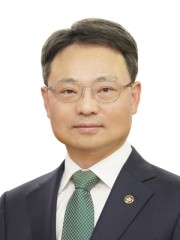
Connecting Asia-Pacific through forests: a green path to shared prosperity
Korea Forest Service chief Park Eun-sik shares forest policy achievements at 6th APEC Forest Ministers' Meeting Wildfires no longer respect the seasons. The climate crisis is redrawing the map of the world's forests and upending our lives along with it. Humanity now faces an unprecedented compound crisis — extreme heat waves, prolonged droughts, catastrophic wildfires and an accelerating loss of biodiversity, all unfolding at once. These are not problems that stop at any country's border. A crisis of the forests is a crisis for all of humanity, and the solutions must be found through solidarity and cooperation that transcend borders. It was against this backdrop that the 6th APEC Forest Ministers' Meeting was held over two days beginning Monday in Shenzhen, Guangdong Province, China. The meeting served as a forum for cooperation on how to conserve and wisely manage forests in the face of shared challenges — climate change, biodiversity loss and forest disasters — and how to collectively build a sustainable future. Delegations from 21 Asia-Pacific member economies, including South Korea, gathered under the theme "Green Asia-Pacific and Realizing Ecological Welfare for All" to discuss policy directions and cooperation frameworks for achieving global forest goals. I attended as South Korea's government representative and shared the achievements and experiences of our forest policy with the international community. Forests are nature's most effective carbon sink, as well as the foundation of life that safeguards biodiversity and preserves water resources. At the same time, they are a vital asset underpinning the livelihoods and economies of local communities. Protecting forests goes beyond environmental conservation — it is an investment in the prosperity of future generations. The joint declaration adopted at the ministers' meeting affirmed a shared commitment to strengthening science-based sustainable forest management, eradicating illegal logging, promoting trade in legally sourced forest products, and maximizing the diverse values and ecosystem services that forests provide. In line with these international trends, South Korea is advancing its Sixth Basic Forest Plan, which incorporates global forest goals and national greenhouse gas reduction targets. The country is also building a digital forest management system using satellite data and AI to improve management efficiency and strengthen its capacity to respond to cross-border forest disasters. South Korea has repositioned itself from a recipient of international support to a partner that shares its experience and technology. Its success in restoring war-ravaged forests into a verdant landscape that draws global attention has become a widely recognized model for forest restoration. Today, building on that experience, South Korea is broadening its path of cooperative growth by supporting forest restoration and disaster response in developing countries and climate-vulnerable nations. A particularly prominent agenda item at the meeting was the conservation and restoration of mangrove ecosystems — a cornerstone of nature-based solutions. Mangrove forests absorb up to four times more carbon than ordinary tropical rainforests and serve as natural breakwaters protecting coastlines from typhoons and storm surges. South Korea restored 330 hectares of degraded mangrove forest in Vietnam, simultaneously reviving the ecosystem and raising the incomes of local residents. The project was selected as an OECD public-sector innovation case. It stands as a prime example of how forest restoration can go beyond environmental recovery to drive sustainable development in local communities. In the rapidly urbanizing Asia-Pacific region, urban forests and the restoration of riparian ecosystems also emerged as important agenda items. The Futian Mangrove Ecological Park and the Dashahe Ecological Corridor in Shenzhen, which I visited in person, organically connect urban ecological corridors with waterfront spaces, demonstrating that nature and people can coexist harmoniously even within a high-tech city. The sites confirmed that the future of cities responding to the climate crisis lies not in more concrete, but in more forests and green spaces. South Korea is also consistently expanding its urban green infrastructure through climate-response urban forests, urban wind-corridor forests and child-safe green forests. The country is also pursuing the development of 40 garden cities nationwide, transforming urban spaces into sustainable ecological corridors. Through this meeting, South Korea shared these policies and experiences with member economies and presented a new development vision in which cities and forests grow together. Forests are a shared asset of humanity that cannot be divided by the artificial boundaries of national borders — a legacy we must pass on to future generations. Just as forests quietly prepare for spring even in the frozen ground of winter, the deeper the climate crisis grows, the more firmly we must plant and nurture the seeds of green solidarity. Wildfire smoke and climate change recognize no borders, but the power of cooperation can cross those borders to bring about even greater change. The climate crisis is not a challenge any single country can solve alone. When we tend forests together and share our experiences and technology, our collective future will grow greener. It is my hope that the forest solidarity connecting the Asia-Pacific region will become the sturdy roots from which we move beyond the climate crisis toward shared prosperity.
July 30, 2026
-
The silent ambition of Kevin Warsh — will Trump get blindsided again?
"A ruler does not reveal what he desires. If he shows his intentions, his ministers will dress themselves up accordingly … If the ruler conceals his preferences, his ministers will immediately reveal their true minds. If the ruler hides his stratagems and wisdom, his ministers will conduct themselves with care." — Han Feizi, "The Way of the Ruler" The end of the 'helpful' Fed The first notable change since Kevin Warsh took office as the new Federal Reserve chair has been his announcement that the Fed will scale back so-called forward guidance — the practice of signaling the direction of monetary policy in advance. The stated rationale is that when markets know where the Fed is headed, distortions from one-sided positioning can follow. Warsh is a former hedge fund professional who knows better than most how macro and arbitrage strategies are built around interest rate directionality. But the deeper motivation is the restoration of the Fed's authority. Working at Morgan Stanley and the White House, Warsh watched Alan Greenspan move markets through deliberate ambiguity rather than open communication. Then, as the youngest Fed governor in history, he encountered Ben Bernanke, who responded to the financial crisis by emphasizing transparency and rolling out quantitative easing. At odds with that philosophy, Warsh resigned his governorship in 2011. In the years that followed, the Fed conducted monetary policy based on widely available economic indicators — with its hand visible to all, outside interference intensified. The running battle between President Donald Trump and former Chair Jerome Powell is the most prominent example. When Warsh returned to the Fed as chair last May — 15 years after his departure — his inaugural address cited Greenspan as his role model and did not mention Bernanke, his five-year colleague, by name. Since then, Warsh has kept his mouth shut and his cards close, working to rebuild the Fed's institutional authority. The task force he established last month to drive Fed reform is the clearest expression of that effort. 'Reform the Fed' — five working groups take shape When a new leader sets out to reshape an organization, legitimacy is everything. Soliciting the views of respected outside experts is a highly persuasive way to build it. The TF comprises 15 heavyweights — including former central bank governors of the United Kingdom, India and Brazil, a Nobel laureate in economics, and corporate CEOs — divided into five working groups: Data, Inflation Frameworks, Communication, Balance Sheet Policy, and Productivity & Jobs. Together they will chart the direction of Fed reform. These are outside experts in name, but if the leader chose them and set the agenda, the broad direction is already decided. Given how prominent these figures are, their likely positions are also fairly predictable. A brief forecast of where each of the five working groups is headed: First, read the economy through data that reflects the present, not the past. Second, reduce interest rate volatility through policy credibility. Third, let markets function rationally by saying less. Fourth, use quantitative tightening rather than rate hikes to deflate asset bubbles and encourage fiscal discipline. Fifth, build confidence in productivity gains driven by AI and other technological innovation as a counterforce to inflation. The overarching message: keep the Fed's hand as hidden as possible while pursuing the optimal policy for economic conditions. Keeping rate hikes to a minimum to tame inflation Under this framework, the Fed's authority would be strengthened relative to today, and the tendency of markets to pile into one direction would diminish — reducing the need for sharp rate moves in either direction. Add quantitative tightening and technological innovation to the mix, and Warsh's direction points toward a clear inference: tame inflation with the smallest possible rate increases. The message is that the big knife should not be swung too often or too wide. Recklessness and authority are incompatible. Trump nominated Warsh as chair with the expectation that he would cut rates. Instead, Warsh appears to be engineering a Fed that is harder for the government to meddle with. Why? Warsh comes from money. He is the son of a wealthy family and the son-in-law of the Estée Lauder dynasty. He served as the youngest Fed governor on record and spent years in investment banking. He has little reason to chase a paycheck or a title. Power and legacy are more likely what drive him. Successfully installing what might be called the Warsh system at the Fed would be a considerable honor and a source of lasting authority. Greenspan became chair at 61 and served for 18 years. Warsh is 56 this year — young enough to think in decades. 'Kevin is ambitious' — comparing past Fed chairs There is even academic research analyzing the relationship between the height of past Fed chairs and their monetary policy stances. But what about reading their faces? Physiognomy is not science. Yet there is a saying that the face is the mirror of the mind. One should never judge a person by appearance alone. Still, the faces of those who have held power for a long time bear the imprint of habit and responsibility, etched by time. The face does not determine destiny — it is the life lived that shapes the face. So what monetary philosophy might be written in the faces of past Fed chairs? First, Paul Volcker (1979–1987), who carried out extreme tightening: the type who charges straight at the objective — a general of raw courage. Second, Alan Greenspan (1987–2006), the longest-serving chair: the inscrutable strategist whose true intentions are never known. Third, Ben Bernanke (2006–2014), who used quantitative easing to navigate the financial crisis: the skilled physician. Fourth, Janet Yellen (2014–2018), who began winding down QE but managed the pace carefully: the virtuous commander. Fifth, Jerome Powell (2018–2026), gentle but committed to balance and principle: the mediator. Read through the lens of physiognomy, Warsh's face can be summed up in a phrase: a prime minister type bent on restoring authority. His gaze is focused, the space between his brows is clear, his lips are firmly set, and his jaw is strong. He has a large sense of ambition and the bearing of someone destined for high office — though the moment of full ripening has not yet arrived. Yet there is visible tension in Warsh's bearing. It may stem from the weight of the role, but it may also reflect his awareness of the wide gap between the wishes of Trump, who appointed him, and the demands of the market. Known as a hawk, Warsh secured the chairmanship by arguing for the need to cut rates. But in his first rate decision after taking office, he showed a decidedly hawkish hand — a signal that friction with both the market and Trump may lie ahead. 'Success is what counts' — the stakes of reform for the global economy The era of low interest rates that took hold after the global financial crisis appears to be drawing to a close. The balance between central banking and fiscal policy has never mattered more. AI is becoming a variable capable of shaking the financial system to its roots. The Fed, too, seems overdue for change. Whether Warsh will succeed in his reform effort, however, remains to be seen. Concern about the fallout from quantitative tightening remains substantial. Former Chair Powell, breaking with convention, has stayed on as a governor, and governors appointed under Democratic administrations still hold a majority. How much of the outside experts' advice the conservative Fed bureaucracy will absorb is also an open question. Above all, what matters most is whether the Fed can earn the market's trust through accurate diagnosis and sound policy. How faithfully new data sources reflect economic reality will require rigorous verification. Silence can amplify market misreading and push up risk premiums. Conversely, forward guidance can serve as a stabilizer that reduces uncertainty in medium- and long-term interest rates. The price the United States — and the world — would pay for a Fed misstep is too high. A central bank's authority does not come from words — it comes from getting the call right. Silence, ambiguity and forward guidance are all ultimately just tools in the pursuit of credibility. Markets will not trust the Fed on authority alone, at least not for a while. Warsh's success or failure will be determined not by his silence, but by the accuracy of the judgment that lay behind it. Han Feizi's art of statecraft builds a ruler's authority. But the moment the market — as the ruler's subject — reads that silence not as depth but as anxiety, the hidden hand becomes not authority but risk. Whether Warsh's silence proves to be one or the other, the Fed's results will ultimately provide the answer. [Appendix] The five working groups of the TF Kevin Warsh established at the Fed, and their members ▶ Data Most of the economic indicators the Fed uses in its decisions are figures that are at least a month old. Warsh wants data that reflects the present. Harvard economist Raj Chetty built a system during the COVID-19 pandemic that combined credit card transactions, private payroll records and small-business revenue data to track economic conditions by neighborhood and income bracket — weeks ahead of government statistics. Doug McMillon, former CEO of Walmart, is someone with deep firsthand knowledge of the real economy. Kevin Murphy, a professor at the University of Chicago, is a leading authority on price theory and an expert at identifying data and determining what it actually means. ▶ Inflation Frameworks Trump wants rate cuts. Bringing inflation down requires raising rates, which puts a heavy burden on the economy and public finances. Thomas Sargent, a Nobel laureate in economics and professor at New York University, has researched how coordination between a central bank and fiscal authorities alone can break inflation — the key being a government that stops adding to its deficit and a central bank that holds a firm line to win market confidence. Harvard economics professor Greg Mankiw is also expected to provide the theoretical grounding for the argument that managing public expectations makes taming inflation considerably easier. Bill White, an economist who spent his career at the Bank for International Settlements (BIS), predicted the 2008 financial crisis by focusing on debt and asset bubbles. He is expected to offer a framework for reading inflation not just from price indexes but from debt levels and asset prices. ▶ Communication Mervyn King, former governor of the Bank of England, focused during his tenure on earning market trust without signaling the path of interest rates — exactly the Warsh style. Peter R. Fisher ran trading operations at the New York Fed and led the fixed-income division at BlackRock, the world's largest asset manager. He is an expert on how markets react when the Fed signals its intentions in advance, and what effect that has on the broader economy. Arminio Fraga, former governor of the Central Bank of Brazil, also earned market credibility during his tenure by taming inflation through action rather than words — having already traveled the road Warsh wants to take. ▶ Balance Sheet Policy Warsh resigned as Fed governor in protest at the expansion of QE during the financial crisis response. Shrinking the balance sheet — selling into the market the government bonds the Fed accumulated through QE — is unfinished business for Warsh, but it is also the policy markets fear most, since it effectively tightens financial conditions by draining liquidity. Looked at another way, it is also a means of fighting inflation without raising interest rates. Jeremy Stein, a Harvard economics professor and former Fed governor, holds that prolonged monetary easing causes markets to chase higher returns, building up risk in the system. Raghuram Rajan, former governor of the Reserve Bank of India, has long warned of the dangers of the liquidity expansion that QE produces. Karen Dynan, former assistant secretary for economic policy at the Treasury Department, is positioned to offer views on how QE has affected households. ▶ Productivity & Jobs Warsh believes that productivity gains driven by AI have the power to hold inflation in check. Charles Jones, a former Stanford economics professor now working at Anthropic, is researching the impact AI will have on economic growth. Marc Andreessen is a Silicon Valley venture investor and specialist in digital assets, and one of the most plugged-in observers of the latest developments in technology. Asha Sharma, a Microsoft executive, is among the experts best positioned to read how companies are actually deploying AI.
July 30, 2026
-
![[Biz Insight] Where does a decisive competitive edge come from?](https://wimg.heraldcorp.com/news/cms/2026/07/27/news-p.v1.20260724.804d1b676a34423ba36f278f34ecc0c0_T1.jpg?type=h&h=240)
[Biz Insight] Where does a decisive competitive edge come from?
Businesses built on capital and equipment are easy to imitate. Adding advanced technology to the mix does not widen the gap by much. At least when a platform business — one where the first mover's lock-in effect takes hold — forms a full ecosystem, it can create a decisive edge and sustain it for a considerable time. Even then, companies often grow complacent within that advantage and find themselves displaced by a new platform ecosystem before long. Others fall behind simply because their capacity for innovation cannot keep pace with the speed of obsolescence. The trait experts most consistently rank as the primary condition for a decisive competitive edge is "rapid adaptability to a changing environment" — in other words, the ability to make decisions quickly and to mobilize and deploy resources at speed. This is the product of flexibility and dynamism built up over time through experience. Creativity and innovation, experts say, serve as powerful supporting forces behind it. When that adaptability is systematized into accumulated knowledge, experience and capability — that is, into know-how — a genuine competitive advantage emerges. The edge gained this way widens the gap with rivals progressively, and it applies across industries without exception. Particularly when an economic crisis strikes, that difference grows sharply. It makes overtaking, substitution and even imitation difficult for competitors. As long as a company stays alert to strategies of circumvention and leapfrogging, it can hold its dominant position for a long time. The mechanism, experts note, mirrors the logic of natural selection — the survival of the fittest through the mutation and inheritance of traits adapted to the environment. Nearly all of this comes down to human resources. The problem, however, is that truly top creative talent is in short supply. The practical answer, then, is to secure a large pool of capable people who bring the right attitudes and character. If learned and developed skills and competencies are added on top of that, so much the better. Only the growth of people, the thinking goes, can grow an organization and expand its lead over competitors. These elements must be steadily executed under a clear mission, vision and strategy, with active feedback loops in place. Strong leadership and vigorous communication must also underpin the whole effort. Beyond these, a culture of mutual consideration, encouragement of action and tolerance of failure, and well-designed incentive mechanisms are also cited as necessary conditions for building and sustaining a decisive edge. Embedding these qualities in an organization, it is said, requires insight drawn from social psychology. Ultimately, conflict management is the core of it all. Meanwhile, there is a counterargument that an overwhelming competitive edge can itself be dangerous. Entry barriers that are too high — in organizational culture, technology and know-how — can end up trapping the leader as well. The concern is that a company can lose sight of the strategies its rivals are pursuing. A distance at which tension is maintained and the competition remains observable — close enough to keep watch — may actually be the less dangerous position.
July 27, 2026
-
![[CONTRIBUTOR] It's not words that count anymore — it's ships: A path forward for MASGA](https://wimg.heraldcorp.com/news/cms/2026/07/26/news-p.v1.20260726.92ee037bd45f444f8cbd6905addd8940_T1.jpg?type=h&h=240)
[CONTRIBUTOR] It's not words that count anymore — it's ships: A path forward for MASGA
US-Korea shipbuilding cooperation has moved beyond summit declarations and MOUs into the implementation phase. The Korea-US Shipbuilding Partnership Center (KUSPC) has launched in Washington, D.C., and the $150 billion MASGA initiative has begun to take shape in earnest. The question now is no longer whether the will to cooperate exists, but whether that will can be translated into tangible results — actual ship production, shipyard modernization, workforce development and supply chain construction. Commerce Secretary Howard Lutnick's message was unambiguous. He made clear that US-Korea shipbuilding cooperation would be measured not by the number of meetings or MOUs signed, but by capital invested, facilities modernized, workers trained, supply chains built and ships actually produced in the United States. He also pledged support in removing the regulatory barriers Korean companies face when building vessels in the US. What America is asking for is not words — it is ships. For Korea, that is both a pressure and an opportunity. Movement has also begun in what had long been the most uncertain arena: the US Congress. Staff members from the House Appropriations Committee's defense subcommittee recently visited HD Hyundai Heavy Industries, Hanwha Ocean and Samsung Heavy Industries to assess South Korea's warship-building capabilities firsthand. They toured Aegis destroyers, frigates and submarines, and received briefings on shipbuilding capacity including replenishment vessels. The fact that congressional staffers who handle the US defense budget traveled directly to Korean shipyards signals that Congress, following the executive branch's lead, has begun verifying the actual capabilities of Korea's shipbuilding industry. Legislative changes are also taking shape. Title 10, Section 8679 of the United States Code (10 U.S.C. § 8679) generally prohibits the construction of US military vessels and their major hull and superstructure components at foreign shipyards. Even when the president grants a national security waiver, the law requires congressional notification and a 30-day waiting period. However, the fiscal year 2027 defense appropriations bill passed by the House Appropriations Committee proposes narrowing the scope of restrictions on overseas construction — from the previously broad category of naval vessels to "covered ships" defined as combat forces. While this does not open the door to all overseas construction, it creates the potential for greater budgetary flexibility to use allied shipyards for non-combat support vessels and similar craft. The Senate Armed Services Committee's fiscal year 2027 National Defense Authorization Act proposal similarly allows for limited procurement of bulk fuel ships and strategic sealift vessels from foreign shipyards, while requiring participating companies to invest in the US maritime industrial base and bring subsequent production and supply chains back to American soil. In short, the Senate is moving to crack open the door to limited procurement from allied shipyards, while the House Appropriations Committee is working to lower the budgetary threshold that has blocked overseas construction in non-combat areas. Neither chamber has passed final legislation, and the core prohibition of 10 U.S.C. § 8679 remains in place. But a structural opening has clearly begun to appear in what was once a nearly closed door. This moment matters for Korea. What the United States wants is not Korea's shipbuilding reputation — it is the restoration of American shipbuilding production capacity. Korea's argument, therefore, must not be "we will build US warships in Korea's place." It must be: "Korea will help restore the shipyards, workforce, supply chains and production technology that will allow America to build more of its own warships again." Only with that framing will the US Congress accept the use of allied shipbuilding capacity not as something that strips away American jobs and industrial base, but as something that rebuilds them. The role of Korean shipyards must be designed with this in mind. The ultimate destination is the United States. However, it will take time for American production facilities — including Philly Shipyard — to develop sufficient capacity. A bridge model, in which Korean shipyards temporarily fill that gap, needs to be negotiated. The approach would be to launch limited pilot programs with non-combat vessels such as bulk fuel ships and strategic sealift vessels, demonstrating delivery timelines, quality, cost management, security and supply chain capabilities. Rather than demanding full authorization for overseas construction of combat vessels from the outset, carving out legal and budgetary exceptions for such pilot programs is the more realistic path. If domestic Korean construction buys time, US-based investment must be the work that converts that time into production capacity. Philly Shipyard, acquired by Hanwha, is one of the central platforms for that effort. The goal is to transfer Korea's design expertise, block and module construction, process and schedule management, quality control, automation and workforce development capabilities to American soil — transforming the yard into one capable of building more warships on its own. Hanwha's investment in Philly Shipyard, HD Hyundai's cooperation with US shipbuilding and technology firms, and Samsung Heavy Industries' collaboration on unmanned surface vessels and workforce training must all be viewed as part of the same picture. KUSPC, too, must be more than a liaison office — it must serve as a platform connecting this transfer of capabilities. Joint research and development must lead to productivity innovation; workforce training must translate into a skilled labor pool; and supply chain cooperation must result in the restoration of a domestic equipment and components ecosystem within the United States. US-Korea naval vessel cooperation also requires a sequenced approach. The first step is to convert the limited overseas procurement and budgetary deregulation movements emerging in both chambers into actual policy, establishing a precedent for using allied shipbuilding capacity with non-combat auxiliary vessels and strategic sealift ships. The second step, during that period, is to build up the maintenance, repair and overhaul (MRO), module production and auxiliary vessel construction capabilities at US yards including Philly Shipyard. The third step is to establish a joint production framework combining US-Korea co-design, module and block supply, and final assembly in the United States. Only after sufficient track record and trust have been built should the question of expanding joint construction to combat support ships and surface combatants be considered. The road to combat vessels does not begin with combat vessels. Building a track record with auxiliary ships and growing production capacity inside the United States must come first. The recent visit by House Appropriations defense subcommittee staff should be understood in that light. The fact that they toured Korea's Aegis destroyers, frigates and submarines does not mean Congress has approved Korean construction of US combat vessels. But the sequence of developments — the administration's requests for information, President Donald Trump and Commerce Secretary Lutnick's stated commitment to shipbuilding cooperation, legislative movement in both chambers, and now on-the-ground verification by congressional staff — represents clear progress. Political signals, working-level review and legislative momentum are beginning to converge in the same direction. Over the long term, this shipbuilding cooperation could also serve as a foundation of strategic trust that advances discussions on nuclear-powered submarines for Korea. However, it must not become a transaction in which Korea demands submarine technology in exchange for helping build US warships. Nuclear-powered submarines must be addressed separately, within the distinct frameworks of nuclear nonproliferation, technology transfer and alliance strategy. That said, if Korea becomes a trusted core partner in rebuilding the US shipbuilding industry and naval power, it could positively shape the strategic environment in which the United States views the strengthening of Korea's undersea warfare capabilities in the Indo-Pacific. The United States is now asking for ships, not words. In Congress, moves have begun to widen the institutional space for using allied shipbuilding capacity to produce those ships. What Korea must do is not force the door open. It is to build a track record with auxiliary vessels, grow shipyards, workforce and supply chains inside the United States, and give the US Congress the justification it needs to open the next door itself. Domestic Korean shipyards should serve as a temporary bridge; US yards including Philly Shipyard should become the long-term production base; and auxiliary vessels should serve as the institutional stepping stone toward combat ships. The door that has opened is still a small one. But if designed correctly, it can become a passage that deepens the US-Korea maritime security alliance far beyond shipbuilding cooperation alone. Lee Ki-sik is a former commissioner of the Military Manpower Administration and former commander of Naval Operations.
July 26, 2026
-
![[CONTRIBUTION] Global trade order in turmoil — but export doors must stay open](https://wimg.heraldcorp.com/news/cms/2026/07/24/news-p.v1.20260721.f65a28e669e5455190c31a8a15584482_T1.jpg?type=h&h=240)
[CONTRIBUTION] Global trade order in turmoil — but export doors must stay open
Successive wars and rising protectionism have thrown the global industrial environment and international trade order into prolonged disarray. For South Korea, where trade dependence — the combined share of exports and imports — accounts for 60 percent of GDP, the reshaping of global supply chains and the deepening trend of economic nationalism heighten uncertainty about the future. Risks tied to international raw material prices, interest rates and exchange rates are converging and growing more complex. Mounting pressure to meet carbon neutrality commitments in response to the climate crisis adds yet another burden. Yet what can be done? As the saying goes, real opportunity often hides within crisis. Now, precisely when industrial and trade orders are being shaken to their foundations, is the moment to draw fully on the capabilities South Korea has built up over the decades. With semiconductors, shipbuilding and defense industries leading a boom at the front lines, this is an ideal time to spread into global markets on the wings of digital innovation and international standards. Industrial complex companies — the driving force behind South Korea's manufacturing growth — must lead the charge. It was fitting, then, that a regional cooperation launch ceremony for the 2nd Korea Industrial Complex Export Fair (KICEF 2026) was held at EXCO in Daegu on July 2. This year's fair will be held in Daegu in September, linked to the 62nd Industrial Complex Day commemoration — the first time the event has been hosted outside the Greater Seoul area. It marks an opportunity to spread export momentum, long concentrated in the capital region and among large conglomerates, to industrial complexes across the country. It is also expected to serve as a prime occasion to showcase the latent strength and global competitiveness of small and midsize enterprises in regions that have until now gone largely unrecognized. Succeeding in global markets today demands far more than producing quality products at low cost. Companies must meet a complex set of conditions: manufacturing innovation capabilities integrating AI and robotics, the ability to manage carbon emissions across products and processes, and transparency and stability throughout the supply chain. The fair coming to Daegu in September must serve as a bridgehead for industrial complex tenants seeking new markets and global expansion. It cannot remain a one-off event where companies merely display their products. Organizers must ensure that leading buyers from the Americas, Europe, Asia and the Middle East can hold in-depth consultations with promising domestic companies. Through this, South Korean technology and products should reach a global audience — and the results should extend to long-term partnerships. KIBA has joined hands with the Korea Industrial Complex Corporation and the Global Leading Companies Association (GLCA), among other organizations, to build a joint public-private implementation framework. At its core is a regional organizing committee formed around the heads of regional associations across the country's five major zones and three special zones. The committee gathers on-the-ground input from industrial complexes in each region while identifying promising companies that have strong technology and products but have yet to find an export channel. This field-centered cooperation will serve as a solid foundation helping Korean companies open export pathways even as the external environment shifts rapidly. "From regional strength to the future, from corporate challenge to the world" is the fair's slogan. It is a chance to pool the energy and wisdom of business people from industrial complexes nationwide. Small innovations from the field, gathered together, can become the engine that opens a path for South Korea's exports as a whole. Until Korean companies bear fruit in global markets, KIBA will stand close to the field as a steadfast pillar and pacemaker. As long as companies are willing to take on the challenge, South Korea's exports will not stop. As it has always been, the door opens only for those who knock.
July 24, 2026
-
Is Wall Street now calling the shots on Korea's stock market?
SK hynix's American depositary receipt listing has been widely welcomed by the market. The prevailing view was that raising dollar capital in the United States while securing a higher valuation than at home would be a win-win for the domestic shares as well. In practice, however, the domestic shares are structurally prone to trading at a discount to the ADR. The ADR also involves the issuance of new shares — even as SK hynix canceled treasury shares in January, citing a commitment to shareholder value. The latest offering raised substantial capital, but any future ADR issuance will require either SK Square to buy additional shares or SK hynix to manage its parent company's ownership ratio through share buybacks and cancellations to stay within holding-company regulations. More troubling, SK hynix's ADR has now collided with the "monster" of single-stock leveraged ETFs — handing US investors a grip on Korea's stock market that is hard to shake. Every silver lining has a cloud, and this one is particularly dark. The Korea-US 'feedback loop' created by the ADR The ADR and the domestic share operate in a semi-convertible structure. SK hynix's ADR can be converted into domestic shares, but converting domestic shares into ADRs requires a complex process that makes it effectively impossible. Arbitrage — buying the domestic share when it is cheaper and converting it into the higher-priced ADR — is not realistically viable. Without a mechanism to close the gap, the ADR is likely to sustain a premium over the domestic share. TSMC, which has a similar structure, also trades at a persistent premium to its Taiwan-listed shares. Even so, the ADR and the domestic share influence each other's prices. Through the ADR, SK hynix's Seoul-set price is reassessed in New York each day, and the result feeds back into Seoul the following morning — a classic feedback loop. The concept gained wider currency through George Soros, the legendary hedge fund investor, who used his Theory of Reflexivity to explain market bubbles. The theory holds that market participants' perceptions and actual market fundamentals feed back into each other, amplifying volatility. Expectations push prices higher, and higher prices in turn inflate expectations further. Volatility amplifier No. 1: single-stock leveraged ETFs on both sides Single-stock leveraged ETFs are turbocharging the feedback loop. In Korea, 16 single-stock leveraged ETFs and two single-stock leveraged ETNs based on Samsung Electronics and SK hynix listed simultaneously on May 27. In the United States, just four days after the ADR debuted, GraniteShares (SKUU, SKDD) and ProShares (SKHU) launched 2x products on Tuesday, followed by Direxion (SKHL) on Wednesday. The structure creates a channel through which amplified price swings in the US travel via the ADR to the domestic share, where domestic single-stock leveraged ETF rebalancing then amplifies them further. TSMC also has single-stock leveraged ETFs tied to its US ADR, but leveraged exposure to the Taiwan-listed shares is available only through futures and options. Volatility amplifier No. 2: thin ADR liquidity in a deep market Liquidity is another variable. ADRs represent about 20 percent of TSMC's total shares outstanding, compared with just 2.5 percent for SK hynix. A small float means even modest trading can move the price sharply. US markets are far deeper than Korea's, and a surge of American liquidity into a relatively thin ADR market could widen price swings considerably. Leverage can be built not only through physical shares but also through futures and options, and the US options market offers a wide variety of instruments — single-stock options are commonplace, and products with a one-day expiry exist as well. Most US single-stock leveraged ETFs do not buy the ADR directly; they use total return swaps and options instead. Even when an asset manager does not hold the ADR outright, the TRS counterparties and options market makers hedge their own risk by trading the ADR or related derivatives. Once delta and gamma hedging are layered on top, the volume of trading in the underlying asset and surrounding markets can far exceed the actual capital that has flowed into the ETF. Options trading on SK hynix's ADR began at the Chicago Board Options Exchange on Tuesday. Volatility amplifier No. 3: hedge funds that profit from a wider gap Hedge funds are yet another wild card. At the time of the ADR offering, the premium over the domestic share was roughly 3 percent. It widened to 16 percent on the first day of trading, surpassed 23.7 percent on Monday and briefly exceeded 51 percent on Tuesday, before pulling back to the 20 percent range on Wednesday. On Thursday it expanded again to 41.8 percent, calculated using the Seoul foreign-exchange market closing rate at each point. The wider the price gap and the greater the volatility, the more opportunity there is for relative value trading strategies. Long-short and pair-trading approaches — hedge fund strategies that target the spread between two assets rather than the absolute direction of either — thrive in exactly this kind of environment. UBS, for instance, recommended a strategy of shorting SK hynix's domestic shares and going long the ADR before the listing. The stock loan balance — a leading indicator of short selling — jumped 31.4 percent between June 23 and July 8, compared with 11.7 percent for Samsung Electronics over the same period. This suggests foreign investors anticipated a premium for the ADR over the domestic share and positioned themselves early, buying the more expensive ADR while shorting the cheaper domestic stock. Such trades profit from a widening gap, making it more likely that the spread grows rather than narrows. Single-stock leveraged ETFs concentrate their rebalancing at the close of trading to maintain the target multiple against the underlying asset's price. Because the direction of that rebalancing can be read from the underlying's intraday moves, it invites anticipatory trading and high-frequency trading, which can push volatility in the underlying even higher. Korea has effectively handed New York pricing power over its second-largest stock SK hynix is the second-largest stock by market capitalization on the Kospi, so swings in its share price ripple through the index as well as ETFs and derivatives tied to it. Single-stock leveraged ETFs can translate volatility in a single name into volatility across the broader market. The combined Kospi market cap share of Samsung Electronics and SK hynix rose from 51.06 percent on May 26 — the day before the single-stock leveraged ETFs listed — to 55.17 percent on July 10. The two stocks' share of total trading value climbed from around 30 percent to as high as 44 percent. When Samsung Electronics and SK hynix move, the resulting rebalancing of related ETFs ripples out to other stocks as well. SK hynix has left the door open to issuing additional ADRs. When TSMC first listed its ADR in 1996, it represented just 2.9 percent of shares outstanding; the company gradually increased issuance to reach the current 20 percent. The more ADRs SK hynix issues, the stronger the grip US investors will have on Korea's stock market. Because US markets are far larger, Korean investors' ability to influence New York through SK hynix's ADR will remain limited no matter how much the issuance grows. SK Group's ownership structure limits the capital-raising benefit of the ADR SK hynix's ownership structure also complicates the capital-raising rationale for the ADR. The company decided in January to cancel 15.3 million treasury shares — yet the ADR issuance created even more new shares, totaling 17.79 million. The offering raised approximately 40 trillion won ($26.5 billion), but that may be as far as it can go. Any additional ADR issuance would push SK Square's stake in SK hynix below the 20 percent minimum that the Fair Trade Act requires a holding company to maintain in a subsidiary — SK Square currently holds exactly 20 percent. To keep the ratio at or above that threshold, SK Square would need to buy more shares or SK hynix would need to repurchase and cancel its own stock. In other words, even when the ADR raises capital, the group must spend a significant amount managing the ownership ratio. Remedies announced, but they fall short — a fundamental fix is needed The Financial Services Commission announced supplementary measures for single-stock leveraged ETFs on Thursday. The focus was on raising deposit requirements and minimum trading units while tightening education and marketing regulations to make access harder for retail investors. Even so, the measures do not apply retroactively to existing holdings, and rapid intraday trading remains unrestricted. Brokerages and asset managers face higher accountability for managing premium-discount ratios, but the end-of-day rebalancing mechanism — widely seen as the primary driver of volatility — was left to the industry to address through self-regulation. The measures appear insufficient to tackle the root of the problem. The core issue is that leveraged ETFs, options, and hedge fund strategies on both sides of the Pacific have all converged on a structure where the arbitrage channel between the domestic share and the ADR is narrow. SK hynix has not merely listed its shares in New York — it has effectively ceded part of the price-discovery function for Korea's stock market to New York as well. "Even a wise man, if he thinks a thousand times, will make at least one mistake; even a fool, if he thinks a thousand times, will arrive at least one correct conclusion." — Yanzi Chunqiu When Duke Jing of Qi saw the modest circumstances of his prime minister Yan Ying and offered him great wealth, Yan declined. The duke pointed to the example of Duke Huan, who had lavished enormous riches on his prime minister Guan Zhong. Yan's reply was that Guan Zhong, wise as he was, had erred in accumulating personal wealth while serving as prime minister — and that he himself, though less gifted, intended not to repeat that mistake. Both the ADR listing and the single-stock leveraged ETFs appear to carry significant side effects and unresolved problems. It is hard to call either the work of a truly wise hand. Even Yan Ying — held in the highest regard by Confucius — described himself as a fool. One can only hope that policymakers and market participants will approach these issues with Yan's humility, thinking a thousand times before acting.
July 18, 2026
-
Korea Customs Service chief Lee Jong-ok on securing borders, fair trade and AI transformation
A safe border protects citizens, a fair border grows businesses, and an open border drives South Korea's growth Over the past half-century, South Korea's trade volume has grown 550-fold and the number of international travelers has increased 37-fold. This year, K-beauty exports reached $7 billion and K-food exports hit $6.57 billion, both setting all-time records, while the number of foreign tourists visiting South Korea surpassed 10 million in the first half of the year alone — the first time that milestone has been reached within a single half-year period. Yet the darker side of open borders has grown alongside the economic gains. In the first half of this year, nearly one ton of narcotics was intercepted at the border, and the value of trade security violations blocked — including smuggling of strategic goods and core technologies — reached 1.3 trillion won, already surpassing the full-year figure for last year. At a crossroads where opportunity and risk converge, the Korea Customs Service must sharpen its role in managing and overseeing trade, travelers and foreign exchange transactions to protect both public safety and economic vitality. The most urgent priority is stopping narcotics. South Korea has no domestic drug manufacturing base and is a consumption country where virtually all illicit drugs enter from abroad. Once drugs reach the domestic market, their highly addictive nature makes treatment and rehabilitation difficult, and the personal devastation — job loss, family breakdown — ripples outward, generating wide social costs. Intercepting drugs at the border is therefore both the most important and the most efficient line of defense. The customs service has historically detected about 80 percent of all narcotics seized domestically through border inspections. Under the existing single-tier inspection system, however, officers conducting a single check must simultaneously verify not only for drugs but also tax compliance, import licensing and country of origin — making it difficult to focus on drug interdiction. The system has also struggled to detect narcotics in the wide variety of forms they take, including liquids and powders. In response, the customs service has been building an "N-tier interdiction" system by adding dedicated second- and third-stage X-ray screening and inspection steps for every entry channel. The N-tier framework for international mail and general container cargo was completed and put into operation in the first half of this year. In the second half, the agency plans to extend it to cover travelers' carry-on baggage, express courier shipments, and crew members and port workers boarding and disembarking trade vessels. The risks at the border are not confined to physical goods — they also lurk in financial flows. Crimes that exploit trade transactions to defraud public finances or distort capital markets are emerging as a new threat. Common schemes include manipulating trade figures to claim government subsidies fraudulently, relabeling imported goods as domestic products to win public procurement contracts, and inflating export records to create fictitious sales that drive share price manipulation. The result is fiscal leakage, erosion of market fairness and damage to investor confidence. Recognizing the seriousness of these emerging crimes, the customs service has conceptualized them as "trade-based financial crime" (TBFC) to target them precisely. Drawing on the Customs Act and the Foreign Exchange Transactions Act, the agency conducts integrated analysis of trade records and international fund flows to strengthen its monitoring system for anomalies hidden behind trade transactions. In the second half of this year, it will build a comprehensive TBFC prevention and enforcement framework that links data on government support programs, public procurement and stock listings to identify and crack down on suspected fraudulent beneficiaries, sharing findings with relevant agencies. Equally important to protecting public safety is building a fair foundation for economic growth. The moment low-quality imports are passed off as domestic products, genuinely made Korean goods are crowded out and jobs disappear. Fair competition cannot exist when law-abiding companies that compete on quality are undercut by rivals profiting from origin fraud or undervalued declarations. Country-of-origin enforcement has traditionally focused on consumer protection for agricultural and fishery products, but the paradigm must now shift toward protecting domestic manufacturing. The customs service plans to build a tripartite "comprehensive origin-fraud enforcement system" in collaboration with local governments and producer associations. Under the framework, the customs service will use clearance data to detect signs of origin fraud, local governments will assess damage to regional industries, and producer associations will identify affected products by sector. The agency will also conduct targeted customs investigations into undervaluation and tax evasion, work with foreign customs authorities to build local protection against counterfeit K-brand goods, and expand joint special enforcement operations to level the playing field. Growing the overall economic pie must go hand in hand with these efforts. The domestic market is finite, but global consumer markets are wide open. For more economic participants to join and grow together, everyone must be able to compete in the world market — it is time to move beyond "entrepreneurship for all" to "exports for all." Cross-border reverse e-commerce in particular offers individuals and small businesses a practical channel to reach overseas consumers directly. To that end, the customs service plans to streamline tax refund procedures related to reverse e-commerce exports to ease the tax burden on exporters, and to expand maritime express shipping cooperation with neighboring countries to help cut clearance and logistics costs. Maritime express shipping — transporting small cargo to nearby countries by sea — matches air express in speed while costing significantly less, lowering the logistics barrier for e-commerce exports. The agency will also develop e-commerce export statistics based on clearance data and provide them to export newcomers to support strategy development, market discovery and new business opportunities. It will additionally simplify certificate-of-origin procedures for promising export categories such as K-beauty, K-food and used vehicles to help open new overseas markets. Underpinning all of these changes is an AI transformation. Given the vast volumes of customs and trade data the agency handles, the potential for AI is significant. Since 2017, the customs service has been cultivating in-house talent that combines domain expertise with AI development skills, and earlier this year it established an AI Transformation (AX) task force. Going forward, the agency will complete an AI information strategy plan centered on that team to drive AI adoption across all areas of customs administration, and will hold biannual "AX Challenges" to embed a culture in which frontline staff develop and apply AI models themselves. Innovation that starts on the ground will raise both the accuracy and the speed of border management. A safe border protects citizens. A fair border — one that upholds the rules — grows businesses. And an open border that makes exporting easy becomes the engine of an irreplaceable South Korea. The Korea Customs Service will stand at the front line of the border, closing every gap against transnational crime, establishing a fair trade order, and supporting more companies as they take on the world market.
July 15, 2026
MOST READ
- 1KAIST develops high-performance bio-based adhesive using E. coli instead of petroleum
- 2Pope Leo XIV declines French honors and banquet, accepts only private meeting with Macron
- 3Daimler Truck unveils next-generation transport solutions at IAA 2026
- 4What was Rachmaninoff's performance fee? A 1928 price list tells all
- 5Samsung Biologics union's show of force backfires at the bargaining table
- 6APR says hair-loss treatment research published in international journal
-
WORLD
US warns of punishment for anyone enabling Iran's Strait of Hormuz toll scheme
-
INDUSTRY
Toyota union puts productivity first; Hyundai Motor union demands bigger share of profits
-
FINANCE
National Growth Fund to invest $531M in FuriosaAI, which rebuffed Meta's $800M takeover bid
-
INDUSTRY
Korea Shipowners' Association holds amateur baduk tournament for Maritime Day