
Key takeaways:
- This year's Nobel laureates in economics reaffirmed that macroeconomic analysis must begin not from the top down but from the actual behavior of households and businesses.
- When an economic slowdown and a supply shock occur simultaneously, premature demand stimulus can fuel inflation. Once price stability breaks down, economic stability becomes equally elusive.
- A central bank's role extends beyond setting interest rates. Accurately reading economic conditions on the ground and communicating future policy direction in a way that markets and economic actors can trust are themselves part of monetary policy.
- Ultimately, Fed Chair Kevin Warsh's success or failure will hinge on how well he reads the real economy and how effectively he communicates with markets.
The winners of the 2026 Nobel Prize in Economics have been announced: Robert E. Hall, professor emeritus at Stanford University, and Michael Woodford, professor at Columbia University. The two scholars laid the theoretical groundwork that led us to pay attention not only to interest rate decisions by the Federal Reserve and other central banks around the world, but also to the expected path of future rates and the messages those institutions send. Their research is already being applied directly to central bank policymaking.
It is quite significant that their work has been recognized with the Nobel Prize at a moment when inflation and supply chain disruptions have thrust the role of central banks back into the spotlight. Examining their contributions also offers considerable help in anticipating where central banks are headed. Their insights can be distilled into two questions and their answers.
Will benchmark interest rates rise further?
Is Fed Chair Kevin Warsh doing a good job?
The limits of Keynesianism — too far removed from the real economy
Traditional Keynesian models assumed that the statistical relationships among major macroeconomic variables — inflation, unemployment, consumption and output — were relatively stable and broadly linear. The Phillips curve, which holds that inflation tends to fall when unemployment is high and rise when unemployment is low, is the classic example. The assumption that household consumption rises when disposable income increases follows the same logic.
Then came the oil shocks of the 1970s, when unemployment rose even as inflation climbed. The relationship between income and consumption also proved far less stable than the models had assumed. Overstimulating demand in response to the slowdown and rising unemployment made inflation worse, leaving years of low growth and high prices as a lasting legacy.
Robert E. Lucas Jr., who won the Nobel Prize in Economics in 1995, identified the limits of this approach. Inflation is shaped by the pricing decisions of countless individual firms. Private consumption flows from the decisions of countless households. Output is determined by the choices of individual companies and workers. Lucas argued that macroeconomic phenomena can only be properly understood by studying the behavior of individual economic actors and aggregating those findings.
People respond to information — a shift in thinking
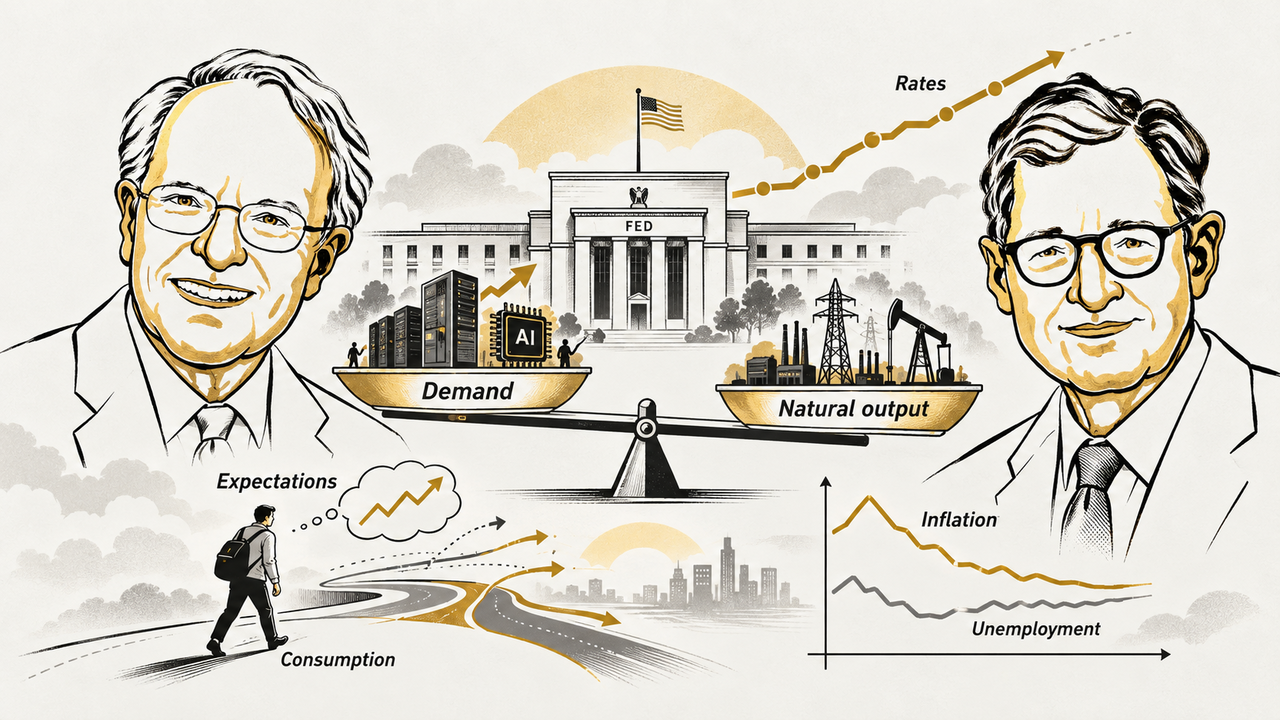
Robert E. Hall is among the most prominent researchers to have given concrete form to the "microfoundations" Lucas demanded, doing so in the realm of consumption. Hall argued that what matters for changes in household consumption is not information that has already been anticipated, but unexpected new information. If a salary increase next year is already certain, people can factor that into their spending plans now rather than waiting until next year arrives. Only when new information arrives that changes their view of the future will their consumption plans shift.
Woodford brought this forward-looking consumer into macroeconomic models. The key variable in that framework is the interest rate — not the current rate alone, but the expected path of real interest rates going forward. When rates are expected to stay high, saving becomes more attractive than current spending; when the opposite holds, current consumption rises. A central bank can move today's consumption and investment by adjusting the current rate while simultaneously shaping expectations about future rates.
The same forward-looking logic applies to corporate pricing decisions. Firms set their current prices based on expectations about how competitors' prices and their own costs will evolve. Ultimately, what people believe about how a central bank will respond to future inflation and interest rates also influences prices today. That is why Woodford placed such weight on central bank credibility, transparency and policy communication.
The New Keynesian model that emerged from Hall and Woodford's research can prescribe a different course of action from simple demand stimulus when the economy faces a supply shock — a sudden surge in energy prices, a disruption to global supply chains, or any other event that abruptly affects the economy's productive potential.
The prescription is to accept a near-term growth slowdown and align demand with reduced supply capacity in order to prevent inflation from getting out of control. Cutting rates to stimulate demand when the economy is weak risks channeling more demand into a supply-constrained economy, which can make inflation worse rather than better.
Question 1: Will rates rise further? Probably.
Now for the answers.
On interest rates: US economic data show that consumption remains solid. Real personal consumption expenditures rose 0.6 percent month on month in August, PCE inflation was up 3.4 percent year on year, and core PCE climbed 3.0 percent. Enormous capital demand driven by AI investment, some supply bottlenecks, and energy supply shocks stemming from ongoing conflicts continue to weigh on the economy. Applying the Hall-Woodford framework to the current US economy, there is at least no case for rushing to cut rates. If anything, the case for a further hike could be made.
The minutes of the September FOMC meeting, at which the benchmark interest rate was raised, show that Fed participants flagged the possibility that AI investment could push aggregate demand above aggregate supply, along with energy shocks and still-elevated inflation. Some participants actually raised their estimates of the neutral rate. Several judged that the current benchmark rate of 3.75 to 4.00 percent was "not restrictive, or only slightly restrictive."
What matters here is not the number itself — the fact that the benchmark rate is close to 4 percent. What matters is how far the current rate actually stands above the neutral rate. If AI investment, productivity gains and large-scale fiscal demand have pushed the economy's neutral rate higher, then 4 percent — once considered comfortably high — may not represent as strong a tightening stance as it once did.
Chair Warsh voted in favor of the September rate hike, showing a hawkish streak that ran counter to the expectations — or perhaps hopes — of President Donald Trump, who appointed him. Markets also widely expect the Fed to raise rates again in December, even if doing so at the October meeting, just before the midterm elections, would be difficult.
Question 2: Is Warsh doing a good job? He needs to be.
Since taking office, Warsh has consistently expressed skepticism about forward guidance, arguing that it can distort price discovery by making markets focus on the Fed rather than on the economy itself.
Warsh's logic has merit. If the Fed spells out its future rate path too helpfully, markets end up watching the Fed's every word rather than processing real information coming from the economy. The Fed then looks at the market prices shaped by that dynamic to inform its own policy judgments — what Warsh calls a kind of "hall of mirrors."
But the risks on the other side are equally serious. If economic actors cannot get adequate information about the central bank's policy direction and uncertainty about inflation and interest rates grows, consumption and investment can contract. Greater uncertainty about the rate path also raises the risk premium investors demand. As a result, market interest rates can climb even without the central bank raising its benchmark rate.
Ultimately, Warsh's experiment is a challenge to the tradition of "expectations management" that modern central banks have built since Woodford. Is Warsh right to warn against the excesses of forward guidance? Or does Woodford's insight — that central banks must offer credible policy direction to reduce uncertainty — still matter more? Warsh is making rate decisions that broadly resemble the Woodford prescription, while simultaneously challenging the post-Woodford tradition in the way he communicates policy.
US long-term Treasury yields top 5% — warning or opportunity?
The hottest issue in financial markets right now is elevated long-term interest rates — the product of a complex interplay of high oil prices, the US fiscal deficit and government bond supply, large-scale bond issuance by AI companies, and mortgage-related hedging activity.
Monetary policy primarily feeds through to short-term rates directly, but market perceptions of inflation and the central bank's response also reach all the way to long-term rates.
If the Fed demonstrates sufficient resolve to tighten, bringing down inflation expectations and cooling an overheating economy, that becomes a factor pulling long-term rates lower over the medium to long term. If markets instead judge the Fed's response to be inadequate, inflation expectations and risk premiums can keep long-term rates elevated.
What matters most is the state of the economy when the Fed meets in December. As long-term rates have risen, wariness about AI investment and the semiconductor boom has also grown. With the yield on the 10-year US Treasury note surpassing 5 percent, the case for avoiding risk assets has strengthened considerably.
If AI investment cools and the appeal of beaten-down bond prices comes to the fore, both the economy and share prices could turn down simultaneously. Should long-term rates fall on the back of weaker AI investment, falling share prices and growth concerns, the Fed's justification for further tightening would also weaken.
But inflation has not gone away. What happens if energy supply shocks originating from Iran and Russia continue to push prices higher? Returning to the Hall-Woodford framework, the Fed's response in that scenario could well be further tightening despite an economic slowdown.
If the Democratic Party wins a majority in the House in the US midterm elections, it could put the brakes on additional fiscal expansion by the Donald Trump administration. That would be a factor reducing government bond supply and long-term rates, but it would be a negative for the economy.
In the end, the battle that will determine the direction of US interest rates is relatively clear.
On one side stand a weakening economy and softening employment. On the other stand elevated inflation, supply shocks and a neutral rate that may have moved higher. If the former prevails, rates will fall. If the latter wins out, today's high rates will persist longer — or rise further. The balance of evidence so far makes it hard to dismiss the latter.
An economy that needs high rates, shaken by the very rates it needs
Applying the work of this year's Nobel laureates to the current US economy yields a paradoxical conclusion. The problem with the US economy may not be that rates are too high. The problem may be that demand and inflation are strong enough to require rates that high.
But once those high rates begin to rattle AI investment and asset prices — stocks, bonds and the rest — the picture changes. If the Fed tightens aggressively, the economy and asset prices will suffer. If it moves slowly, inflation and long-term rates will not come down easily. An economy that needs high rates may ultimately be destabilized by the very rates it requires. That is probably the single most important thing markets should be watching between now and the December FOMC meeting.
Korea faces a rougher road, with volatility already running high
For the Korean stock market, where share price and exchange rate volatility are already unusually high, the pressure is even greater. Elevated US interest rates and long-term yields can heighten risk aversion and affect the flow of foreign capital. The won's recent strength — driven in part by export growth in semiconductors — despite a stronger dollar is itself a double-edged development.
For foreign investors already holding Korean equities, a stronger won creates an incentive to realize currency gains. All else being equal, won appreciation also reduces the won-denominated sales and profits of export-oriented companies. Moreover, the semiconductors and AI sectors that have led the Korean market recently are precisely the large-scale investment industries most sensitive to high interest rates and long-term yields. A rate problem that starts in the United States can transmit simultaneously to share prices, the exchange rate and corporate investment in Korea.
The external environment is daunting. The Korean stock market, which ranked among the world's best performers in the first half of the year before tumbling to near the bottom globally in the second half, has limited defenses it can build on its own — and ultimately those defenses come down to corporate value. We cannot change external interest rates. What Korean companies can do themselves is raise shareholder returns and capital efficiency, building the kind of corporate value that can withstand high rates.
In the Joseon Dynasty, there was a practice known as "gwanpung" — observing the customs of the people. Officials would read the popular songs and poems of ordinary life to gauge the successes and failures of governance and the state of the world. Even the title "gwanchalsa," the highest provincial official overseeing a region, is connected to this tradition of gwanpung.
In that tradition, poetry was not mere literature. It was the song of the people, carrying within it joy and sorrow, anger and longing, and the texture of daily life. The gains and losses of politics, the light and shadow of society, naturally surfaced in the songs of ordinary people. That is why those in power gathered the songs of the common folk to read the world.
The tradition is far older than Joseon. The "Treatise on Food and Money" in the Book of Han records that in spring, officials would travel the roads collecting poems to present to the grand historian, who would then recite them to the Son of Heaven.
"The king knows all under heaven without peering through his window." — Classic of Poetry
The "Treatise on Arts and Literature" in the same work makes the purpose even clearer: "In ancient times there were officials who collected poetry. Through it, the king observed the customs of the people, learned of successes and failures, and corrected himself."
Going back further still, the "Royal Regulations" chapter of the Book of Rites records that when the Son of Heaven made his royal tours, he would have the grand historian "present the poems to observe the customs of the people."
The 160 poems of the Guofeng section of the Classic of Poetry are the most celebrated legacy of this idea, gathering songs from 15 different regions. The underlying conviction was that to know all under heaven from within the palace walls, one must first attend to the circumstances of each individual beyond them.
What Hall and Woodford did in modern macroeconomics is ultimately the same bottom-up approach. They read the macro by aggregating the micro — the behavior of individual households and firms that determine consumption, prices and output.
It is worth applying the same thinking to asset management. Rather than staring only at sweeping economic indicators, one must read what people are buying, where companies are putting their money, and what new information markets are reacting to. The world moves first in the daily lives of people; macroeconomic indicators and policy follow behind.
kyhong@heraldcorp.com




