
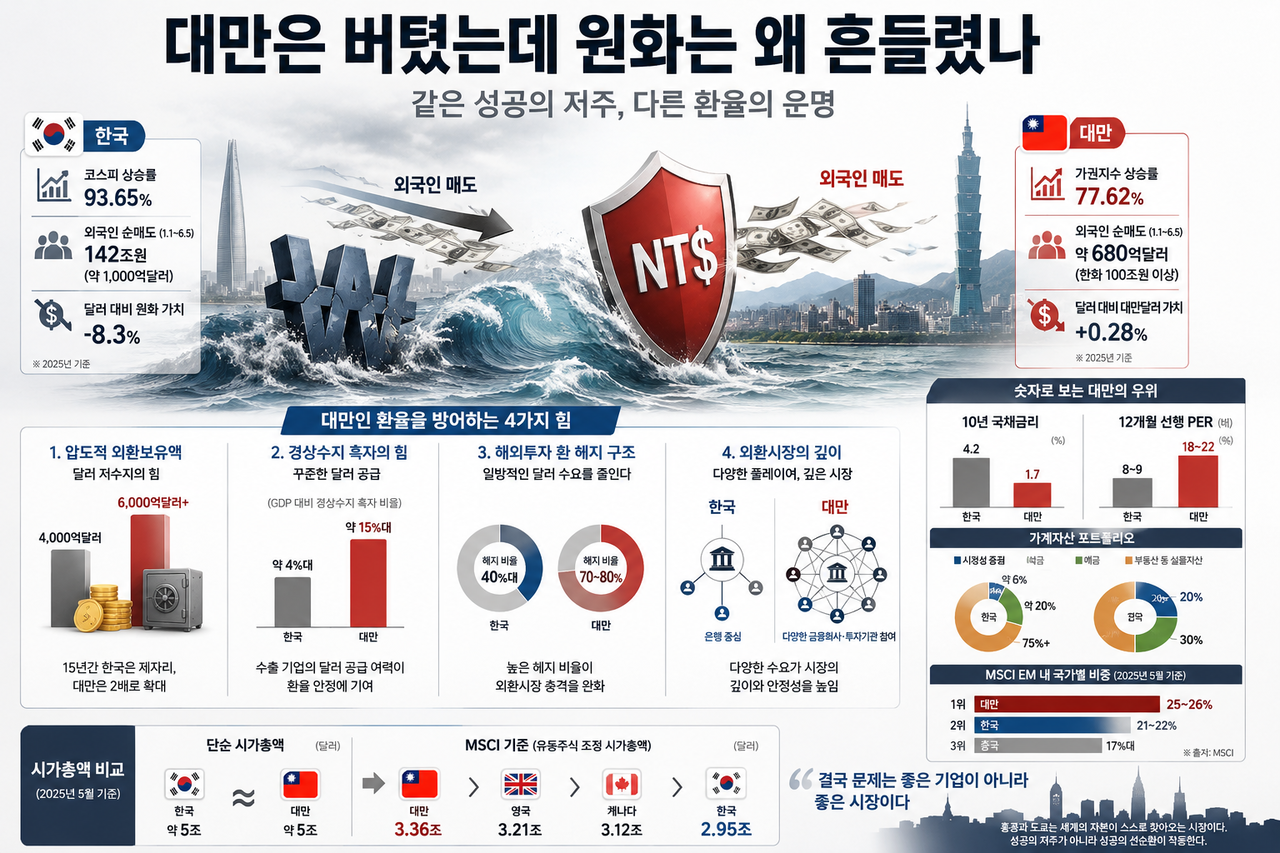
Exchange rate volatility this year: Taiwan 0.28% vs. Korea 8.3%
The Kospi has surged 93.65% this year. Yet foreign investors have been selling. Their cumulative net selling through Friday reached 142 trillion won (approximately $92.9 billion) — roughly $100 billion when average exchange rates are applied. Over the same period, the won fell 8.3% against the dollar.
Taiwan tells a similar story. The Taiwan Weighted Index climbed 77.62% this year, and foreign investors net sold roughly $68 billion worth of Taiwanese shares — more than 100 trillion won. Yet the Taiwan dollar barely moved. The dollar-Taiwan dollar exchange rate fluctuated by just 0.28%.
Korea and Taiwan are the most comparable markets this year. Both rank among the biggest beneficiaries of the AI semiconductor rally. Share prices have surged, and foreign investors have been locking in gains at scale through portfolio rebalancing — adjusting positions swollen by rising valuations — a phenomenon sometimes called the "Curse of Success." What stands out is how differently the two currencies have responded. The won has swung sharply while the Taiwan dollar has held its ground, a difference that comes down to each market's capacity to absorb foreign selling and the resulting dollar demand.
Dollar liquidity shortage in the foreign exchange market triggers sharp rate moves
Does this signal a serious problem with the Korean economy? Not necessarily. Korea runs a current account surplus. The cumulative surplus through May this year, including estimates, is believed to be around $140 billion. Semiconductor exports remain strong, and the Kospi's market capitalization has climbed to roughly sixth in the world. This looks nothing like a typical crisis. The issue is not a shortage of dollars — it is that dollars have not been reaching the market quickly enough.
Foreign investors' net selling of 142 trillion won this year amounts to around $100 billion at current exchange rates — comparable to the foreign exchange reserves of many countries. Domestic investors are also channeling more money abroad: the national pension fund is raising its overseas asset allocation, while individual investors are buying US stocks and ETFs. All of this creates dollar demand. Meanwhile, Korean companies are in no hurry to convert their export earnings back into won. The dollar-earning capacity is strong, but the pace at which those dollars flow back into the market has slowed, leaving it unable to keep up with rising demand.
Taiwan's well-developed mechanisms for balancing dollar supply and demand
Taiwan is different. Despite heavy foreign selling, its exchange rate barely moved — thanks to several shock-absorbing mechanisms.
The first is foreign exchange reserves. Taiwan holds more than $600 billion in reserves — more than Korea despite having a smaller economy. Taiwan cannot easily secure a standing currency swap with the US Federal Reserve the way Japan can, partly because of constraints on formal diplomatic relations. So instead of relying on a dollar credit line, Taiwan has built a large dollar stockpile. Over the past 15 years, while Korea's reserves have hovered around $400 billion, Taiwan has doubled its foreign currency holdings.
The second is the strength of its current account surplus. Taiwan's current account surplus is large relative to the size of its economy. Dollars earned from semiconductor exports flow in consistently. When exchange rates become unstable, Taiwanese exporters tend to supply those dollars to the market. Korean companies, by contrast, are reluctant to convert their export earnings. With the won already volatile and domestic interest rates lower than in the United States, there is little incentive to exchange dollars for won.
The third is the currency-hedging structure of overseas investment. Taiwan's financial institutions — including insurers — invest heavily abroad, and they hedge a high proportion of their currency exposure, which reduces one-sided dollar demand in the foreign exchange market. In Korea, much overseas investment goes unhedged. Leaving foreign investment unhedged can be a deliberate strategy, but when large pools of capital move without hedging, the impact on the broader foreign exchange market grows — and so does the case for hedging, particularly to limit exposure to exchange rate volatility when those investments are eventually unwound.
The fourth is market depth. Neither the won nor the Taiwan dollar is traded on global markets. But while Korea's foreign exchange market is narrow and bank-dominated, Taiwan's draws participation from a wider range of financial institutions and investment firms. Greater diversity of participants deepens trading and improves the market's ability to absorb shocks.
Exchange rates ripple into bond markets and valuations — Taiwan leads emerging markets
Exchange rate movements reach into the bond market as well. A weaker won pushes up import prices. With oil-related product prices already rising amid tensions in the Middle East, further currency depreciation adds to inflationary pressure. This year's real economic growth rate is forecast at around 7% for Taiwan and around 3% for Korea, yet the 10-year government bond yield stands at 1.7% in Taiwan and 4.2% in Korea. Lower interest rates are generally more conducive to economic growth.
Lower rates also support higher equity valuations. On a 12-month forward basis, Korea's price-to-earnings ratio stands at 8 to 9 times, while Taiwan's is 18 to 22 times. Korea's semiconductor rally began in the second half of last year, but TSMC's share price moved earlier — meaning foreign investors began rebalancing out of Taiwan first. Taiwan's domestic capital absorbed that selling well. Household assets in Taiwan are allocated roughly 20% to marketable securities and 30% to deposits, with real estate accounting for just 30%. In Korea, more than 75% of household assets are tied up in real estate and other physical assets, with deposits at around 20% and marketable securities at less than 6%.
Taiwan also has the edge in market depth. As of May, Taiwan accounted for 25 to 26% of the MSCI Emerging Markets Index by country weight, ranking first, while Korea stood at 21 to 22%, in second place — a gap of more than 3 to 4 percentage points. MSCI country weights are determined not by GDP but by free float-adjusted market capitalization, which captures roughly 85% of large- and mid-cap shares available to the public after excluding controlling shareholder and government stakes. Total market capitalization is similar for both countries at around $5 trillion, but on the MSCI measure Taiwan stands at $3.36 trillion against Korea's $2.95 trillion. On that same measure, the United Kingdom ($3.21 trillion) and Canada ($3.12 trillion) also rank ahead of Korea.
Modernizing capital and foreign exchange markets is essential for a wealthier Korea
The AI investment boom has driven a semiconductor supercycle that has sharply lifted the earnings and share prices of Korean companies in the sector. Amendments to the Commercial Act and related reforms have also gone some way toward addressing concerns about the marginalization of minority shareholders. Yet the state of Korea's capital and foreign exchange markets still does not match the country's economic standing — they remain trapped in a 20th-century regulatory mindset.
Advanced economies are ones where capital has accumulated and is put to work efficiently — where returns on capital can outpace those from labor. When a country that boasts the world's sixth-largest stock market and one of the world's largest current account surpluses has underdeveloped capital and foreign exchange markets, the cost to capital efficiency is severe. Both foreign and domestic investors are likely to look elsewhere. That is how the Curse of Success keeps repeating itself.
Ultimately, the problem is not the quality of the companies — it is the quality of the market. Hong Kong and Tokyo are not markets that trade only domestic companies. They are markets that global capital seeks out on its own terms. In those markets, success breeds more success rather than a curse. For those who hope to see the Kospi reach 10,000 and stay there, the goal need not be New York — but surely Korea should be able to close the gap with Hong Kong and Tokyo.
kyhong@heraldcorp.com




