
- HOME
- INDUSTRY
-
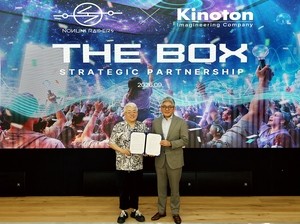
Kinoton, Noneuni Teukgongdae sign MOU to develop immersive screen concept 'The-BOX'
From K-pop to media art, a multipurpose content space Companies aim to open first Seoul location in first half of next year Kinoton, a domestic digital media and spatial solutions company, is joining forces with Noneuni Teukgongdae Entertainment to develop The-BOX, a new-concept immersive screen venue. The two companies signed a business MOU on Friday, agreeing to combine Kinoton's video, audio and LED technology and platform planning capabilities with Noneuni Teukgongdae's content development expertise, AI and video production technology, and artist network. Under the agreement, Kinoton will oversee the overall planning and operation of The-BOX, while Noneuni Teukgongdae will focus on sourcing and developing K-pop-centered content and connecting the project with entertainment agencies and artists. The two companies plan to carry out detailed joint work on the business model and content strategy, with the goal of opening the first The-BOX location in Seoul in the first half of 2027. They intend to use that launch as a springboard to convert some screens at multiplex theaters in South Korea and abroad to The-BOX system, steadily expanding the project's reach. The-BOX is a multipurpose immersive screen venue built around LED technology, designed to present K-pop live streaming, performances, media art, and family and children's content all under one roof. The space and visitor flow are structured so that the audience experience continues seamlessly from entry through the main program and beyond. Kinoton has spent several years working with Cosm, a US-based immersive entertainment company, under an agency agreement, developing immersive dome environments along with the video, audio and broadcast systems to support them. The company has particularly focused on expanding beyond the traditional planetarium concept to research a new generation of viewing experiences covering live performances, sports, media art and interactive content. The-BOX is the next-generation spatial model that emerged from that extended research and development process, designed to deliver vivid, immersive visuals in dome entertainment venues and movie theaters alike. Noneuni Teukgongdae will draw on its content expertise in music, performance and entertainment to secure and develop programming for The-BOX. The company plans to leverage the production experience and industry network of co-CEO Kim Hyung-seok — a composer and producer with more than 1,400 registered copyrights — to build a diverse portfolio of content intellectual property and actively pursue new co-productions. "When groundbreaking content is combined with the video, audio and LED technology that Kinoton has built over 20 years as the country's leading media and visual solutions company, we will be able to deliver a viewing experience that no conventional screen can match," Kinoton CEO Bae Yun-seong said. "Through The-BOX, we will develop and bring to life a new screening model where technology, content and space work together organically." "The ways in which content reaches audiences are expanding rapidly as technology and the media environment evolve," said Kim Hyung-seok, co-CEO of Noneuni Teukgongdae. "We will work to make The-BOX a space that connects diverse content with audiences, drawing on our AI and video production capabilities and our K-pop artist network." Meanwhile, Kinoton marked its 20th anniversary in June and unveiled a future vision at that time. The company aims to strengthen its existing business lines while also identifying, developing and holding content intellectual property — positioning itself as an "IP holder" that integrates the entire process from content production through distribution under one roof.
Sept. 18, 2026
-
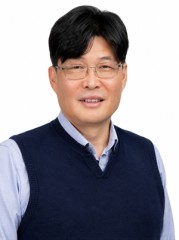
'Intelligent satellites that think for themselves will usher in the space AI era'
Interview with Seo Hyun-seok, head of KAI's space business division A satellite expert who has led South Korea's space development Intelligent satellites seen as the core of space AI solutions KAI focusing on 'AI onboard processing' to get there Seeking to transform from satellite manufacturer to space data company Reliable operation in space is the key challenge for space AI CubeSat demonstrations underway to minimize trial and error "The core of Korea Aerospace Industries' vision for space AI solutions is the realization of 'intelligent satellites' — satellites that can analyze data on their own and make the necessary decisions autonomously." Seo Hyun-seok, executive director and head of KAI's space business division, summed up the company's direction in space in a single sentence during an interview Friday. KAI, a key player in South Korea's defense industry, is expanding into new businesses such as space to move beyond its traditional defense-focused structure. "The ultimate goal is to transform KAI from a company that builds satellites into a company that uses AI to turn space data into valuable information," Seo said. Building an integrated solution based on intelligent satellites Seo is a satellite expert who has spent roughly 30 years at KAI and helped lead South Korea's space development efforts. He has participated in every national satellite program the country has undertaken. This year, he received the Ungbi Medal of Science and Technology in recognition of his contributions to national satellite development. He explained the difference between conventional satellites and intelligent ones. "A conventional satellite transmits data captured or collected in space down to the ground, where people analyze it and then send commands back up to the satellite," he said. "An intelligent satellite equipped with AI, by contrast, analyzes its own data, identifies anomalies and adjusts its mission as needed," he added. To develop intelligent satellites, KAI is focusing first on implementing "AI onboard processing" — the autonomous analysis of a satellite's condition based on data collected by an AI module. KAI is applying its own AI module to a CubeSat project being pursued by Space LiinTech and Yonsei University, running a demonstration program to verify whether the system can diagnose abnormal satellite conditions and respond to failures in space. "Using AI in space is not something KAI can claim as an exclusive technology," Seo said. "What we want to differentiate ourselves on is combining AI with actual satellite systems to create an integrated, operational solution." The goal is for KAI's medium, large and very small satellites to operate together as a single AI-based system. "In the short term, the priority is demonstrating the AI module in space and securing its reliability. In the medium term, we want to expand the scope of AI applications to areas such as image analysis and anomaly detection," he said. "Over the long term, we aim to develop an intelligent satellite constellation in which multiple satellites form a network, share information with one another and divide up mission tasks." 'Government should expand space demonstration programs' The biggest challenge in developing intelligent satellites is making AI operate reliably in space, Seo said. "On the ground, you can draw on high-performance computing resources such as GPUs, but satellites have limited power and processing capacity and are exposed to the harsh environment of cosmic radiation," he said. "Once a satellite is launched, physical repairs from the ground are not possible if something goes wrong." To reduce trial and error, KAI is conducting CubeSat demonstration tests of the kind described above. KAI is also collaborating with a range of companies to accelerate development. As part of that effort, it recently held a K-AI Family technology exchange forum with affiliated companies that possess AI capabilities. "At the forum, we discussed ways to apply AI technology to satellites and manned-unmanned teaming systems," Seo said. "Going forward, we plan to expand our cooperation model to include not only domestic startups but also overseas companies." Seo said that for KAI and other South Korean companies to achieve results in the space sector, they will need broad government support. "To compete with the world's leading space powers, South Korea needs an ecosystem that brings together not only satellite developers but also AI companies, chipmakers, startups, universities and research institutions," he said. "The government must continue to provide sustained support to build that kind of ecosystem." He added that securing opportunities to demonstrate space AI in actual space environments and building an early track record are critically important, and that the government must expand demonstration programs and public-sector demand so that private companies can develop technologies and apply them to real satellites. Seo is scheduled to speak at the Herald Business Forum 2026, to be held Monday at the Shilla Hotel in Jung-gu, Seoul, where he will introduce KAI's vision for space AI solutions.
Sept. 18, 2026
-

Stellantis to unveil 9 concept cars at Paris Motor Show
8 brands, over 60 vehicles on display Peugeot concept car, 9X8 hypercar to debut Fiat SUV, Leapmotor EVs also making first appearance CEO Filosa, other executives to outline future strategy Stellantis, the automaker behind Peugeot, Fiat, DS Automobiles and Alfa Romeo, will unveil nine concept cars at next month's Paris Motor Show. The group plans to display more than 60 vehicles — spanning electric, hybrid, high-performance and racing models — to showcase the next-generation strategies of its individual brands. Stellantis announced Friday that eight of its brands will participate in the 2026 Paris Motor Show, running Oct. 12–18 at the Porte de Versailles exhibition center in Paris. The Stellantis booth, located in Hall 4, will cover 5,340 square meters — the largest footprint among all exhibitors at the event. The space will bring together vehicles ranging from compact urban mobility solutions to long-distance models, presenting the group's multi-energy strategy that encompasses both electrification and internal combustion. Peugeot will be among the brands bringing the widest variety of vehicles. It will debut a previously unseen concept car alongside a high-performance production model. The brand will also display the Polygon concept car, which features its next-generation HyperSquare steer-by-wire system. Motorsport machinery will also be on show. Peugeot will present the 9X8 hypercar, which competes in the FIA World Endurance Championship, alongside the new E-208 GTi. DS Automobiles will make the international motor show debut of the DS N°7, available in both hybrid and fully electric versions. The electric variant offers a maximum range of 740 kilometers on a single charge. Fiat will unveil the Grizzly, a new family SUV, and the Grizzly Fastback, a coupe-bodied variant. Chinese electric vehicle maker Leapmotor is also pushing ahead with its European expansion. The brand, which operates a joint venture with Stellantis, will introduce the B03 — a B-segment compact EV — and the D19 flagship SUV to the European market for the first time. Lancia will present the new Gamma, signaling the brand's return to the C-segment crossover market. Opel plans to reveal the final design of its GSE 27FE Formula E racing car, along with the new Corsa GSE and a new concept car, all in world premieres. Alfa Romeo will display its current lineup, including the Junior, Tonale, Giulia, Stelvio and 33 Stradale. The classic Spider "Duetto," marking its 60th anniversary, will also be brought from a museum for the occasion. Citroën, which traces its origins to Paris, will unveil its recently refreshed product lineup alongside a separate project inspired by iconic models from the brand's past. The nine concept cars Stellantis will present are intended to reflect the design direction and technology each brand plans to apply to future production vehicles. On the technology front, the group will highlight its new modular multi-energy platform, STLA One. The platform supports multiple powertrains within a single vehicle development architecture, combining electrification, software and AI to shorten development timelines. Senior Stellantis executives will converge on Paris for the event. CEO Antonio Filosa and European Chief Operating Officer Emanuele Cappellano will attend brand-specific press conferences in person. Ned Curic, head of engineering and technology, will present technologies to be applied to future group vehicles, while Ralph Gilles, Stellantis global design chief, and Gilles Vidal, European design chief, will outline the design direction for the group and its individual brands. Meanwhile, the show comes as Stellantis pursues an earnings recovery. The group posted net revenue of 43.48 billion euros ($49.9 billion) in the second quarter of this year, up 13 percent from a year earlier, while net profit came in at 293 million euros, swinging back to the black from a loss in the same period last year. The company is pushing ahead with new model launches and a return to profitability under its medium- to long-term strategy, FaSTLAne 2030, unveiled in May. European sales are also rebounding. Stellantis registered about 1.37 million vehicles in the EU30 region in the first half of this year, up 3.8 percent from the same period a year ago. Including Leapmotor sales, the growth rate rises to 7.3 percent.
Sept. 18, 2026
-
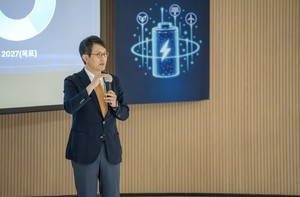
L&F targets 4.5-fold output growth by 2030 with high-nickel, LFP two-track strategy
Shipment volume target set at 4.5 times 2025 levels by 2030 Product mix to shift to 63% NCM, 37% LFP Annual LFP capacity to reach 60,000 tons by first half of next year New demand from 46-series cells, robotics to broaden customer base L&F, long focused on high-nickel cathode materials, is moving to make lithium iron phosphate a second core business. The company aims to broaden its product lineup in response to shifting electric vehicle demand and a growing energy storage system market, targeting total cathode shipments 4.5 times last year's level by 2030. L&F held its "2026 Investor Day" for domestic and international institutional investors and analysts Thursday at the Guji 3 factory in Dalseong-gun, Daegu, unveiling the mid-to-long-term strategy. The centerpiece is a two-track approach: growing high-nickel nickel-cobalt-manganese cathode materials and LFP simultaneously. L&F plans to diversify away from its current high-nickel-heavy structure, targeting a product mix of 63 percent NCM and 37 percent LFP in total shipments by 2030. Through this strategy, L&F has set a goal of expanding total 2030 shipments to 4.5 times 2025 levels. The company also plans to reduce its dependence on specific products and customers while addressing new battery demand beyond electric vehicles — including ESS and robotics. Within its existing NCM lineup, L&F is positioning 46-series large cylindrical battery cathode materials as a growth driver. Having begun supplying cathode materials for 46-series cells late last year, the company aims to grow NCM shipments at an average annual rate of 23 percent through 2030, riding broader adoption by global automakers and rising demand for robot batteries. LFP annual capacity to double from 30,000 to 60,000 tons, with 120,000 tons under review On the LFP side, L&F will target the ESS market first. Its strategy is to secure non-Chinese markets, including North America, by leading with domestic production in an LFP supply chain currently dominated by Chinese manufacturers, before eventually expanding into entry-level electric vehicles. The LFP business will be handled by wholly owned subsidiary L&F Plus. L&F is developing third-generation high-density LFP with a packing density of 2.50 g/cc or above, focusing on addressing the relatively low energy density that has long been a weakness of conventional LFP. Mass production is also ramping up. L&F shipped trial LFP cathode material from its Daegu factory in late July and plans to begin commercial production at an annual capacity of 30,000 tons by the end of this month. It will then expand capacity to 60,000 tons per year by the first half of 2027. The company is also reviewing a further expansion to more than 120,000 tons annually, depending on additional orders. On the raw materials side, L&F is diversifying its precursor suppliers while also developing "precursor-free" LFP technology that eliminates the precursor process altogether. The LFP push is already translating into orders. L&F signed an LFP cathode supply agreement with SK On on Thursday valued at around 160 billion won ($117 million), covering ESS cathode material supply through the end of 2028, with an option to extend the contract by up to three additional years depending on market conditions and demand. The LFP cathode materials supplied to SK On are expected to go into ESS-dedicated LFP battery production lines in Seosan, South Chungcheong Province, and in the state of Georgia. The deal follows a supply agreement L&F signed with a US battery technology company in July, extending its customer base to a domestic battery maker as well. 'Ahead of the targets set in 2024' L&F also provided an update Thursday on the progress of mid-to-long-term targets set at its first Investor Day in 2024. This year's cathode shipment volume is expected to roughly double that of 2024. The company also projected that its 2027 shipment volume and the share of new overseas customers would both exceed the goals set at the time. Investors attending the event toured the L&F Plus LFP production line, observing the full process from raw material input through cathode production and storage, and checking on commercial production readiness. L&F Chief Financial Officer Ryu Seung-heon said the event gave the company a chance to share directly with investors both the business results achieved so far and its growth strategy going forward. "We will deepen the technological competitiveness of our high-nickel NCM, aggressively expand the LFP business, and broaden our foundation into new growth areas such as 46-series cells and robotics," he said. Ryu added that the company would "continuously diversify our product, customer and regional portfolio to strengthen our ability to respond to market changes, and enhance corporate value on the basis of a differentiated growth platform."
Sept. 18, 2026
-
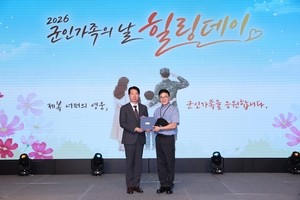
Hanwha defense units host 'healing day' for military families
Now in its third year, the event invited 60 families of exemplary service members Hanwha Group's defense affiliates joined the Ministry of National Defense to host a "healing day" event for exemplary service members and their families in honor of Military Family Day. Hanwha's three defense units — Hanwha Aerospace, Hanwha Systems and Hanwha Ocean — invited 60 families of exemplary service members, selected through a family essay contest, to The Plaza hotel in Seoul on Thursday. This year marked the third time Hanwha has held the healing day event for military families. Jeon Jun-beom, director of the Defense Ministry's AI Planning Bureau, and Hanwha Aerospace Executive Vice President Moon Ji-hoon attended to encourage the service members and their families. Kim Chang-ok, head of Kim Chang-ok Academy and a well-known communications expert, also spoke at the event, delivering a lecture titled "The Art of Joyful Communication." In his congratulatory remarks, Director Jeon said, "It is the support and commitment of their families that allows service members devoted to the nation and its people to focus on their duties." He added that he hoped the gathering would be "a meaningful occasion for mutual encouragement." In his welcoming address, Executive Vice President Moon thanked the exemplary service members and their families for their commitment. "Hanwha will fulfill its corporate social responsibility so that military families can take even greater pride in what they do," he said.
Sept. 18, 2026
-
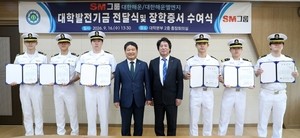
Korea Line marks 40 years of maritime scholarships at Mokpo university
Development fund donated annually since 1987 Scholarships awarded to top shipboard trainees High scorers to receive hiring preference Korea Maritime and Ocean University supported since 1985 Korea Line, an SM Group affiliate, has donated a development fund to Korea National Maritime University in Mokpo, marking 40 consecutive years of support since the company made its first contribution in 1987. Students who earn top marks in shipboard training evaluations will also receive preferential treatment in future hiring processes. Korea Line announced Friday that it held a development fund presentation ceremony Wednesday at the university in Mokpo, South Jeolla Province. About 20 people attended, including Korea Line CEO Min Sang-ki, university President Choi Bu-hong and scholarship recipients. Kwon O-gil, CEO of KLCSM — the maintenance, repair and overhaul arm serving Korea Line and SM Line vessels — also took part. The industry-academia partnership between Korea Line and the university dates to 1987. The company has donated a development fund every year since, continuing the scholarship program even after joining SM Group in 2013. This year's funds will be used as scholarships for students who performed well in Korea Line's shipboard training assessments. The company plans to link the scholarship program to talent recruitment by giving those students an advantage when they apply for positions at Korea Line. "Even as the global shipping industry undergoes rapid change amid the sweeping tide of the Fourth Industrial Revolution, competitiveness ultimately comes from skilled people who thrive on the front lines," Min said. "We will provide even more active support so that these aspiring maritime officers can develop both expertise and practical capabilities, and grow into the leaders who will shape the future of Korea's shipping industry." Choi responded with gratitude. "I am deeply thankful to Korea Line for its generous support and attention to nurturing talent over these 40 years," he said. "We will continue to provide the best possible educational environment so that our students can rise to become next-generation maritime professionals." Beyond Mokpo, Korea Line also provides scholarships to Korea Maritime and Ocean University in Busan. The company's ties with that institution go back to 1985, and it held a separate development fund donation ceremony at the university in Yeongdo-gu, Busan, on Sept. 2. Korea Line operates bulk carriers transporting iron ore and coal, as well as LNG carriers, with its business centered on dedicated vessel contracts and long-term transport agreements. The company's core shipping business has been showing improving profitability. Korea Line posted a consolidated operating profit of 63 billion won ($46 million) in the second quarter of this year, up 91 percent from the same period a year earlier. Its cumulative operating profit for the first half reached 137.4 billion won, supported by the recognition of long-term transport contract earnings and an expansion of charter vessel operations.
Sept. 18, 2026
-
Hankook Tire & Technology signs OE supply deal with Schmitz Cargobull
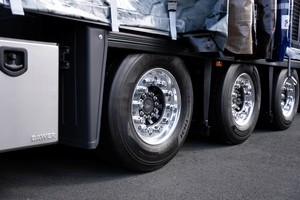
Supply agreement extended through June 2030 Deal covers both original equipment and replacement tire markets Hankook Tire & Technology announced Friday that it has signed an original equipment tire supply agreement with Schmitz Cargobull, Europe's leading trailer manufacturer, to supply truck and bus radial tires. Hankook Tire first supplied original equipment tires to Schmitz Cargobull in 2013 and expanded its product lineup through 2022. Under the new agreement, the company will supply TBR products to Schmitz Cargobull for four years through June 2030. Schmitz Cargobull is Europe's largest specialized trailer manufacturer, with production facilities across the continent — including in Germany, the United Kingdom, Spain, Lithuania, Romania and Turkey. The company leads the European logistics industry with products such as refrigerated semi-trailers and dump trailers. During the partnership, Hankook Tire will supply commercial vehicle tires incorporating its top-tier TBR technology platform, Smart+Technology, across the full range of commercial vehicle lineups manufactured by Schmitz Cargobull. "This partnership reflects the outstanding competitiveness of Hankook Tire's truck and bus tire products and our reliable supply capabilities," a company official said. "By meeting Schmitz Cargobull's rigorous standards for quality, performance and high mileage, we have laid the groundwork to further strengthen our position in the European commercial vehicle market." Hankook Tire plans to accelerate its push into the European commercial vehicle market by continuing to participate in major industry trade shows, including the Road Transport Expo in the United Kingdom, IAA Transportation and the Logistics and Transport Fair in Germany, and The Tire Cologne, where it will showcase its innovative TBR technology. Meanwhile, Hankook Tire has also been making its mark in motorsports — having been named the official tire supplier of the Belgian Rally Championship — as it continues to expand its customer reach worldwide.
Sept. 18, 2026
-
Hanwha Systems joins national space situational awareness program as private developer
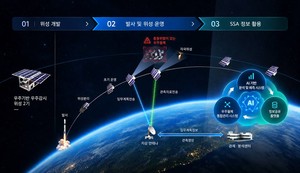
Company signs contract with Korea Astronomy and Space Science Institute for space surveillance satellite and SSA system As low-Earth orbit grows more crowded, proactive collision and reentry response becomes critical Firm aims to build core SSA and SDA capabilities to bolster South Korea's space security Hanwha Systems announced Friday that it signed a contract with the Korea Astronomy and Space Science Institute on Sept. 9 for the development of a space-based space surveillance satellite and a ground-linked space situational awareness system, formally joining the national Space Situational Awareness system, known as K-SSA, as its private system developer. The proliferation of low-Earth orbit satellites has heightened the risk of collisions with artificial and natural objects in orbit, making space situational awareness capabilities — including the ability to respond proactively to collision and reentry threats — increasingly vital to protecting national space assets. The project is part of the K-SSA development initiative led by the Korea AeroSpace Administration. The Korea Astronomy and Space Science Institute serves as the principal research institution, overseeing the program's overall technical direction. As the private system developer for K-SSA, Hanwha Systems will develop the space-based surveillance satellite, build the ground-linked situational awareness infrastructure, and handle integration, linkage and verification across the system's subsystems. The space surveillance satellite Hanwha Systems will develop is a microsatellite designed to operate in low Earth orbit at an altitude of approximately 480 kilometers. Equipped with an optical camera for space situational awareness, it will detect and track artificial and natural objects in real time and collect the observational data needed to analyze collision and reentry risks. The accompanying ground-linked space situational awareness system will serve as the terrestrial infrastructure for integrating and analyzing data on space objects gathered from the surveillance satellite and other observation sources. Applying AI technology, the system will precisely predict and analyze orbital trajectories and collision or reentry risks, and share information to support rapid situational assessment and response. "Through this project, we will secure core technological competitiveness in space situational awareness and space domain awareness, and contribute to strengthening South Korea's independent space security and response capabilities," said Song Seong-chan, head of Hanwha Systems' space business division.
Sept. 18, 2026
-
Doosan bets W3.5tr on semiconductors despite AI slowdown fears
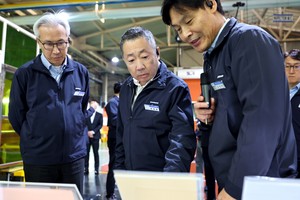
Doosan announces 970 billion won facility investment in South Korea and China Plans 180 billion won new production line in Thailand, announced in April Commits 2.3 trillion won to acquire SK Siltron stake in July Pours 3.5 trillion won into semiconductors this year alone amid AI deceleration debate Company sees long-term semiconductor demand as resilient Aims to broaden business portfolio beyond core units Doosan has been moving aggressively to expand its semiconductor business. This year alone, the conglomerate has committed more than 3 trillion won ($2.19 billion) to semiconductor-related ventures, including scaling up production of copper-clad laminate — commonly known as CCL — and acquiring a semiconductor wafer maker. The push comes even as debate grows over whether the pace of AI development is slowing, with Doosan apparently betting that long-term semiconductor demand will remain robust. According to industry sources, Doosan has invested a total of 3.45 trillion won in semiconductor-related businesses so far this year. Of that, 1.15 trillion won has gone toward expanding CCL capacity. On Thursday, the company announced a 970 billion won facility investment in South Korea and China, and in April it unveiled plans to invest 180 billion won to build a new production line in Thailand. CCL is a core material used in substrates for AI semiconductors. It is widely used in AI accelerators, network switches and optical modules that go into AI data centers. Through this latest investment, Doosan will expand its domestic CCL production lines for optical modules and build a factory in China to manufacture CCL for AI accelerator network switches. The Thailand facility will focus primarily on producing high-performance CCL for network equipment. Some of Doosan's CCL production lines are already running at utilization rates above 100 percent, driven by surging demand from the expansion of AI infrastructure. The company said the capacity additions will allow it to respond swiftly to customer orders while cementing its position as a CCL supplier with strong technological and production capabilities. In July, Doosan invested 2.3 trillion won to acquire a 70.6 percent stake in SK Siltron, the only South Korean company with the technology to manufacture silicon wafers for semiconductors. SK Siltron ranks third globally in market share for 12-inch wafers. Doosan fired the opening shot in its semiconductor portfolio push in 2022 with the acquisition of Doosan Tesna, a back-end semiconductor testing firm. This year's trillion-won-scale investments have allowed the group to complete a vertically integrated semiconductor operation spanning front-end materials — wafers and CCL — through to back-end testing. The investments are drawing attention precisely because they were made amid growing calls for a slowdown in AI development. Major global AI companies, including Anthropic, OpenAI and Google DeepMind, have recently argued that the pace of AI advancement should be deliberately slowed, citing safety concerns among other reasons. Should those firms pull back on investment, demand for semiconductors used in data centers and other AI infrastructure could weaken. Doosan pressed ahead regardless, judging that the current strength in semiconductor demand will hold over the long term. While global technology companies are voicing calls for restraint, each still needs to keep investing to advance its own AI models — and sustained investment points to an upward trajectory for semiconductor demand. In fact, real-world semiconductor market demand continues to grow sharply. According to market research firm Omdia, the global semiconductor market posted double-digit quarter-on-quarter growth for four consecutive quarters from the third quarter of last year through the second quarter of this year. A strong desire to broaden its business portfolio also factored into the trillion-won-scale investments. Past restructuring forced Doosan to divest several affiliates, leaving the group heavily reliant on Doosan Enerbility, which handles nuclear power plant components and power generation, and Doosan Bobcat, which makes compact construction equipment. Together, the two units accounted for well over 80 percent of Doosan Group's total sales last year. Collaborative robots and fuel cells hold significant long-term potential as future growth engines, but their sales remain modest compared with the core businesses. Doosan Robotics, which develops collaborative robots, posted sales of just 33 billion won last year. Doosan Fuel Cell, which mass-produces fuel cells, recorded sales of 454.8 billion won for the same period. Doosan concluded that investing in semiconductors was necessary to drive near-term revenue growth. SK Siltron, which Doosan acquired, posted annual sales of 2 trillion won and operating profit of 400 billion won last year. Doosan's Electronics Business Group, which runs the CCL business, recorded sales of 1.9 trillion won last year — an 86 percent increase from the previous year — and is expected to approach 3 trillion won in sales this year.
Sept. 18, 2026
-
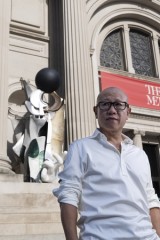
Genesis covers New York Met's Fifth Avenue facade with new works by Liu Wei
Four new works on Metropolitan Museum facade Exhibition explores fragmentation, transformation and regeneration Third artist in Genesis facade commission series, following Lee Bul and Jeffrey Gibson On view through June 8 next year The Fifth Avenue facade of the Metropolitan Museum of Art in New York is now covered with large-scale sculptures by Chinese contemporary artist Liu Wei, marking the third installment of a contemporary art project Genesis launched with the museum in 2024. Genesis announced Friday that "The Genesis Facade Commission: Liu Wei, Speculation" opened Thursday (local time) and will remain on view through June 8 next year. The Genesis Facade Commission is an annual contemporary art project that selects one artist each year to present a large-scale installation on the Fifth Avenue facade of the Metropolitan Museum of Art. It launched in 2024 with Korean artist Lee Bul, followed last year by American artist Jeffrey Gibson. This year's featured artist is Beijing-based Liu Wei, who since the late 1990s has worked across photography, painting, video, sculpture and installation to capture the rapidly changing landscape of Chinese society and its cities. He is recognized for reinterpreting conceptual art — which prizes ideas, process and context over the finished form — in his own distinctive way. The exhibition presents four large-scale sculptures centered on the themes of fragmentation, transformation and regeneration, exploring the process by which things are dismantled and then remade. The four works are titled "Speculation / Λ," "Speculation / G," "Speculation / c" and "Speculation / h" — each incorporating a fundamental physical constant used in physics. Viewed up close, the sculptures appear to blend fragments of crumbled architecture with parts of the human body. The materials range from composite fiberglass, iron and aluminum alloy to bronze, leather and rope. Rather than forming a single, complete shape, each work is composed of multiple objects connected in deliberately incomplete ways. The motif of hands recurs throughout all four works — a recurring element in Liu Wei's practice. Rendered as a familiar part of the human body yet distorted into forms that could not exist in the real world, the hands serve as a device linking reality and imagination. The exhibition title "Speculation" carries meanings of conjecture and contemplation. Through it, the artist expresses the uncertainty individuals face in a rapidly changing society, along with the tension and conflict that arise in the process. A Genesis official said the exhibition "reframes familiar forms through a distinctive artistic language to illuminate multiple layers of contemporary reality," expressing hope that it would offer audiences insight into the human experience in an era of rapid change. Max Hollein, director and CEO of the Metropolitan Museum of Art, said Liu Wei's works would demonstrate "not only curiosity and innovation but also the artist's distinctive humor," adding that he was honored to expand the possibilities of the museum's facade through The Genesis Facade Commission. On Tuesday, the museum will host "An Evening with Liu Wei," in which the artist will discuss his creative process and artistic practice in person. Beyond New York, Genesis continues its arts patronage in Los Angeles, where it has formed a long-term partnership with the Los Angeles County Museum of Art to sponsor "The Genesis Talks." In South Korea, the automaker is also supporting the National Museum of Modern and Contemporary Art's exhibition on Suh Do-ho, which runs through Feb. 9 next year.
Sept. 18, 2026
-
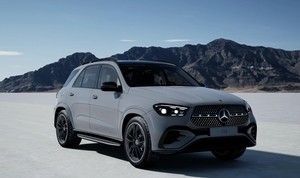
Mercedes-Benz Korea launches limited-edition GLE, GLE Coupe and GLS to mark 140 years of the automobile
Manufaktur Alpine Grey and Obsidian Black exterior colors Night Package applied across lineup Popular convenience and driving options included 680 units total across three models Mercedes-Benz Korea announced Friday the launch of the "140th Anniversary Edition II" for three of its flagship SUVs — the GLE, GLE Coupe and GLS — to commemorate 140 years since the invention of the automobile. The edition honors 140 years of innovation and expresses gratitude for customer support, featuring a curated selection of premium specifications favored by Korean customers at a competitive price. The lineup comprises the GLE 450 4MATIC AMG Line, the GLE 450 4MATIC Coupe and the GLS 580 4MATIC AMG Line. All three models in the 140th Anniversary Edition II share a unified design identity, finished in either Manufaktur Alpine Grey or Obsidian Black with the Night Package applied, and a consistent interior design concept throughout. The GLE 450 4MATIC AMG Line and GLE 450 4MATIC Coupe build on the AMG Line's dynamic styling with added black design elements for a sporty yet refined look. Exterior appointments include Manufaktur Alpine Grey and Obsidian Black color options, the Night Package — bringing a dark chrome radiator grille, AMG apron, high-gloss black exterior mirrors and window line trim — along with dark chrome door handles and black door sill panels. Inside, black Nappa leather and anthracite open-pore wood trim create a premium cabin atmosphere. The vehicles also come fitted with 22-inch AMG 5-twin-spoke lightweight alloy wheels. The GLS 580 4MATIC AMG Line adds sporty design and a heightened level of ride comfort to the commanding presence of a full-size luxury SUV. It comes equipped with 23-inch AMG 5-twin-spoke lightweight alloy wheels and E-ACTIVE BODY CONTROL suspension to reinforce its flagship credentials, while the AMG Line exterior combined with the Night Package emphasizes both its imposing stature and sporty character. Prices, including VAT and based on the 5 percent individual consumption tax rate, are 141.4 million won ($103,000) for the GLE 450 4MATIC AMG Line 140th Anniversary Edition II, 145.4 million won for the GLE 450 4MATIC Coupe 140th Anniversary Edition II, and 199 million won for the GLS 580 4MATIC AMG Line 140th Anniversary Edition II. A total of 350 units of the GLE 450 4MATIC AMG Line 140th Anniversary Edition II will be available — 175 in Manufaktur Alpine Grey and 175 in Obsidian Black. The GLE 450 4MATIC Coupe 140th Anniversary Edition II will be offered in 230 units, split evenly at 115 each between the two colors. The GLS 580 4MATIC AMG Line 140th Anniversary Edition II is limited to 100 units, available exclusively in Alpine Grey. "We will continue to expand our edition portfolio to meet the distinctive lifestyles and discerning tastes of our customers, while further strengthening our leadership as a luxury brand," a Mercedes-Benz Korea official said. Meanwhile, Mercedes-Benz Korea has been pursuing a range of initiatives to enhance customer service, including recently holding a joint launch ceremony at its Training Academy in Yongin, Gyeonggi Province, to mark the start of the 19th cohort of its AET technician training program and the 10th cohort of its Ausbildung program.
Sept. 18, 2026
-
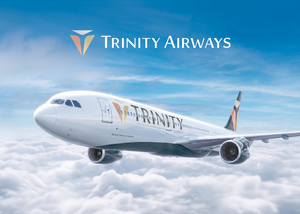
Trinity Airways launches new website and app to reflect rebranded identity
New brand operations began Thursday Brand transition completed at major customer touchpoints Airline pledges continued expansion of customer engagement Trinity Airways announced Friday that it has launched a new website and mobile app reflecting its updated brand identity. The airline began operating under its new brand Thursday, starting with the domestic Daegu-Jeju route and the international Incheon-Narita route. In step with the relaunch, Trinity completed the brand transition across major customer touchpoints — including its website, mobile app and airport counters — to ensure passengers experience the new identity consistently at every stage of their journey. The website overhaul focused on applying the new brand identity across the digital environment while retaining the existing menu structure and core functions. Key user interface elements — including colors, fonts, images and graphic motifs — were updated in line with the new brand guidelines, giving the site a unified design tone. Particular attention was paid to conveying the brand values of Sono Trinity Group's Trinity Airways — centered on being a "comfortable and trustworthy airline" — through visual elements and content that feel natural in a digital setting. Trinity Airways also built a standalone brand microsite to introduce the values and vision behind its new identity. The microsite presents the airline's new beginning and brand story alongside its core values, service direction and brand identity, using a range of visuals and interactive content. "We have embedded our new brand identity into the digital touchpoints our customers encounter most often, in keeping with this fresh start," a Trinity Airways official said. "We will continue to strengthen the brand experience so that Trinity's unique brand values are conveyed naturally across all customer touchpoints." Meanwhile, Trinity plans to introduce the next-generation Airbus A330-900neo wide-body aircraft and Boeing 737-8 this year as it works to build a more competitive lineup of differentiated services and medium- to long-haul routes. Trinity is also participating for the fourth consecutive year in the 2026 Future Tomorrow Work Experience program, which provides young job seekers with hands-on experience in the aviation industry, as part of its broader commitment to corporate social responsibility.
Sept. 18, 2026
-
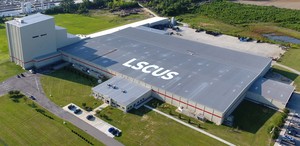
Gaon Cable to more than double US production capacity with $50m investment
Only Korean cable maker with a US power cable factory Expanded local production expected to ease tariff burden Infrastructure investment set to grow if Korea-US energy projects proceed Gaon Cable, a subsidiary of LS Cable & System, announced Friday it will invest $50 million in its US subsidiary LSCUS to more than double local cable production capacity. Gaon Cable is the only Korean cable maker with a power cable factory in the United States. The investment is expected to reduce tariff and logistics costs while improving delivery times and supply stability. The company also anticipates indirect benefits from South Korea's large-scale energy investment push into the United States. Projects under consideration as part of the government's US investment drive include large combined-cycle gas power plants and nuclear power plant construction. As power generation investment picks up, demand is expected to grow not only for nuclear and gas power equipment but also for transmission and distribution networks connecting generated electricity to data centers and industrial facilities — all of which would boost demand for the power products Gaon Cable mass-produces. Orders are already coming in. Gaon Cable is supplying underground distribution URD cables to solar power complexes in the United States and providing distribution cables for private power plant projects serving AI data centers. On the back of consecutive orders, the company's exports of cables for AI data centers and solar power grids to the US market are forecast to grow from about 100 billion won ($73.1 million) last year to 200 billion won this year. The string of orders has driven sharp earnings growth. LSCUS sales this year are expected to roughly double from last year's 470 billion won. Bus duct sales are also projected to rise from the hundreds of billions of won last year to the trillions of won range this year. Driven by strong US business performance, Gaon Cable's consolidated sales for the first half of this year reached 1.63 trillion won, up 27.3 percent from the same period a year earlier. Operating profit hit a record 64 billion won for a half-year period, up 41.8 percent year on year. To sustain the momentum, the company plans to expand its business scope. Using its US production base, Gaon Cable intends to build a value chain spanning power generation, transmission and distribution, and AI data centers — covering URD cables for solar farms, cables for power plants and grid networks, and bus ducts inside data centers. "US investment in nuclear and gas power generation is likely to trigger follow-on investment in transmission and distribution networks," a securities industry official said. "Gaon Cable is the only Korean cable maker with a local power cable production base in the United States, and it is already posting sharp growth in solar and AI data center segments. It deserves attention as a prime beneficiary of expanding US power infrastructure investment."
Sept. 18, 2026
-
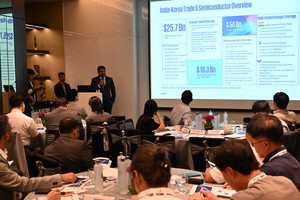
KOTRA backs Korean firms' push into India's booming semiconductor supply chain
'Korea-India Semiconductor Partnership Week' tied to Semicon India 2026 15 Korean firms, 40 Indian buyers hold 80 one-on-one consultations India commits $8.4 billion to build domestic semiconductor ecosystem Korea's exports to India up 30.8% in January–August Korean materials, components and equipment companies are moving to secure a foothold in India's semiconductor supply chain, targeting a market projected to reach $110 billion by 2030. As India rapidly expands its semiconductor production facilities backed by large-scale government subsidies, the push is to help Korean firms lock in local business relationships from the earliest stages of that buildout. KOTRA announced Friday that it held the "Korea-India Semiconductor Partnership Week" from Wednesday through Saturday in conjunction with Semicon India 2026 at Yashobhoomi in New Delhi. The event is one of the follow-up initiatives stemming from expanded economic cooperation between the two countries since President Lee Jae Myung's state visit to India in April. During that visit, Lee and Indian Prime Minister Narendra Modi agreed to raise bilateral trade from around $25 billion annually to $50 billion by 2030 and to accelerate negotiations on improving the Korea-India Comprehensive Economic Partnership Agreement (CEPA). Having held an event last month to boost exports of Korean consumer goods, KOTRA broadened the scope of cooperation this time to cover the semiconductor supply chain. The program ran from policy seminars on India's semiconductor landscape to exhibitions, export consultations and roundtable discussions between companies from both countries. India is building a domestic semiconductor production base through its government-led India Semiconductor Mission (ISM), channeling roughly $8.4 billion in subsidies into the effort. Of the 12 semiconductor projects currently approved, nine are concentrated in back-end processes such as packaging and testing. Global companies including Micron and Foxconn have also been making local investments. India's semiconductor market is forecast to more than double, from $54 billion last year to $110 billion by 2030. With the Indian government rolling out a follow-on policy called "Semicon 2.0," competition among global companies to secure early positions in production equipment, materials and components is intensifying. Semicon India 2026, which opened Thursday, drew more than 600 companies from 52 countries. South Korea set up a dedicated national pavilion alongside Japan, the Netherlands, Singapore and others. KOTRA is particularly focused on helping small and mid-sized Korean materials, components and equipment firms enter India's new production facilities as suppliers from the ground up. The strategy targets not only cutting-edge advanced-node processes but also equipment for mature-node processes widely used in automotive and home appliance applications, as well as the materials and components market for local factories. Earlier, KOTRA invited Amitesh Kumar Sinha, CEO of the India Semiconductor Mission, to an online policy briefing for Korean companies on Sept. 8. The Semiconductor Partnership Strategy Seminar held Wednesday in New Delhi brought together Invest India, the Electronics Sector Skills Council of India (ESSCI), KPMG and EY, among others. The session introduced Korean companies to India's semiconductor market outlook, regional investment conditions, tax and labor regimes, and strategies for securing local talent. Fifteen Korean companies dealing in back-end semiconductor equipment, packaging materials and power semiconductors participated in the Korean pavilion, which runs for three days starting Thursday. Those firms held a total of 80 one-on-one export and technology cooperation consultations with 40 Indian buyers. Major local semiconductor companies — including Tata Electronics, Kaynes, CG Semi and IndiaChip — also took part, exploring the possibility of adopting Korean products and technology. On Friday, KOTRA co-hosted the "Korea-India Semiconductor Roundtable" with the India Electronics and Semiconductor Association (IESA). About 60 representatives from companies, government agencies and industry organizations from both countries attended, discussing supply chain cooperation and investment incentives. Semiconductors are also playing a growing role in bilateral trade. Korea's exports to India totaled $16.8 billion in the January–August period this year, up 30.8 percent from the same period a year earlier. Rising semiconductor demand driven by India's expanding investment in AI and data centers was identified as a key factor behind the export surge. KOTRA plans to connect the purchasing and investment demand identified at the event with additional Korean companies, and to provide follow-up support for promising projects through its Global Partnering program. A market report on India's semiconductor industry and entry environment is also set for release in the fourth quarter of this year. "Now is the time to partner with local players and prepare to secure an early position in the market, as India emerges as a global semiconductor production hub," KOTRA President Kang Kyung-sung said. "We will do our utmost to expand the K-materials, components and equipment partnership — building on consumer goods and now centering on semiconductors — to help usher in the era of $50 billion in Korea-India trade by 2030, as announced by the two leaders during the April summit."
Sept. 18, 2026
-
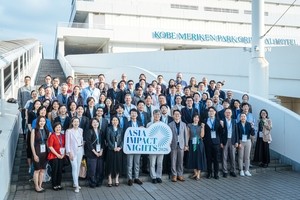
Hyundai Motor Chung Mong-koo Foundation highlights catalytic capital role at Asia impact investment forum
Main session held at Asia Impact Investment Forum 100 leaders in Asian impact investment gather The Hyundai Motor Chung Mong-koo Foundation said Friday it hosted a main session at "2026 Asia Impact Nights" (AIN 2026), held in Kobe, Japan, from Wednesday through Oct. 3, where it discussed the role of capital in sustainable social innovation and avenues for collaboration with leading figures in Asia's impact investment ecosystem. This year's event centered on the theme "Asia's Triple Transition: From Risk to Opportunity," exploring ways to turn Asia's shared challenges — demographic shifts, the climate crisis and the AI transition — into new impact opportunities. AIN is an Asia-wide impact investment forum that began in 2016 as an initiative by D3 Jubilee Partners to introduce impact investing to South Korea, marking its 10th anniversary this year. It has since expanded to include participants from Japan, Hong Kong, Singapore and Southeast Asia, growing into a platform where investors, foundations, corporations, social innovators and ecosystem builders forge long-term relationships and trust. This year's event was co-hosted by South Korea's D3 Jubilee Partners and Japan's Social Innovation and Investment Foundation (SIIF), drawing 100 impact sector leaders from South Korea, Japan and across Asia, as well as from the United States, Europe and Australia. Secretary General Choi Jae-ho of the Hyundai Motor Chung Mong-koo Foundation presented the role of public-interest foundations in building social wealth during a session on "catalytic capital" on Thursday. Drawing on the distinction between capital and wealth, Choi said, "If capital is the means to reach a destination, then wealth is the destination we ultimately seek to arrive at," adding that the social role of a public-interest foundation lies in converting its assets into human and social capital to accumulate sustainable social wealth for future generations. Choi also highlighted what he called the "gray zone" that social enterprises face after public support ends but before private investment takes hold in earnest, arguing that private foundations need to play a catalytic role by sharing the risk of early-stage failure during that interval. He further proposed a "public-philanthropic partnership" in which governments and private foundations share risk and promote social innovation to address complex challenges such as low birth rates, aging, regional depopulation and the climate crisis. As a prime example of catalytic capital in action, Choi cited the foundation's CMK Impact-preneur program, which has contributed to building a social economy ecosystem. Since 2012, the foundation has identified and nurtured impact startups that tackle social problems through innovative business models and technology. Over the past 14 years, it has supported 374 companies, created 7,481 jobs and attracted a cumulative 377.9 billion won ($276 million) in investment. Starting this year, the foundation has shifted the focus of its support from organizations to individual entrepreneurs, building a fellowship and ecosystem that allows social innovators to keep growing and take on new social challenges. Also beginning this year, the foundation has partnered with the United Nations Development Programme to advance the CMK Global Impact-preneur program, which nurtures promising social innovators across the Asia-Pacific region. It is connecting the mentoring experience accumulated domestically with a global network to help participants grow and collaborate across borders. "We will continue to broaden exchanges and cooperation with diverse partners — including foundations, impact investors, corporations and public institutions across Asia — and work to build an Asian social innovation ecosystem where innovators can keep pushing boundaries," a foundation official said. Meanwhile, the Hyundai Motor Chung Mong-koo Foundation has also been actively identifying and nurturing talent across a range of fields, recently hosting the "2026 CMK Chamber Music Series" at the IBK Chamber Hall at Seoul Arts Center. The CMK Chamber Music Series is part of CMK Young Arts, the foundation's classical music talent development program, and features performances in which scholarship recipients studying classical music take the stage alongside their faculty mentors.
Sept. 18, 2026
-
K Car executives buy W400m in shares, citing confidence in company value
Four executives purchase 63,000 shares worth 400 million won Move follows KG Group's acquisition and corporate rebrand Earnings recovery and group synergy remain key challenges Senior executives at KG Mobility Platform, the operator of the K Car used-car brand that recently joined KG Group, have purchased about 400 million won ($292,000) worth of company shares. The purchases, made shortly after a change in controlling shareholder, signal the management team's commitment to improving corporate value and accountability. KG Mobility Platform announced Friday that Chief Executive Officer Jung In-kook and three other senior executives bought a combined 63,000 shares on the open market. Jung led the purchases, acquiring 40,000 shares. Park Ji-won, head of the rental car division, and Jeon Ho-il, head of the marketing division, each bought 10,000 shares, while Hwang Jae-hyeok, head of the auction division, purchased 3,000 shares. The total value of the purchases came to about 400 million won. It is not the first time Jung has bought company shares. In 2022, he invested about 250 million won to acquire 10,000 shares. The timing is notable. KG Group completed its acquisition of K Car on Aug. 31, and the company formally relaunched this month under its new corporate name, KG Mobility Platform, having previously operated as K Car. The consumer-facing K Car brand will be retained. KG Group is pursuing an expansion of its mobility business by linking KG Mobility, which handles vehicle manufacturing, with used-car sales, rental cars and auto financing. Earnings recovery is another challenge for the new management. Last year, the company posted record-high sales of 2.44 trillion won and operating profit of 76 billion won. In the second quarter of this year, it recorded sales of 439.2 billion won and an operating loss of 33.6 billion won, hurt by weak consumer sentiment in the used-car market and disruptions to Middle East exports. It was the company's first quarterly operating loss since its listing in 2021. KG Mobility Platform's core business involves buying used vehicles directly, inspecting them and reselling them through company-owned outlets. It also operates rental car and auction businesses, with 48 directly managed locations nationwide and an online home-delivery purchase service. Since joining KG Group, the company has been working to broaden its scope by linking its used-car operations with KG Mobility's new-vehicle business and expanding into rental, auction and financial services. How quickly the group can generate meaningful synergies across its affiliates is expected to be a key variable in the company's future valuation. "This share purchase is our way of showing, through action, that management has conviction in the company's growth potential and corporate value," Jung said. "We will continue to strengthen our core business competitiveness, deliver stable earnings and do our utmost to enhance corporate and shareholder value."
Sept. 18, 2026
-
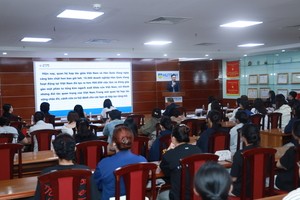
KITA takes K-career roadshow to 280 Vietnamese students
Helping Korean firms in Vietnam secure local talent Ho Chi Minh City university tour offers employment roadmap The Korea International Trade Association announced Friday that it had held a "K-Career Employment Roadmap Tour" to help Korean companies operating in Vietnam recruit local talent. The three-day program ran from Tuesday through Thursday (local time) at three major universities in Ho Chi Minh City and at the Korean Chamber of Commerce and Industry in Vietnam (KOCHAM), reaching about 280 university students majoring in Korean language and Korean studies. Vietnam ranks among Korea's top three investment destinations and top three trading partners. According to the Export-Import Bank of Korea, cumulative overseas direct investment since 1980 places Vietnam third at $43 billion, behind the United States at $282.5 billion and China at $99.8 billion. The lectures were designed to help Korean firms in Vietnam hire locally based candidates with Korean-language skills, while also strengthening students' competitiveness in the Korean job market. Sessions were held at the KOCHAM seminar room, followed by Huflit University of Technology, Hong Bang International University and Van Lang University — four sessions in total. The curriculum covered KITA's Trade Academy and online trade-practice courses, as well as a roadmap for landing jobs at Korean companies. Jeong Mi-jin, a career coach at the Trade Academy's Employment Support Center, told students that breaking into Korean companies requires more than language ability — they must also develop job-specific expertise and an understanding of the local market. She also drew on an analysis of recent job postings by Korean firms in Vietnam to walk students through Korean corporate culture, the qualities companies look for in candidates, and the core competencies required for different roles. She additionally shared tips on writing Korean-style resumes and cover letters in both Korean and English, navigating AI-based aptitude assessments, and preparing for in-person interviews. "The more than 10,000 Korean companies in Vietnam have created over 900,000 jobs and account for roughly a quarter of the country's exports, making them a core partner in Vietnam's economy," said Kim Young-jin, head of KITA's Ho Chi Minh City branch. "As Korean companies increasingly seek candidates who not only speak the language but also understand corporate culture and possess practical skills, we will use this lecture series as a springboard to expand our support for local young people pursuing K-careers in earnest." KITA's Ho Chi Minh City branch plans to give students who attended the lectures access to the Trade Academy's online foundational trade-practice course, and to open an offline intensive Korean-language program focused on trade practice. It also intends to follow up with one-on-one job coaching and job-matching services for graduates to support hiring by Korean companies in the country. Meanwhile, KITA co-hosted the "Korea-Abu Dhabi Networking Forum" with the Abu Dhabi Chamber of Commerce and Industry on Thursday at Trade Tower in Samsung-dong, Gangnam-gu, Seoul. The forum was organized on the occasion of a visit to Korea by an Abu Dhabi Chamber delegation, with the aim of providing Korean exporters with information on entering the Abu Dhabi market and creating networking opportunities with local businesses.
Sept. 18, 2026
-
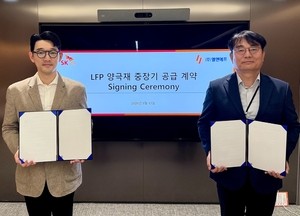
SK On to source W160b in LFP cathode materials from L&F to build China-free ESS supply chain
LFP cathode supply deal runs through end of 2028 Contract extendable by up to three additional years Materials to feed LFP cell lines in Seosan and Georgia L&F targets annual capacity of 60,000 tons by first half of 2027 SK On will source 160 billion won ($117 million) worth of lithium iron phosphate (LFP) cathode materials from L&F as the battery maker expands production of LFP cells for energy storage systems (ESS) in the United States and South Korea and moves to secure a domestic supply chain for key materials long dominated by Chinese suppliers. The two companies signed the LFP cathode supply agreement Thursday at SK On's Gwanhun Campus in Jongno-gu, Seoul, and announced the deal Friday. Kim Seong-tan, SK On's head of raw material procurement, and Lee Byeong-hui, L&F's chief operating officer, attended the signing ceremony. Under the agreement, SK On will receive high-density LFP cathode materials for ESS use from L&F from this year through the end of 2028, with the total supply valued at about 160 billion won. The two sides also left open the possibility of extending the contract by up to three additional years, subject to review of supply performance, market conditions and customer demand. The cathode materials will go into LFP battery cells for ESS produced at SK On's factory in Seosan, South Chungcheong Province, and at its plant in Georgia. LFP batteries are generally cheaper than ternary batteries that use nickel and cobalt, and are valued for their thermal stability and long cycle life. Although their energy density is relatively lower, demand has been growing rapidly, particularly for large-scale ESS applications and entry-level electric vehicles. Chinese companies are estimated to account for more than 90 percent of the global LFP cathode supply chain. As demand for non-Chinese battery materials grows, especially in the United States, South Korean battery and materials companies have been accelerating efforts to build their own production bases. SK On has been developing ESS as a new growth engine alongside its electric vehicle battery business. Last month, it signed a deal with US-based ESS company Neovolta Power to supply a total of 9 gigawatt-hours of LFP battery cells over five years starting in 2027, a contract the industry estimates at around 1.5 trillion won. The two companies are also pursuing a plan to expand their cooperation to a cumulative 18 gigawatt-hours. In South Korea, SK On secured 284 megawatts out of 565 megawatts put up for bid in the second round of the ESS central contract market auction in February. To meet growing ESS demand, SK On is converting some of its existing electric vehicle battery production facilities for ESS use. At the Seosan factory, 3 gigawatt-hours of the total 7-gigawatt-hour production capacity will be converted to an ESS-dedicated LFP line, with supply expected to begin in the first half of next year. A portion of the Georgia factory's production lines will also be converted to manufacture ESS LFP battery cells. "As the shift away from Chinese suppliers accelerates in the global ESS battery market, we have proactively secured high-quality domestic LFP cathode materials through a medium- to long-term supply agreement," Kim said. "This contract will significantly strengthen SK On's competitiveness in LFP battery materials." L&F broadens business beyond high-nickel into LFP For L&F, the deal is expected to serve as a turning point in expanding its business portfolio beyond its high-nickel cathode focus into LFP materials. L&F established a wholly owned subsidiary, L&F Plus, dedicated to its LFP business in August last year. The company set up a dedicated LFP cathode factory on a roughly 100,000-square-meter site in the Dalseong-gun national industrial complex in Daegu. The factory was completed in May, and L&F shipped its first trial production from the domestic LFP cathode mass production line in late July. The product L&F will supply to SK On is a third-generation high-density LFP cathode material developed to achieve a packing density of 2.50 grams per cubic centimeter or higher, targeting the low energy density that has traditionally been seen as a weakness of LFP chemistry. L&F plans to scale up production in stages. The company entered commercial production at an annual capacity of 30,000 tons at the end of the third quarter and aims to reach an annual capacity of 60,000 tons by the first half of 2027. Further expansion will be considered if demand continues to grow. L&F has also been diversifying its customer base, having earlier supplied LFP prototype materials to other customers in North America. "This contract is recognition of L&F's LFP product competitiveness, customer responsiveness and early mass production capability," Chief Operating Officer Lee said. "We will continue to expand our customer base in the ESS and entry-level EV markets on the strength of stable mass production and differentiated product competitiveness, and grow into a leading materials company driving the global non-Chinese LFP supply chain."
Sept. 18, 2026
-
Samsung Display chief says 'we're the best' at foldables, vows OLED won't suffer LCD's fate
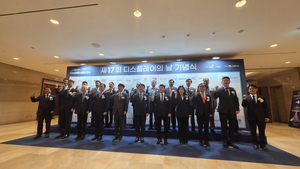
17th Display Industry Day ceremony Samsung Display supplies all OLED panels for Apple's iPhone Duo Lee Cheong expresses confidence in foldable technology lead Warns of China's 'relentless offensive' backed by capital and policy support Government pledges support until 80% market share is reclaimed 500 billion won research institute planned Lee Cheong, chairman of the Korea Display Industry Association and chief executive of Samsung Display, expressed confidence in his company's foldable display technology, declaring "we're the best." On China's pursuit of OLED technology, he warned that the industry "cannot repeat the painful experience of LCD." Lee made the remarks Thursday afternoon at the 17th Display Industry Day ceremony at Lotte Hotel World in Seoul, opening with a note on the difficult business environment. "Over the past year, external conditions — including oil price instability triggered by the war in the Middle East, rising raw material and component costs, and demand contraction caused by chipflation — have continued to weigh on the industry," he said. He was particularly alert to China's rise. "A rival nation that once seized dominance in LCD through technology theft and aggressive government support is now reinvesting its accumulated capital and capabilities into OLED, once again setting its sights squarely on Korea's display industry," Lee warned. He added that while Korea had pioneered the OLED market through relentless technological innovation and sustained investment, its competitors were "mounting a relentless offensive to enter the global market, rapidly expanding production capacity in a short period backed by massive capital and policy support." "We cannot repeat the painful experience of LCD," Lee said, adding that if industry, government, academia and research institutions truly came together as "one team" to protect core technologies and build next-generation competitiveness, "we can turn the tide on this uneven playing field back in our favor." He went on to say that every individual present played a vital role. "Your technology, experience and effort have built Korea's display industry today and will lead 'Display Powerhouse Korea' tomorrow," he said. "I hope this becomes a time of gathering strength and preparing for new challenges." Earlier, ahead of the ceremony, Lee told reporters that Samsung Display's foldable technology was superior to China's, saying simply, "we're the best." Samsung Display is supplying all foldable display panels for the iPhone Duo, Apple's first foldable phone, which was recently unveiled. As China accelerates its push into OLED — having already overtaken Korea in LCD — both the government and the National Assembly pledged full support. Democratic Party of Korea lawmaker Park Jeong said displays would grow increasingly important as the interface through which people interact with AI, urging the Ministry of Trade, Industry and Energy to "provide sufficient policy backing so that our companies can maintain an overwhelming lead in the global market." Democratic Party lawmaker Jeon Eun-su said the display industry had become "a contest of national capabilities, not just corporate competition," and pledged that the government would take the lead on necessary support and regulatory reform rather than leaving it all to companies. "We will do our utmost to put in place the laws and systems needed during this regular session of the National Assembly," she said. Min Woo Lee, director general for industrial growth at the Ministry of Trade, Industry and Energy, said Korea's OLED market share had peaked at 81.3 percent in 2022 before falling to 67.2 percent in 2024, with a slight recovery to 68.7 percent last year. "The government will continue its support until we surpass 70 percent this year and reclaim 80 percent," he promised. He added that the government would increase display research and development funding by 5.5 percent to 117 billion won ($85.5 million) and was conducting a preliminary feasibility study for a display research institute worth 500 billion won. "We will work hard to create new markets," he said. Meanwhile, 36 individuals who contributed to the advancement of the display industry were honored with government and private-sector awards at the ceremony. The Silver Tower Order of Industrial Service Merit went to Lee Ki-seung, chief executive of Se Gyung Hi Tech, for his contributions to localizing materials, components and equipment and to the designation of national advanced strategic technologies. A presidential commendation was awarded to Yoon Ji-hwan, executive vice president of Samsung Display, who led the development of the world's first QD-OLED technology. Hwang Sang-geun, an executive at LG Display, and Lee Jae-hyeok, chief executive of ELP, each received a prime ministerial commendation.
Sept. 17, 2026
-
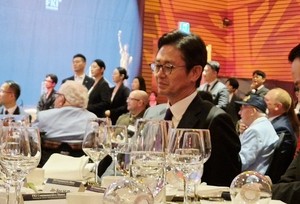
Samsung, SK hynix government-affairs chiefs attend US founding anniversary dinner amid semiconductor investment pressure
Korea business lobby hosts gala marking 250th anniversary of US founding Samsung Electronics' Kim Won-kyung attends as top external affairs executive Jung Yeo-jin of SK hynix makes her debut at major business gathering US Ambassador Michelle Steel makes first official public appearance since taking post Senior executives from South Korea's top conglomerates gathered Thursday at a gala dinner marking the 250th anniversary of the founding of the United States, reaffirming economic ties between Seoul and Washington. The "Appreciation Gala for the 250th Anniversary of the United States," held at the FKI Tower Conference Center in Yeouido, Seoul, brought together the government-affairs chiefs of Samsung Electronics and SK hynix — the two companies at the center of South Korea's semiconductor investment strategy toward the US. Samsung Electronics was represented by Kim Won-kyung, president and head of global public affairs, while SK hynix sent Jung Yeo-jin, executive vice president. Both executives came to their respective companies from government: Kim from the Ministry of Foreign Affairs and Trade, and Jung from the Ministry of Economy and Finance. Each was recruited externally as their company moved to strengthen its global strategy. Jung, who only began reporting to SK hynix last month, made her first appearance at a major domestic business gathering Thursday, signaling the start of her public-facing role as a corporate executive. She was seated at a table alongside Robert M. O'Neill, a veteran whose family has served in USFK across two generations. "This is the first time I have attended a public event with senior executives from major companies," Jung said. "Going forward, I will be responsible for developing public affairs strategy with key foreign government agencies on behalf of SK hynix." Jung previously held a series of positions at the Ministry of Economy and Finance, including director of youth policy, director of climate and environment budget, secretary to the deputy prime minister for economic affairs, director of foreign exchange policy and director of foreign currency funding. Earlier this year, following a government reorganization, she served as director of strategic economic coordination at the ministry. Much of her career focused on international finance — she played a key role in preparing for the Korean won's inclusion in the World Government Bond Index (WGBI) and managing the foreign exchange market. She also worked as an economist at the IMF for four years beginning in 2016. SK hynix recently broke ground on an advanced packaging production facility in Indiana, and with additional investment under consideration amid tariff pressure, Jung's role is expected to center on shaping strategy in response to shifts in the US policy environment. As SK hynix expands its US footprint through the establishment of an AI company there, the chipmaker plans to draw on Jung's global expertise. Also attending Thursday's event were Kim Dong-jo, executive vice president at Hyundai Motor, and Ko Yun-ju, head of LG Group's LG Global Strategy Development Institute. Among the business leaders present were Federation of Korean Industries (FKI) council members Shin Dong-bin, chairman of Lotte Group; Cho Won-tae, chairman of Korean Air; Kim Yoon, chairman of Samyang; Lee Jang-han, chairman of Chong Kun Dang; and Kim Jeong-su, chairman of Samyang Roundsquare. Also in attendance were Koo Ja-eun, chairman of LS; Choi Yun-beom, chairman of Korea Zinc; and Heo Jin-su, vice chairman of Sangmidang Holdings. US Ambassador to South Korea Michelle Steel, making her first official public appearance since taking up her post, said the military and economic bonds between the two countries "have never been more important," adding that the two nations could "grow together on a solid foundation and bring real benefits to both sides." FKI Chairman Ryu Jin said in his welcoming remarks that "the hope created by the courage and sacrifice of war veterans has led to today's proud Republic of Korea — to freedom and prosperity." He expressed gratitude to veterans and USFK personnel, and said, "The Korea-US alliance is evolving beyond military security into an economic and technological alliance. I hope the two countries will continue to write a brilliant new chapter in history together as allies." Gen. Xavier Brunson, commander of USFK, said the Korea-US alliance had grown "from shared sacrifice on the battlefield into a global partnership that today spans not only defense but also economics, technology and culture." After the dinner, singer In-soon-ee and the Eighth Army jazz band took the stage for a joint performance that drew sustained applause.
Sept. 17, 2026
MOST READ
- 1What was Rachmaninoff's performance fee? A 1928 price list tells all
- 2Korea Expressway Corporation uses AI to crack down on toll evaders
- 3Pope Leo XIV declines French honors and banquet, accepts only private meeting with Macron
- 4Samsung Biologics union's show of force backfires at the bargaining table
- 5APR says hair-loss treatment research published in international journal
- 6Xi Jinping health rumors resurface after BRICS dinner no-show
-
WORLD
US warns of punishment for anyone enabling Iran's Strait of Hormuz toll scheme
-
INDUSTRY
Toyota union puts productivity first; Hyundai Motor union demands bigger share of profits
-
FINANCE
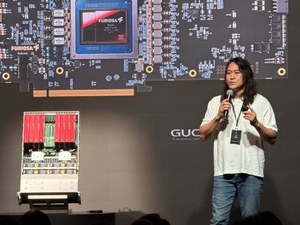
National Growth Fund to invest $531M in FuriosaAI, which rebuffed Meta's $800M takeover bid
-
INDUSTRY
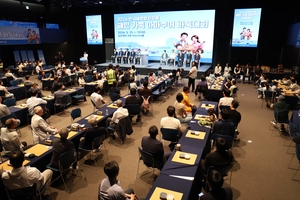
Korea Shipowners' Association holds amateur baduk tournament for Maritime Day