SK hynix raised 40 trillion won through an ADR offering just over a month ago and has now announced a 40 trillion won share buyback and cancellation — a governance constraint means canceling shares is required before more ADRs can be issued. Samsung Electronics chose a 30 trillion won special dividend instead of a buyback, a structure that benefits the tax positions of major shareholders Samsung Life Insurance and Samsung Fire, as well as Samsung C&T. Both companies have pledged shareholder returns tied to free cash flow, but future capital expenditure guidance remains opaque — making the actual payout hard to predict.
SK hynix, which raised 40 trillion won ($28.7 billion) in the United States through an American depositary receipt offering just over a month ago, has announced it will buy back and cancel 40 trillion won worth of its own shares. Samsung Electronics will distribute 30 trillion won in cash to shareholders first, with an additional 60 trillion to 80 trillion won in returns planned for the first half of next year. It is an unprecedented windfall, made possible by the AI semiconductor boom.
Shareholders have every reason to welcome the news. But tracing the flow of money reveals the distinct corporate logic — rooted in each company's governance structure — at work behind the decisions. For SK hynix, the key variables are its ADR program and share price. For Samsung Electronics, they are the ownership stakes of its financial affiliates and the tax implications of different payout methods. Both companies have anchored their shareholder return pledges to free cash flow, but that figure contains an unknown that most investors cannot easily calculate. Beneath the shared label of "shareholder returns," two very different capital strategies are operating.
SK hynix: issuing high, canceling low
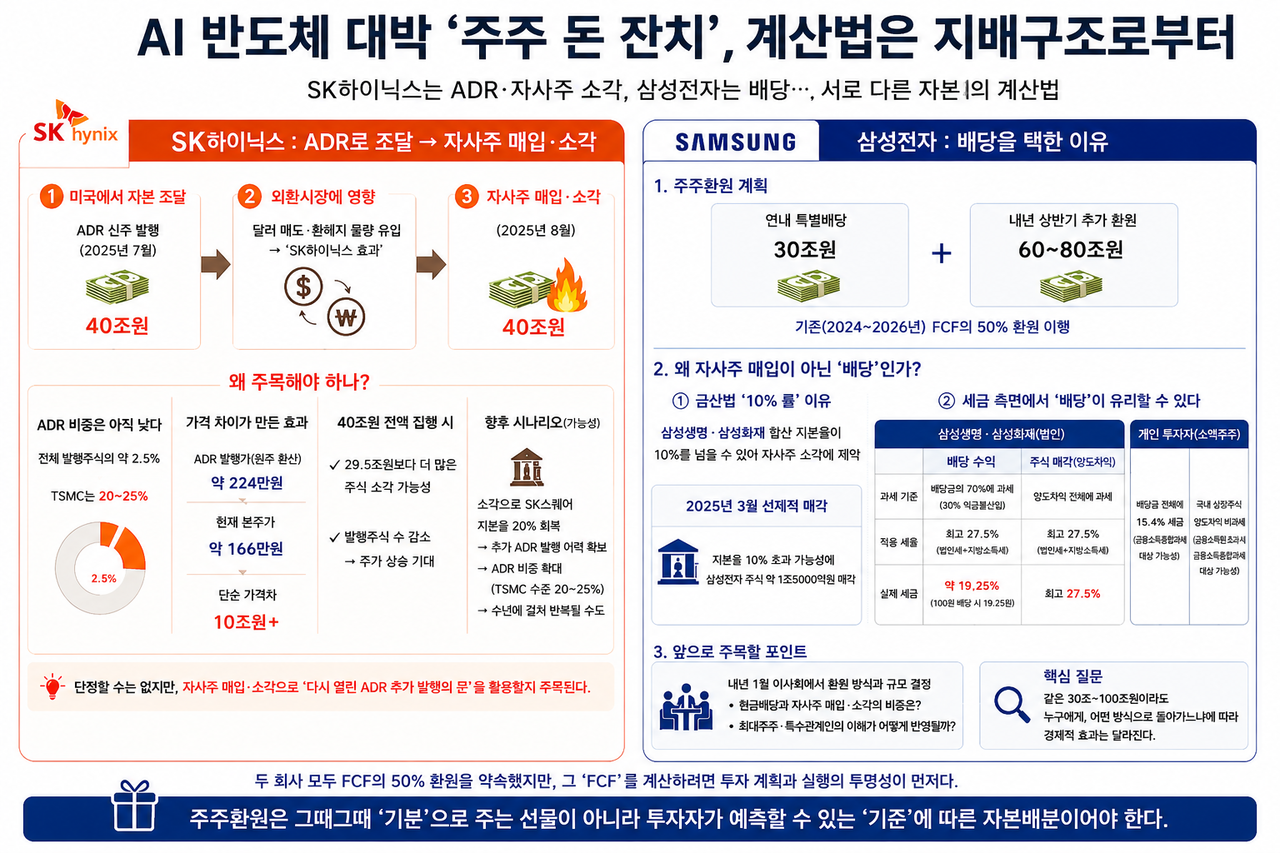
Start with SK hynix. The confirmed commitment is a 40 trillion won share buyback and cancellation. Just over a month ago, the company issued new shares to list ADRs in the United States — also at 40 trillion won. The stated purpose of that capital raise was domestic capital expenditure. After the ADR issuance, a large volume of dollar selling and currency-hedging flows entered the foreign exchange market, reversing a sharp rise in the won-dollar rate — a move analysts described as the "SK hynix effect." A significant portion of the dollars raised has likely already been converted to won or hedged.
That is not to say the ADR proceeds are being directly used to fund the buyback. Money is fungible. But had SK hynix not issued the ADRs, the 40 trillion won needed for domestic capital expenditure would have had to come from existing cash, future earnings or borrowing — leaving that much less available for shareholder returns. The company's overall cash flows need to be viewed together.
A question worth asking: SK hynix's ADRs currently represent about 2.5 percent of total shares outstanding. Will that stay the same? TSMC's ADRs account for 20 to 25 percent of its total shares.
SK hynix faces a structural constraint on issuing more ADRs. Under the Fair Trade Act, SK Square — the holding company — must hold at least a 20 percent stake in listed subsidiary SK hynix. Last month's ADR issuance diluted SK Square's stake to just above that 20 percent threshold. To issue additional new-share ADRs, SK Square's ownership ratio must rise. That can happen either by SK Square buying more SK hynix shares, or by SK hynix buying back and canceling its own shares to reduce the total number outstanding.
Share prices typically fall on new issuances and rise on buybacks and cancellations. If ADRs trade at a premium to the domestic shares, issuing new shares in the United States at a higher price and then retiring existing shares at a lower price domestically is economically attractive — not arbitrage in the classic sense, but a capital restructuring that effectively exploits the price gap between the Korean and US markets.
Last month's ADRs were issued at the equivalent of about 2.24 million won per share. With SK hynix's domestic shares currently trading at around 1.66 million won, buying back the same number of shares on the market would cost roughly 29.5 trillion won — a simple price difference of more than 10 trillion won. If the full 40 trillion won is deployed rather than just enough to match the number of ADR shares issued, SK hynix could end up canceling more shares than it created through the ADR offering, depending on where the share price moves.
Once the cancellation raises SK Square's ownership ratio again, room opens up for another ADR issuance. As long as ADRs continue to trade at a premium to domestic shares, SK hynix has a meaningful economic incentive to raise additional capital in the United States. If the company were to raise its ADR ratio toward TSMC's level, this cycle of issuance and cancellation could repeat several times over the coming years.
There is no evidence that SK hynix decided on this buyback with additional ADR issuances in mind. But whether the company uses the window that the buyback and cancellation reopens is worth watching.
Samsung Electronics: dividends offer a tax edge for affiliated shareholders
Samsung Electronics said it will pay a 30 trillion won special dividend before the end of this year, with an additional 60 trillion to 80 trillion won in shareholder returns planned for the first half of next year after this year's accounts are settled. This is not a new commitment — it fulfills the existing 2024–2026 shareholder return policy of distributing 50 percent of free cash flow. Still, by providing an estimated payout figure for this year's performance, Samsung was more specific than SK hynix, which offered no projected return amount for the current year.
Samsung's choice of a special dividend over a share buyback also draws attention. The market had expected Samsung to favor dividends because of the so-called "10 percent rule" under the Financial Industry Capital Act. If Samsung were to buy back and cancel its own shares, the combined stake held by financial affiliates Samsung Life Insurance and Samsung Fire could exceed the legally permitted 10 percent ceiling. In March, when a previous round of Samsung share cancellations raised that possibility, both companies preemptively sold about 1.5 trillion won worth of Samsung Electronics shares.
That explanation has merit, but it is not the whole story. If the combined stake exceeds 10 percent, the excess can simply be sold at a gain. Depending on timing, Samsung Life Insurance and Samsung Fire could end up selling Samsung Electronics shares that Samsung Electronics itself then buys back as treasury stock.
The same shareholder return does not produce the same economic outcome for everyone. From a purely tax perspective, dividends are more favorable for Samsung Life Insurance and Samsung Fire than selling shares triggered by a cancellation. Under current corporate tax law, 30 percent of dividends received by a corporation holding less than a 20 percent stake in another domestic corporation is excluded from taxable income. Both Samsung Life Insurance and Samsung Fire hold less than 20 percent of Samsung Electronics, so both qualify for this treatment.
Setting aside other tax adjustments and applying the top corporate tax rate plus local income tax for 2026, a simple calculation shows that 70 percent of a dividend is taxed at 27.5 percent — meaning roughly 19.25 won in tax for every 100 won received. By contrast, selling Samsung Electronics shares would subject the capital gain — the sale price minus the tax-basis acquisition cost — to a combined corporate and local income tax rate of up to 27.5 percent.
Samsung Life Insurance and Samsung Fire acquired their Samsung Electronics shares a very long time ago, meaning their tax-basis acquisition cost is far below the current share price. A substantial portion of any sale proceeds would therefore constitute a taxable capital gain. That said, Samsung Life Insurance faces other variables — including obligations to participating policyholders — so tax alone cannot determine which option is more advantageous.
For individual investors, the calculus runs in the opposite direction. Retail shareholders in domestically listed stocks generally pay no tax on capital gains, but dividends are taxable. Combined with other interest and dividend income, annual financial income exceeding 20 million won can trigger comprehensive financial income taxation.
Samsung Electronics said its board will decide in January on the method and scale of returns — whether cash dividends, share buybacks and cancellations, or a combination. How that decision is made, and what role the interests of the controlling shareholder and related parties play in shaping it, will be worth examining closely.
Past capex and FCF are knowable — but the future is not
50 percent of FCF? Without investment guidance, it's a black box
SK hynix said it will raise its shareholder return target from "up to" 50 percent of three-year cumulative free cash flow to "at least" 50 percent. Samsung Electronics described its latest payout as fulfilling its pledge to return 50 percent of FCF. Whether the commitment is "at least 50 percent" or exactly "50 percent," what matters is the actual figure — and that figure is difficult to calculate.
FCF is the cash left over after a company subtracts capital spending on factories and equipment from its operating cash flow. How much a company earns matters, but FCF swings sharply depending on how much it invests. Past investment figures can be verified through cash flow statements. The problem is the future. Without disclosure from the company, outsiders have no reliable way to know how much will be invested going forward. The companies have provided the return ratio — but one of the key variables in the equation is missing.
US companies commonly provide annual or forward-year capex guidance as a range when reporting earnings. The reason hyperscalers' AI investment has become a central market variable is precisely that they update their investment guidance with every earnings release — and revise it when plans change. Investors use that information to recalculate future FCF and shareholder return capacity.
Compared with major US technology companies, neither SK hynix nor Samsung Electronics provides sufficient quantitative forward capex guidance. Both describe investment direction and capacity expansion plans, but neither consistently discloses year-by-year investment figures at a level of detail that would allow investors to project future FCF. If a company ties its shareholder return policy to FCF, the transparency of its investment guidance needs to match that commitment.
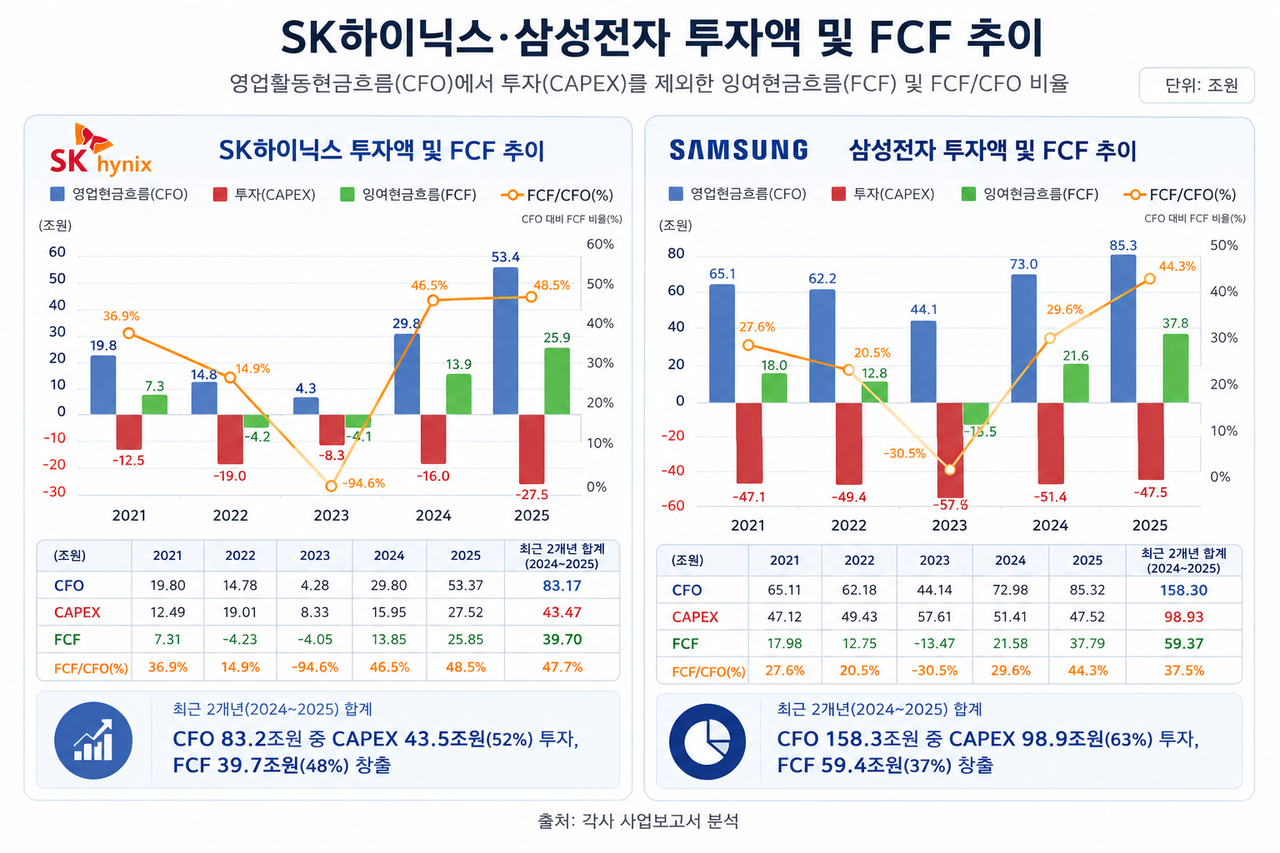
Over the past two years, SK hynix generated 83 trillion won in operating cash flow and spent about 43 trillion won — roughly 52 percent — on acquiring tangible and intangible assets. Samsung Electronics generated 158 trillion won in operating cash flow over the same period and invested about 99 trillion won, or 63 percent. By simple arithmetic, the cash remaining after investment was about 48 percent and 37 percent, respectively.
Both companies now face what is being called the "three mega projects" — investment commitments of astronomical scale. SK hynix alone announced a series of long-term investment strategies between late June and early July: 600 trillion won for Yongin, 100 trillion won for Cheongju and 400 trillion won for the southwestern region, totaling 1,100 trillion won. The aggregate is known; the annual breakdown that would determine FCF for this year and next is not.
On top of that, the semiconductor boom is sharply increasing the burden of employee performance bonuses. Surging profits do not translate into FCF growing at the same pace.
If a company promises to return 50 percent of FCF, it should first make FCF calculable. Transparency about investment plans matters as much as the stated return ratio. Large-scale investment decisions represent the single greatest informational asymmetry that a controlling shareholder holds over ordinary investors. That power should be exercised transparently.
Shareholder returns are not gifts handed out on a whim — they are capital allocation decisions that investors should be able to anticipate based on clear, consistent criteria.
kyhong@heraldcorp.com