Semiconductor share prices have been dizzying. Even companies worth more than 1 quadrillion won can swing more than 10 percent in a single day. Will they come crashing down, or will they eventually stand tall again? The most important factor, to put the answer plainly, is investor psychology.
In the historical novel "Lieh-kuo Chih," Jian Shu — the celebrated chief minister of Duke Mu of Qin during the Spring and Autumn period — offered three principles of governance.
"Do not be greedy, do not be angry, do not be hasty."
The elaboration goes: "Greed brings great loss; anger drives people away; haste invites repeated failure."
The Kospi has experienced far steeper rallies and deeper corrections than most other major markets, partly because some of the retail investors who drove the index higher were greedy, angry and hasty. Many sought to trade volatility using leverage rather than betting on structural growth. A speculative approach inevitably carries the cost of volatility. To improve the odds of investment success, it is important to understand the AI and semiconductor ecosystem clearly.
<style ref="s0">How did the AI bubble narrative begin?</style>
The story behind the rise in semiconductor share prices goes like this.
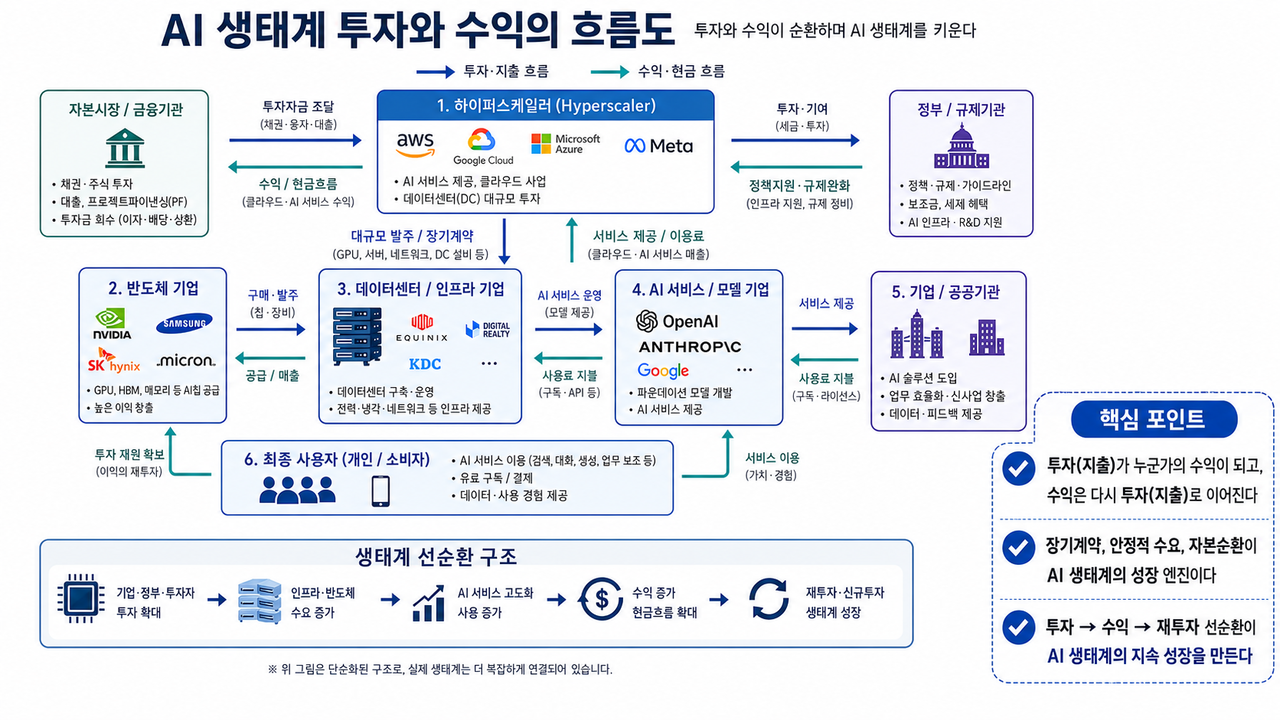
First, AI requires data centers, and data centers require semiconductors.
Second, whoever builds data centers fastest can capture the AI market first — so securing semiconductors takes priority, whatever the cost.
As hyperscalers — the large-scale data center operators — began buying semiconductors at prices several times higher than before, the profits of Samsung Electronics, SK hynix and Micron surged. Rising profits naturally pushed share prices higher. The engine driving those prices up, however, was profit growth, not profit stability. Semiconductor prices have historically tended to fall just as quickly as they rise.
From late last year, hyperscalers — known for their strong earnings — began issuing corporate bonds, raising questions about whether they were spending too much on data centers. This year, they moved beyond bond issuance to equity raises, deepening those concerns. Consider the ratio of capital expenditure to operating cash flow: Amazon's ratio climbed from 51 percent in the second quarter of 2024 to 89 percent in the third quarter of last year, and has since exceeded 100 percent this year, pushing free cash flow into negative territory — meaning the company is spending more than it earns. Alphabet finds itself in a similar position.
<style ref="s1">The 'Levy-Kalecki formula' and</style> the power of investment
Operating profit margins at memory chip makers have reached as high as 80 percent. Such margins are difficult to sustain when the coffers of their main customers — the hyperscalers — are running dry. If high chip prices cause hyperscalers to pull back on investment, chipmakers will suffer as well. In that environment, the right response is to manage prices rationally while locking in stable supply volumes through long-term contracts to grow the overall profit base. That is why Samsung Electronics and SK hynix have recently drawn up large-scale capacity expansion plans.
"Corporations (capitalists) earn what they spend; households (workers) spend what they earn."
This is the core insight from a paper on the principle of effective demand published by Polish economist Michał Kalecki — three years before John Maynard Keynes released "The General Theory of Employment, Interest and Money" (1936), widely regarded as the bible of macroeconomics.
Jerome Levy of the United States grasped this structure 25 years before Kalecki. Drawing on it, he predicted the Great Depression of 1929 and liquidated his business and all his shareholdings months before the market crash. The Jerome Levy Forecasting Center, founded by his descendants, has since earned a reputation for accurately predicting major financial crises, including the dot-com bubble and the subprime mortgage crisis.
The "Levy-Kalecki formula" — rarely covered in mainstream economics but widely used among professional investors — states:
Corporate profits = Private investment (I) + Government deficit (G) + Net exports − Household savings + Dividends and other items
Why Jensen Huang keeps traveling the world
Nvidia CEO Jensen Huang visited South Korea twice — in November last year and again in June — meeting not only direct business partners Samsung and SK but also Hyundai Motor, LG Group, Naver and NCsoft, among other major Korean companies. Nvidia has also invested in OpenAI and is channeling more than one-third of its operating cash flow into external investments.
Alliances and cross-investments have become routine across the AI ecosystem. OpenAI is in effect pursuing a strategic partnership with the US government by offering it a 5 percent stake. Some observers suspect a financial shell game, but viewed through the Levy-Kalecki lens, it looks more like an attempt to build a mutually beneficial structure — one person's investment becomes another's revenue, and another's spending becomes one's income.
Investment by Samsung Electronics and SK hynix creates profit opportunities for semiconductor equipment makers and others. Building large-scale data centers domestically also generates demand for chips. Chip prices cannot rise indefinitely, but if robust demand takes hold, earnings become more predictable — and that predictability alone justifies a higher valuation.
The semiconductor and AI growth story remains intact
The sharp swings in AI chip stocks should not be read simply as a harbinger of a bubble bursting. Excess profits born of supply shortages are bound to normalize, and hyperscalers cannot sustain an ever-accelerating pace of investment. Price adjustments, supply increases and the spread of long-term contracts may represent not the collapse of the ecosystem but its search for equilibrium. For chipmakers, what matters is not short-term ultra-high margins but predictable long-term demand and a stable earnings base. A scenario in which hyperscalers cut data center investment, chip company profits fall and markets collapse seems unlikely.
News that Meta plans to lease out computing power has revived talk of a data center glut, and reports have emerged that many companies are hesitant to adopt AI because of the cost. This feeds the argument that hyperscalers will reduce investment, deflating the chip stock bubble.
Yet the data center business itself is booming. Google CEO Sundar Pichai announced at the first-quarter earnings call in April that cloud revenue surpassed $20 billion in a single quarter for the first time. The cloud backlog — contracts signed but not yet fulfilled — nearly doubled quarter-on-quarter to exceed $460 billion.
To plug its own capacity shortfall, Google signed a contract to lease computing capacity equivalent to roughly 110,000 GPUs from Elon Musk's SpaceX (xAI) at $920 million (about 1.3 trillion won) per month. Even then, computing power remained scarce enough that Google was forced to throttle usage for one of its key customers, Meta.
Markets read Meta's move to lease out data center capacity as a signal of oversupply, sending major semiconductor stocks tumbling worldwide. But Meta's computing lease closely resembles SpaceX's data center rental arrangement — it looks less like a symptom of excess supply and more like a company with insufficient in-house AI capability selling surplus assets back into the market. The reallocation of spare computing capacity through leasing may be part of the ecosystem finding its balance. Data center demand is likely to keep growing steeply.
Jevons' paradox, sovereign AI, and <style ref="s2">the unrelenting growth of AI demand</style>
Anthropic's Mythos and Fable, and OpenAI's ChatGPT 5.6, are advanced enough that the US government has moved to regulate their distribution. According to Jevons' paradox, improvements in AI performance lead to greater data consumption, not less — and the token consumption of Fable or ChatGPT 5.6 is enormous. Once users experience the latest model, earlier versions quickly feel inadequate. As performance keeps improving, the share of paying users will inevitably rise, feeding revenue back to data centers and hyperscalers.
US AI regulations have made sovereign AI a pressing topic among major nations. Not every country can build its own foundation models on the scale of ChatGPT, Gemini or Claude, but the case for domestic data centers is growing. That means the number of entities outside US hyperscalers investing in data centers — and needing semiconductors — could expand significantly.
The initial public offerings of OpenAI and Anthropic also matter. These companies need to raise sufficient capital through their listings to keep paying data center fees. SpaceX, too, can be seen as having rushed toward a listing partly to fund its xAI investment. If they fail to list successfully, repaying the capital they have raised will become difficult, and their contracts with major data centers could be disrupted. Given the central role these companies play in the AI ecosystem, the fallout in a worst-case scenario would be hard to gauge.
July checkpoints: second-quarter earnings and the Fed
The second-quarter earnings releases due this month are critically important. The first priority is assessing the state of the hyperscalers. Even if AI has not yet generated sufficient returns, it would be reassuring if their core businesses remain healthy — and these are companies whose core operations are highly profitable.
The Federal Reserve's interest rate decision also comes this month. A hold is widely expected, but market rates have risen sharply as inflation has been pushed up by the war involving Iran and compounded by strong investment demand from both corporations and governments. High interest rates have historically been a headwind for equities. Softening employment data has slightly reduced the probability of a Fed rate hike this year, which is not bad news for capital and money markets — but it is too early to relax. There is an old saying on Wall Street:
"Bull markets don't die of old age — they are murdered."
The most common murder weapon is a sharp rise in interest rates.
kyhong@heraldcorp.com