<style ref="s0">"Hong Gil-yong's Hwasik Yeoljeon," which launched in August 2008 just before the global financial crisis, has reached its 900th installment. From its beginnings as "Hong Gil-yong's Money Story" to its current form, this column has endured thanks to the unwavering support of its readers. There is still much room for improvement. Whether it can reach the rare milestone of 1,000 installments — something almost unheard of in Korean economic commentary — remains to be seen. Your encouragement means everything. I will continue to give my best.</style> Thank you.
Dear President Lee Jae-myung,
I have been writing "Hong Gil-yong's Hwasik Yeoljeon" since 2008, and this piece marks the column's 900th installment after 18 years. I gave considerable thought to what this milestone entry should say. The question of Korea's inclusion in the MSCI developed-market index has grown increasingly urgent, and while it may not happen this year, I believe it is a task that must be accomplished within your term. That conviction is why I have chosen to write this column as an open letter to you.
This month is a watershed moment. On June 24, MSCI's annual market classification review will determine whether Korea is placed on the watch list for potential reclassification as a developed market. Even if Korea makes the watch list this year, the path forward is gradual. Missing the cut means waiting another year — but the timeline still falls within your term. This is a goal that can realistically be completed before you leave office.
You have just returned from the G7 summit. Korea is not a formal member, but it has been invited to the G7 table repeatedly in recent years — a sign that the world recognizes Korea as a core partner among advanced economies. Semiconductors, defense, shipbuilding, batteries, automobiles, K-pop and drama series have become indispensable to the global economy and culture.
And yet one anomaly remains. Korea is a developed nation in every practical sense, but on the global financial map it is still classified as an emerging market.
The final piece of Korea's transformation into a fully developed country is its capital market. Inclusion in the MSCI developed-market index is not simply a positive catalyst for stocks. It is a rare, historic reclassification event that would redirect enormous flows of global capital — and a prerequisite for the structural leap that could dramatically transform the fundamentals of the Korean economy.
<style ref="s1">The fastest route to a Kospi 20,000 era</style>

Korea's stock market has recently climbed to among the top six in the world by market capitalization. Korea's weight in the MSCI Emerging Markets index stood at 23 percent at the end of May, and securities industry estimates incorporating the recent market rally put that figure as high as 26 percent. A Korean reclassification would be on an entirely different scale from past cases such as Greece or Israel.
A market of Korea's size moving out of the emerging-market category would shift the balance between developed and emerging markets globally. Korea's entry into the developed-market index would substantially alter the composition of that index as well.
Particularly significant is what reclassification would mean for Korean corporate valuations. Korea's forward return on equity stands at 28.9 percent — more than 50 percent above the emerging-market average of 18.3 percent and the developed-market average of 18.9 percent. Yet its forward price-to-earnings ratio hovers around 8 times, roughly 31 percent below the emerging-market average and 57 percent below the developed-market average. Korea is not a market trading cheaply because of weak fundamentals. It is a market generating strong profits while being priced as if it were not.
Reclassification as a developed market could normalize that abnormal discount. If corporate earnings growth follows, Kospi levels of 15,000 or even 20,000 move from slogan territory into the realm of arithmetically plausible targets. These are not index targets per se — they are symbols of a market where Korean companies finally receive fair value.
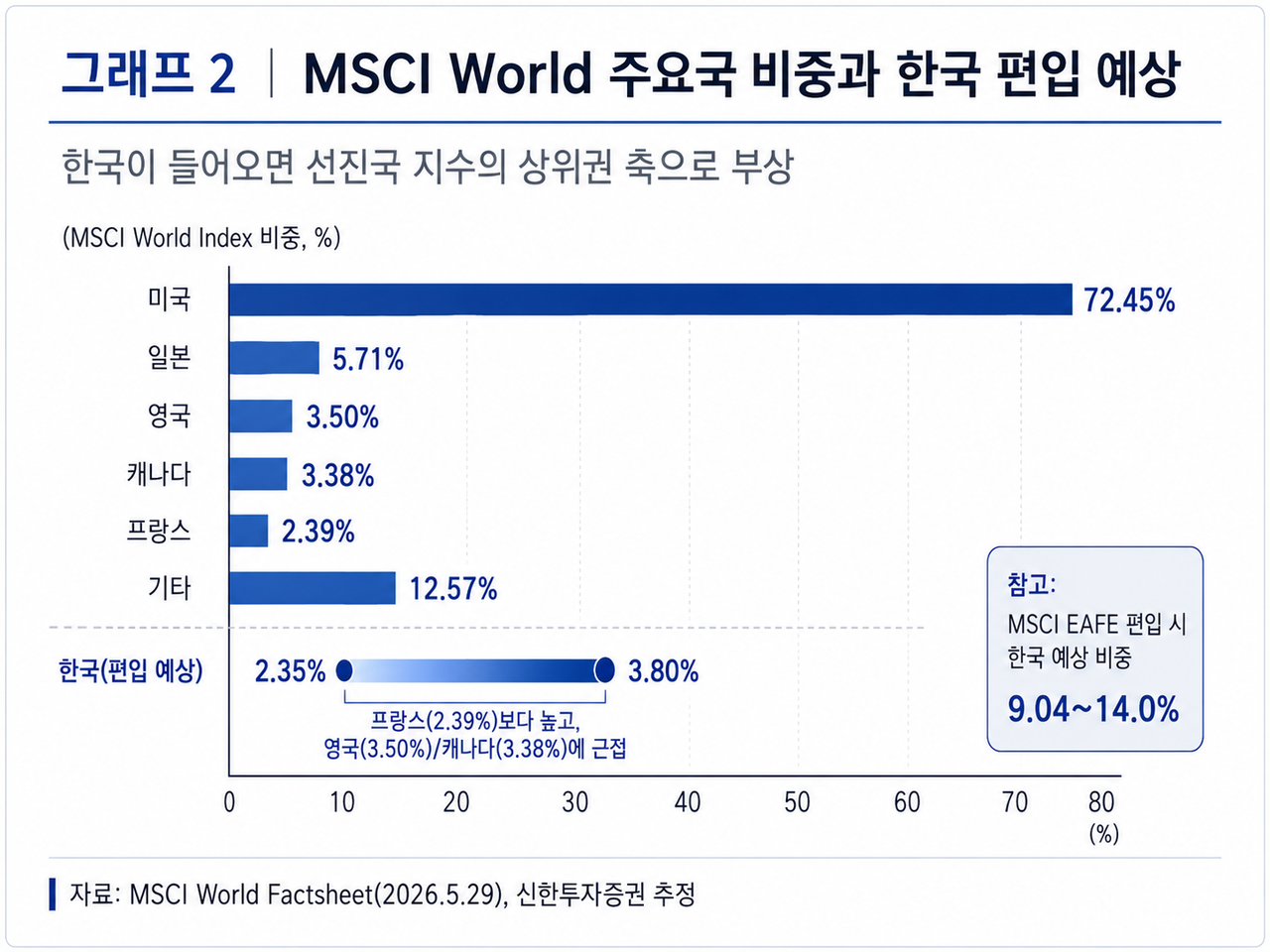
According to estimates by Shinhan Investment strategist Noh Dong-gil on Monday, Korea could account for approximately 3.8 percent of the MSCI World index upon inclusion, making it the third-largest constituent after the United States and Japan. Its weight in the EAFE index — which covers developed markets excluding the US — could reach as high as 14 percent. These estimates are based on current prices, which still reflect the emerging-market discount and foreign-exchange market restrictions. The moment Korea is reclassified, the prices themselves could change.
<style ref="s2">Economic strength plus K-culture: Korea has earned its place</style>
The fundamentals are there. The United States holds an overwhelming lead in software, foundational technology and platforms. But technology alone — lines of code and patents — cannot reshape the world. It must be turned into semiconductors, connected through power grids, and realized in warships, satellites, batteries, automobiles, factories and data centers. In that physical execution and mass-production capability, Korean companies rank among the very best in the world. The Korean stock market is the market that holds that capability.
AI requires HBM and memory chips, power equipment and cooling infrastructure. Space demands precision manufacturing, advanced materials, and satellite and defense technology. Defense needs mass production and on-time delivery, ammunition and ground weapons, warships and electronic systems. The energy transition cannot happen without nuclear power plants, power grids, batteries and energy storage systems. Korean companies are present on every one of these fronts.
Korea rose from the ruins of war to achieve industrialization and democracy. It has no history of invading other nations. K-pop, drama series, film, food and beauty have won the affection of people around the world. Few countries in history have possessed both soft power and hard power at the same time. Korea is not a power the world fears — it is a power the world likes and trusts.
Developed-market inclusion could ignite a global wave of K-investment. If K-culture has opened hearts around the world, K-investment is about opening portfolios.
<style ref="s3">A key to solving the real estate, youth and aging crises</style>
This transformation connects directly to the lives of ordinary Koreans.
The concentration of wealth in real estate is not greed — it is the memory of success. Previous generations built their way into the middle class through homeownership. They took out loans, bought homes, and watched rising prices turn into assets.
For today's young people, however, real estate is less a ladder than a wall. Young Koreans need a new ladder — and that ladder must be corporate growth. It should be a path where a portion of each paycheck goes into quality companies and indexes, and where dividends, share buybacks and rising corporate value are shared by all. The concentration in real estate can ease naturally once a better investment alternative exists.
Young people without homes, and salaried workers saving into pension funds, should all be able to ride the growth of Korean companies.
A larger stock market raises returns across all types of pension funds. The long-term sustainability of public pensions, including the national pension, could improve as well. A more secure retirement for citizens reduces the government's future fiscal burden. Concerns about consumption slowdown driven by aging would also diminish. A resilient economy and sound public finances give the government the foundation to increase forward-looking spending.
<style ref="s4">The foreign-exchange system: the biggest obstacle on the road to developed-market status</style>
Developed-market inclusion is not a project for foreign investors. It is a national asset project. So why has Korea's stock market not yet made it into the developed-market index?
Corporate competitiveness and market size are already sufficient. Shareholder-oriented governance has advanced, in part because of the commercial law reforms you have championed. Kospi has posted the highest returns among major global indexes this year, as it did last year. Requirements such as English-language disclosures and global investor relations roadshows can be implemented quickly with sufficient political will.
The biggest remaining bottleneck is the foreign-exchange system. The memory of the 1997 currency crisis left a deep wariness in economic policymakers and corporate executives alike. But that wariness has now reached the point where it is itself a discount embedded in Korea's capital markets.
For the past 30 years, the logic governing the bureaucratic approach to foreign exchange has gone like this:
"Korea is a small open economy with a high dependence on trade. Allowing offshore won trading could destabilize the foreign-exchange market."
The reality of the Korean economy has changed. Sales at Korean companies tied to the AI revolution are growing rapidly. Trade volumes have expanded, and the stock market's sharp rally has elevated the capital market to an entirely different scale. A system built around trade settlement and bank-intermediated transactions — rooted in an outdated self-image as a "small open economy" — has reached its limits.
Global capital must be able to convert won, buy and sell shares, settle transactions, hedge positions and exit — as smoothly as in any developed market. Foreign companies and investors holding won or won-denominated assets should not have to worry about excessive exchange-rate volatility.
<style ref="s5">A foreign-exchange system befitting Korea's economic scale is not optional — it is essential</style>
Some worry that liberalizing the foreign-exchange market will increase volatility and trigger dollar liquidity crunches. But a restrictive foreign-exchange market is already generating costs. Foreign investors route around it through offshore non-deliverable forwards and other workarounds, and the price of that inconvenience shows up as a discount on Korean assets. When Korean companies are developed-market in scale but the foreign-exchange infrastructure remains stuck in emerging-market conventions, the discount persists. Because the won lacks sufficient autonomy, it is easily dragged along by moves in the yuan or the yen. The Korea discount is still very much alive.
The 1997 currency crisis did not happen because Korea opened its foreign-exchange market. Before the crisis, the government controlled the exchange rate far more tightly. What matters is the capacity to manage foreign-currency liquidity and the credibility of the financial system.
A recent report by the Korea Capital Market Institute found that extending foreign-exchange trading hours into the early morning actually stabilized exchange-rate volatility rather than amplifying it. When the 24-hour trading regime takes full effect on July 6, volatility could fall further. Lower volatility reduces currency risk for exporters and foreign investors alike, which in turn stabilizes the value of the won — a virtuous cycle.
If foreign-exchange market reform leads to developed-market inclusion and draws larger global capital flows into Korean equities, the case for the United States, Europe and other reserve-currency nations to establish standing currency swap arrangements with Korea will grow stronger. Such swaps would not be favors extended to Korea — they would serve as safety valves for the capital those countries have invested in Korean markets.
<style ref="s6">Kosdaq must be separated from Korea Exchange to stop companies from transferring their listings away</style>
The first wave of capital following developed-market inclusion will concentrate in mega-cap stocks such as Samsung Electronics and SK Hynix. That is to be expected. But the future of any nation's capital market grows not from companies that are already large, but from companies that will become large. That nursery is Kosdaq — and Kosdaq's governance structure needs to be redesigned from the ground up.
Debuting on Kosdaq, growing, and then transferring to the main board has become standard practice. A market that serves as a waystation rather than a destination for growth companies cannot become a world-class technology exchange. Just as Nasdaq is not a second-tier market beneath the New York Stock Exchange, Kosdaq should not be a second tier beneath Kospi. Left on its current trajectory, the capital market will replicate the same concentration dynamic seen in Korea's geographic over-centralization around Greater Seoul. Kosdaq must be separated and made independent from Korea Exchange.
<style ref="s7">A global K-investment wave is not out of reach</style>
K-investment is not a slogan. It is the set of institutions and culture that allows global investors to understand Korean companies, trust them and hold them for the long term. Foreign-exchange market access, English-language disclosures, global investor relations, shareholder returns, minority shareholder rights and an independent Kosdaq all point in the same direction: make it possible for the world to invest in Korea, and ensure that Korean citizens are the primary beneficiaries of that growth.
Korea already has the industries the world needs. It has the culture the world loves. It has the democratic foundations and alliance relationships the world can trust. In industry, culture and alliances, Korea is already a developed nation. The one remaining box to check is the market. The moment that box is filled, Korea becomes a fully developed country in every sense.
The era when real estate was the ladder is drawing to a close — and it should. The next generation's ladder must be the growth of Korean companies. The key that opens the door to a future where young Koreans without homes can become owners of Korean enterprise is in your hands, Mr. President. Developed-market inclusion for the Korean stock market is not a share-price event. It is a change in Korea's economic identity.
For 18 years I have written about where money flows. One thing is clear: money goes where it is trusted. The world already trusts Korea. What remains is to let that trust flow into the Korean market.
Within your term, Mr. President — please open that final door.
kyhong@heraldcorp.com