
Sejong apartment transactions rose from 325 in August to 509 in September
Zero move-in supply expected next year as relocation inquiries surge
Jeonse and monthly rent shortage pushes some tenants toward buying
![An aerial view of Government Complex Sejong and its surroundings on Tuesday. [Yonhap]](https://wimg.heraldcorp.com/news/cms/2026/10/14/rcv.YNA.20261013.PYH2026101318620001300_P1.jpg)
It's not just people who plan to live in Sejong eventually — those looking at it as an investment are gradually buying in too. A legal professional working at a nearby district court recently made a purchase, and we're getting a lot of inquiries from high-income workers in their 30s and 40s who want to invest but find the Greater Seoul area too expensive.
Expectations of a housing price recovery in Sejong's real estate market are growing after the government on Tuesday laid out detailed plans to relocate 44 administrative agencies from the Greater Seoul area. Following an announcement earlier last month on the direction of a second round of administrative and public institution relocations, the government also unveiled plans to move personnel from central administrative agencies — totaling around 10,000 people — prompting a noticeable uptick in purchase inquiries from end-users who had been sitting on the fence and from outside investors.
Over the past month, buying sentiment in Sejong has shown signs of partial recovery on the back of the relocation news, according to industry sources. More prospective buyers who had been waiting are now making decisions, and tenants approaching the end of their lease contracts are increasingly switching to purchasing.
Noh Hee-jeong, who runs Simpul Real Estate Agency in Sodam-dong, Sejong, said her office was quite busy with sales contracts and purchase inquiries for about two weeks immediately after the relocation direction was announced in September. "Because Sejong also faces a shortage of jeonse and monthly rental supply, some people with expiring leases decided to just buy and live there themselves," she said. "There was also demand from buyers in their 30s and 40s looking to purchase with monthly rent income as an investment, within the limits of policy loans."
Analysts say the shift from watching to acting reflects a desire to get in before prices rise on the back of the relocation news. Under the government's current plan, 27 agencies and 2,995 personnel are set to move to Government Complex Sejong next year alone — yet the projected move-in supply for Sejong stands at zero units, according to estimates by the Korea Real Estate Board and real estate platform Budongsan114. Concerns about a supply-demand imbalance in the rental market are adding further fuel to buying sentiment.
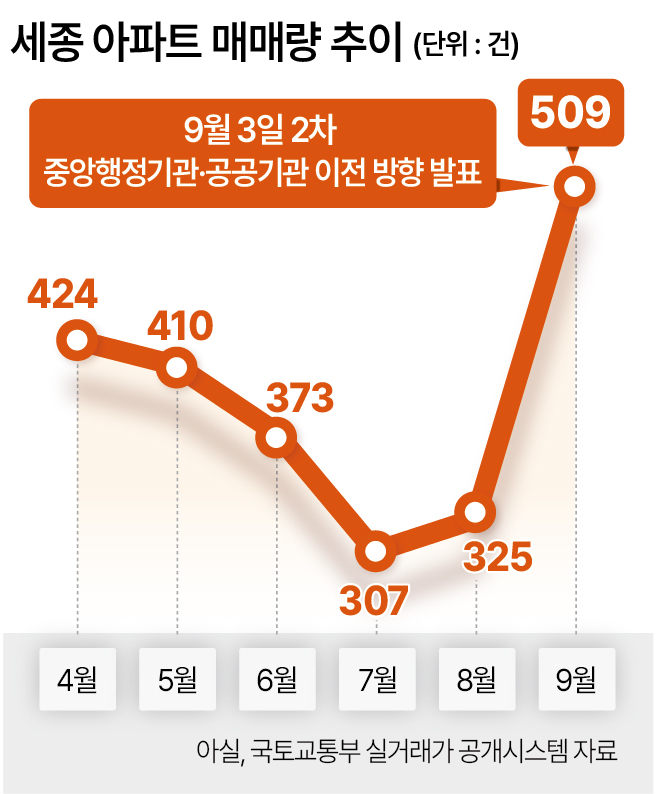
Sejong apartment transactions have in fact surged into the 500s over the past month. A total of 509 units changed hands in September, according to real estate platform Asil — a 56.6 percent increase from the 325 recorded in August. With the deadline for reporting September transactions running through the end of this month, the final tally is expected to climb even higher.
Even as end-user and investment demand shows signs of recovery, a significant number of homeowners are pulling their listings off the market in anticipation of further price gains.
"Most multi-home owners in Sejong have already sold off a lot of their properties, so the ones still holding on are in no particular rush," said the head of Agency A. "As expectations grow that additional good news could push prices even higher, they're withdrawing their listings."
Against this backdrop, record-high transactions have been recorded in some complexes. According to the Ministry of Land, Infrastructure and Transport's actual transaction price disclosure system, an 84-square-meter unit at Naritjae 6th Complex Hanshin The Hue Reserve in Naseong-dong, Sejong, sold for 1.09 billion won ($813,000) on Saturday, setting a new all-time high for the complex. A 59-square-meter unit at Saetteum 7th Complex Tomorrow City in Saereum-dong sold for 470 million won on Wednesday, also setting a record.
Experts say the market is likely to continue a gradual upward trend for now, given Sejong's limited land supply and the new demand expected from the incoming relocations. "Sejong is a planned city, so there are inherent limits to supply," said Seo Jin-hyung, a professor in the real estate law department at Kwangwoon University. "The relocations will generate a certain level of demand, and there is ample reason to expect prices to trend upward."
On the ground, however, observers say the rebound is unlikely to escalate into the kind of overheating seen during the sharp price surge of 2020 and 2021. "I've been brokering in Sejong for more than 15 years, and the conditions for buying are very different now compared to the past," Noh said. "Lending rules and tax regulations are strict, so multi-home owners and investors can't move as freely — this is an end-user-driven market, and prices won't spike sharply."
hwshin@heraldcorp.com




