
LG H&H, Lotte Chilsung Beverage post weak beverage earnings
Carbonated drink sales stall amid low-sugar trend and price hikes
Large-format coffee at around 2,000 won fast becoming a substitute
![Carbonated drinks on sale at a convenience store in Seoul. [Kim Jin]](https://wimg.heraldcorp.com/news/cms/2026/09/15/news-p.v1.20260915.6013470ee65342af86b374b0face5303_P1.jpg)
"People are drinking cheap coffee instead of carbonated drinks," said an industry official.
Budget coffee chains have emerged as direct rivals to cola and other carbonated beverages. Analysts say large-format coffees priced between 1,500 and 2,000 won have become a strong substitute, their appeal amplified by the growing low-sugar trend.
According to industry data, budget coffee chains offer a lower price per volume than carbonated drinks. An iced Americano (710 milliliters) at Mega MGC Coffee runs 1,500 to 2,000 won depending on the location. Compose Coffee sells the same menu item in a 591-milliliter size at a similar price. By comparison, a 350-milliliter can of Coca-Cola at a convenience store costs 2,200 won, while a 600-milliliter PET bottle of Pepsi-Cola goes for 2,500 won.
"Cumulative price increases on carbonated drinks have put them in roughly the same price bracket as budget coffee," one industry official said. "More consumers are turning to budget coffee — which is just as accessible and similarly priced — rather than buying a soda at a convenience store."
The budget coffee market is expanding rapidly. According to the Korea Fair Trade Commission, the number of coffee franchise outlets reached 29,101 at the end of 2024, up 15.8 percent from the previous year, with low-cost brands dominating the top spots: Mega MGC Coffee (3,325 locations), Compose Coffee (2,649), Ediya Coffee (2,562) and Paik's Coffee (1,712). MGC Global, the operator of Mega MGC Coffee, posted sales of 646.9 billion won ($481 million) and operating profit of 111.4 billion won in 2025, up 30.4 percent and 3.5 percent, respectively, from the prior year.
Convenience store coffee sales are also climbing. GS25 said sales of pouch beverages such as coffee and ice cups from June through August this year rose 12 percent and 25.1 percent, respectively, from the same period last year. Sales of iced items under its private-label brand CAFE25, priced at around 2,000 won, surged nearly 107 percent. At CU, sales of iced beverages including coffee and ice cups rose 7.9 percent and 14.7 percent, respectively, over the same period.
Meanwhile, the earnings of South Korea's major carbonated drink manufacturers have been sliding of late. LG H&H's refreshment beverage division saw sales fall 2.9 percent, from 1.82 trillion won in 2024 to 1.77 trillion won in 2025, while operating profit dropped 15.4 percent, from 168 billion won to 142.2 billion won. In the first half of this year, the division posted sales of 869 billion won and operating profit of 79.9 billion won, down 0.8 percent and 10.7 percent, respectively, from a year earlier. Coca-Cola products account for roughly half of the beverage division's sales.
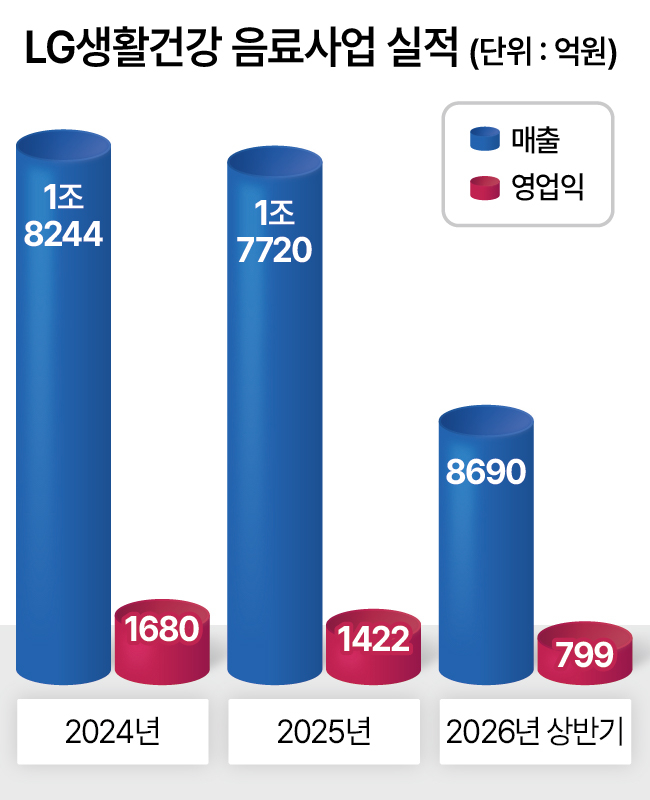
LG H&H's beverage division posted sales of 383.5 billion won and an operating loss of 9.9 billion won in the fourth quarter of last year — its first quarterly loss since acquiring Coca-Cola Korea in 2007. The result prompted its 90-percent-owned subsidiary Coca-Cola Beverages Korea to offer a voluntary retirement program last November. The subsidiary's sales slipped 2.4 percent, from 1.64 trillion won in 2024 to 1.6 trillion won in 2025, while operating profit fell 8.1 percent, from 165.6 billion won to 152.3 billion won.
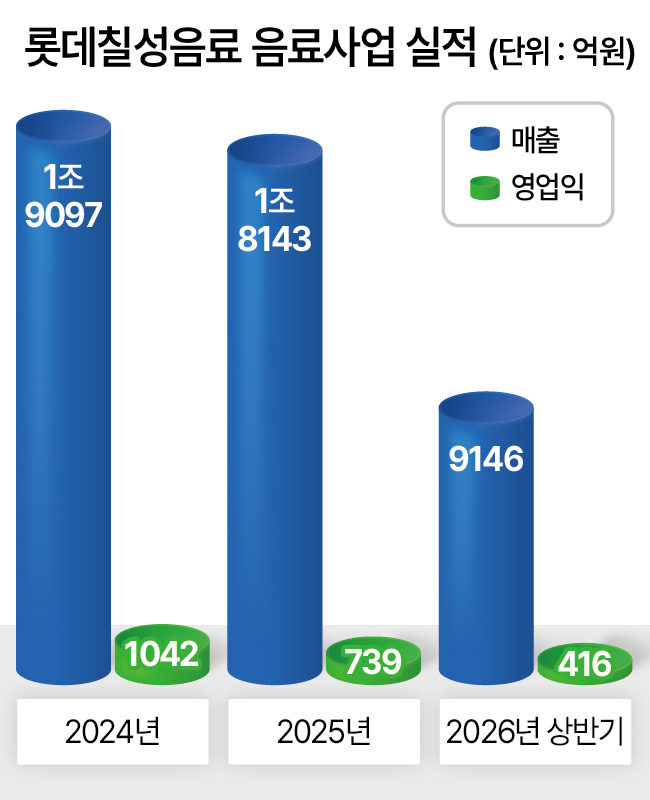
Lotte Chilsung Beverage has fared no better. Sales fell from 1.95 trillion won in 2023 to 1.81 trillion won in 2025, with operating profit collapsing from 162 billion won to 73.9 billion won over the same period. The company launched its first-ever voluntary retirement program at the end of last year, which contributed to an operating loss of 17.9 billion won in the fourth quarter. In 2024, the consolidation of its Philippine Pepsi factory and related restructuring resulted in a fourth-quarter operating loss of 8 billion won. The moves reflect efforts to restore profitability amid sluggish demand.
Major players are responding by expanding their low-sugar carbonated drink lineups. LG H&H recently launched Coca-Cola Zero Lemon Lime and also offers zero-sugar versions of its hydration drinks Powerade and Toreta. Lotte Chilsung Beverage introduced Happiz, a prebiotic soda brand that combines a low-sugar, low-calorie formula with five fermented ingredients derived from patented bacterial strains.
"The refreshing sensation that carbonation provides is hard to replicate with coffee," another industry official said. "The trend is toward expanding product ranges that cater to health-conscious consumers."
soho0902@heraldcorp.com




