
Ministry of Employment and Labor holds second TF meeting on national qualification system
Dedicated smart-device supervisors to be expanded; detection equipment to be upgraded
Unified anti-cheating standards to be applied across tax, appraisal, customs and patent exams
Deputy Minister Kwon Chang-jun: 'Undermining exam fairness is a serious crime that shakes the foundations of society'
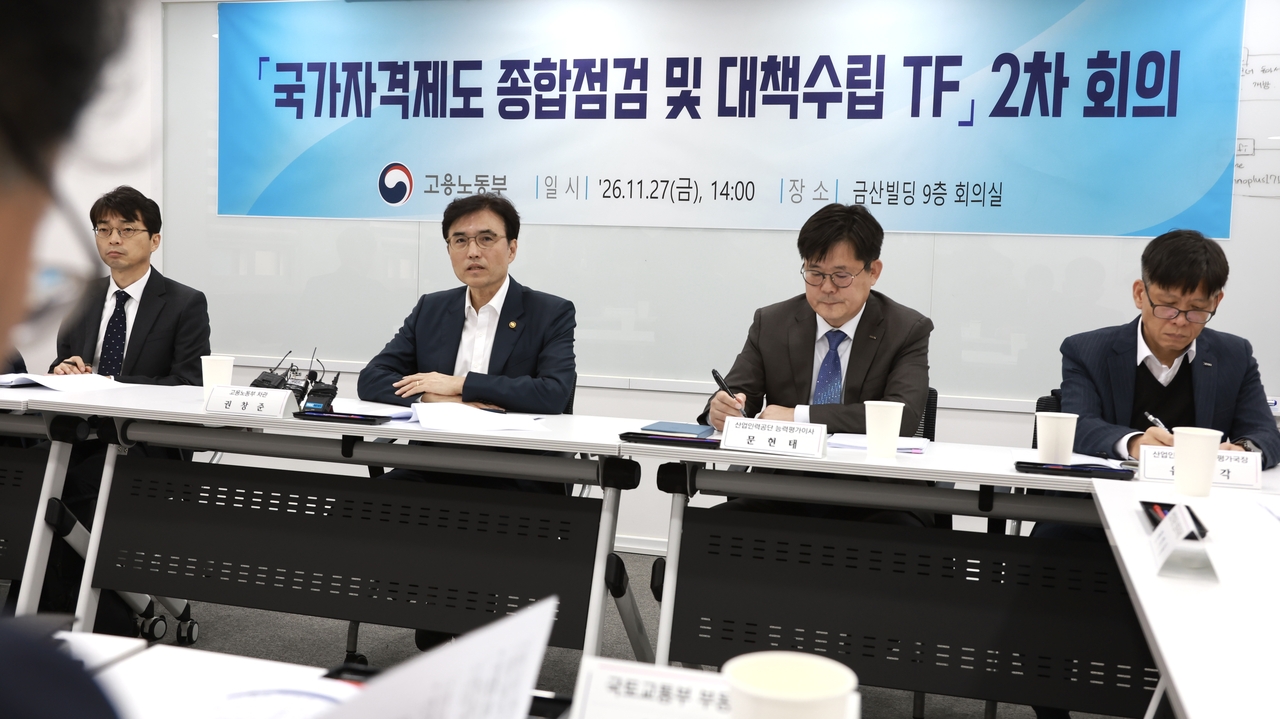
The government will expand the deployment of supervisors dedicated to monitoring smart devices and introduce radio-wave detectors at national licensing examinations starting next year, as part of efforts to prevent cheating using AI and other advanced technology. Authorities also plan to build a system for tracking and detecting suspected cheating even after an exam has ended, and to apply unified anti-cheating standards across national professional licensing exams overseen by different ministries.
The Ministry of Employment and Labor held the second meeting of its Task Force on Comprehensive Review and Countermeasures for the National Qualification System on Friday at Geumsan Building in Yeongdeungpo-gu, Seoul, chaired by Deputy Minister Kwon Chang-jun. The meeting followed up on the "Plan to Ensure Fairness in National Licensing Examinations," which was reported to the Cabinet on Tuesday.
Attendees included the Human Resources Development Service of Korea; the Ministry of Finance and Economy, which oversees the certified tax accountant exam; the Ministry of Land, Infrastructure and Transport, which administers the certified appraiser exam; the Korea Customs Service; the Ministry of Intellectual Property; and experts in radio communications and the qualification system.
The ministry reviewed anti-cheating measures in three phases: before, during and after examinations. The review was prompted by a judgment that advances in high-tech devices have made it increasingly difficult to prevent cheating through conventional supervision methods alone.
Before exams, the government will work to raise awareness that cheating constitutes a serious crime and will thoroughly check and collect any devices that could be used for misconduct. However, recognizing the limits of preventing examinees from concealing or failing to surrender devices before entering exam venues, authorities said they would develop additional preventive measures.
During exams, the government will strengthen its capacity to detect cheating involving advanced devices. Starting next year, dedicated smart-device supervisors will be deployed in greater numbers and radio-wave detectors will be introduced. Authorities will also continuously improve the performance of detection equipment and review ways to better support exam supervisors in actively catching violations.
The government also plans to establish a post-exam detection system capable of tracking cheating after an examination has concluded. The plan calls for developing effective tools to identify cheaters who were not caught at the venue and to closely examine suspected cases, as well as inter-agency cooperation frameworks to support such efforts.
Deputy Minister Kwon instructed officials to implement measures that can be acted on immediately without delay, and to quickly finalize concrete plans for those requiring budgetary, organizational or legislative support. Kwon also said cooperation among related ministries must be strengthened so that consistent, unified standards are applied to all national professional licensing exams, regardless of which ministry oversees them.
"As the president said at the Cabinet meeting on Tuesday, undermining the fairness of examinations is a serious criminal act that shakes the very foundations of our society," Kwon said. "Please raise, without reservation, every problem that could actually occur on the ground and every blind spot that current measures cannot address, and review everything with a sharp focus on the effectiveness of the countermeasures."
fact0514@heraldcorp.com




