
Workers of all employment types eligible for rights protection
Ten worker support centers nationwide offer free in-person, phone and KakaoTalk consultations
Freelancer SOS provides legal support for unfair contracts and unpaid fees
Public-private labor rights network set to launch next year

A 39-year-old Nepali worker at a farm in North Jeolla Province had three fingers severed by a machine and spent 46 days receiving outpatient treatment. The employer presented an agreement stating that, because the workplace had fewer than five employees, industrial accident compensation was not available — the company would cover hospital bills but would not pay wages for the days the worker was unable to work. The worker, with limited Korean, signed without fully understanding the terms.
Everything changed after the worker reached a local private labor organization supported by the Korea Labor Foundation. After filing a complaint with the labor office, the worker was dismissed — but following three consultations with a labor attorney and negotiations with the employer, the worker recovered medical expenses, injury compensation and unpaid wages, and got the job back.
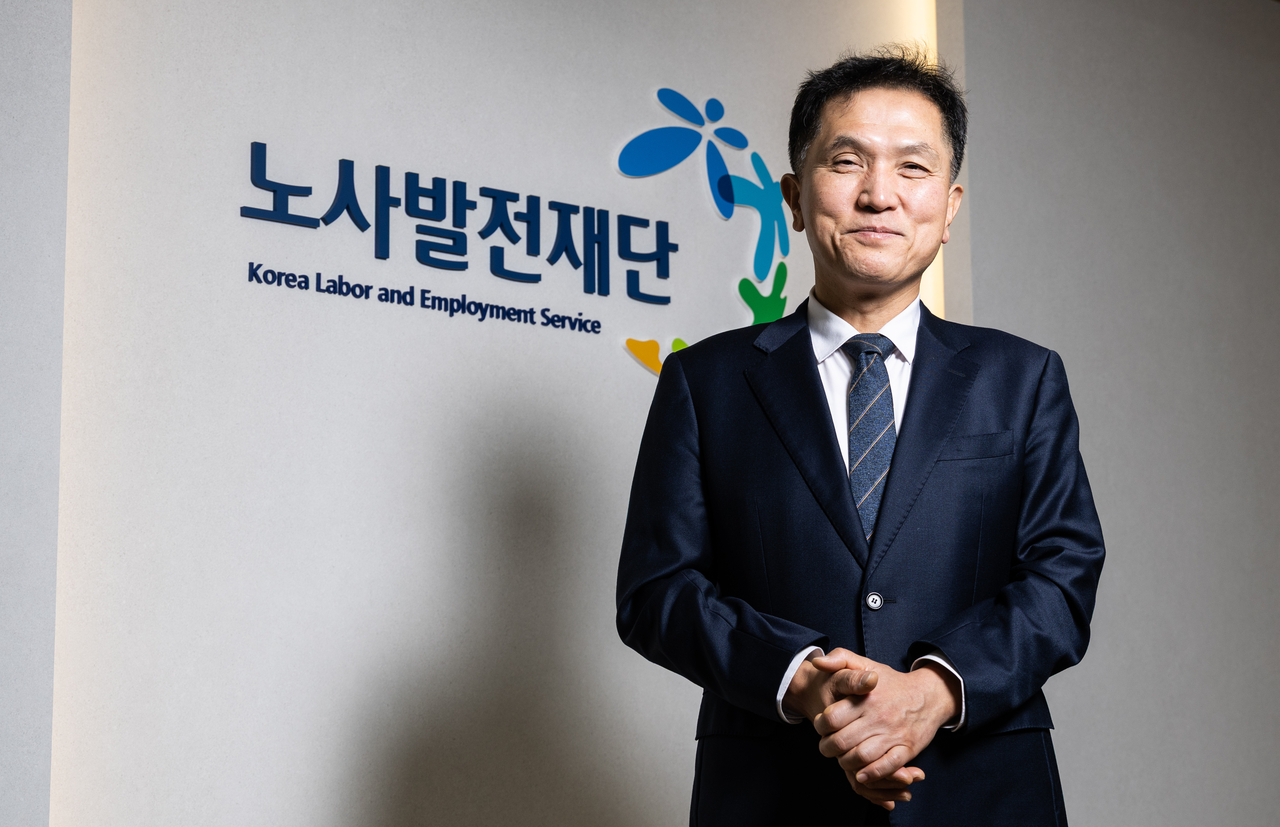
Park Jong-pil, secretary-general of the Korea Labor Foundation, said the foundation's work protecting vulnerable workers comes down to "giving people the feeling that someone is thinking about them and looking out for them." He was speaking at an interview Thursday at the foundation's office on Chungjeong-ro in Seoul. For workers who cannot access union support or fall outside the reach of labor law, the foundation aims to be that "someone" standing up for their rights and safety, Park said.
The government is moving to enact a Basic Act for Working People that would guarantee fundamental labor rights for all workers regardless of employment type — delivery riders, broadcast writers, translators and others. While the government builds the institutional framework, the foundation's role is to bridge the gap between the law and the reality on the ground.
In person, by phone, on KakaoTalk: three ways into the worker support centers
The foundation operates 10 Geullojaieum Centers — worker support centers — across the country, in Seoul, Gimpo, Pyeongtaek, Cheongju, Cheonan, Gunsan, Gwangju, Daegu, Busan and Ulsan. Certified labor attorneys are on staff to advise on wage theft, workplace harassment, industrial accidents and unfair dismissal. Services are free and range from drafting and filing complaints to referrals to court-appointed labor attorneys and civil legal consultations with contracted lawyers.
"The centers are not simply there to provide legal advice," Park said. "Their role is to help vulnerable workers work through problems that are too difficult to solve alone, together with experts."
Workers who do not have a center nearby or cannot visit during working hours can call the foundation's main hotline or contact the KakaoTalk channel "Nodong SOS" (Labor SOS). Phone consultations are available on weekdays from 9 a.m. to 6 p.m. The KakaoTalk channel offers one-on-one chat sessions with labor attorneys on weekdays from 9 a.m. to 7 p.m. and on Saturdays from 9 a.m. to 5 p.m.
'Nothing I can do — I'm a freelancer?' Freelancer SOS offers free legal counsel
The foundation has also set up a dedicated channel for freelancers and platform workers who are not recognized as employees under the Labor Standards Act. Called Freelancer SOS, it launched in April this year.
As of late October, contract disputes — including unfair contracts and unilateral terminations — accounted for 34.8 percent of consultations, the largest share. Unpaid fees made up 26 percent and questions about employee status 20 percent. More than six in 10 cases involved contract or payment issues.
Workers who are not classified as employees under the Labor Standards Act often have no recourse but civil litigation when they go unpaid. Many give up on seeking redress, however, because they lack legal knowledge or cannot afford to hire a lawyer.
"There should never be a situation where someone gives up on their rights simply because they are a freelancer, when solutions exist," Park said. "The significance of this channel is that it gives anyone who works — regardless of whether they are classified as an employee — access to expert help through a public service."
Workers can add the Freelancer SOS KakaoTalk channel and request a one-on-one consultation with a lawyer without submitting any documents in advance. The service covers a range of legal issues free of charge, including unfair contracts, unpaid fees and copyright infringement, and refers cases requiring litigation to the Korea Legal Aid Corporation and similar bodies. Consultations are available on weekdays from 9 a.m. to 7 p.m. and on Saturdays from 9 a.m. to 5 p.m.
In-person consultations are also available. Each of the 10 centers holds a "Legal Day" twice a month, when a lawyer visits to consult directly with workers. Appointments can be booked through the main hotline or via Freelancer SOS.
Ten centers cannot reach every vulnerable worker in the country. In response, the foundation launched a private labor center activation support project this year, selecting regional private labor centers with established counseling and education infrastructure and funding them to design and run programs tailored to local industries and labor market conditions.
Eligible programs cover not only labor law issues such as wage theft and unfair dismissal but also expert consultations on contract and tax matters for freelancers and platform workers, as well as labor rights education customized by occupation and employment type.
"We do not simply hand over funding and step back," Park said. "We monitor performance, identify and share best practices, and support capacity-building for counselors."
This year the foundation supported 96 programs at 34 private labor centers. Starting next year, the scheme will shift to a model in which local governments apply for the project and regional labor centers serve as implementing bodies. Around 30 centers will be selected and each will receive up to 50 million won ($37,200).
Alongside this, the foundation will next year begin building Nodongkwonrie-eum, a support network for vulnerable workers bringing together central and local government, private labor centers and labor organizations. The name, chosen through an open competition, carries the meaning of connecting workers' rights with the resources they need and linking the public and private sectors.
"We want to create a structure where the network follows the worker, not the other way around," Park said. "The goal is that no matter which organization a worker approaches first, they can be connected to everything they need — expert consultations, rights remedies, employment and vocational training, and psychological counseling."
The foundation is also running the Safety-eum Project, which sends staff directly to delivery and courier riders, outdoor workers and others. Since last year, safety campaigns covering more than 1,000 workers across six regions have been held nine times, offering free motorcycle inspections and distributing safety supplies.
"What matters more than the safety supplies themselves is giving workers a moment to think again about their own safety," Park said.
The foundation, which marks its 20th anniversary next year, also faces the tasks of merging with the Korea Employment and Labor Education Institute and relocating its offices.
"Combining the institute's expertise in labor education with the foundation's capacity to deliver integrated, field-centered services — counseling, rights remedies, education — should generate real synergies in protecting vulnerable workers," Park said.
Park Jong-pil graduated from Korea University with a degree in history and entered public service through the 38th administrative examination. A labor policy specialist, he served in a series of senior roles at the Ministry of Employment and Labor, including head of the labor inspection policy division, director of labor standards policy, head of planning and coordination, and spokesperson, before taking office as secretary-general of the Korea Labor Foundation in April last year. Drawing on his years in public service, he has also authored books including guides on effective reporting and competency assessment.
fact0514@heraldcorp.com




