Physical AI, data centers draw massive funding for next year; integrated care budget trimmed by 97.3 billion won, hydrogen vehicle subsidies slashed across the board
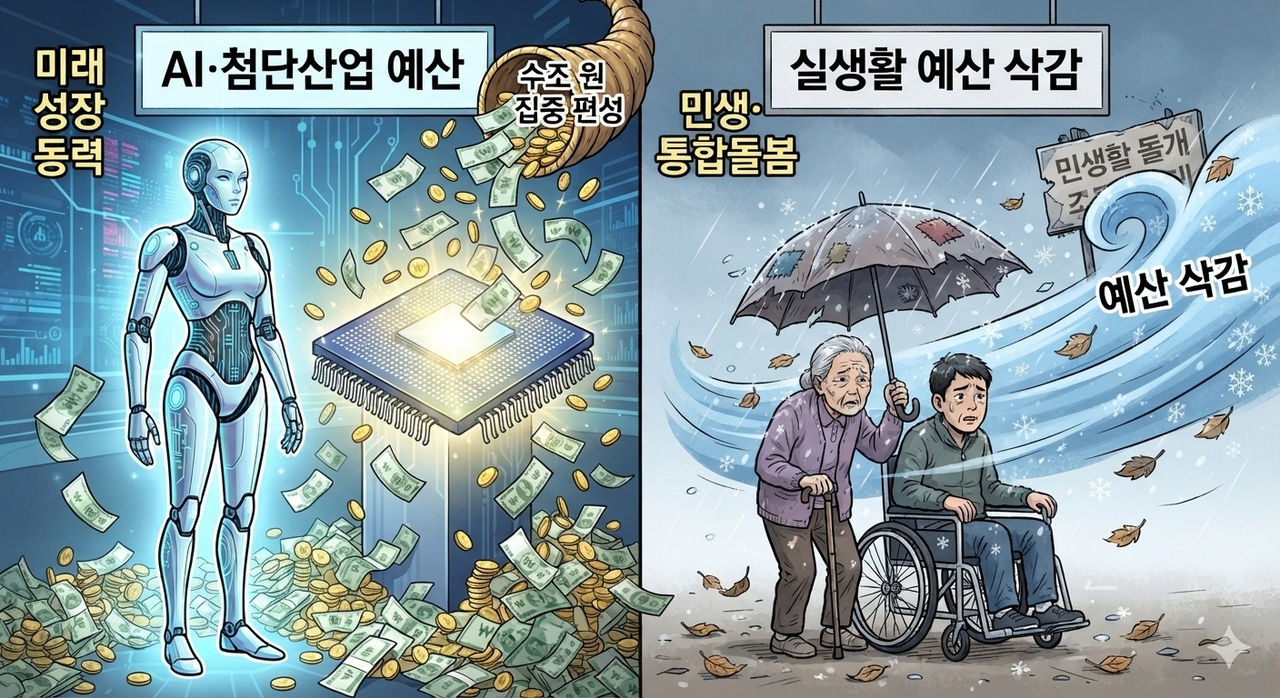
The government has allocated vast sums to AI and advanced technology in its budget proposal for next year, while sharply cutting or freezing spending on programs that directly affect the daily lives of vulnerable groups — a divide expected to trigger fierce debate during National Assembly budget deliberations.
The government says the spending priorities are aimed at securing future growth engines, but critics argue the plan ignores the kind of tangible, on-the-ground spending that people actually feel. Ruling and opposition parties are expected to clash bitterly over the proposal.
According to ministry-level budget plans released Wednesday, the government has drawn up an aggressive investment package under the banner of building an AI ecosystem and accelerating digital transformation.
The Ministry of Health and Welfare will commit 37.7 billion won ($28.1 million) in new funding to a physical AI introduction and demonstration project aimed at deploying domestically developed AI-integrated medical devices and robots in the field. The Ministry of Interior and Safety has also earmarked a combined 108.5 billion won for AI-related initiatives — 81.5 billion won for AI-based administrative services and 20.3 billion won to build an AI-integrated civil affairs platform.
The Ministry of Climate, Energy and Environment set aside 1.93 trillion won exclusively for advanced industries including semiconductors and AI data centers, and separately committed 10 billion won to develop safety management technology for AI-based long-distance high-pressure hydrogen pipelines.
Yet in sharp contrast to this sweeping AI investment push, budgets for programs closely tied to everyday life have been cut.
The Ministry of Health and Welfare's integrated care program — which helps elderly and disabled people receive support in their own homes and communities ahead of an era of rapid population aging — had 97.3 billion won trimmed from its original request of 253.1 billion won, leaving only 155.8 billion won in the final government proposal. Critics say the cut contradicts the current administration's stated policy of closing welfare blind spots and strengthening a field-centered welfare system.
The Ministry of Climate, Energy and Environment's budget for expanding hydrogen vehicle adoption — a key green-mobility initiative — was also sharply reduced.
The ministry cut both the total number of hydrogen vehicles it plans to support next year and the per-unit subsidy rates across vehicle categories, including passenger cars and buses. With private demand already frozen due to a shortage of hydrogen refueling infrastructure and high vehicle prices, further reductions in subsidy rates risk widening the gap between what the market needs and where policy is headed on the transition to eco-friendly vehicles.
Reaction from the National Assembly and policy experts has been cold. The opposition party vowed to restore the cut budgets, saying the government "lavishes hundreds of billions of won on advanced AI projects whose effectiveness has not been proven, while ruthlessly slashing care budgets for vulnerable people struggling day to day and on-the-ground funding to address the climate crisis."
Budget experts, while acknowledging the need to invest in future technologies, warned that an allocation that sacrifices balance with livelihood spending could stoke social conflict and erode the quality of public administrative services.
Ultimately, the fate of next year's budget will be decided in the Assembly's Budget and Accounts Committee. The final stretch of negotiations is expected to be turbulent, with a sharp standoff between the competing priorities of future investment and near-term economic stability.
thlee@heraldcorp.com