
'A chance to pass on the values of democracy' vs. 'Too soon to enshrine a still-contested event'
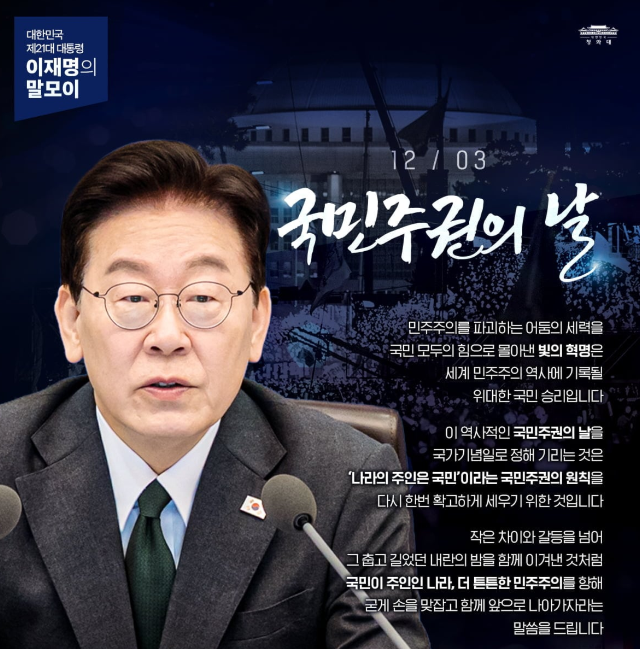
A government move to designate Dec. 3 as an annual national commemorative day — "12·3 National People's Sovereignty Day" — has sparked a sharp divide online, with netizens clashing across social media and internet communities over whether the designation is appropriate.
The day is intended to honor the citizens who stood up to defend constitutional order and democracy during the emergency martial law crisis of Dec. 3, 2024. But it has drawn a wide range of reactions, with debate centering on how history should judge that night, whether there is sufficient public consensus, how commemorative events should be run, and whether the day should be made a public holiday.
'Honoring the resolve and courage of citizens who defended democracy'
Supporters of the designation say it is meaningful for the state to officially record and honor the resolve and courage of citizens who defended democracy through peaceful means.
"It is only natural that the state mark as a commemorative day the moment when the people showed the will of the sovereign while standing up to armed troops," one user wrote. "I hope the memory of that day does not fade, and that it becomes an occasion to pass on the values of democracy to the next generation."
Another user expressed anticipation that commemorative events previously held separately by civic groups and the National Assembly would now be consolidated under a single government-organized ceremony, lending the occasion greater weight and significance.
Some also highlighted the cultural and academic programs planned around the holiday, including exhibitions, book concerts and documentary screenings.
Several users said the day could take root as a citizen-participatory commemoration if it went beyond simply marking the date — for instance, by creating spaces to share archival materials from that night and winning entries from related competitions. Others added that the name itself was a reminder of the constitutional principle that all sovereign power derives from the people.
'Doubt over enshrining a still-contested event as a national commemoration'
Skeptical and opposing voices, however, are equally strong.
Some netizens said it was premature to rush the designation while the political fallout and social divisions stemming from the emergency martial law crisis had yet to fully subside.
"A national commemorative day should rest on broad consensus that transcends generations and political camps," one user said. "I question whether it is right to lock in a national commemorative day for an issue that is still being debated."
Concerns about budget spending and partisan controversy also surfaced repeatedly online.
"Given that a considerable amount of public money will go toward designating the holiday, organizing various commemorative events and running related committees, the details and actual effectiveness should be scrutinized carefully," one post read.
Others warned that if each change of government brought new commemorative days built around specific incidents or slogans, the unifying purpose of such days could be undermined.
Opinions split on whether the day should be a public holiday
Whether Dec. 3 should be designated a public holiday has also drawn divided reactions.
Some users expressed disappointment that the day would be a commemorative day but not a day off, saying it would be hard to feel its significance in everyday life. Others pushed back, arguing that the more important question was not whether people get a day off but whether they take time to reflect on the historical context and meaning behind the date.
The name of the holiday itself also drew competing views — some called it a fitting title that clearly captures the nature of the event, while others said it invited comparisons with other historical commemorative days and raised questions of consistency.
The online debate continues, with supporters emphasizing the significance of defending popular sovereignty and backing the designation, while critics raise concerns about insufficient public consensus, budget implications and the risk of partisan bias.
The government approved the designation Tuesday at a Cabinet meeting, passing an amendment to the regulations governing national commemorative days and officially establishing Dec. 3 each year as "12·3 National People's Sovereignty Day."
thlee@heraldcorp.com




