The UN climate conference runs Monday through Nov. 20 in Antalya, Turkey
Talks will focus on accelerating Paris Agreement implementation and limiting global warming
Global electrification, just transition support and climate finance also on the agenda
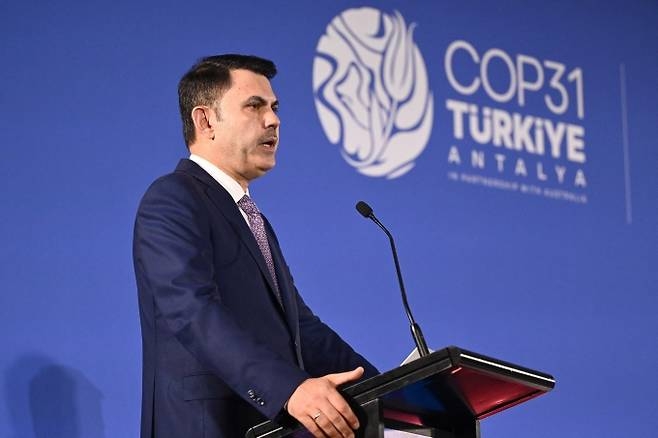
Ten years after the Paris Agreement — the world's first universal climate accord committing nations to cut greenhouse gas emissions — entered into force, its signatories are gathering once again to chart a course through the climate crisis.
South Korea's Ministry of Climate, Environment and Energy announced Sunday that the 31st Conference of the Parties to the UN Framework Convention on Climate Change (UNFCCC COP31) will be held in Antalya, Turkey, from Monday through Nov. 20.
About 100,000 participants are expected to attend, including government delegations from signatory states. South Korea will be represented by a government delegation led by Climate, Environment and Energy Minister Kim Sung-hwan, joined by officials from relevant ministries and technical experts.
This year's conference will operate under a new cooperative framework in which host country Turkey leads the presidency and drives the climate action agenda, while Australia serves as negotiations chair, guiding talks among the parties.
As at last year's COP30 in Belém, Brazil, accelerating implementation of the Paris Agreement is expected to be the central challenge on the table.
The conference will focus particularly on strengthening international cooperation to minimize how far and how long global average temperatures exceed 1.5 degrees Celsius above pre-industrial levels, and on translating each country's climate targets into concrete policies and investments.
Key agenda items include greenhouse gas mitigation, climate change adaptation, the global stocktake, just transition, climate finance, loss and damage, and transparency in Paris Agreement implementation.
The South Korean delegation plans to work with major countries and the Environmental Integrity Group to participate in negotiations on core agenda items including mitigation, adaptation and just transition.
Drawing on South Korea's Korea Green Transformation (K-GX) strategy and its vision of becoming an "electricity state," the delegation also plans to actively engage in international cooperation on expanding electrification — including joining the host country's "35 by 35" global electrification pledge, which aims to raise electricity's share of global final energy consumption to 35 percent by 2035.
Minister Kim will attend the high-level segment from Nov. 16 through Nov. 18, where the schedule includes a national statement, bilateral talks with major countries and international organizations, side events on climate and energy cooperation, and meetings with youth groups, civil society organizations and industry representatives.
South Korea's national pavilion will host 51 side events this year, providing a platform for academics, youth groups and local governments to showcase their climate action work to the international community. A technology exhibition will also highlight a range of carbon neutrality solutions.
Minister Kim said the climate crisis "is a shared global challenge that no single country can solve alone, and this is a moment when the international community's unwavering cooperation is essential for the coexistence of the planet and humanity." Kim added that COP31 should "serve as an opportunity to translate the promises of the Paris Agreement into concrete and substantive action and advance climate multilateralism to the next level," and pledged that South Korea "will take the lead in implementing the Paris Agreement by expanding K-GX into a global green transformation undertaken together with the international community."
thlee@heraldcorp.com