![SK Group Chairman Chey Tae-won (center), SK hynix CEO Kwak Noh-jung and other senior executives pose for a photo in front of the NASDAQ Tower at Times Square in New York on July 10 (local time). [Reuters]](https://wimg.heraldcorp.com/news/cms/2026/07/14/news-p.v1.20260713.8269e0d406ae4894b4b630c078451595_P1.jpg)
Renewed tensions over the Strait of Hormuz have rattled South Korea's stock market again. The Kospi gave back roughly half of its gains since April in the latest selloff and fell nearly 30 percent from last month's intraday peak. A sharp drop in heavyweight semiconductor stocks triggered sustained foreign selling, while oil prices and the won-dollar exchange rate surged simultaneously — a triple headwind that froze investor sentiment.
Yet the reaction from the brokerage community has been surprisingly measured. Analysts say the selloff mirrors the pattern seen during the US-Iran clash in March, when fear was priced in ahead of any fundamental deterioration, while the AI investment cycle itself remained intact. Several brokerages have argued this is a "re-pricing process, not a bear market" and recommended maintaining positions in market leaders.
According to Korea Exchange, the Kospi closed Monday at 6,806.93, down 669.01 points, or 8.95 percent, from the previous session. That marks a decline of 27.4 percent, or 2,578.66 points, from the intraday high of 9,385.59 reached on June 19, and erases roughly half of the rally that began in April.
Monday's close was the first time the Kospi had fallen below the 7,000 mark since breaking through that level on May 6 — a gap of about two months, or 46 trading sessions. The index had crossed 9,000 just 17 trading sessions, or 25 calendar days, before sliding back below 7,000.
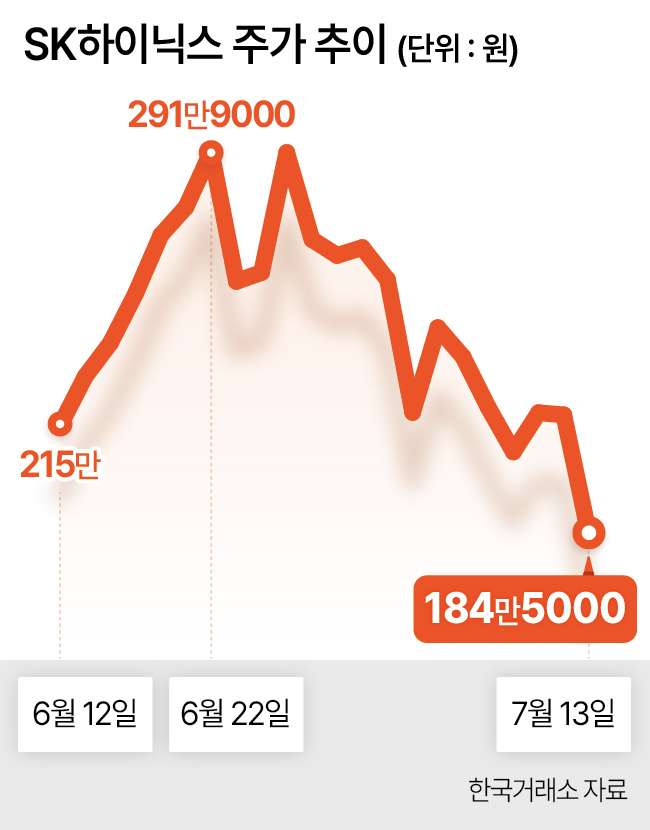
The two largest stocks on the Kospi — Samsung Electronics and SK hynix — plunged on concerns about a semiconductor earnings peak, dragging the broader index lower. Samsung Electronics fell 10.70 percent to 254,500 won ($174), while SK hynix dropped 15.37 percent to 1.845 million won on Monday.
SK hynix's single-day decline was the steepest in the company's history. Its market cap in won terms shrank to 1,314.94 trillion won, dropping it out of the $1 trillion market cap club.
The selloff was ignited by a fresh flare-up of tensions over the Strait of Hormuz. Against a backdrop of lingering concerns about a semiconductor earnings peak, US airstrikes on Iran sent international oil prices and the won-dollar exchange rate sharply higher, dampening investor appetite.
US President Donald Trump said Monday (local time) on the conservative radio program "The Hugh Hewitt Show" that the United States would "hit Iran hard again Tuesday night, and tomorrow." He added that the strikes were meant as "an example" rather than an attempt to eliminate Iran, and called Iranian leaders "crazy people."
Analysts, however, say the market needs to recall the lessons of March and April. Just as during the Iran war shock in March, fear has simply been priced in ahead of the fundamentals, they argue. Some brokerages went further, specifying that a rebound was possible within two to three days.
Kim Byeong-yeon, a researcher at NH Investment & Securities, said "volatility in the Korean stock market has expanded to levels exceeding those seen during the financial crisis," but added that "even if a further spike-type decline occurs at the current index level, we believe a rebound within two to three days is possible." With multiple headwinds already priced in over a short period, he said a near-term recovery was likely even if additional sharp declines materialized.
The main reason analysts do not view this correction as the start of a bear market is that the AI investment cycle has not yet turned. Concerns have surfaced simultaneously about the possibility of big tech companies cutting AI spending — starting with Meta — and about an earnings slowdown at SK hynix as long-term supply agreements, or LTAs, are factored in. But the prevailing view is that evidence to support an actual reduction in AI investment remains insufficient.
Kim Dong-won, head of research at KB Securities, said next year is expected to be the tightest supply environment in the semiconductor industry's 70-year history. "With virtually no new general-purpose memory capacity coming online, big tech companies' long-term supply agreements will kick in earnest next year, and new memory output will be allocated first to the big tech firms that have signed LTAs," he said. "The memory supply shortage felt by ordinary customers will deepen to a cliff-like level."
Brokerages held their target prices and kept buy recommendations even as share prices plunged. Korea Investment & Securities in particular maintained its target price for SK hynix at 3.8 million won and reiterated a buy call — a figure 105.9 percent above Monday's closing price.
Chae Min-suk, a researcher at Korea Investment & Securities, said the key question from here is the sustainability of earnings. "The expansion of LTAs is reducing the earnings volatility that has long been a weakness of the memory industry," she said. "As the share of contract-based sales grows and supply shortages persist due to capacity being absorbed by expanding HBM production, high profitability will be maintained over the long term."
Not everyone is sanguine, however. Kim Du-eon, a researcher at Hana Securities, said that if the American depositary receipt premium narrows rapidly and both memory prices and earnings forecasts fall at the same time, "the second-leg rally hypothesis would need to be revisited." He said whether this correction marks the end of the bull market or a re-pricing ahead of a second leg up hinges on whether the AI investment cycle and memory earnings hold.
th5@heraldcorp.com
jiyun@heraldcorp.com