'The right ETF investment approach for retail investors'
ISA, family gifting among key tax-saving tools
Buy when VIX tops 30 or circuit breakers trigger, expert says

Tax strategy has emerged as the decisive factor in long-term returns for retail investors caught up in the ETF investment boom.
Park Min-su, a bestselling author on stock investment who writes under the pen name Choi Go-min-su, delivered a lecture Saturday at Herald Money Festa 2026 at Dongdaemun Design Plaza in Jung-gu, Seoul, on "The right ETF investment approach for retail investors."
Park outlined tax-saving strategies using pension savings accounts, individual retirement pension (IRP) accounts, ISAs and intra-family gifting, saying that even substantial long-term ETF gains can shrink in real terms if investors fail to manage their tax exposure.
"Domestic equity ETFs are exempt from capital gains tax, but other domestic ETFs that track indexes such as the NASDAQ are subject to dividend income tax on both capital gains and distributions," he said. "Once annual financial income exceeds 20 million won ($14,700), it becomes subject to comprehensive taxation and, when combined with salary and other income, can be taxed at a rate of up to 49.5 percent."
As a remedy, Park urged investors to make maximum use of tax-advantaged accounts such as pension accounts and ISAs. Pension accounts accept contributions of up to 18 million won per year, with tax credits available on combined contributions of up to 9 million won — typically 6 million won through a pension savings account and 3 million won through an IRP.
An ISA allows investors to hold a range of financial products — deposits, funds and shares — in a single account while enjoying tax benefits. Investment gains generated inside an ISA are tax-exempt up to 2 million won for standard account holders and up to 4 million won for low-income earners and farmers and fishermen; any gains above those thresholds are subject to a reduced, separately taxed rate of 9.9 percent.
Park noted that transferring ISA maturity funds into an IRP within two months qualifies for additional tax credits. "After taking advantage of that, opening a new ISA is also worth considering," he said.
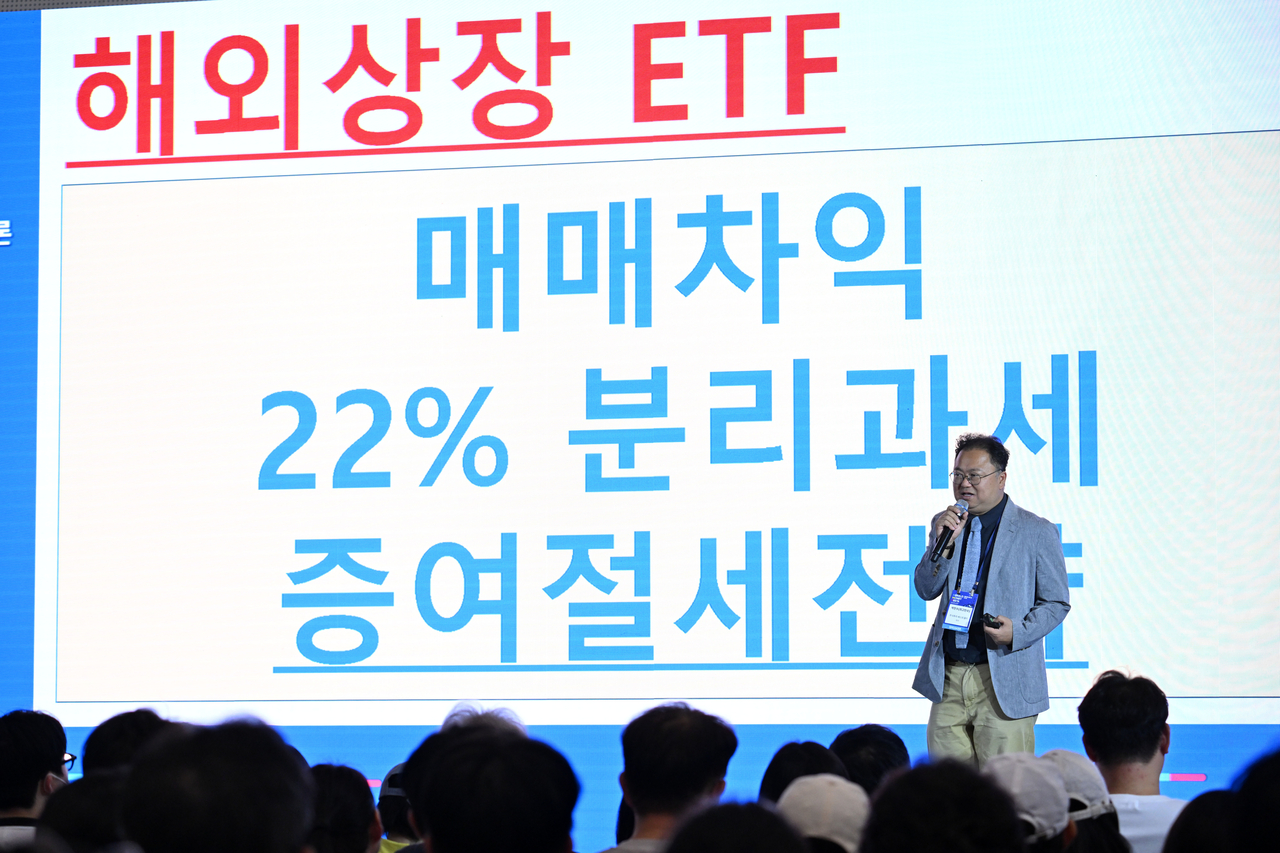
For investments of 100 million won or more, Park proposed intra-family gifting strategies. When investors directly purchase ETFs listed on US markets and realize capital gains, a 22 percent tax rate applies to profits exceeding 2.5 million won.
"For example, if you invest 100 million won and QQQ grows to 500 million won, you could consider transferring it to your spouse using the spousal gift deduction — which allows up to 600 million won over a 10-year period — and then selling one year later," he said. He also mentioned using the 10-year gift deduction limits for adult children (50 million won) and minor children (20 million won).
For portfolio construction, Park introduced a "4-4-2" framework: allocate 40 percent of assets to broad benchmark indexes, 40 percent across two or three promising individual sectors, and the remaining 20 percent to monthly-dividend covered-call products.
For more conservative investors, he recommended adjusting the ratio to "5-3-2" — 50 percent in benchmark indexes, 30 percent in individual sectors and 20 percent in covered calls. Among benchmark indexes, he named the NASDAQ 100 as his top pick.
To navigate market downturns, Park introduced a "2-4-6 strategy" for adding to positions. For high-quality benchmark indexes such as the NASDAQ 100, he recommended buying one unit when the index falls 20 percent from its peak purchase price, doubling that allocation at a 40 percent decline, and quadrupling it at a 60 percent decline.
He pointed to the VIX — widely known as the "fear index" — as the key timing indicator for executing this approach. "Historically, when the VIX exceeds 30 or circuit breakers are triggered, markets are gripped by excessive fear, and that is the opportunity," Park said. "Rather than aggressively reinvesting capital gains in normal times, investors should keep cash on hand and deploy it through staged buying during those crisis moments."
Park also sounded a note of caution on monthly-dividend covered-call ETFs, which have attracted retirement savings in recent years on the strength of their high-yield appeal. "Because the structure involves selling call options — giving up some upside — to fund distributions, gains are capped in a bull market, and distributions come alongside share price adjustments," he said. "Caution is warranted."
jiyun@heraldcorp.com
snsd@heraldcorp.com