Three ETF specialists outline sector picks and portfolio tactics for a turbulent market
AI bottleneck industries — power, nuclear, shipbuilding — seen as key plays
Account-specific portfolios essential for maximizing tax benefits
Raising bond allocation within portfolios worth considering

With stock market volatility at a peak amid high US interest rates and broader macroeconomic uncertainty, leading ETF specialists from South Korea's top asset managers gathered Friday to lay out their strategies for navigating the second half of the year.
The experts were unanimous: rather than being rattled by short-term earnings swings, investors should spread their money across the "bottleneck industries" that inevitably emerge as the AI ecosystem expands, and stay in the market by building positions gradually and constructing goal-oriented portfolios.
Yuk Dong-hwi, head of ETF product marketing at KB Asset Management; Cheon Gi-hun, head of the ETF consulting team at Shinhan Asset Management; and Choe Chang-gyu, head of ETF consulting at Mirae Asset Global Investments, took part in a panel discussion titled "Sectors and investment strategies to watch in an era of volatile markets" at the Herald Money Festa 2026, held at Dongdaemun Design Plaza in Jung-gu, Seoul.
Despite recent share price corrections among semiconductor and big-tech companies, the three panelists agreed that the AI paradigm remains a powerful and durable megatrend.
"Valuations have become stretched as future earnings get pulled into today's share prices, and high interest rates make it difficult to rotate nimbly between sectors," Yuk said. "This is a time to spread investments logically across the bottleneck industries within the AI paradigm — from HBM shortages to data center power to cybersecurity — and wait."
He added that once macroeconomic risks ease, those bottleneck industries stand to rise together. "Right now, the key is not what to buy or when, but how long you can hold on and endure," he said.
Cheon agreed, pointing to Micron Technology's strong recent earnings as evidence that a supplier-favorable market is likely to persist through 2028. "If secondary batteries and the metaverse were story-driven, today's semiconductor sector is backed by real numbers — actual earnings — and that is the decisive difference," he said. He cautioned, however, that while the market used to be driven mainly by industry cycles, macroeconomic variables such as interest rates and inflation now carry far greater weight, making volatility management essential.
Choe highlighted the massive capital expenditure of AI big-tech companies as the key indicator to watch. "There is a possibility of one more US benchmark interest rate hike in December, but the market has already built up a tolerance for high rates," he said. "Hyperscalers' capital expenditure next year is expected to reach $1.2 trillion, so there should be no major disruption to the market." He added that investors should look beyond semiconductors to sectors where AI is embedded — singling out nuclear power as a solution to data center energy shortages, and the shipbuilding sector, including Hyundai Heavy Industries and Hanwha Engine, which supply marine engines for use as emergency generators at data centers.
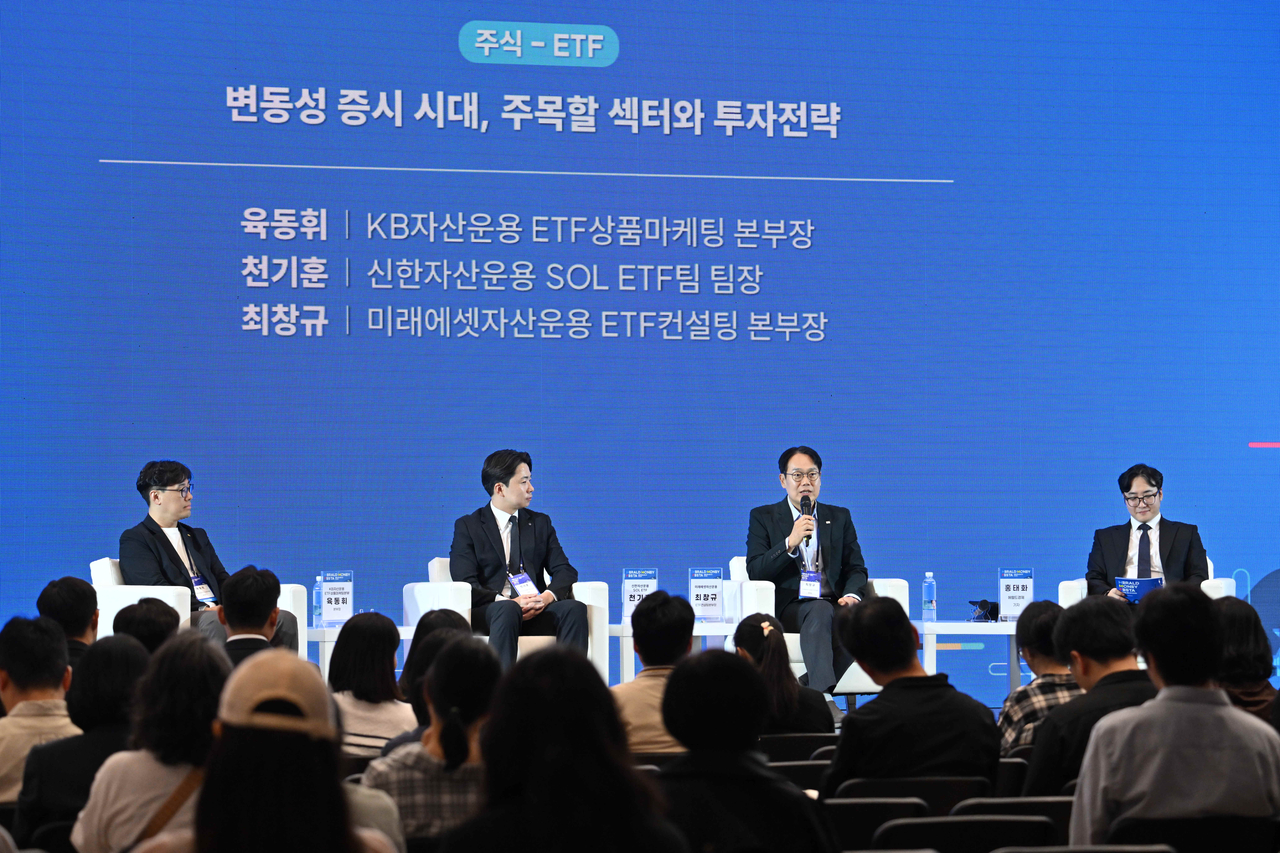
On strategy for retail investors in the fast-growing ETF market, the panelists recommended a gradual accumulation approach. Choe said investor fatigue is running high among those who entered at this year's peak and suffered losses. "Rather than putting in a large sum all at once, the trend will be toward accumulation investing — using fractional share purchases or stock and ETF accumulation features to bring down the average cost," he said.
He identified four core underlying assets worth building up: the S&P 500, the NASDAQ 100, the US Dividend Dow Jones index and the Kospi 200. He particularly noted that the Kospi 200 is effectively a direct play on the semiconductor value chain — Samsung Electronics and SK hynix together account for more than 50 percent of the index, which also includes Samsung Electro-Mechanics and LG Innotek — making it "an excellent alternative for investors with no semiconductor exposure."
For those who already hold semiconductor positions, the panelists suggested looking at high-dividend stocks or bonds. Choe noted that the yield on 30-year US Treasury bonds has surged to around 5.7 percent, a 22-year high, which conversely means bond prices have fallen to near their floor. "This is an exceptional market environment unusual enough to break the traditional 60-percent-equity, 40-percent-bond allocation formula," he said. "Gradually raising the bond allocation within your portfolio from year-end onward is a strategy well worth actively considering."
The panel also stressed the importance of tailoring ETF investments to specific goals and account types. Yuk warned against abandoning the market out of exhaustion from volatility. "Rather than simply picking a sector, investors need to respond with goal-oriented ETFs matched to the purpose of their money," he said.
He explained that investors who struggle to stomach downside volatility could consider adding monthly distribution ETFs to their portfolios, using the regular payouts to repurchase assets and lower their average cost basis.
Cheon emphasized building account-specific portfolios to maximize tax benefits. "After the introduction of leveraged ETFs and the overseas investment boom that followed COVID-19, the current growth engine of the ETF market is tax-advantaged accounts — pension savings accounts, retirement pension accounts and ISAs," he said. "Among the more than 1,200 ETFs listed domestically, which products go into which accounts is the key factor that determines returns."
He advised that retirement pension accounts should make active use of bond-mixed ETFs in line with the 30-percent safe-asset requirement; that the productive finance ISA set to launch next year is well suited to domestic high-dividend ETFs given its larger tax-exemption benefits; and that domestic equity-based covered-call products, given their tax-exempt nature, are best held in regular brokerage accounts where liquidity can be managed. "Diversification across account types is essential," he said.
For investors wrestling with the right balance between domestic and overseas exposure, Yuk offered a practical rule of thumb. "Don't try to predict which market will outperform — match your allocation to the nature of each account," he said. "If you have filled your tax-advantaged accounts with overseas investments, holding domestic investments in your regular account to maintain a roughly 50-50 neutral balance has historically been the most effective defense in a falling market."

jiyun@heraldcorp.com
park.jiyeong@heraldcorp.com
moon@heraldcorp.com