A preview of next year's comprehensive real estate tax bills — Heukseok Acro River Haim faces jump from 5.75 million to 11.22 million won
Government expects relief from reform bill, but non-Gangnam Seoul and southern Gyeonggi Province may see steeper burdens
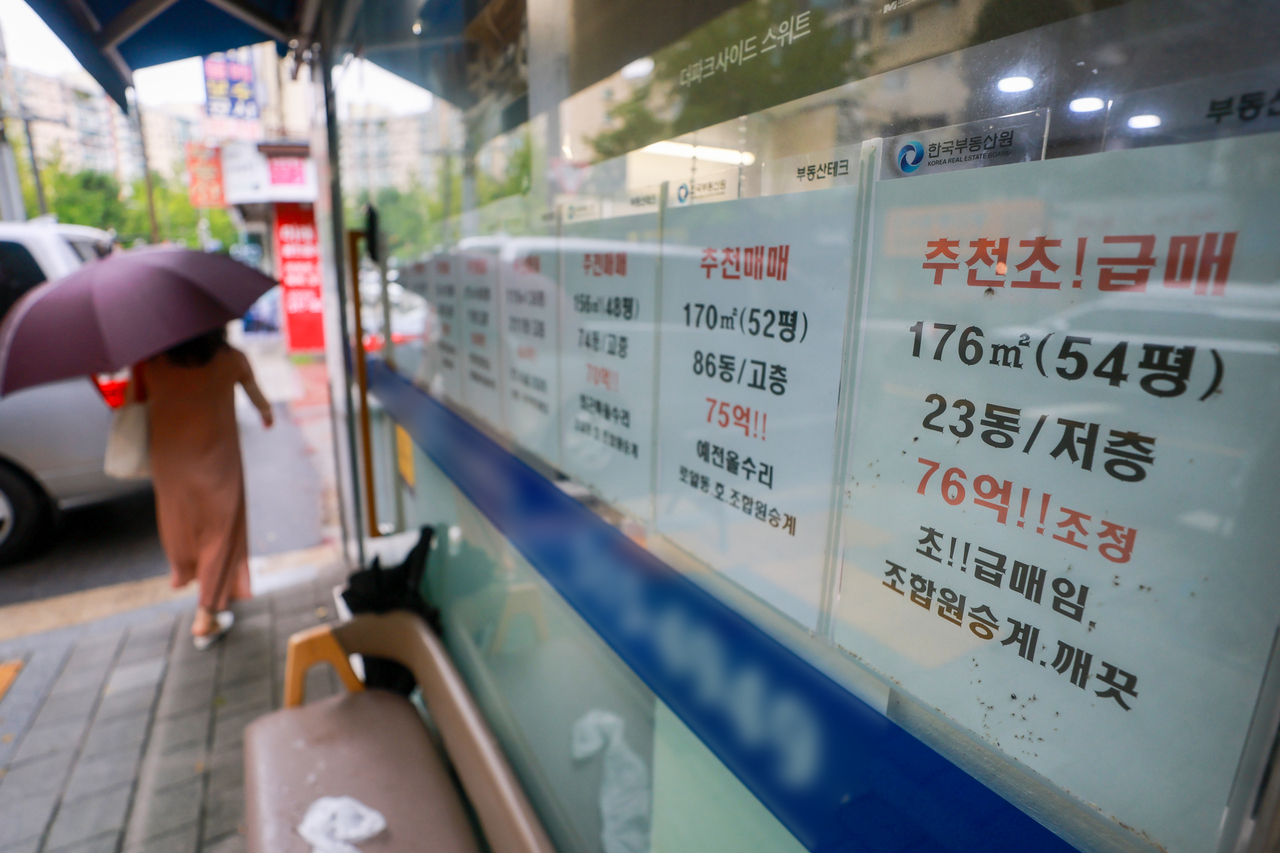
If publicly assessed home values rise next year at the same rate as this year, single-home owners of major Seoul apartments could see their property tax bills nearly double — even if the government's proposed comprehensive real estate tax relief package clears the National Assembly unchanged, according to new estimates.
Concerns are growing that surging assessed values, particularly in non-Gangnam areas of Seoul and southern Gyeonggi Province where home prices climbed sharply this year, could offset the relief the government's reform is meant to deliver for owner-occupiers.
A simulation by real estate tax calculation service Sellymon released Sunday found that an owner-occupier of an 84-square-meter unit at Raemian One Bailey in Banpo-dong, Seocho-gu, Seoul would face a property tax bill of 45.44 million won ($33,800) next year — up 17.34 million won, or 61.7 percent, from this year's 28.11 million won.
The figures were calculated using the government's pending tax reform bill, which covers both property tax and the comprehensive real estate tax. The simulation assumed next year's assessed value rises by the same percentage as this year's increase, that the unit is held solely in one person's name and occupied as a primary residence, and that no tax credits apply.
If One Bailey's assessed value rises by the same rate as this year — 33 percent — the property tax portion would climb from 9.38 million won to 10.22 million won, while the comprehensive real estate tax would jump from 18.72 million won to 35.22 million won. Some 95 percent of the total increase would come from the comprehensive real estate tax.
Also in Banpo-dong, an 84-square-meter unit at Acro River Park would see its property tax bill rise 50.2 percent, from 24.07 million won to 36.17 million won. At Jamsil Jugong 5 Complex (82.51 square meters) in Songpa-gu, the bill would surge 63 percent from 1.45 million won to 21.92 million won, while an 84-square-meter unit at Eunma in Daechi-dong, Gangnam-gu, would rise 69.1 percent from 10.7 million won to 18.1 million won.
The steepest increase among the properties analyzed would fall on Acro River Haim in Heukseok-dong, Dongjak-gu. Its assessed value already rose 43.9 percent this year; if it rises by the same margin again next year, the property tax bill would climb 95.3 percent — from 5.75 million won to 11.22 million won, nearly doubling the burden.
Among the so-called "Ma-Yong-Seong" districts — Mapo-gu, Yongsan-gu and Seongdong-gu — Raemian Oksu Rivergene in Seongdong-gu posted the highest projected increase at 71.2 percent, followed by Mapo Raemian Prugio in Mapo-gu at 58.1 percent and Hangaram in Yongsan-gu at 54.9 percent. A 79.24-square-meter unit at Yeouido Sibeom in Yeongdeungpo-gu would also face a 65.6 percent rise.
A three-home owner living at Acro River Park and also holding one unit each at Jamsil Ricenz and Mapo Raemian Prugio — all 84 square meters — would see the combined property tax bill for the three apartments rise about 60 million won, or roughly 50 percent, from 119.97 million won to 180 million won.
The Ministry of Finance and Economy said it expects the comprehensive real estate tax burden to ease once home prices stabilize and the government's reform bill passes, citing the relief effect for owner-occupiers of residential properties.
Under the proposal, the tax threshold for single-home owners would rise from a publicly assessed value of 1.2 billion won to 1.4 billion won, meaning homes with a market value of up to 2 billion won would be exempt from the comprehensive real estate tax regardless of whether the owner lives there.
However, if assessed values continue rising at this year's pace, a significant number of apartments could cross the new 1.4 billion won threshold and become newly subject to the tax.
The owner-occupier of an 84-square-meter unit at Mokdong Hillstate in Yangcheon-gu received a comprehensive real estate tax bill for the first time this year — 449,000 won — after the unit's assessed value rose 23 percent to 1.38 billion won, clearing the current 1.2 billion won threshold.
If assessed values hold steady, the government's proposal would bring that bill to zero. But if values rise again at this year's rate, the assessed value would exceed the new 1.4 billion won threshold at 1.69 billion won, and even an owner-occupier would owe 901,000 won — twice the current bill.
Analysts warn that assessed values in non-Gangnam Seoul and southern Gyeonggi Province, where home prices surged this year, could rise even more steeply next year, potentially intensifying the comprehensive real estate tax burden in those areas.
Weekly data from the Korea Real Estate Board show that apartment sale prices in Gangnam-gu fell 2.57 percent and in Seocho-gu fell 0.80 percent from the start of this year through the third week of this month.
By contrast, Seongbuk-gu led all districts with a 17.76 percent gain, followed by Seodaemun-gu at 15.03 percent, Guro-gu at 13.80 percent, Gangseo-gu at 13.73 percent, Dongdaemun-gu at 13.53 percent, Gwanak-gu at 13.30 percent and Nowon-gu at 13.24 percent — all areas that had posted annual gains of no more than around 5 percent last year.
In Gyeonggi Province, Dongtan-gu in Hwaseong led with a 23.01 percent rise, followed by Yeongtong-gu in Suwon at 19.29 percent, Gwangmyeong at 19.08 percent and Dongan-gu in Anyang at 18.86 percent.
"Many new transaction-price records were set in the second half of this year, and the gains outside the three Gangnam districts were especially large," a tax industry official said. "In those areas, we cannot rule out the possibility that next year's assessed values will rise further, increasing the property tax burden."
The official added that while the higher 1.4 billion won threshold could reduce the number of taxpayers subject to the comprehensive real estate tax, new taxpayers could emerge in southern Gyeonggi Province areas such as Hwaseong Dongtan, Yongin and Bundang, which saw sharp price increases in the second half of this year partly driven by the semiconductor industry. "We'll have to wait and see, but I don't think the reduction effect will be as large as the government expects," the official said.
The National Assembly's Finance and Economy Planning Committee held back-to-back sessions of its tax subcommittee Tuesday and Wednesday and closed-door sub-subcommittee meetings Thursday and Friday in a last-ditch effort to finalize revisions to the comprehensive real estate tax law, but reached no conclusion.
Some Assembly members have argued that the 1.4 billion won basic deduction should apply uniformly to all single-household, single-home owners above that threshold regardless of whether they live in the property. The government's proposal would set the deduction at 1.4 billion won for owner-occupiers but keep it at 1.2 billion won for non-resident single-home owners.
Deputy Prime Minister and Finance and Economy Minister Lee Hyeong-il reaffirmed Monday at a press briefing that the government still believes incentives should favor owner-occupied housing, saying his position on the need for differential treatment "remains exactly the same."
oskymoon@heraldcorp.com