
19 promising non-semiconductor products should be nurtured to reach global No. 1 status
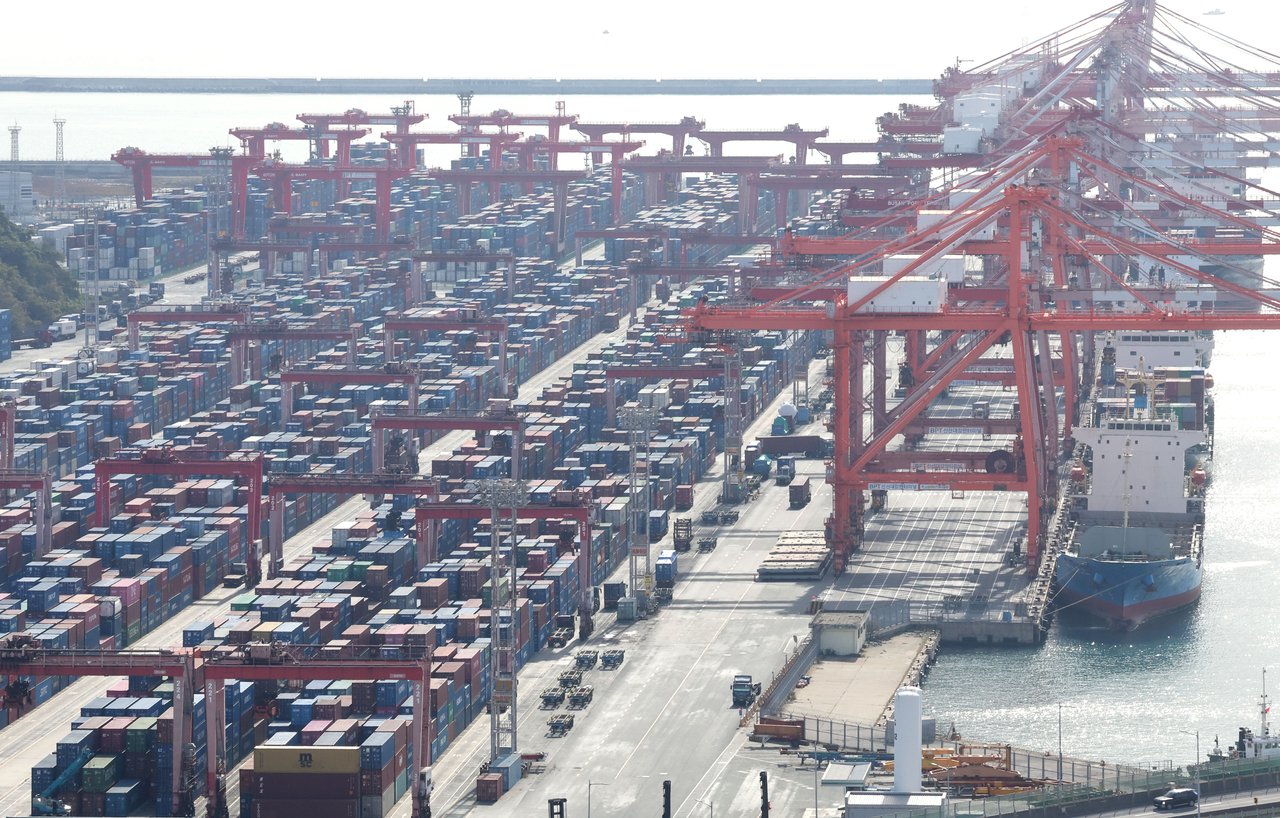
A state-run research institute said South Korea must channel surplus tax revenues generated by the semiconductor boom into non-chip industries to sustain the export momentum that pushed the country past the $1 trillion mark.
The Korea Institute for Industrial Economics and Trade released a report Friday, titled "Korea's $1 Trillion Export Era: Diagnosing Sustainability and Policy Challenges," saying such a shift is essential to keeping exports above the $1 trillion threshold.
South Korea's exports surpassed $700 billion last year, making it the sixth country in the world to reach that level. This year, it crossed the $1 trillion mark — becoming only the fourth country to do so, after the United States, Germany and China, and achieving the milestone in just one year.
The report said South Korea's path to $1 trillion more closely resembles Germany's than China's. Germany saw its dollar-denominated exports swell between 2002 and 2008 as the euro appreciated. China, by contrast, reached the milestone through a surge in manufacturing production and export volumes following its accession to the World Trade Organization.
South Korea, which crossed $1 trillion on the back of rising memory chip prices, follows a "price-driven" growth model closer to Germany's than to China's "volume-driven" approach.
However, the report warned that because the price factor stems from semiconductor unit prices rather than exchange rates, a downturn in the semiconductor price cycle could cause South Korea's exports to contract sharply.
Semiconductors' share of total exports has been expanding — from 35.5 percent in the first quarter of this year to 41.4 percent in the second quarter and 46.4 percent in the third. In October, the figure approached half of all exports at 48.9 percent.
In response, the report recommended that policy goals focus on expanding non-semiconductor exports so the economy can absorb the shock if chip prices fall.
As a first step, it called for establishing in advance a principle that a portion of the surplus corporate tax revenues generated by the semiconductor boom be earmarked for equipment and supply chain investment in key non-semiconductor export sectors.
The report also said policy finance institutions should play a greater role. It recommended designing a system in which lending limits for non-semiconductor equipment financing are linked to indicators of export concentration — such as the semiconductor share of total exports — so that as concentration rises, investment capacity in non-chip sectors automatically expands.
The report said the funding and financing should target existing products already climbing the global rankings rather than entirely new industries.
The plan calls for intensively developing 19 products that each recorded more than $100 million in exports in 2024 and have been steadily rising to between second and 10th place globally, with the aim of increasing the number of products South Korea ranks first in worldwide.
All 19 products are in non-semiconductor sectors and include tanks and armored vehicles (third), mixing and grinding industrial machinery (third), light oils and preparations (sixth), automotive drive shafts (sixth), and forklifts (sixth). Pushing them to the top spot would help reduce the country's heavy reliance on semiconductors, the report said.
The report added that to prevent support from becoming permanently locked in to specific products, assistance should end once a product reaches global No. 1, and eligibility should be reassessed if a product fails to improve its ranking within three years.
"The policy goal should be to reduce the sensitivity of the export structure to semiconductor price shocks," the report said. "To that end, the scale of non-semiconductor products capable of absorbing the impact of a price decline must be expanded."
oskymoon@heraldcorp.com




