Leading tenor of Korea's first opera generation
Took his first starring role as the Duke of Mantua in 1958
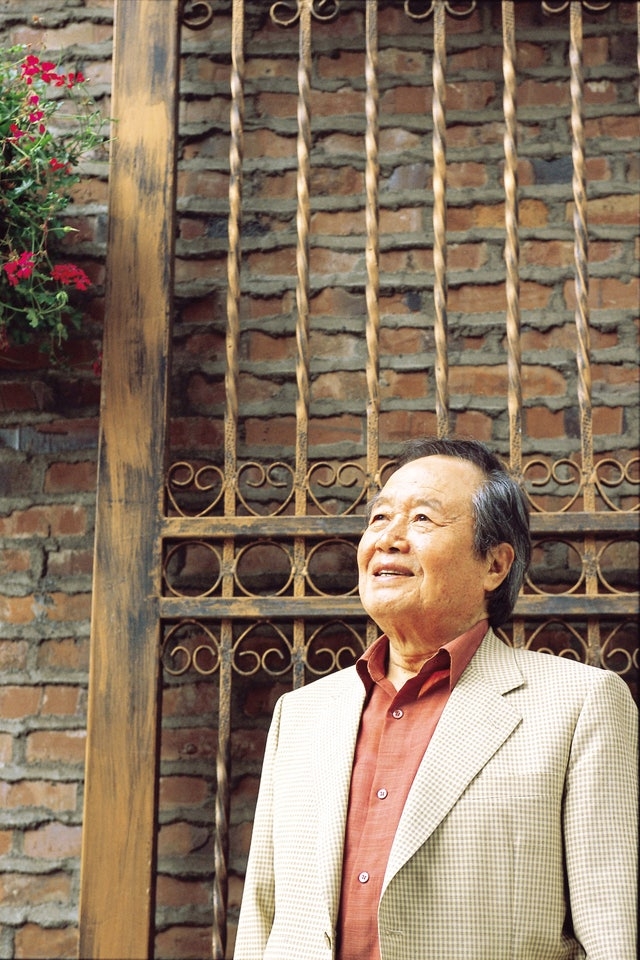
Ahn Hyung-il, an honorary professor at Seoul National University's College of Music and a founding figure of Korean opera who rose to prominence as the Duke of Mantua in Verdi's "Rigoletto" in 1958, has died at 100.
The National Academy of Arts announced Saturday that Ahn died of age-related illness at around 9:30 a.m.
Born in 1926 — 1927 according to his family register — in Jongju, North Pyongan Province, Ahn began studying voice in his third year of a five-year middle school program at the encouragement of his music teacher, Choi Yong-rin. His family, prosperous farmers, paid for his lessons in rice rather than cash. In 1946, he crossed alone into the South, leaving his family behind to pursue music school. Arriving in Seoul by smuggler's boat from Haeju, he lived in a single room in a shantytown and supported himself by working at a market and as a houseboy for a US Army officer. He never reunited with the family he left in the North.
After enrolling at Gyeongseong Music School — now Seoul National University's College of Music — he joined the Navy's music and morale corps when the Korean War broke out, performing at military hospitals and UN allied forces units. He graduated from Seoul National University's vocal music department in 1953, taught music at Jeongsin Girls' High School and Sookmyung Girls' High School, and in 1960 joined Hanyang University's College of Music as an assistant professor at the invitation of Hyun Je-myung, helping to lay the groundwork for the fledgling school.
He became a founding member of the National Opera Company of Korea in 1962 and served as its fourth director in 1983. At Seoul National University's College of Music, he taught for 26 years from 1966 until his retirement in 1992, nurturing a generation of singers including the late tenor Park Se-won. After retirement, he continued teaching as an adjunct professor at Chugye University for the Arts from 1995.
Ahn made his operatic debut in 1955, taking the supporting role of Dancaïre in "Carmen" at the National Theater. He claimed his first starring role in "Rigoletto" in 1958. According to the National Academy of Arts, he went on to star in a substantial number of productions, including "Chunhyangjeon," "Lucia," "Tosca," "Aida," "Faust," "Madama Butterfly," "Turandot" and "Norma" in 1988.
Between 1963 and 1997, he appeared in more than 500 concerts at home and abroad, touring Japan, the United States, Thailand, Germany, Nepal and Taiwan. In the National Opera Company's inaugural production, "Prince Hodong," in 1962, he played the title role. When he took over as director in 1983, he opened his first regular season with "Chobun," an original Korean opera with a libretto by Oh Tae-suk and music by Park Jae-yeol, staged at the National Theater's small hall.
The role he returned to most was Rodolfo, the impoverished poet in "La Bohème." After his first performance as Rodolfo in 1959, he sang the part in eight productions through 1992. Bass Oh Hyun-myung, in his 1987 book "Opera Failure Stories," compared Ahn's upper register to a "golden trumpet," recalling how a colleague who had worried that Ahn's voice was hoarse from a night of heavy drinking watched him deliver a flawless high C in "Che gelida manina" once he stepped onstage. His final operatic performance was the National Opera Company's "La Bohème" in February 1992.
Though he left the opera stage, he never stopped singing. In 2008, he shared the main stage of the Sejong Center for the Performing Arts with his students for a "Golden Voice" concert, and in May 2013 he returned to the same hall to sing "La donna è mobile" from his debut starring role, "Rigoletto." It was a fulfillment of a pledge he had made in an interview with the Seoul Shinmun near the time of his retirement: "I want to stand before an audience with music until my voice runs out."
Ahn became a member of the National Academy of Arts in the vocal music category in 1996 and served as chair of its music division and as chairman of the Korea Vocal Artists Association. He compiled an eight-volume collection of Italian art songs. His honors included the Korea Culture and Arts Award (1971), the Korean Music Grand Prize (1991), the National Academy of Arts Award (1992), the Mogyeon Order of Civil Merit (1992) and the Silver Crown Order of Cultural Merit (2000).
He is survived by two sons and a daughter — Ahn Jong-seon, Ahn Jong-deok and Ahn Jong-suk — along with son-in-law Noh In-su and daughter-in-law Park Seon-ha. The funeral home is located at room 5 of Seoul National University Hospital's funeral hall. The funeral service will be held at 11 a.m. Monday, with interment at Namhangangong Wonmyowon. For inquiries, call (02) 2072-2018.
shee@heraldcorp.com