
Traditional music community breaks silence, pushes for systemic reform
Emergency coalition to become permanent body
Ministry task force to launch in early to mid-December
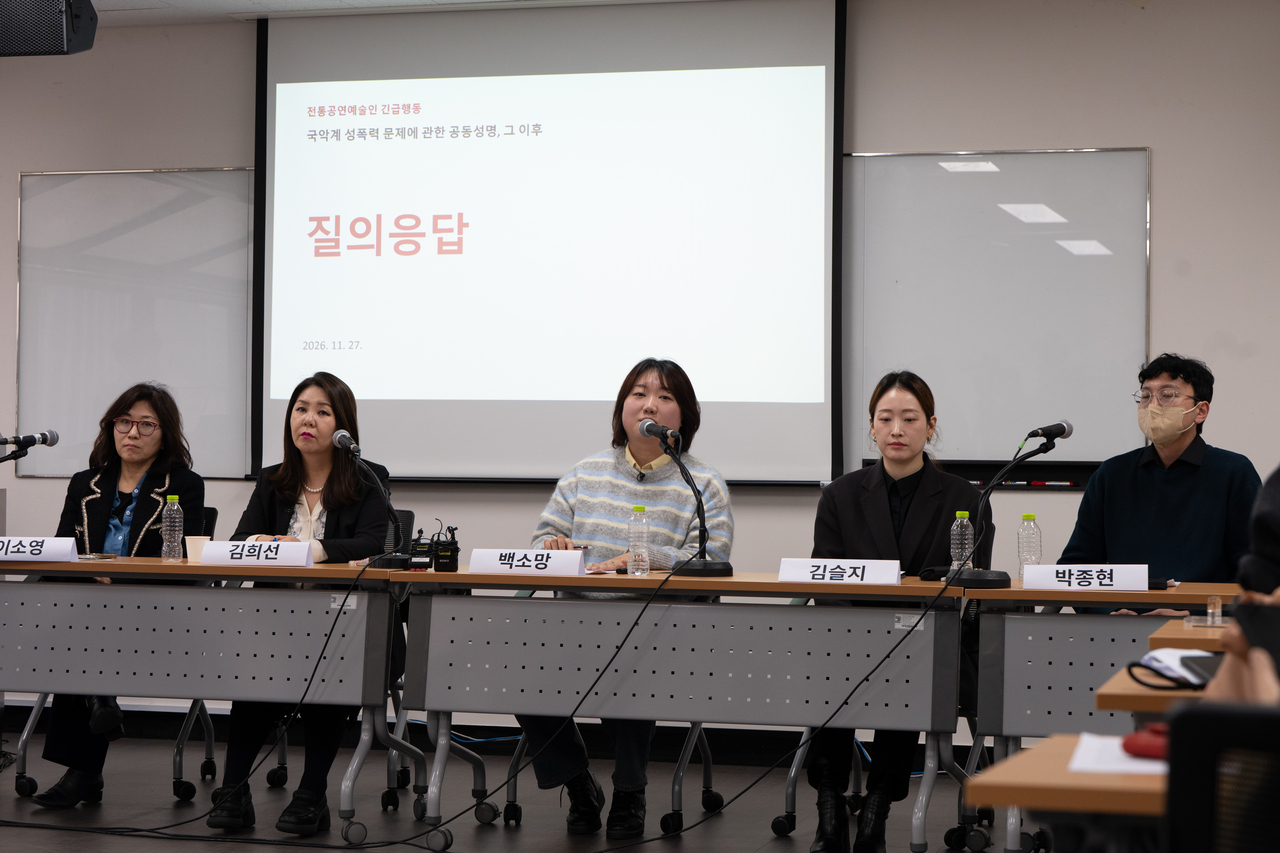
"We learned that there are perpetrators who have been committing abuse far more widely, and for far longer, than we had imagined."
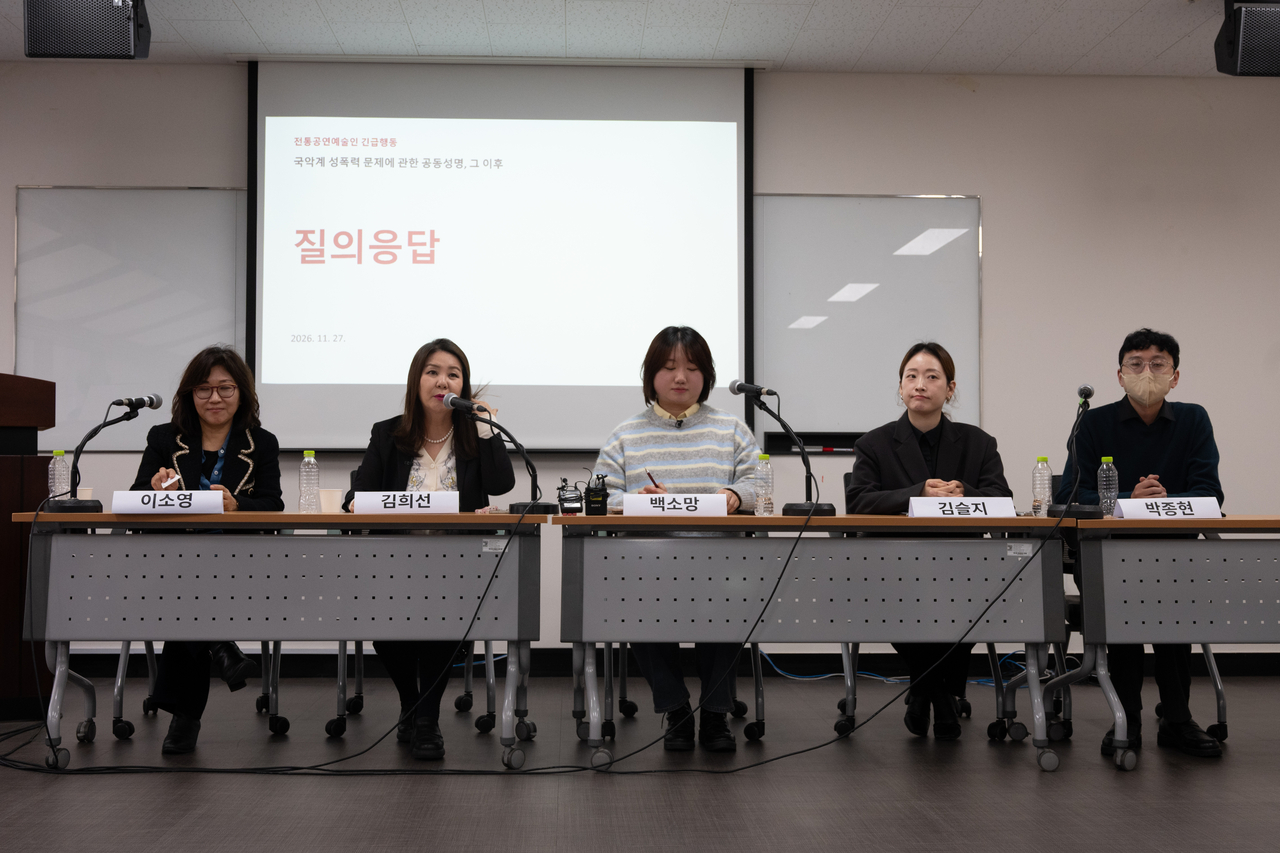
Kim Hee-sun, co-chair of the Traditional Performing Arts Emergency Action coalition and a professor at Kookmin University, made the remarks Friday at a press briefing held at the Traditional Performing Arts Promotion Foundation in Jongno-gu, Seoul. The event was titled "After the Joint Statement on Sexual Violence in the Korean Traditional Music Community."
The coalition announced the results of its petition drive and outlined its plans going forward, saying it would join a public-private task force being organized by the Ministry of Culture, Sports and Tourism next month to push for institutional reform. Kim added that a preparatory meeting for the TF was held last week and that the body is expected to launch in the first or second week of December.
The petition, open from Nov. 7 to Nov. 21, drew 5,658 signatories, including the 30 original proposers. One in four signatories was a student — the generation that grows up watching their teachers' moods in lesson rooms and classrooms responded in the greatest numbers.
Breaking down the figures, high school, undergraduate and graduate students made up the largest group at 1,409 people, or 24.9 percent. Performers, entertainers and creators followed at 1,198 (21.2 percent), non-arts professionals such as office workers and parents at 698 (12.3 percent), and researchers, teachers and professors at 441 (7.8 percent). Producers, critics and composers added 331 signatures, while writers, playwrights, directors and actors contributed 285. The petition surpassed 1,900 signatures the day after the statement was made public and nearly tripled by the time it closed.
The coalition announced Friday that it would conclude its work as a temporary organization and transition into a permanent body called the Traditional Performing Arts Anti-Sexual Violence Alliance. Six steering committee members in their 30s and 40s — Kim Yeo-jin, Park Min-hee, Bang Ji-won, Baek So-mang, Seong Hye-in and Lee Geon-myeong — will lead the group, with plans to recruit student members as well.
From gang rape at an arts high school to charges against a prominent musician
The incidents began in May last year. Two male third-year students at the National Traditional Arts High School are accused of raping a classmate and filming the assault without consent at a music practice room in Anyang, Gyeonggi Province. The victim reported the assault to the school and police in June of that year, and police referred the two students to prosecutors in January this year on charges including aggravated rape, without seeking their detention.
However, while the school violence deliberation committee delayed its judgment pending the police investigation, the two students graduated and enrolled in university. The process from the initial report to the case's conclusion took 291 days, yet no school violence measures were ever imposed. The case came before the National Assembly's national audit last month and subsequently triggered an investigation by the Seoul Metropolitan Office of Education. Culture Minister Choi Hwi-young, whose ministry oversees the school, bowed his head at the Oct. 23 audit hearing and said he felt "deeply sorry and a great sense of responsibility."
Incidents emerged elsewhere as well. A member of the National Orchestra of Korea, identified only as A, was summarily indicted last month on charges of groping a university student who had been the member's pupil since middle school, including at a year-end dinner gathering. Prosecutors sought a summary order of 3 million won ($2,230) in fines, and the victim has asked the court to refer the case to a full trial. A separate criminal complaint has been filed with the Seoul Metropolitan Police Agency alleging that a prominent traditional music performer — a presidential award recipient — sexually exploited a minor student who was preparing for entrance exams to a traditional music high school over roughly four years beginning in 2019. The performer's side has denied the charges and the investigation is ongoing.
Court records show that teacher-student sex crimes in lesson rooms and classrooms are not new. In 2021, a pansori instructor surnamed Lee who taught in Gangseo-gu, Seoul, was sentenced to two years and six months in prison after forcing a 12-year-old student, who had briefly fallen asleep on a practice room mat, to lie beside the instructor under the pretense of offering an arm as a pillow, then embracing and touching the child. Lee also kissed the student as the child tried to leave after practice and bit the student's arm inside a car, then warned the child not to tell the parents.
A traditional music hagwon operator in Incheon surnamed Baek, a certified practitioner of a national intangible heritage, was sentenced to four years and six months in prison at a first trial in August 2024 and taken into custody in the courtroom after being convicted of groping an 11-year-old student in front of a hagwon elevator in August 2020. The child had been preparing for entrance exams to an arts middle school. Baek also faced charges of groping the child's mother. The court found the sentence warranted given Baek's position as an entrance-exam instructor who should have helped the child develop sound values. Music critic Lee So-young said at Friday's briefing, "If you push back against the teacher who coached you for your entrance exam, your exam is on the line — it becomes a question of whether you can even pursue your major."
As the cases mounted, voices of self-reflection emerged from within the traditional music community itself. Thirty active professors, performers, critics and directors from Seoul National University, the Korea National University of Arts, Dankook University and other institutions formed the Emergency Action coalition and issued a joint statement on Nov. 7. Acknowledging that the community had stayed silent during the 2018 MeToo movement, they called for swift and independent investigations and disciplinary action, reflection on the hierarchies embedded in entrance exams, hiring, recommendations and casting, and government-led surveys along with the establishment of an independent reporting channel.
The government responded. Minister Choi posted on SNS on Nov. 9, writing, "As the minister of the agency responsible for protecting artists, I feel an immeasurable sense of responsibility and offer my sincere apology." The ministry announced it would run a special sexual violence reporting period through year-end at the Artists' Grievance Center and at schools and national arts organizations under its jurisdiction, and said it would bar anyone confirmed to have committed sexual violence from performances, lectures, adjudication panels and hiring. The ministry also dismissed a member of an affiliated arts organization who had received a fine for sexual misconduct.
Background checks for lesson instructors, 'one-strike' rule among proposals for TF
The closed, one-on-one lesson room is the setting common to all of the cases.
Kim said the ministry can only prioritize institutions under its direct supervision, but acknowledged that "in reality, most harm occurs outside school, in private entrance-exam coaching or individual tutoring." That is why the alliance examined child and youth protection systems abroad. The United States Center for SafeSport, which operates within the US Olympic and Paralympic framework, publicly discloses sanctions and interim restrictions against coaches and requires that instruction take place in observable environments. Australia's New South Wales Working With Children Check extends background screening to music instructors who teach children alone outside of schools.
Drawing on those models, the alliance is reviewing specific policy proposals: background checks for private lesson instructors who teach minors, cross-institutional sharing of sanction information, and improvements to closed one-on-one lesson environments. The group also proposed examining a "one-strike" rule that would strictly bar anyone confirmed to have committed serious sexual violence from participating in educational or artistic activities. Specific criteria — including who would be covered, the scope of the rule, and the procedures for fact-finding and enforcement — are to be determined after reviewing relevant regulations and field conditions.
Establishing sexual violence response protocols for public institutions and schools is another priority the alliance identified. The group plans to pursue institutional reform and legislation through the public-private TF while sustaining campaigns and forums to drive self-correction within the traditional music community. Detailed operating procedures will be announced separately after a formal meeting.
'Victims must not be the ones who leave'
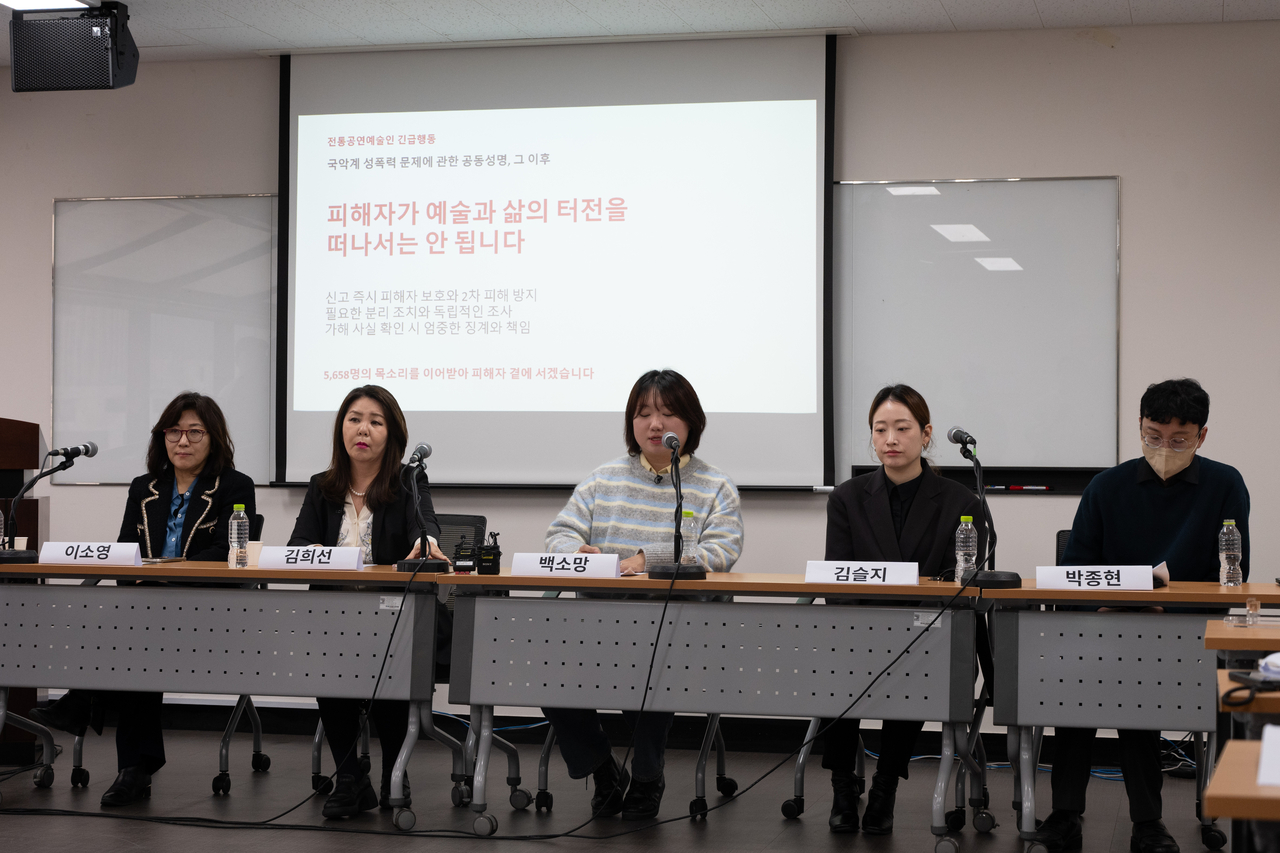
The Emergency Action coalition was firm that the presumption of innocence must not be used as grounds for delaying victim protection or proactive institutional responses. When a sexual violence complaint is received, the coalition said, institutions must immediately separate the victim to prevent secondary harm and take interim measures — removing the reported individual from duties or separating classes and spaces. An independent investigation should then determine the facts, and if the conduct is confirmed, strict disciplinary action commensurate with the offense must follow.
Additional reports of harm reached the coalition while the petition was open, and the group said it is currently supporting those victims. The coalition also urged the community not to look away from victims' accounts out of concern over the fallout that challenging influential figures might bring. Ensuring the safety of victims and their ability to continue working, the group said, is the community's foremost responsibility — so that those who speak up are never again the ones who stop performing or leave the field.
Holding the government to its word is also part of the alliance's mandate. Since the formation of the TF and institutional reform remain unfulfilled commitments, the alliance said it will monitor whether the government's promises translate into meaningful victim protection and real change on the ground. Minister Choi had written on SNS earlier: "There must be no more cases where the perpetrator stays and the victim leaves. I will see this through until traditional arts becomes a place where people can learn, teach and take the stage without fear."
shee@heraldcorp.com




