14 years after unified design, experts still confuse the labels
Consumer awareness at 79.4%, comprehension scores at 76 out of 100
Government begins talks on differentiating certification mark designs
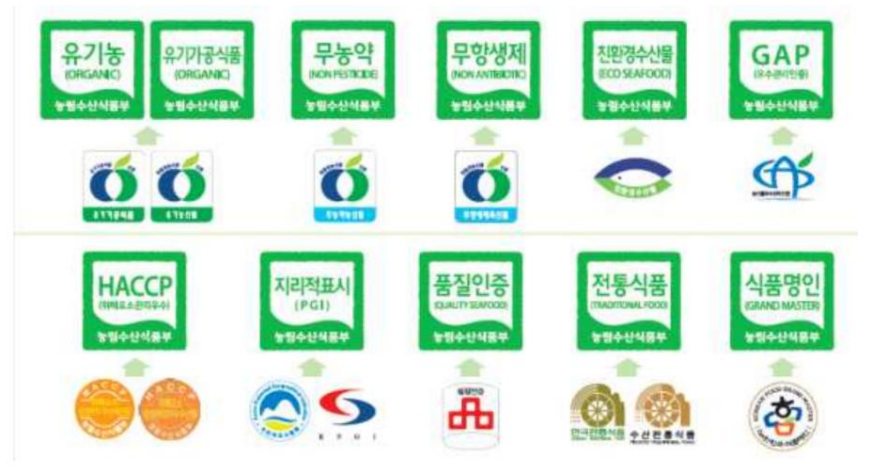
"Organic," "pesticide-free," "Good Agricultural Practices (GAP)" — these are the certification marks shoppers routinely encounter when picking out fruit or vegetables at the supermarket. The names differ, but the marks look nearly identical: a green rectangle enclosing a taeguk symbol, with only the certification name swapped out. Consumers can generally tell that a product has received some form of government certification, but what exactly sets one apart from another is far less clear. Whether organic is held to a higher standard than pesticide-free, or whether GAP even qualifies as an eco-friendly certification, is the kind of question that trips up even attentive shoppers.
Critics say the agricultural food national certification marks, designed to help consumers make informed choices, are no longer doing their job — and that their near-identical designs are to blame. Fourteen years after the government unified what had been a patchwork of different marks into a single system, the resulting uniformity has itself become the problem, obscuring the distinctions between certifications. The government has recently begun discussing ways to differentiate the colors and designs of eco-friendly certification marks.
According to the Ministry of Agriculture, Food and Rural Affairs, the Rural Development Administration's Agricultural Education and Information Service, and a master's thesis on agricultural food certification mark design by researcher Lee Su-bin of Hongik University's Graduate School of Industrial Arts, seven design professionals with at least five years of experience were shown rice packaging bearing the organic and pesticide-free certification marks. Four of the seven could not accurately distinguish between the two certifications' standards.
A survey by the Agricultural Education and Information Service last year found that while overall awareness of the national agricultural food certification system stood at 79.4 percent, consumers who said they knew the system scored only 76 out of 100 on a comprehension test.
'Pesticide-free must be stricter, right?' — even experts stumble over the green marks
In 2022, researcher Lee showed seven design professionals two rice packages — one bearing the organic certification mark and one bearing the pesticide-free mark — and asked them to compare the cultivation standards the two certifications represent.
The results were surprising. Only three of the seven ranked the certifications in the correct order of stringency. Of those, just two accurately understood what the organic certification actually meant. Some believed the pesticide-free certification was the stricter of the two — the word "pesticide-free," meaning the absence of agricultural chemicals, apparently read as a more demanding standard than "organic."
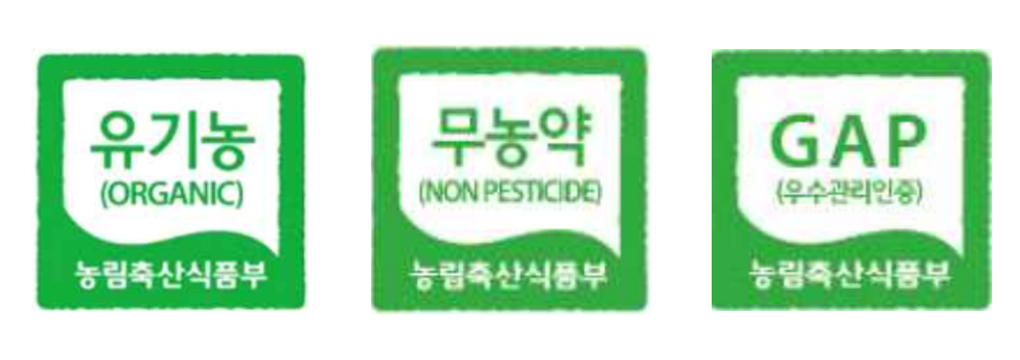
The actual certification standards, however, are distinct. Organic produce must be grown without synthetic pesticides or chemical fertilizers. Pesticide-free produce also prohibits synthetic pesticides but allows chemical fertilizers at up to one-third of the recommended application rate.
In other words, organic applies a stricter standard on chemical fertilizer use than pesticide-free does. Yet both marks share the same design — a green rectangle with a taeguk symbol — making it nearly impossible to tell them apart without reading the text carefully.
GAP has an entirely different purpose. While organic and pesticide-free focus on how a crop was grown, GAP is a system for managing hazards — pesticide residues, heavy metals, harmful organisms — across the entire production chain from farming through post-harvest handling. It is not a higher or lower tier of eco-friendly certification; it is a separate food-safety management certification.
They unified the marks to end the confusion — now they all look the same
The agricultural food certification marks were not always so similar.
In the past, each certification type used its own colors and shapes. As the proliferation of different marks made it increasingly difficult for consumers to identify which products carried government certification, the government introduced a unified national certification mark in January 2012.
The new design used a taeguk symbol, a square border evoking a traditional national seal, and the color green as common elements across all certifications — the intent being to make it immediately clear to consumers that any product bearing the mark was part of a government-managed system.
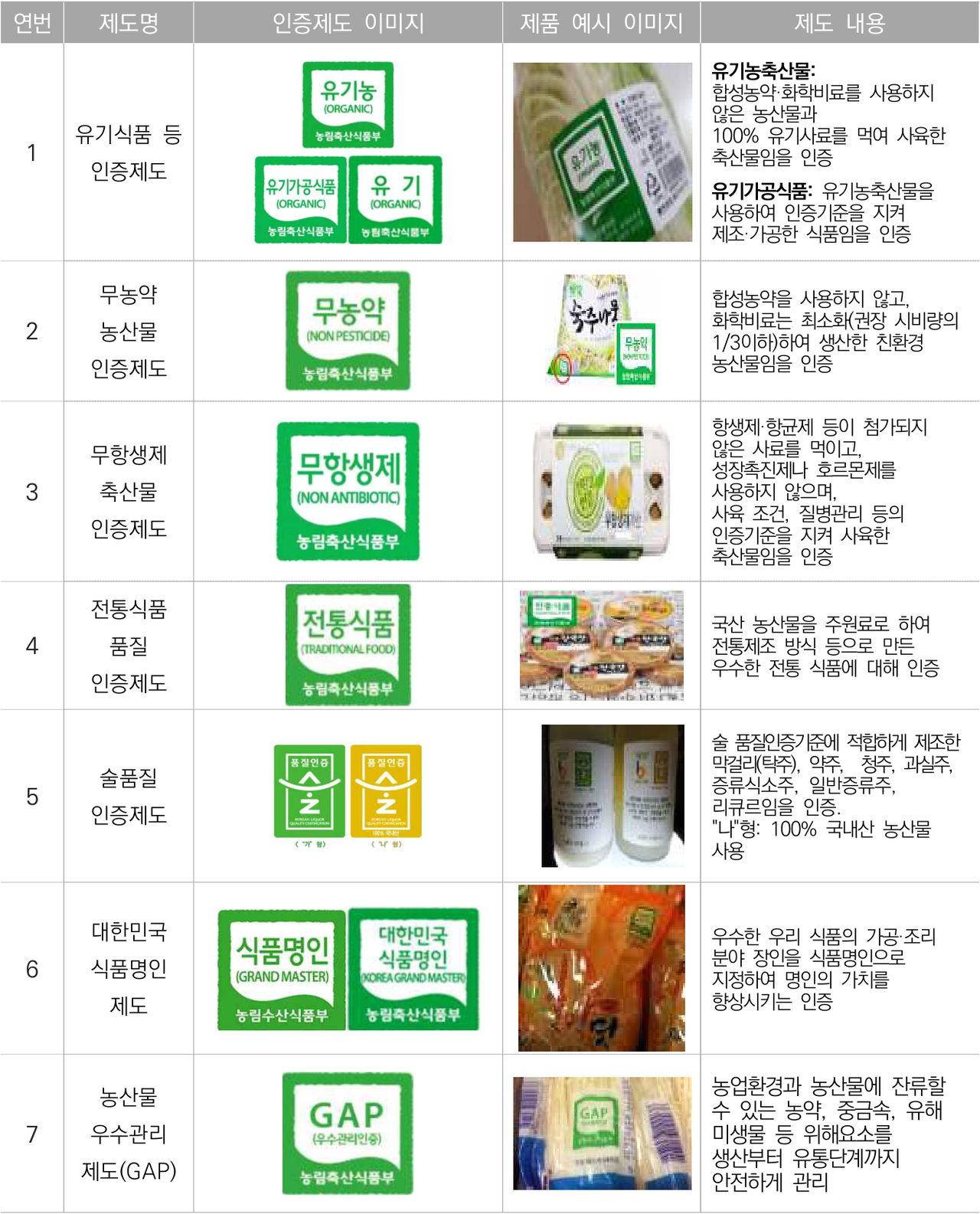
What was once a problem of too much variety has now become a problem of too much sameness.
Certifications with different purposes and standards — organic produce, organic processed food, pesticide-free produce, antibiotic-free livestock products and GAP, among others — all use near-identical designs. Without reading the text inside the mark, there is no way to tell them apart.
The problem is compounded on small food packages, where the marks are inevitably printed small. Certifications with long names, such as "pesticide-free ingredient processed food," must squeeze multiple characters into a limited space. When shopping on a smartphone, reading the certification name at all can be a challenge.
The names themselves are also considered consumer-unfriendly. In the thesis, Lee pointed out that similar organic-related certifications are inconsistently labeled, with terms such as "organic," "organic agricultural" and "organic produce" used interchangeably.
Safety is the top reason consumers buy certified products — but each mark guarantees something different
How well do consumers actually understand the national agricultural food certification system?
According to the Agricultural Education and Information Service's 2025 consumer awareness survey on the national agricultural food certification system, overall awareness of the system last year stood at 79.4 percent — virtually unchanged from 79.0 percent in 2023 and 79.3 percent in 2024.
An in-person survey of 1,000 shoppers at Hanaro Mart locations last November found that awareness of eco-friendly produce certification was highest at 98.3 percent. Antibiotic-free livestock certification came in at 97.6 percent, followed by the Hazard Analysis and Critical Control Points (HACCP) certification at 95.7 percent. GAP stood at 88.6 percent, low-carbon agricultural product certification at 72.5 percent, and liquor quality certification at 45.3 percent.
Among consumers who said they were aware of the certification system, the overall comprehension score was 76 out of 100. Eco-friendly produce certification scored highest at 82.8 points, followed by antibiotic-free livestock certification at 82.3 points and GAP at 77.6 points. Low-carbon agricultural product certification scored 69.8 points, and liquor quality certification 63.8 points.
The top reason consumers gave for buying certified agricultural food products was an expectation of safety. "I think it is safe agricultural food" was cited by 55.8 percent of respondents, the highest share. "The agricultural food quality is good" followed at 24.8 percent, with "I trust it because the government guarantees it" at 19.5 percent.
Worth noting is that different certifications guarantee different things.
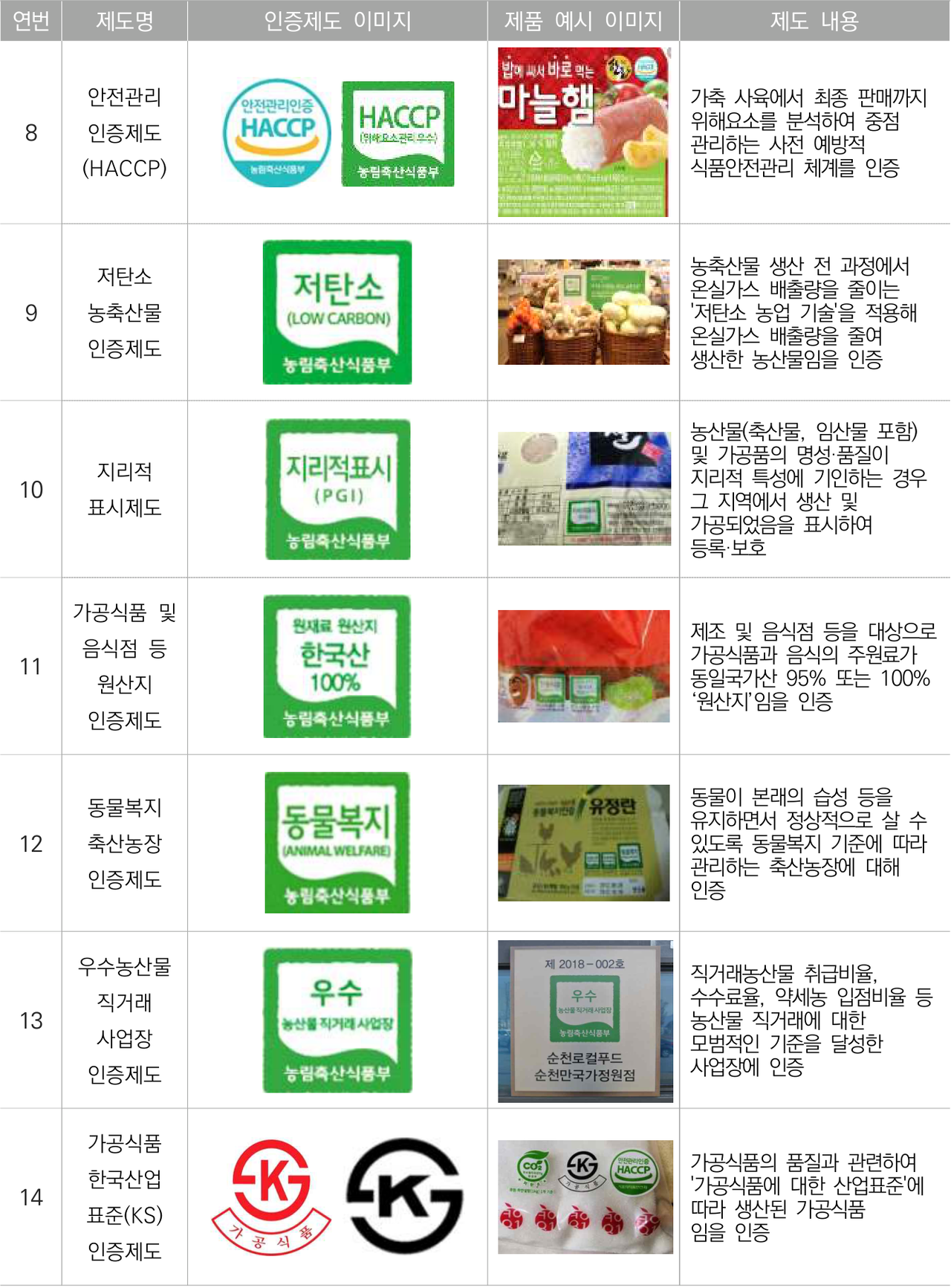
The animal welfare farm certification focuses on livestock housing conditions and welfare. The low-carbon agricultural product certification centers on reducing greenhouse gas emissions during production. The geographical indication system examines the connection between a specific region and the quality or reputation of its agricultural food products.
All are government-managed systems, but none guarantees safety or quality by the same standard.
Redesigned marks score higher on all 5 measures in a 200-consumer test
Would redesigning the certification marks actually improve how well they communicate information?
Researcher Lee developed proposed redesigns for seven eco-friendly agricultural and livestock certification marks, consolidating similar certification names and rearranging information and visual elements to make the distinctions between certifications easier to grasp at a glance.
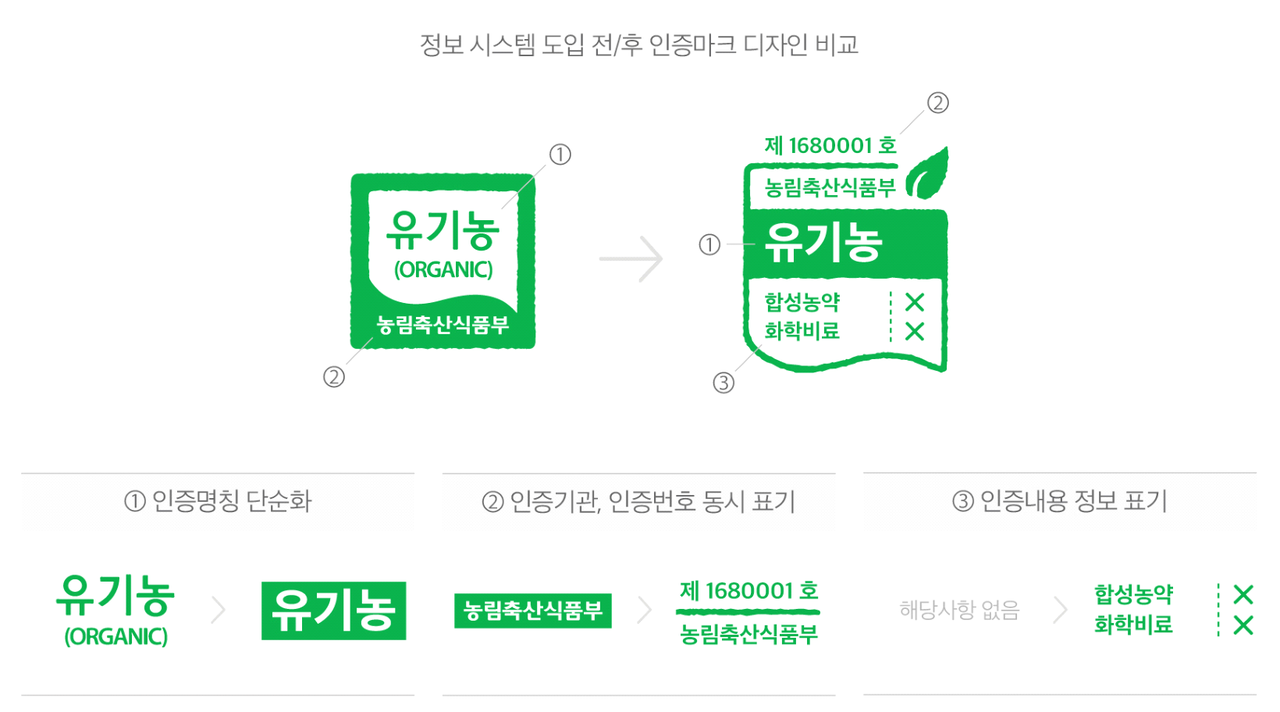
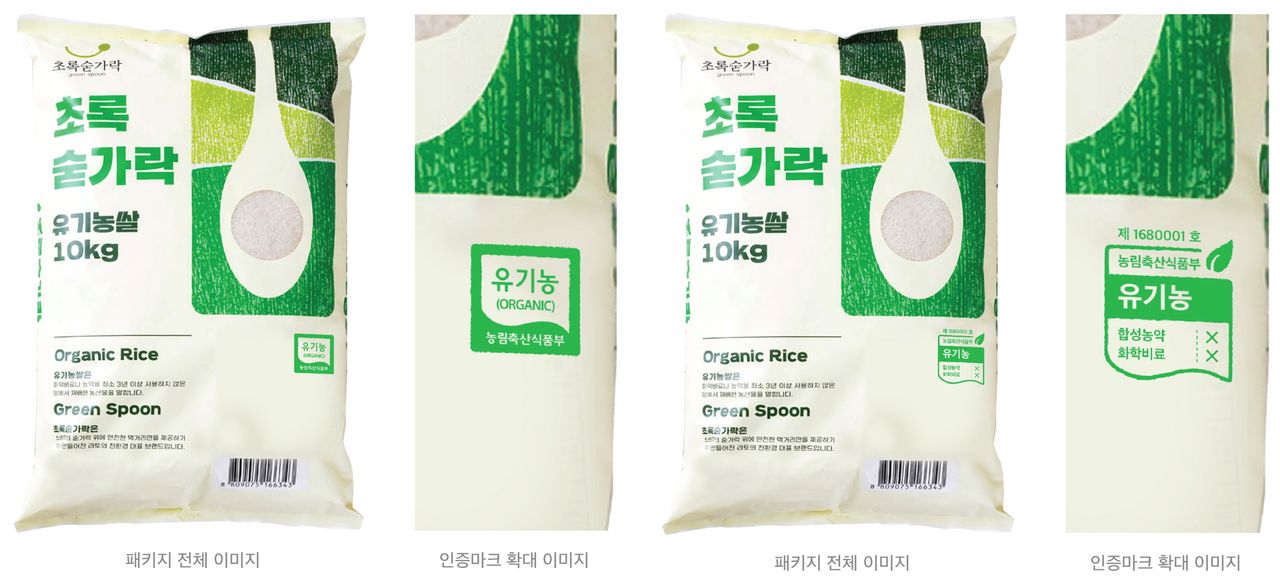
In a comparative evaluation conducted from Oct. 25 to 27, 2022, with 200 consumers in their 20s through 50s, the redesigned marks outscored the existing designs on all five measures: readability, noticeability, clarity, symbolism and aesthetic appeal.
The most striking improvement was in clarity. The existing design scored 3.37 points, while the redesigned version scored 3.94 — a gain of 0.57 points. This measure assessed how clearly the certification mark conveyed its information.
Readability also improved, rising from 3.49 to 3.92 points, a gain of 0.43 points. Symbolism rose from 3.46 to 3.80 points, noticeability from 3.33 to 3.64 points, and aesthetic appeal from 3.40 to 3.64 points. All five differences were statistically significant.
However, these results reflect a comparative evaluation in which survey participants assessed the existing and redesigned marks side by side. The study did not verify how much actual purchasing behavior would change.
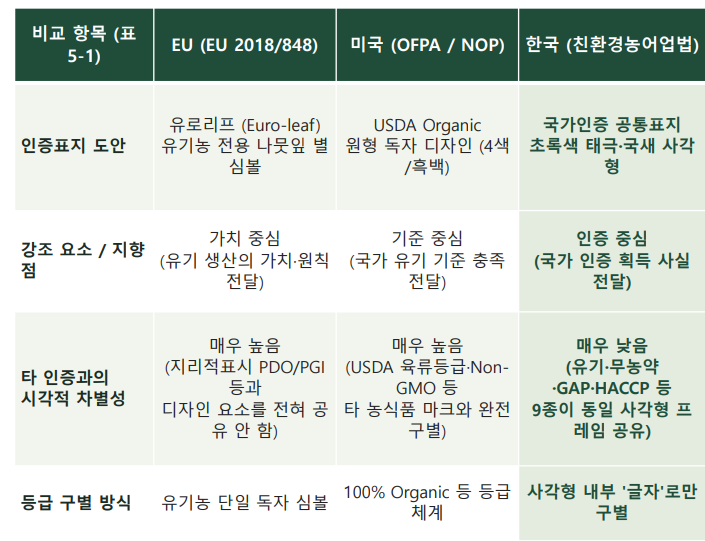
Other countries offer examples of certification marks whose designs reflect the nature of the certification itself. The US organic certification mark, "USDA Organic," features a graphic evoking farmland inside a circle. The EU's organic certification mark, the "Euro-leaf," arranges stars in the shape of a leaf.
The Ministry of Agriculture, Food and Rural Affairs has noted that the EU's design focuses on conveying the values and principles of organic production and the US design on signaling that a product meets national organic certification standards, while South Korea's design emphasizes the fact of government certification itself.
Both the EU and the US use distinct visual designs for their organic certification marks, setting them apart from other agricultural food certification marks. South Korea, by contrast, uses the same square frame for different certifications — organic, pesticide-free, GAP and others — and relies on the text inside to convey the difference.
Domestically, the Ministry of Food and Drug Safety overhauled the color and design of the Good Manufacturing Practice (GMP) mark for health functional foods last September to reduce confusion with the HACCP mark used for general food products. The new design will take effect in 2028.
Government opens talks on revamping certification marks, with star ratings among options
Discussions on improving eco-friendly certification marks have now begun at the government level.
The Presidential Committee on Agriculture, Fisheries, Rural Communities and Food held its sixth eco-friendly agriculture task force meeting Tuesday and discussed ways to improve the eco-friendly certification system as part of the national policy goal of doubling eco-friendly agriculture.
Kim Tae-young, a professor at Gyeongsang National University who presented at the meeting, said the current agricultural food certification marks were too similar in design, weakening the distinctiveness of eco-friendly certifications and causing consumer confusion. Kim proposed either introducing a dedicated eco-friendly certification mark or adding supplementary indicators to the existing marks.
Specific proposals raised at the meeting included differentiating certification mark colors and designs, improving the labeling system using a star-rating format, and distinguishing between basic and supplementary certifications.
The underlying aim is to reflect the environmental value of eco-friendly farming and farmers' efforts in the certification marks, and to allow consumers to intuitively understand what each certification represents.
Participants also noted the need to clarify the relationships among the various certification systems and to give adequate consideration to potential conflicts among producers and the views of other stakeholders during any reform process.
The committee plans to hold consultations with consumer groups to gather public perceptions of eco-friendly certification marks and suggestions for improvement. It will also discuss reforms to the eco-friendly direct payment system and ways to expand consumption and distribution channels for eco-friendly agricultural products.
Kim Ho, chair of the committee, called on members to identify policy tasks that would deliver tangible results without duplicating existing measures, and to develop concrete plans to broaden the consumer base for eco-friendly agricultural products.
Fourteen years ago, the challenge was bringing a fragmented set of marks under one roof. Now the challenge is showing consumers that marks which look the same can stand for very different things.
adastra@heraldcorp.com