
Average local farm yield reaches 4.6 tons per hectare
Seed production complex in Ghana to be completed next year
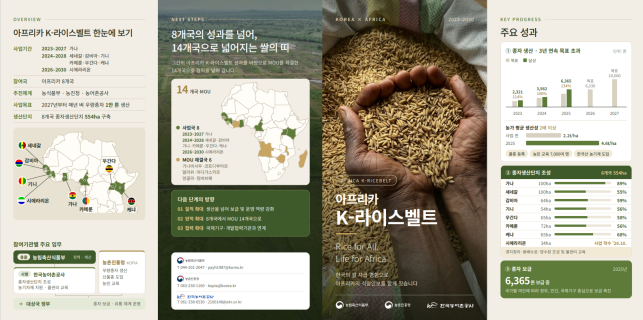
A South Korean agricultural Official Development Assistance initiative that distributes high-quality rice seeds and cultivation technology to Africa has more than doubled average farm productivity in participating countries. The government plans to begin completing seed production complexes starting with Ghana next year, building a stable local seed supply system.
South Korea's Ministry of Agriculture, Food and Rural Affairs, the Rural Development Administration and the Korea Rural Community Corporation held a K-Rice Belt achievement-sharing conference Friday at the President Hotel in Seoul to review four years of results and discuss the program's future direction.
The K-Rice Belt is a Korean-model agricultural ODA initiative that produces and distributes high-quality, high-yield rice varieties suited to local African conditions while supporting the development of production infrastructure. Its goal is to raise food self-sufficiency rates in major rice-consuming countries across Africa.
The program launched in Ghana in 2023 and expanded to Gambia, Guinea, Senegal, Uganda, Cameroon and Kenya in 2024, with Sierra Leone added this year, bringing the total to eight participating countries.
Rural Development Administration chief Lee Seung-don said in his opening remarks that average farm productivity had risen to 4.6 tons — more than double the pre-program level — and that Uganda in particular had achieved yields of up to 9.6 tons through autonomous production led by local farmers' cooperatives.
The government plans to go beyond distributing quality seeds and transferring cultivation techniques by establishing a foundation for stable local seed production. Seed production complexes will be completed in stages, beginning with Ghana next year.
About 100 people attended the event, including officials from the embassies of participating African countries and representatives from the UN Food and Agriculture Organization, the World Food Programme, the African Development Bank, and private-sector companies, organizations and experts.
Experts recommended expanding cooperation with civic groups, businesses and international organizations, increasing the participation of young local farmers, and building market- and consumer-oriented value chains to help spread the program's results.
Park Sang-ho, the ministry's director general for international agricultural cooperation, said stable seed production was set to become a reality as seed production complexes are completed in stages starting with Ghana next year. Park added that the government plans to strengthen cooperation not only with recipient-country governments but also with the private sector and international organizations.
adastra@heraldcorp.com




