
Survey of army, navy and air force academy cadets on proposed unified military academy released
708 responses cited maintaining separate service academies as key consideration
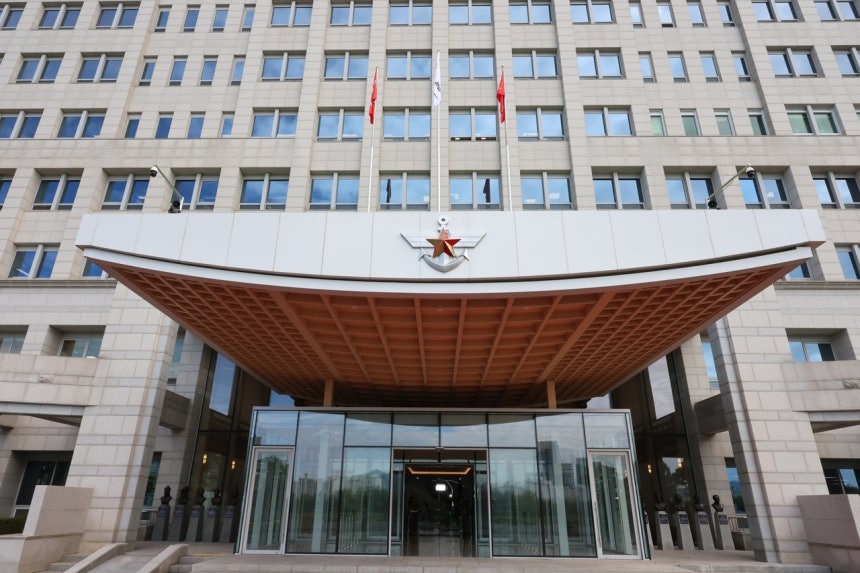
South Korea's Ministry of National Defense asked military academy cadets how to strengthen the educational capacity of a proposed unified Korea Armed Forces Academy. The most common responses were "curriculum reform" (28.3 percent), "improvement of facilities and equipment" (20.3 percent) and "maintain the current system" (17.0 percent). Cadets also expressed support for keeping the separate service academies and pursuing improvements within the existing structure.
The Defense Ministry released the results of the "Survey of Military Academy Cadets on the Establishment of the Korea Armed Forces Academy" on Friday. The survey was conducted from Nov. 13 to 17 among 2,526 cadets from the army, navy and air force academies, drawing 2,240 responses for a response rate of 88.6 percent. Response rates by institution were 94.9 percent at the Korea Military Academy, 83.6 percent at the Korea Naval Academy and 83.7 percent at the Korea Air Force Academy. The survey was a follow-up to a meeting Defense Minister Kang Shin-chul held with cadets on Nov. 10. The ministry said KIDA compiled and verified the results, then stripped cadet identification numbers before handing over the data to ensure respondents' anonymity.
On the question of how to strengthen educational capacity, "curriculum reform" drew 840 responses. Cadets said there were too many required courses and called for more electives and additional advanced major courses. Proposals also emerged for more discussion-based classes, presentations and oral assessments. The "facilities and equipment improvement" category drew 603 responses, with cadets requesting upgrades to lecture and research facilities, better living conditions, and updated equipment and software for practical training and research.
"Maintain the current system," the third most common response, accounted for 504 entries, which the ministry categorized as "keep the separate service academies and improve within the current structure." That was followed by "service-specific specialization" tied to each branch's duties (13.4 percent), "faculty" issues such as strengthening instructor expertise (8.4 percent), and "academic and cadet life" concerns including excessive coursework, military training loads and assessment methods (8.3 percent). Because some responses covered multiple topics, the total response count of 2,964 exceeded the number of respondents.
The ministry said it would use the results to develop a curriculum reform plan — covering future warfare and advanced science and technology — in collaboration with experts from inside and outside the military. It also pledged to create an educational environment where cadets can focus on their studies.
The "maintain the current system" sentiment appeared in other questions as well. When asked what elements are needed to preserve each service academy's traditions and branch-specific expertise, 658 responses were categorized as "maintain the separate service academies." The most frequently cited elements in that question were "strengthening branch-specific education and practical linkages" (34.5 percent) and "respecting each service's culture and way of life" (21.7 percent). Cadets asked that branch-specific ceremonies and customs be preserved — including salutes, terminology, uniforms, military songs and ceremonies such as Hwarang, Seongmu and Chungmu.
In an open-ended question asking what the ministry should consider when establishing the unified academy, "preserving branch-specific characteristics" drew the most responses at 802, followed by "maintaining the separate service academies" at 708. The ministry classified the latter as "no improvements needed." Next was "verification of purpose and feasibility" at 685 responses, with cadets calling for a comparative analysis of the current structure and overseas cases to assess the proposed academy's effectiveness in advance.
"Opinion gathering and process" drew 521 responses, with cadets asking the ministry to disclose the results of public consultations, whether feedback would be reflected in policy and detailed implementation plans.
"School location, facilities and budget," which called for a cost-benefit analysis of maintaining the separate academies versus establishing a unified institution, drew 392 responses. "Cadet selection" concerns — including confusion for prospective applicants and fears of an imbalance in applications toward certain branches — accounted for 215 responses. The survey did not include a direct question on whether cadets supported or opposed establishing the unified academy.
Asked whether they would apply if a graduate school were established at the unified academy, 66.3 percent said they would not, while 27.3 percent said they would. Those who said they would not cited a desire to focus on practical duties after commissioning or a preference for civilian-sponsored education programs. Among those willing to apply, preferred fields of study were AI and computer science (14.4 percent), military strategy and security (14.2 percent), and engineering disciplines including mechanical, naval architecture and civil engineering (12.6 percent).
"We will use the survey results to flesh out a plan for establishing the Korea Armed Forces Academy to train elite officers for the future," the ministry said. "We plan to continue gathering opinions from all walks of life through a variety of channels."
rimsclub@heraldcorp.com




