
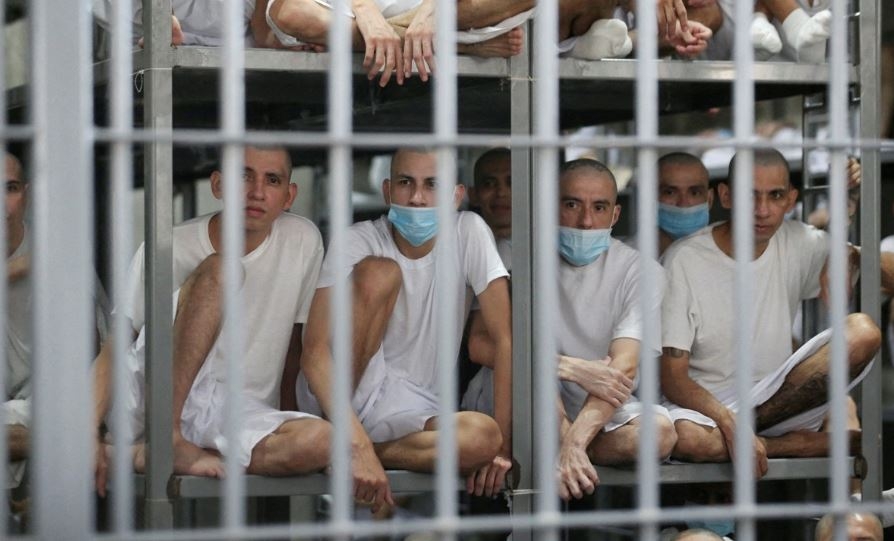
After El Salvador launched sweeping crackdowns and built a massive prison to combat gang violence, the government's official homicide rate fell to a record low. The move has drawn a steady stream of Latin American leaders to San Salvador seeking to replicate the model, and at least 16 mega-prison projects have been announced across 10 countries in the region over the past three years. International human rights organizations warn that the policy has produced serious abuses against detainees and may be poorly suited to countries where criminal networks operate very differently from El Salvador's gangs.
The mega-prison model introduced by Salvadoran President Nayib Bukele to combat organized crime is spreading across Latin America, according to Spain's EFE news agency and other international media.
El Salvador declared a state of emergency in March 2022 after a surge in gang-related killings and launched a mass-arrest campaign. Under the emergency measures, authorities gained expanded powers to detain suspects without warrants, and certain constitutional rights — including the right to a defense — were curtailed.
To house the surge in inmates, the government opened the Terrorism Confinement Center (CECOT) in February 2023, a facility capable of holding up to 40,000 people. Located in Tecoluca, about 70 kilometers east of the capital San Salvador, the prison was completed roughly seven months after ground was broken.
At CECOT, inmates face strict limits on outside contact and movement beyond their cells. Family visits are not permitted, and the vocational training and education programs common in conventional prisons are not offered.
El Salvador's official crime statistics show a dramatic improvement in public safety. The homicide rate fell from 7.8 per 100,000 people in 2022 to 1.3 per 100,000 in 2025 — a drop of about 83 percent. In 2015, the rate had exceeded 100 per 100,000.
The National Assembly approved the 57th extension of the state of emergency on Tuesday. Since the emergency measures took effect in March 2022, 96,457 people have been detained on gang-related charges, the assembly said. Under the latest extension, the measures will remain in force through Dec. 26.
According to a report published in August by InSight Crime, a research organization specializing in Latin American organized crime, at least 16 mega-prison projects have been announced across 10 countries in the region since CECOT opened in 2023.
Honduras, Peru, Ecuador, Panama and Guatemala are among the countries that have pursued large-scale detention facilities, and some have already begun operating them.
Costa Rica opened its High-Security Organized Crime Detention Center (CACCO) on Oct. 14, a facility with a capacity of up to 5,100 inmates, in a ceremony attended by President Laura Fernandez. Built with technical support from El Salvador, the facility was followed two days later by a visit from Fernandez to CECOT to observe how the prison operates.
Peruvian President Keiko Fujimori also visited CECOT on Oct. 29. Fujimori, who took office in July, held summit talks with Bukele and discussed avenues for bilateral cooperation on combating organized crime.
Ecuador has been operating a high-security prison for dangerous inmates since last November. President Daniel Noboa has also announced plans to build an additional facility capable of holding 15,000 people.
Haiti has recently agreed to cooperate with El Salvador on prison construction. Haitian Justice and Public Security Minister Patrice Felicien visited CECOT on Nov. 17 and afterward announced an agreement with the Salvadoran side to build three prisons, according to the Associated Press.
Haiti's detention infrastructure has been severely strained since gangs stormed two major prisons in 2024, even as gangs continue to control large parts of the capital Port-au-Prince. The two countries are pursuing a plan under which Salvadoran and Haitian companies would jointly build the facilities. The cost and financing arrangements have not been disclosed.
International human rights organizations say the mass-arrest and mass-incarceration campaign in El Salvador has been accompanied by serious abuses, including arbitrary detention and torture.
Human Rights Watch (HRW) and Salvadoran rights group Cristosal published a report last November documenting human rights violations against Venezuelan migrants who had been held at CECOT.
Researchers directly interviewed 40 of the 252 Venezuelans deported from the United States to El Salvador in March and April of last year and subsequently held at CECOT. They also collected testimony from 150 relatives, lawyers and other contacts, and reviewed inmates' criminal records, photographs of injuries and legal documents.
All 40 inmates interviewed said they had experienced physical, verbal and psychological abuse inside the prison. Of those, 37 said they had fallen ill during their detention. Researchers said medical care for inmates was also inadequate.
Questions have also been raised about how El Salvador compiles its crime statistics. HRW said the government's limited disclosure of crime-related data, combined with changes to how homicides are counted, has made it difficult to independently assess the true scale of criminal activity.
The differing nature of criminal organizations across Latin America is another factor experts say must be weighed before adopting the mega-prison model. In El Salvador, the dominant criminal threat came from gangs that controlled neighborhoods and extorted residents. In Ecuador, Colombia and elsewhere, transnational networks involved in international drug trafficking and illegal mining operate across borders.
Juanita Goebertus, HRW's Americas director, told EFE that some Latin American criminal organizations have in fact expanded their influence from inside prisons, and that mass-incarceration policies could end up serving as a recruitment pipeline for those groups.
The Salvadoran government itself is reviewing parts of its long-running mass-detention policy. Bukele has said that about 8,000 people arrested since the state of emergency was declared have already been released. Last month, the government also announced plans to pursue conditional release — subject to individual review — for up to half of all those detained.
rainbow@heraldcorp.com




