
Sides remain at odds after first meeting in 10 months
Plan to reach 65 by 2037 gains traction as fallback
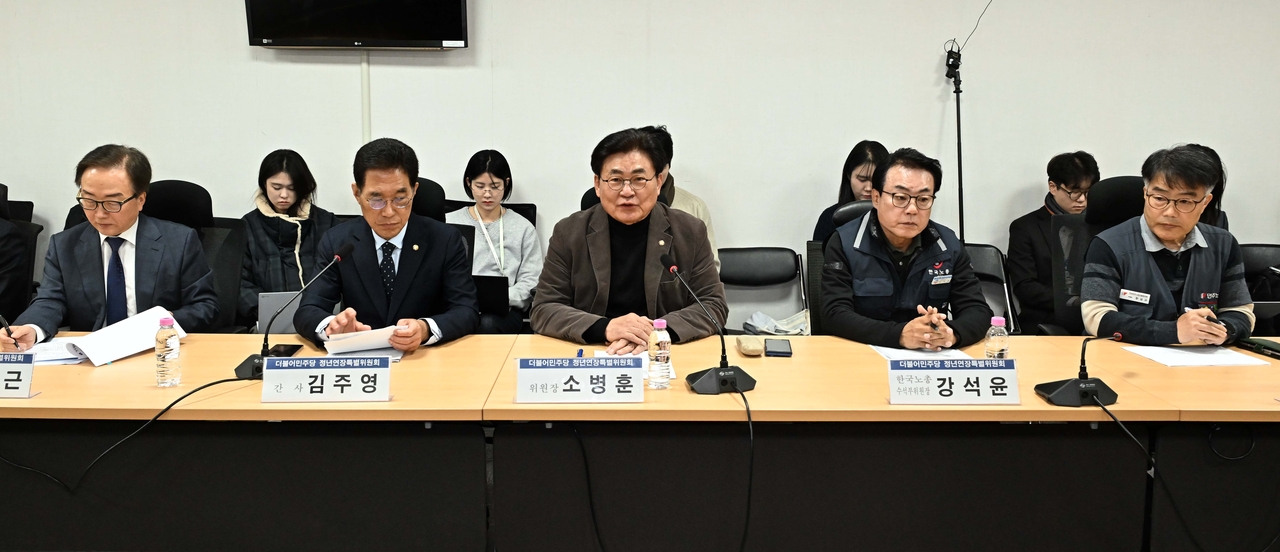
The Democratic Party of Korea's special committee on retirement age extension resumed talks with labor and management representatives Friday after a 10-month hiatus, but the two sides failed once again to reach an agreement amid persistent differences.
Rep. Kim Ju-young, who leads the party's side on the committee, told reporters after the subcommittee session at the National Assembly that the roughly 90-minute discussion had yielded no common ground.
"We prepared a proposal that tried to reflect the positions both sides have put forward so far, and we presented and debated it at today's subcommittee meeting, but the two sides' positions still have not narrowed," Kim said, adding that a final plenary session would be held Wednesday.
Asked whether the gap between labor and management could be bridged at that meeting, Kim said deliberation would likely produce only the same broad-strokes arguments heard Friday. "The time has come to wrap up the special committee's work," Kim said.
Representing management at the meeting were Lee Dong-geun, standing vice president of the Korea Enterprises Federation, and Oh Gi-ung, standing vice president of the Korea Federation of SMEs. On the labor side, Kang Seok-yun, senior vice chairman of the Federation of Korean Trade Unions, and Han Seong-gyu, vice chairman of the Korean Confederation of Trade Unions, attended.
The session was the first labor-management meeting convened by the committee in 10 months, after the panel decided in January to defer legislation on retirement age extension until after the June 3 local elections.
The committee had proposed a mediation plan in June centered on gradually raising the statutory retirement age. Under the plan, the mandatory retirement age would rise to 61 in 2029 and increase by one year every two years, reaching 65 by 2037.
The proposal also included a phased increase in the mandatory rehiring age for workers who reach retirement before the statutory age reaches 65 — rising to 61 in 2028, 62 in 2029, 63 in 2031, 64 in 2033 and 65 in 2035.
Labor unions have rejected the plan, arguing that post-retirement rehiring cannot substitute for a direct extension of the statutory retirement age and calling for an across-the-board increase. Management, by contrast, has maintained that a continued-employment regime should be built around post-retirement rehiring, citing concerns over labor costs and the potential dampening effect on new hiring of young workers.
Those divisions were on full display Friday. Lee of the Korea Enterprises Federation said a uniform extension of the retirement age would deepen the dual structure of the labor market, and called for the discussion framework to be rebuilt to allow broader deliberation involving youth and other stakeholders rather than being bound by a year-end legislative deadline.
Han of the Korean Confederation of Trade Unions rebuffed management's stance, saying that while business groups cite the cost burden of extending the retirement age, they remain silent on the tax breaks they receive from the government. "Returning that kind of support to society is what truly demonstrates social responsibility," Han said.
Kim said that if no agreement is reached by the end, "the time has come when we have no choice but to wrap up based on the proposals discussed so far." With the plan to reach age 65 by 2037 emerging as the leading option, attention is also turning to whether the Ministry of Employment and Labor will announce an official government position without a labor-management consensus.
bigroot@heraldcorp.com
thanks@heraldcorp.com




