Supply price roughly half that of imported rivals, Korean clinical data drive early orders; Pyeongtaek Plant 2 ramping up output; nationwide rollout set for January; 64-week weight-loss data and psoriasis findings unveiled at US obesity conference
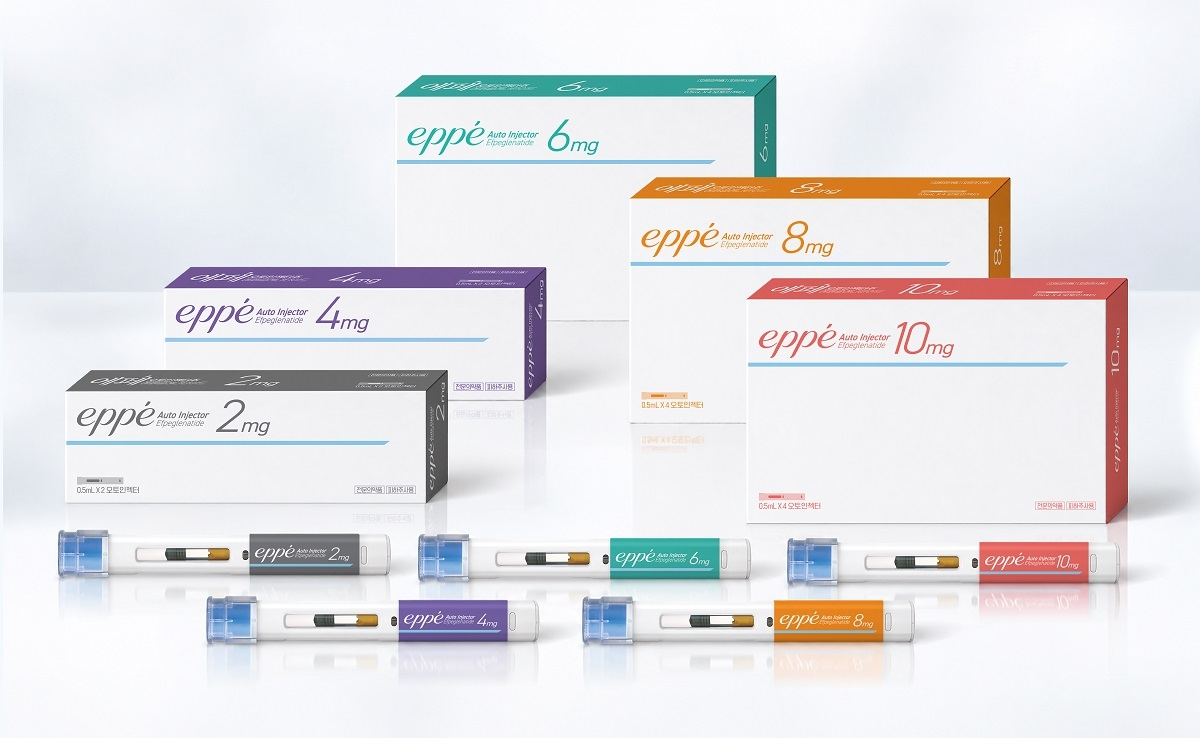
Hanmi Pharm's GLP-1 obesity drug Effe (efpeglenatide) — the first of its kind developed domestically in South Korea — sold out its entire initial supply of 10 billion won ($7.45 million) within two weeks of its first shipment, signaling strong early market demand.
According to industry sources, Effe's initial stock, valued at about 10 billion won at supply price, was fully depleted by Nov. 4, just two weeks after its first shipment on Oct. 22. That marked only six days after the drug's first prescriptions were written at select clinics on Oct. 29.
The sellout does not mean all units have reached patients, but the pace of orders exceeded expectations given that distribution was still limited to select clinics before a broader rollout to hospitals and pharmacies nationwide.
Price competitiveness was the primary driver of early demand. Effe's four-week supply price of 129,800 won is about 50 percent lower than that of competing imported drug Mounjaro. Because obesity treatments are not covered by national health insurance and patients pay the full cost out of pocket, the price gap directly influenced prescribing decisions. Efficacy data from a Phase 3 trial involving 448 Korean adults with obesity or overweight also drew strong interest from clinicians.
To meet the surge in orders, Hanmi Pharm has raised the operating rate at its Biotech Plant 2 in Pyeongtaek, Gyeonggi Province. Because the drug is manufactured domestically, the company has greater flexibility in adjusting supply volumes than importers do, and it plans to expand distribution to hospitals and pharmacies nationwide starting in January.
Mirae Asset Securities projects Effe's sales will grow from 15 billion won this year to 128 billion won next year and 193.4 billion won in 2028, within a domestic obesity drug market forecast to reach 1.5 trillion won this year.
Hanmi Pharm also presented long-term clinical evidence for Effe and preclinical data on its next-generation obesity pipeline at a major global conference. The company unveiled results from six studies covering three pipeline candidates — Effe, the triple agonist Zantrutide (HM15275) and the muscle-building therapy LA-MSTN (HM500197) — at ObesityWeek 2026, held Nov. 14–17 (local time) in National Harbor, Maryland.
A poster presentation by Im Su, a professor of endocrinology and metabolism at Seoul National University Bundang Hospital, showed that patients who continued on Effe saw their average body weight fall by 9.75 percent at 40 weeks and 10.56 percent at 64 weeks. Patients who received a placebo for 40 weeks before switching to Effe also achieved significant weight loss, confirming the drug's efficacy over more than a year of treatment.
Preclinical data from psoriasis animal models stratified by obesity status showed that Effe produced systemic inflammation and skin lesion improvements comparable to semaglutide in obese models. In normal-weight psoriasis models, only the efpeglenatide group showed reductions in skin thickness and local inflammation, suggesting potential for expansion into new indications.
The pipeline's follow-on candidates also produced preclinical data pointing to higher-quality weight loss. Zantrutide, the second asset in Hanmi's H.O.P (Hanmi Obesity Pipeline), outperformed the comparator tirzepatide in a diet-induced obesity animal model, achieving greater body weight reduction (39.9 percent vs. 25.3 percent) and fat mass reduction (66.5 percent vs. 38.1 percent).
In a dyslipidemia model, Zantrutide lowered total blood cholesterol and LDL cholesterol more significantly than tirzepatide. In an obesity-colorectal cancer model, it also outperformed semaglutide in suppressing tumor growth and extending survival under both preventive and therapeutic conditions.
HM500197, a peptide-based muscle-building therapy designed to address the muscle loss associated with incretin-class obesity drugs, selectively inhibits myostatin. In a dexamethasone-induced sarcopenia model, it produced greater gains in skeletal muscle mass and strength than bimagrumab.
When administered as an add-on in obese animal models that had already experienced lean mass and skeletal muscle loss from incretin drug treatment, HM500197 restored muscle mass to normal levels. Hanmi Pharm plans to advance the therapy into a Phase 1 trial in 2027 after completing toxicology studies.
"The global obesity drug market has reached an inflection point where the key competitive edge is no longer just how much weight patients lose, but how healthily they lose it and how long the therapeutic effect is sustained," said Choi In-young, Hanmi Pharm's executive vice president for future growth. "We will translate our preclinical achievements into clinical value through differentiated mechanisms that improve the quality of weight loss, and firmly establish our position as a global leader."
silverpaper@heraldcorp.com