Three 0.5mm brain organoids process Braille signals, outperforming AI alone when noise is introduced
AI-only accuracy reaches 82%, but organoids hold their edge under degraded conditions
Research team eyes prosthetic limbs as next testing ground
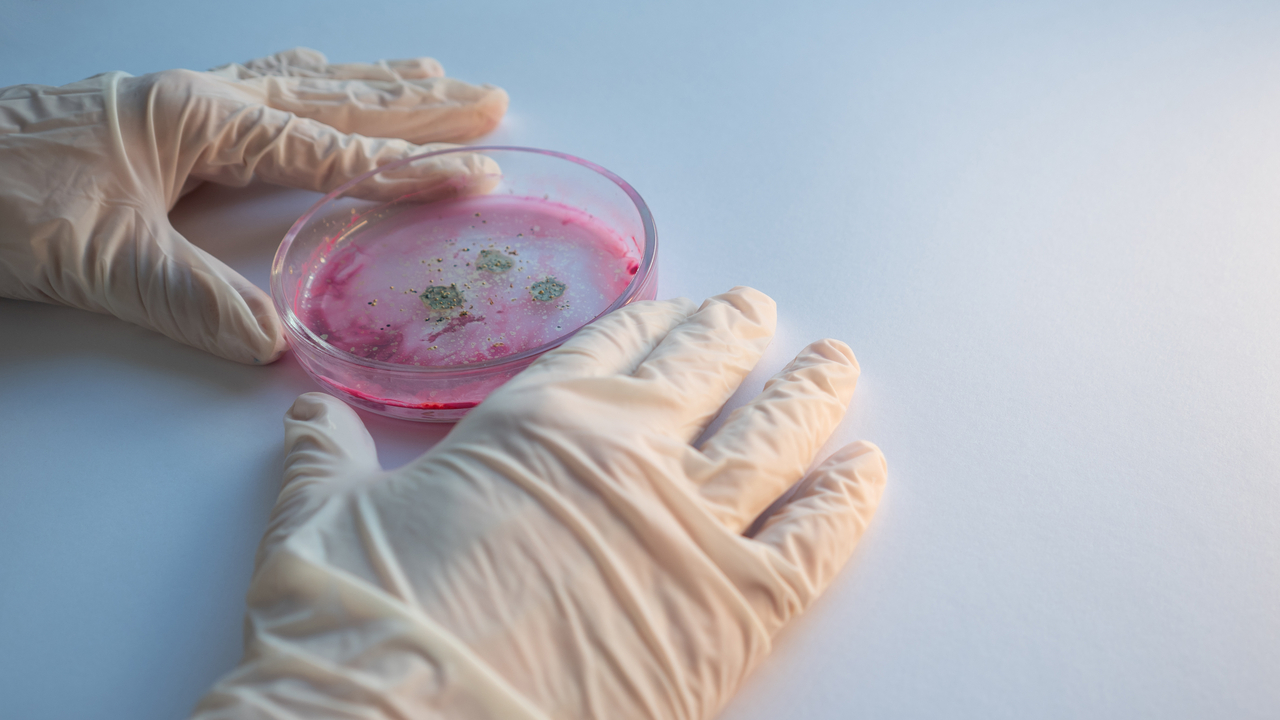
The human brain runs on roughly 20 watts all day — about enough to power a single fluorescent bulb — while thinking, seeing and hearing. Replicating that level of computational complexity with semiconductor chips requires anywhere from several kilowatts to megawatts of power.
That gap has prompted researchers to ask whether real brain cells could do the computing instead. The approach involves placing organoids — tiny brain tissue structures grown from human stem cells, sometimes called "mini brains" — onto electrode arrays and exchanging electrical signals with them. Earlier studies had already shown that cultured neurons could learn to play a computer table-tennis game, and that organoids could distinguish Japanese vowels.
A research team led by Liu Tianyi and Benjamin Ward-Cherrier at the University of Bristol has now published results in the journal Frontiers in Artificial Intelligence showing that an AI program could identify Braille characters by reading the neural responses that organoids produced after receiving tactile signals from a robotic sensor. The AI correctly identified letters from the 26-character alphabet more than eight times out of 10. When the signals were deliberately degraded, the organoid-assisted readings outperformed the AI working directly from the raw signals alone.
Teaching a sand-grain-sized cluster of brain cells to read Braille
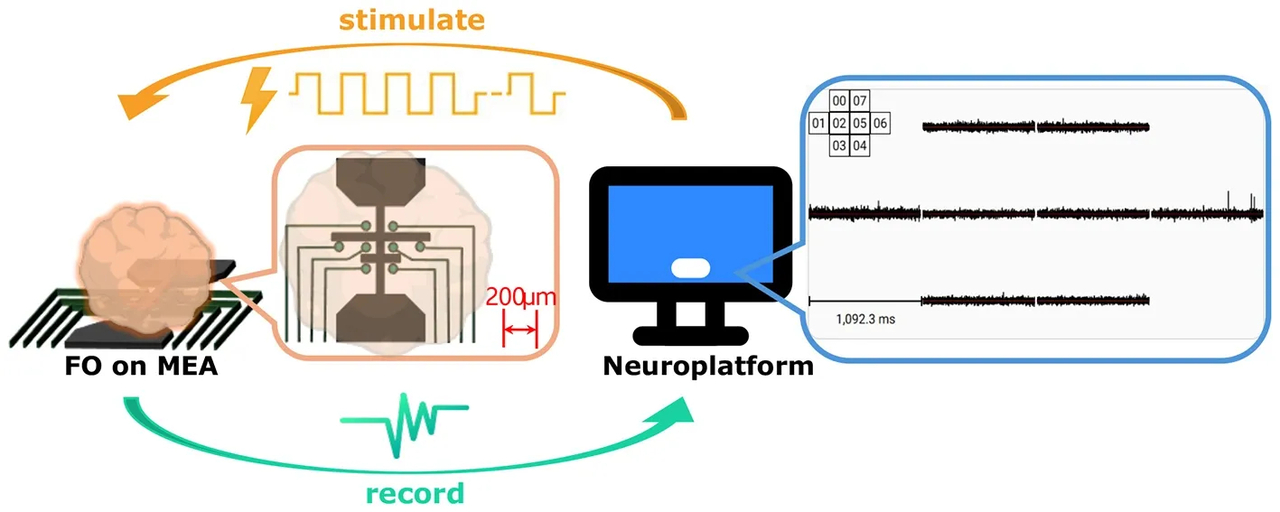
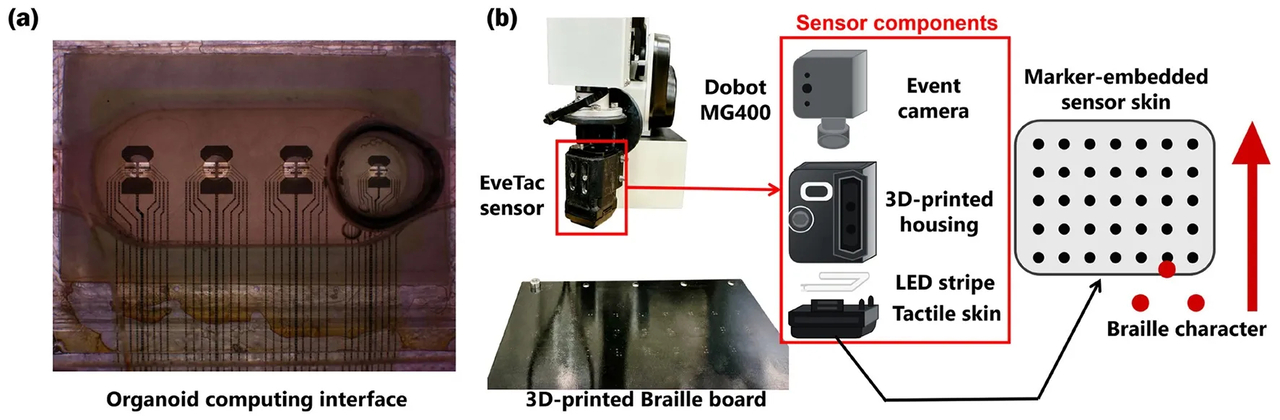
The organoids used in the experiment measured about 0.5mm in diameter. Grown from human stem cells as frontal cerebral tissue, each contains neurons alongside supporting cells and can remain alive and active for around 100 days under favorable conditions. Eight electrodes are attached to each organoid, allowing the researchers to deliver electrical input and record the resulting responses.
The team first established what kind of electrical stimulation the organoids would respond to. Currents weaker than 4 microamperes produced almost no reaction. Responses grew stronger as more pulses were delivered, with the most stable readings coming after four or more pulses.
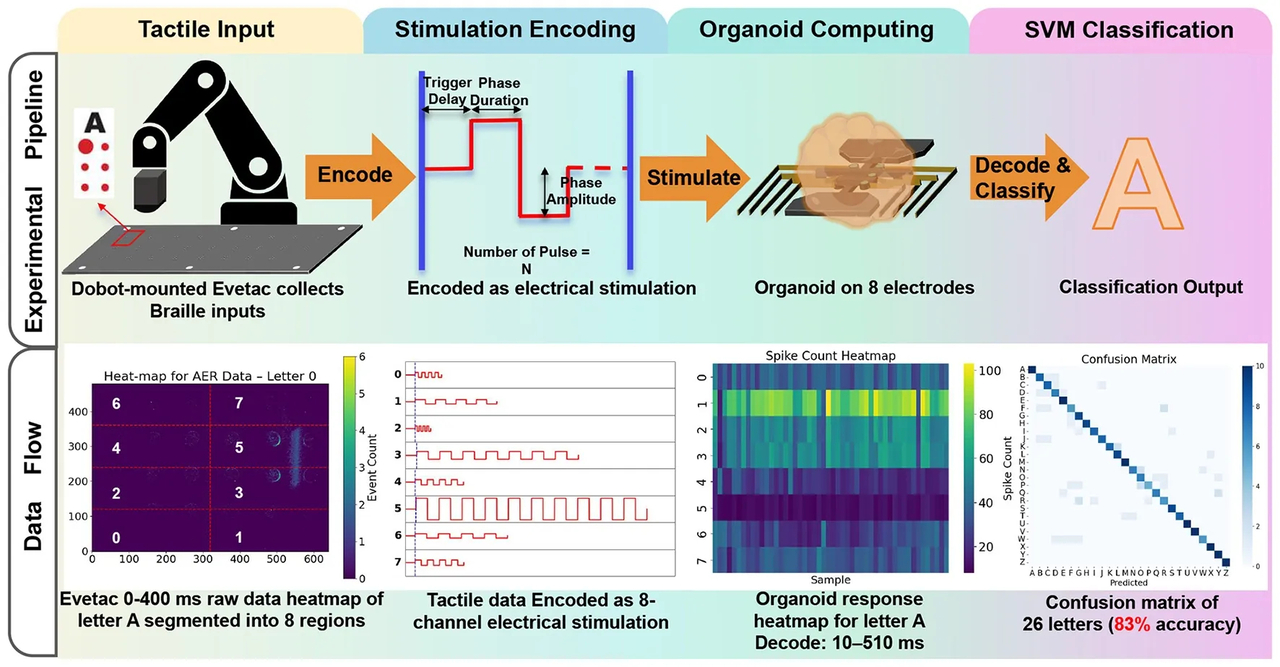
Braille characters were read by a tactile sensor mounted on the tip of a robotic arm. As the sensor glided across a 3D-printed Braille plate, a camera captured the deformation of a soft silicone surface as it pressed against the raised dots.
The sensor's visual field was divided into eight zones, each paired with one of the organoid's eight electrodes. For each zone, the researchers extracted how hard, how long and when contact occurred, then translated those values into parameters for the electrical pulses — how many to send, how long each should last, when to start and how strong to make them. In effect, the system converted fingertip sensation into an electrical language the brain cells could receive.
83% accuracy — on par with AI alone
Each organoid responded to the electrical stimulation with distinct neural firing patterns across its electrodes. The team fed the spike counts into a machine-learning program and asked it to identify which of the 26 letters had been presented. Random guessing would yield a correct answer just 3.85 percent of the time.
Using the responses from a single organoid, accuracy averaged 61 percent, ranging from 57 percent to 67 percent depending on the individual organoid. Combining the responses from all three organoids pushed accuracy to 83 percent.
The team attributed the improvement to subtle differences in neural connectivity across organoids, which meant that the same stimulus produced similar but not identical responses in each — responses that, when pooled, filled in information gaps that no single organoid could provide on its own. "Each organoid may differ slightly in its neural connectivity, developmental stage and activity state," lead author Liu, a doctoral student, said in a University of Bristol press release. "Combining their responses allows them to complement each other with information that cannot be obtained from just one."
The organoids' responses remained largely stable even when the depth of the sensor's contact with the Braille surface varied. However, a zone on the sensor that registered stronger pressure did not necessarily produce a stronger response from its paired electrode.
The team also tested whether the organoids added any practical value. When the same electrical stimulation patterns were fed directly into the machine-learning program — bypassing the organoids entirely — accuracy came out at 82 percent. Under clean signal conditions, using or not using the organoids made almost no difference.
Brain cells hold accuracy under noise; AI cannot
When the researchers introduced noise into four of the eight electrode channels — or deleted some values entirely — the picture changed. The AI program reading the stimulation patterns directly saw accuracy drop to between 55 percent and 67 percent. The organoid-assisted pathway held at 68 percent to 83 percent.
The team said the organoids' value lies less in boosting peak accuracy than in maintaining robustness under noisy conditions.
Liu cautioned, however, that "while we have shown that tactile information can be encoded into organoids and decoded from them, we have not demonstrated learning or long-term adaptation."
Liu added that "if each organoid behaves differently, building a predictable and standardized system becomes that much harder." The team also acknowledged as a limitation that it had not tested whether accuracy would continue to climb if four or more organoids were used instead of three.
Among the experiments the team identified as next steps is one in which the organoid's output would feed back into its own input. Liu said "the next step is clearly to go beyond Braille," adding that doing so would allow researchers to ask "whether organoids can actually adapt through experience."
Meanwhile, the team's longer-term goal is to link an artificial sensor, an organoid and living nerves into a single integrated system — one in which the organoid processes sensory signals from the sensor and then relays signals back to the body's own nerves.
The team said such a device could serve as a testbed for neural-assist technologies such as prosthetic arms and legs before they are applied to the human body.
Reference
DOI: 10.3389/frai.2026.1800219
Paper details: T. Liu, H. Philamore & B. Ward-Cherrier, Encoding tactile stimuli for Braille recognition with organoids, Front. Artif. Intell. 9 (2026) 1800219.
dbsdn1110@heraldcorp.com